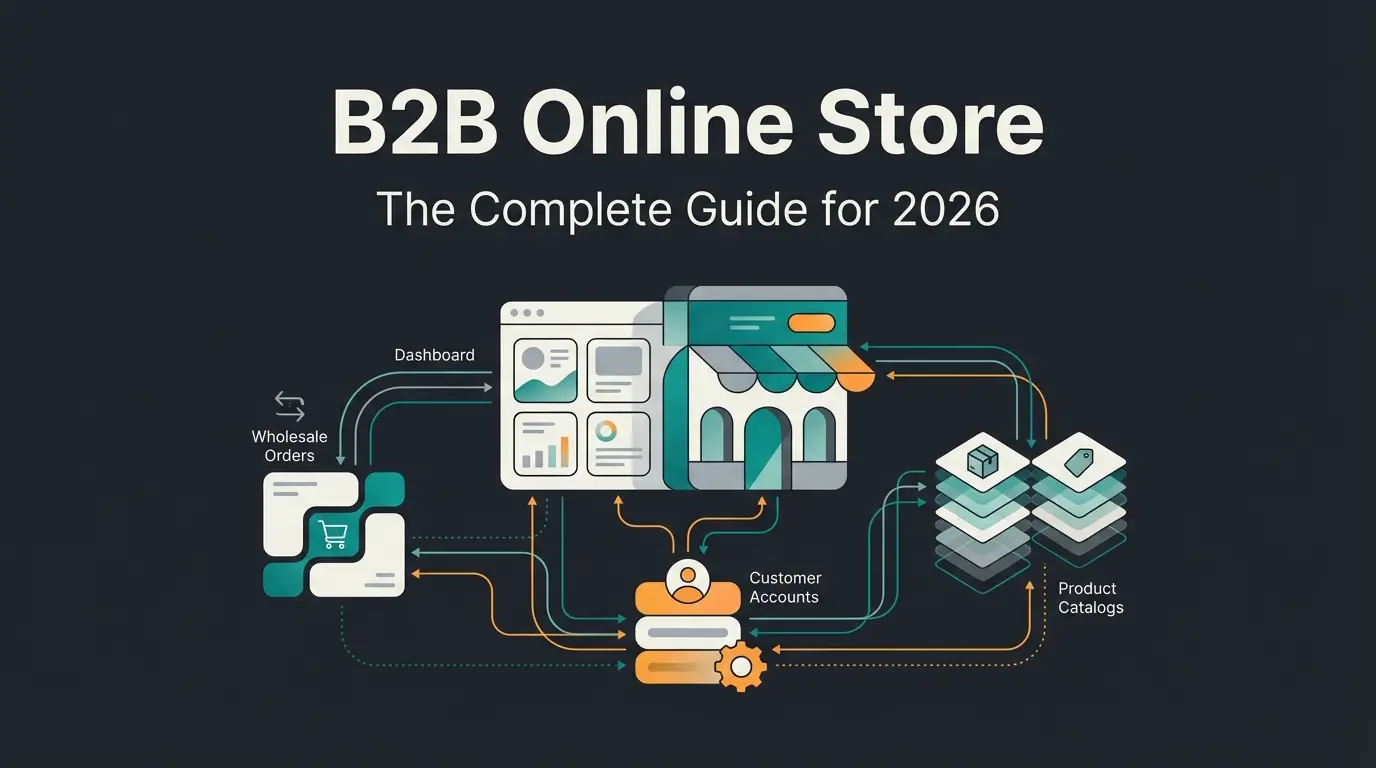
Introduction: The End of Separate Worlds
For a long time, an iron rule governed e-commerce: B2C shops must be beautiful and emotional, while B2B shops just need to function. The B2B buyer was often viewed as a purely rational actor who clicks through gray list views, knows article numbers by heart, and doesn't need any user experience (UX).
This perspective is not just outdated in 2025—it's actively damaging to business.
The German B2B market is undergoing a massive transformation. According to current data from IFH Köln, B2B e-commerce (including EDI) continues to grow steadily, already reaching volumes exceeding 1.3 trillion euros, with online shops and marketplaces serving as growth drivers. For more details, see our B2B online store guide. Particularly exciting: manufacturers are discovering direct-to-consumer sales (D2C) for themselves. They're increasingly bypassing pure wholesale to secure margins and gain direct customer access, as highlighted in analysis from Holger Lentz.
But this transformation brings a massive technical and strategic challenge: How do you serve the emotional end consumer and the rational professional buyer through the same platform? For more details, see our Best B2B Ecommerce Platforms.
In this article, we analyze the duel of [Shopware B2B](/blog/shopware-b2b) vs B2C not as a decision for one or the other, but as a strategy for a hybrid future. We examine how Shopware 6 lays the foundation with features like the Rule Builder and B2B Components—and why only the use of modern AI bridges the last mile of digital consultation. For more details, see our B2B Suite features. If you're exploring AI e-commerce solutions, understanding this landscape is essential.
Core Differences: Shopware B2B vs B2C in Detail
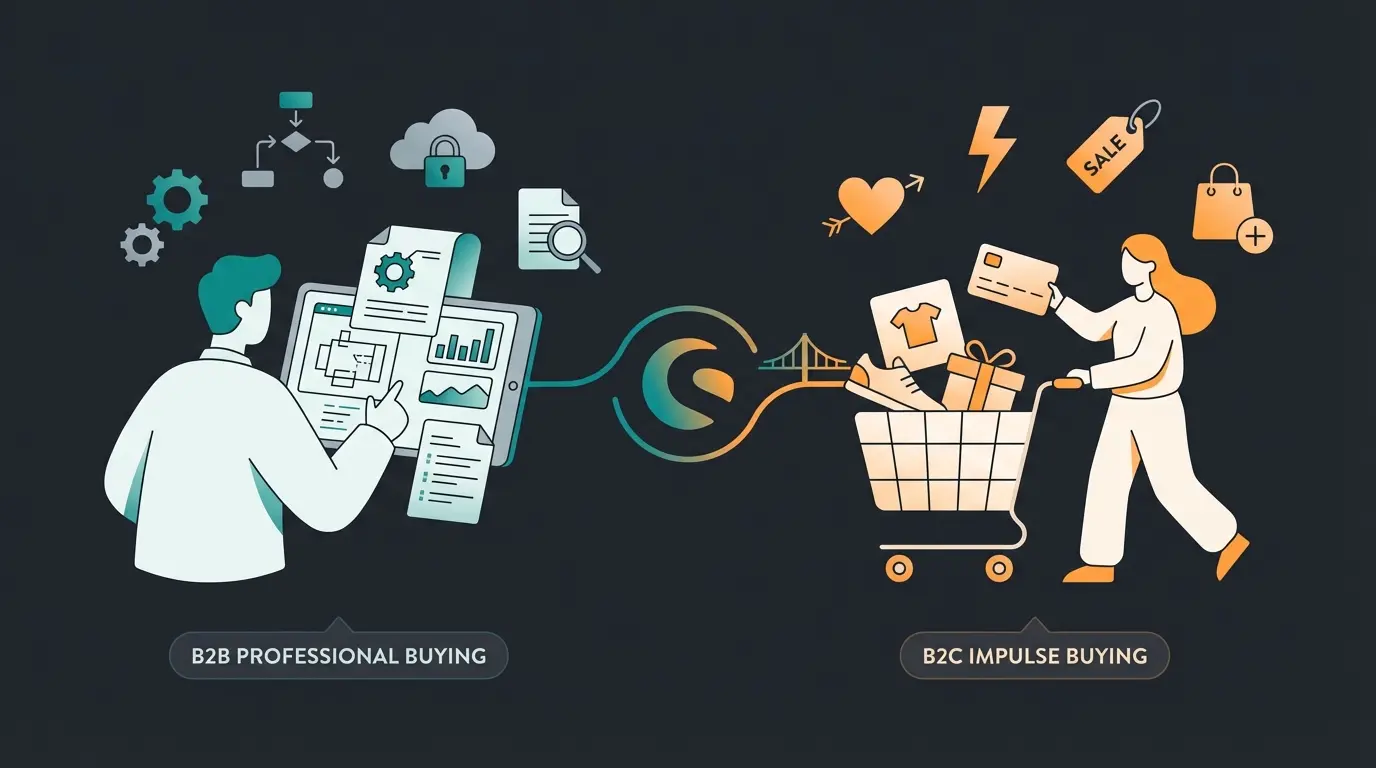
To understand how to unite both worlds, you must first analyze the specific requirements. A B2C customer buys impulsively; a B2B customer buys based on contracts, budgets, and technical necessities.
Shopware 6 is designed from the ground up as a dual-use platform, but the configuration differs massively. Here's a direct comparison of requirements and how Shopware solves them natively:
Feature Comparison Table
| Feature Category | B2C Requirement (Impulse Buyer) | B2B Requirement (Professional Buyer) | Shopware 6 Solution (Native & B2B Components) |
|---|---|---|---|
| Pricing | Uniform gross prices, crossed-out prices, discount promotions (e.g., Black Friday) | Customer-specific price lists, tiered pricing, net prices, framework contracts | Advanced Pricing & Rule Builder: Prices can be defined per customer group or individual rule (e.g., Customer X gets Price Y) |
| Checkout & Login | Guest ordering possible, social login, minimal barriers | Often login required (closed shop), VAT ID verification, approval processes by supervisors | Access Control: Dynamic Access controls visibility. B2B Components enable approval workflows (Approval Rules) |
| Product Search | Visual, inspirational, similar products, cross-selling | Technical, article numbers (SKU), quick order, CSV upload | Elasticsearch & B2B Components: Quick order forms and upload functions are part of B2B extensions |
| Decision Making | Emotional (Do I like it?), reviews from other users | Rational (Does it fit?), data sheets, availability, budget approval | Digital Sales Rooms: Interactive sales rooms for complex B2B presentations |
| Account Management | Simple profile, address book, order history | Company accounts: One main account with many sub-accounts (employees) and role-permission system | Employee Management: Detailed permission management (Who can order what? Who can view invoices?). |
Analysis Conclusion
The comparison of Shopware B2B vs B2C shows: The core (shopping cart, product, order) is identical. The complexity in B2B lies in the processes surrounding it (Who is allowed to buy? At what price? With what approval?). Shopware solves this not through two different software systems, but through a modular architecture that we'll examine in the next section.
Hybrid Solution Architecture: Rule Builder & Flow Builder
Many articles only scratch the surface and list features. To understand whether Shopware is the right choice as a decision-maker in the German SME (Mittelstand) or enterprise segment, we need to look under the hood. The strength of Shopware 6 lies in the decoupling of frontend and business logic.
The Rule Builder: The Shop's Brain
The Rule Builder is the most powerful tool in Shopware 6 for mastering the balancing act between B2B and B2C without programming. It allows you to create business rules based on context, as detailed in documentation from Solution25.
- B2C Example: If cart > €50 AND today is Sunday -> Show 'Free Shipping'
- B2B Example: If customer belongs to group 'Wholesaler A' AND product is from category 'Screws' -> Grant 15% discount AND show payment method 'Invoice'
This logic permeates the entire system. It controls prices, shipping costs, and even content visibility. Understanding how to leverage AI product consultation within these rule structures can significantly enhance your competitive advantage.
Dynamic Access: The Invisible Wall
For manufacturers who want to sell D2C (to end consumers) and B2B (to retailers) simultaneously, Dynamic Access is essential. It allows you to hide categories or products based on rules, according to Shopware documentation.
- The end consumer sees only the 'Home & Garden' series
- The logged-in retailer additionally sees the 'Professional' series and spare parts
- This prevents end consumers from becoming confused or seeing retailer purchase prices
Flow Builder: Automation Without Code
While the Rule Builder defines the state, the Flow Builder defines the action. In the B2B context, this is crucial for complex processes, as explained by Shop-Studio and Rhiem Intermedia:
- Trigger: B2B customer places an order
- Condition: Order value > €5,000
- Action: Send email to department head for approval (instead of sending order directly to ERP)
- Action: Send message to the Key Account Manager's Slack channel
This is where AI-powered product consultation can integrate seamlessly, triggering intelligent responses based on customer behavior patterns.
The Evolution: B2B Suite vs B2B Components
There's often confusion here. Shopware currently offers two paths for B2B functionality:
The B2B Suite (Legacy): A comprehensive all-in-one extension. It's powerful but often rigid. It lays over the shop like a large coat. If you only need one feature from it, you often have to install the entire package, as noted by erock-marketing.
The B2B Components (The Future): Since 2023/2024, Shopware has focused on modular components (API-first). You only install what you need (e.g., only 'Quick Order' or only 'Employee Management'). These components integrate seamlessly into the Rule Builder and Flow Builder, which was often difficult with the old Suite, according to into-commerce and Shopware.
Segment B2B and B2C customers with distinct rules and permissions
Set pricing, visibility, and access rules for each segment
Add modular features like Quick Order, Employee Management as needed
Automate approval workflows and notifications
Add intelligent product guidance for complex B2B purchases
The Hidden Challenge: Product Complexity Gap
Up to this point, we've discussed transaction efficiency. Shopware can technically map that a B2B customer buys differently than a B2C customer. But here lies the major content gap in the current discussion:
Most B2B shops are just digital catalogs. They sell, but they don't advise.
The Scenario
Imagine a German machinery manufacturer selling spare parts:
- The B2C customer searches for 'Red T-Shirt'. The search delivers results. They buy.
- The B2B customer stands in front of a 10-year-old system. They don't know what the spare part is called. They have no article number. They only know: 'I need the gasket for the flange on the upper left, but for the 2019 version that's heat-resistant.'
A classic Shopware search (even with Elasticsearch) often fails here. It either delivers 0 results or 50 gaskets, and the customer doesn't know which one fits.
The consequence: The customer abandons and calls sales. The digital channel has failed. The efficiency gains are gone. This is the 'Consultation Gap'.
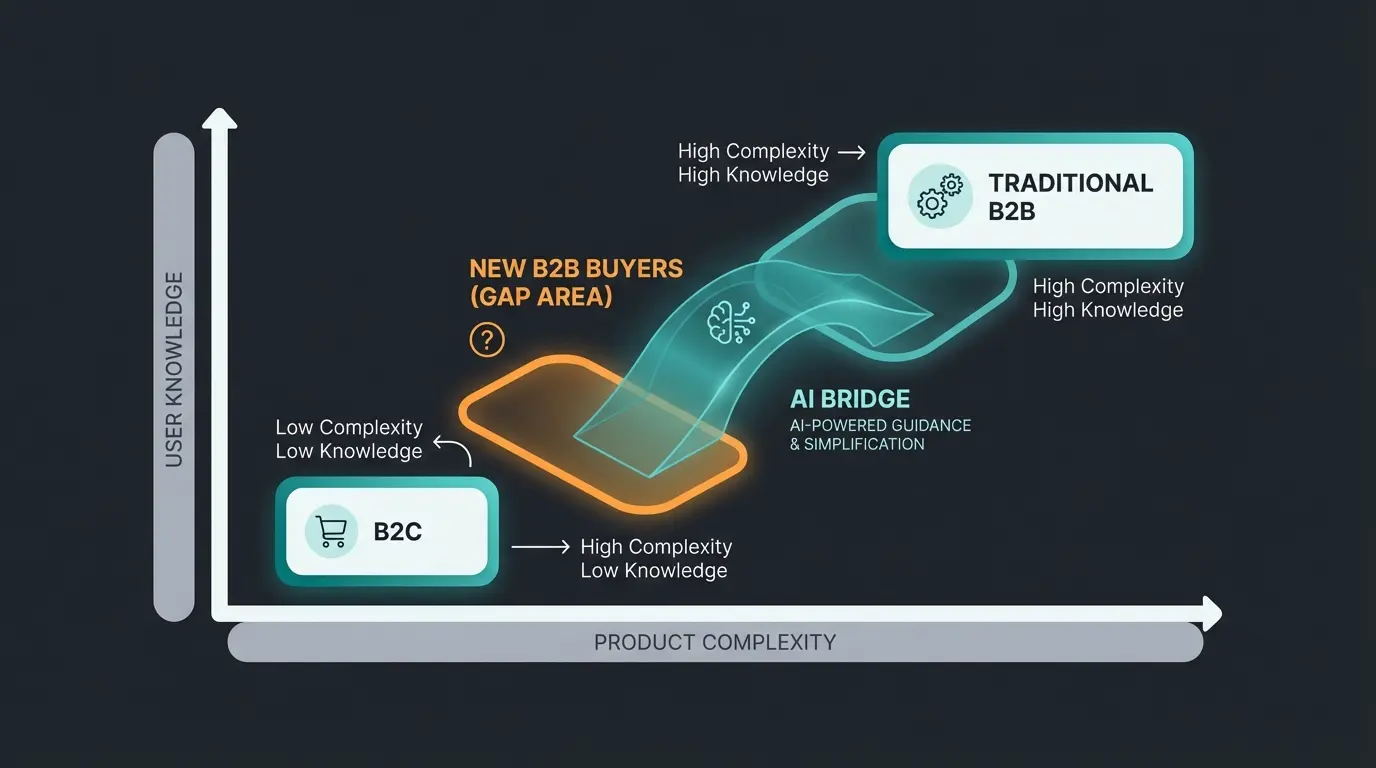
Complex products require consultation before purchase
Technical searches fail for specification-heavy products
Massive market opportunity for consultation-focused solutions
When proper digital consultation tools are available
Bridging the Gap: AI as the Digital Sales Engineer
This is where artificial intelligence comes into play—and far beyond what Shopware currently offers with the AI Copilot in the standard version.
Status Quo: Shopware AI Copilot
Shopware has done excellent work with the AI Copilot to make work easier for merchants. Features include, according to Shopware and EXWE:
- Summarization of product reviews
- Generation of product descriptions
- Creation of keywords for images
- Personalized messages at checkout
These are efficiency tools for the backend. They help the shop operator create content faster. But they do not help the B2B customer find the right complex technical product. This is where Shopware AI solutions need to evolve beyond content generation.
The Future: Generative AI in Frontend
To close the gap between B2B complexity and B2C simplicity, businesses need Generative AI (LLMs) that functions as a technical advisor. This is the essence of Conversational Commerce.
Imagine a chatbot that doesn't just give pre-programmed answers ('Our opening hours are...'), but has access to all PDF manuals, CAD drawings, and ERP data (RAG - Retrieval Augmented Generation).
Use Case: The Intelligent Product Advisor
- User Input: 'Which gasket fits for pump Model X-200 if I'm pumping acid at 80 degrees?'
- AI Analysis: The AI checks compatibility (Model X-200), chemical resistance (acid), and thermal load (80 degrees).
- AI Output: 'For this application, I recommend gasket Art-Nr. 12345 made of Viton. The standard gasket (Art-Nr. 98765) is only rated up to 60 degrees. Should I add the Viton gasket to your cart?'
This level of intelligent guidance transforms passive catalogs into active selling tools. Learn more about implementing AI chatbots that deliver this capability.
The German Context: Data Sovereignty and GDPR
Especially in the German SME sector (Mittelstand), there's great skepticism toward AI when it comes to sensitive data (construction plans, prices), as Shopware acknowledges in their approach to data privacy.
- Challenge: You don't want to load internal company data into a public ChatGPT model in the USA.
- Solution: Use of local LLMs or enterprise instances (e.g., via Azure OpenAI hosted in Europe), which guarantee that data is not used for AI training. Shopware itself emphasizes compliance with European data protection standards and hosting in Europe for its AI features.
Understanding Conversational AI architecture helps businesses make informed decisions about data handling and privacy compliance.
Transform your Shopware store from a silent catalog into an intelligent sales advisor. Our AI Employee provides expert product guidance 24/7 while maintaining full GDPR compliance.
Start Your Free TrialCase Study: The Hybrid Model of Schmidt Tools GmbH
To make the theory tangible, let's sketch the scenario of a fictitious tool manufacturer from the Sauerland region: Schmidt Tools GmbH.
Initial Situation
Schmidt Tools sells high-quality drill bits. Previously only through wholesale (B2B). Now they want to serve DIY enthusiasts (B2C) directly without alienating their retailers.
The Shopware Architecture
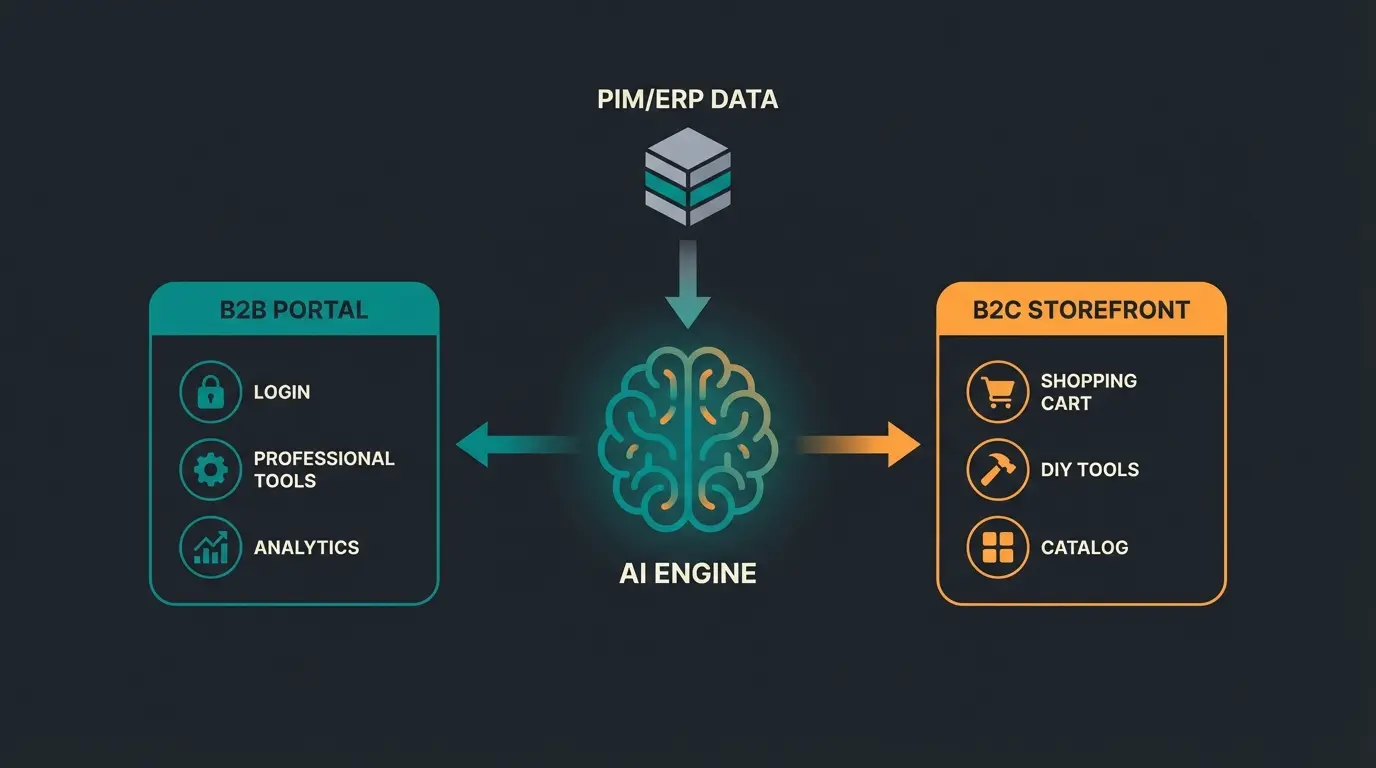
- One System: A single Shopware 6 instance manages all products (PIM) and inventory.
- Sales Channels: Channel A (B2B Portal): Only accessible with login. Prices are net and individually negotiated (via Rule Builder). Features: Quick order, CSV list upload, role permissions for buyer teams (via B2B Components). Channel B (D2C Shop): Publicly accessible. Prices are RRP (gross). Features: Inspiring experience worlds, tutorials, 'Drill Finder'.
- Conflict Avoidance: Via Dynamic Access, professional tools that require explanation are hidden in the B2C shop.
The AI Deployment
Schmidt Tools integrates an AI assistant using Guided Selling principles:
- In the B2C Shop: The AI asks: 'What do you want to drill?' (Wood, concrete, metal) and recommends the appropriate set for beginners.
- In the B2B Portal: The AI functions as technical support. A retailer asks: 'Do you have an alternative to drill X, which is currently unavailable?' The AI checks the technical attributes (diameter, hardness, shank) and immediately suggests available equivalents.
Result
Schmidt Tools increases revenue through the new D2C channel while process costs in B2B decrease because fewer routine inquiries land with sales. Discover how an AI product finder can deliver similar results for your business.
Practical Implementation Tips
If you're facing the decision to introduce Shopware for a hybrid or pure B2B project, follow these steps:
- Start with B2B Components: Avoid the old B2B Suite unless you absolutely need legacy features. The Components are more future-proof and flexible, according to B2B-Sellers.
- Use the Rule Builder Strategically: Define your customer groups cleanly. Nothing is worse than a B2B customer accidentally seeing B2C prices (or vice versa). Test rules intensively. Review our guide on AI product consultation for advanced strategies.
- Think API First: Your ERP (SAP, Microsoft Dynamics, Sage) is the truth. Shopware is the storefront. Ensure clean synchronization of prices and inventory.
- Plan AI as an Employee: Don't see AI just as a text generator for marketing. Budget for an AI solution that 'understands' your product data and advises customers. That's your competitive advantage over Amazon Business. See how companies are succeeding with the AI Employee approach.
AI Strategies for B2B Success
Implementing effective AI strategies requires understanding how different AI applications serve B2B versus B2C needs:
| AI Feature | B2C Application | B2B Application | Combined Value |
|---|---|---|---|
| Product Search | Find red shoes in size 8 | Find compatible spare part for Model X-200 | AI interprets technical context and compatibility logic |
| Recommendations | Similar products, trending items | Cross-compatible parts, bulk alternatives | Personalized suggestions based on purchase history and specs |
| Chat Support | Order status, returns, basic FAQs | Technical specifications, compatibility checks, quote requests | 24/7 expert guidance reducing support load |
| Content Generation | Product descriptions, marketing copy | Technical datasheets, comparison documents | Automated multilingual content at scale |
Feature Matrix: How AI Enhances Both Models
Understanding the intersection of B2B and B2C requirements reveals where AI creates the most value. Here's a comprehensive matrix showing how AI bridges the gap:
AI-guided search vs traditional filtering
Self-service AI consultation handles routine queries
Guided selling increases purchase confidence
Instant technical answers accelerate B2B decisions
Conclusion: Infrastructure + Intelligence = Success
The question Shopware B2B vs B2C is actually the wrong question. The answer is not either/or, but both/and.
Shopware 6 delivers with its modern architecture (Rule Builder, Flow Builder, B2B Components) the perfect infrastructure to unite the complex transaction logic of both worlds in one system. The gap between the worlds is closing technically more and more.
But infrastructure alone is no longer enough in 2025. To survive in the German market, which is characterized by high demands for expert consultation and technical excellence, you need intelligence. The integration of AI-powered consultation transforms your shop from a silent catalog into an active seller.
Those who master this combination—solid Shopware foundation plus innovative AI consultation—will not only close the gap between B2B and B2C but will lead the market.
Frequently Asked Questions
Yes, Shopware 6 is designed as a dual-use platform. Using Sales Channels, Rule Builder, and Dynamic Access, you can serve B2C consumers and B2B professionals from a single installation with different pricing, permissions, and product visibility for each segment.
The B2B Suite is an older, comprehensive all-in-one extension that requires installing the entire package. B2B Components (since 2023/2024) are modular, API-first extensions where you install only what you need. For new projects in 2025, B2B Components are recommended for greater flexibility.
Traditional search fails when B2B buyers don't know exact part numbers or technical terms. AI using Retrieval Augmented Generation (RAG) can access technical manuals, CAD drawings, and ERP data to interpret complex queries like 'which gasket fits for pump X at 80 degrees' and recommend the correct product.
Yes, when implemented correctly. Solutions using local LLMs or enterprise instances hosted in Europe (e.g., Azure OpenAI in EU data centers) ensure data sovereignty. Shopware emphasizes European hosting and data protection compliance for its AI features.
Businesses typically see 25% higher conversion rates from guided selling, 60% reduction in support tickets, and 40% shorter sales cycles. The key benefit is transforming your digital catalog into an active sales channel that doesn't require constant human intervention.
Don't just build a shop—build a digital consultant. Our AI solution understands your product data and guides customers to the right purchase, whether B2B or B2C.
Get Started Today
Lasse is CEO and co-founder of Qualimero. After completing his MBA at WHU and scaling a company to seven-figure revenue, he founded Qualimero to build AI-powered digital employees for e-commerce. His focus: helping businesses measurably improve customer interaction through intelligent automation.