
Introduction: When Your Server Interrupts the Sales Conversation
Imagine walking into a luxury store. You ask the salesperson for running shoe recommendations that will protect your knees. The salesperson stares at you blankly for five seconds before responding. Would you buy? Probably not.
This exact scenario threatens many online retailers in 2026. We've spent years optimizing Magento 2 hosting for caching static pages. Varnish and Redis ensure product catalogs load in milliseconds. But e-commerce faces a massive transformation: the shift from the "Static Shop" (browsing catalogs) to the "Consulting Shop" (AI-powered advice). As conversational AI evolves, the demands on your hosting infrastructure fundamentally change.
If you're planning to integrate intelligent AI agents, semantic search, or personalized real-time consultation into your Magento store, you'll discover that standard hosting is no longer sufficient. An AI that needs to "think" because the server is overloaded kills conversions faster than a blurry product image. According to Timme Hosting, modern e-commerce demands infrastructure that can handle both traditional requests and complex AI processing simultaneously.
This article isn't your typical hosting comparison. We analyze Magento 2 server requirements for the next generation of e-commerce—where computing power doesn't just deliver images but conducts sales conversations. Understanding AI product consultation requirements is essential for making the right hosting decisions.
The Must-Haves: German Standards (GDPR & Basic Performance)
Before diving into high-tech AI requirements, we need to establish the foundation. For any shop operating in the DACH region (Germany, Austria, Switzerland), certain criteria are non-negotiable. Ignore these, and you risk legal warnings and loss of trust before your first customer even uses your AI.
Server Location: Why Frankfurt Is Mandatory
The physical distance between server and user determines latency. A signal from New York to Berlin takes physically longer than from Frankfurt to Berlin. As noted by maxcluster, German server locations provide both performance and legal advantages.
- Latency: For static pages, a 100ms delay might be tolerable. For a fluid AI conversation where every keystroke or voice input is processed, every millisecond feels like an eternity.
- Legal Security: Hosting providers with data centers in Germany (e.g., Frankfurt am Main or Berlin) guarantee that customer data never leaves German jurisdiction. This is essential for GDPR compliance.
This matters significantly when considering Shopware cloud hosting alternatives, as the same principles apply across e-commerce platforms. The infrastructure decisions you make today determine your ability to implement AI features tomorrow.
Security & Certification
Look for Magento 2 hosting providers that are ISO 27001 certified. This demonstrates documented security management. Daily backups (with a retention period of at least 7-10 days) should be standard and ideally stored "off-site" to ensure protection even in case of a data center fire. According to Revion, enterprise-grade backup solutions are essential for compliance-focused businesses.

Magento 2 Server Requirements: The Hidden List for 2026
Adobe's official Magento requirements are well known. But for an AI-ready shop, we need to read between the lines. Here's the comparison between what Adobe demands and what you actually need. Understanding these requirements is similar to evaluating Shopware server requirements for AI readiness.
The Standard Stack (Basic Operations)
With the release of Magento 2.4.8 and newer versions, base requirements have become stricter. According to technical documentation from Chilliapple and dev.to, the current requirements include:
- PHP: Version 8.3 or 8.4 is mandatory. PHP 8.1 and 8.2 are no longer supported.
- Database: MariaDB 11.4 LTS or MySQL 8.4.
- Search: OpenSearch 2.x (Elasticsearch is deprecated and should not be used for new installations).
- Cache: Varnish 7.6 and Redis (or Valkey 8.x).
- Message Queue: RabbitMQ 4.x (critical for asynchronous processes).
These specifications align with findings from Azguards, Mageplaza, and Magecomp, establishing the baseline for any modern Magento installation.
The Intelligence Layer Requirements (AI-Optimized)
Here's where the wheat separates from the chaff. If your shop uses vector search (for recommendations like "show me shoes that look like this") or LLM integrations, the rules change completely.
1. CPU: Single-Core vs. Multi-Core Performance
Magento (PHP) is traditionally single-threaded. This means a single page request is processed by one CPU core. According to performance analysis from Ceph, understanding this architecture is crucial for optimization.
- The Rule: High clock frequency (GHz) is more important than many cores. A 3.0 GHz core is more valuable for Magento than two 2.0 GHz cores.
- The AI Factor: AI processes (e.g., vector database queries or Python middleware) often benefit from parallelization. A modern hosting stack must therefore offer a balance: high-frequency cores for PHP and enough cores for parallel API calls and background workers.
As discussed on Reddit's technical forums, the combination of single-thread performance for PHP and multi-core capability for AI workloads represents the ideal configuration for 2026.
2. RAM: The Engine Capacity for Intelligence
Standard hosting often calculates RAM tightly for PHP workers and database cache. But AI changes everything.
- The Problem: Vector databases (like Milvus, Qdrant, or Weaviate), needed for semantic search, are extremely memory-hungry. They often keep vectors in working memory to deliver fast results. According to Milvus documentation and analysis on Medium, these databases require substantial RAM allocation.
- Recommendation: Plan for an AI-powered shop with 30-50% more RAM than for a pure catalog shop. If your provider recommends 32 GB, take 64 GB to have room for Docker containers with AI services.
Research from IBM and Unblu confirms that AI-driven applications require significantly more memory headroom than traditional web applications.
3. Connectivity & API Handling
Your server no longer just talks to the database. It communicates with OpenAI, Anthropic, or DeepL. This is fundamentally different from how traditional Shopware hosting costs are calculated, as API-heavy workloads require different infrastructure considerations.
- Outbound Traffic: Check if the host has limits on outgoing connections.
- Latency to API Endpoints: A server in Frankfurt often has better connections to European endpoints of major AI providers than a budget server in a remote data center.
AI workloads need significantly more memory than catalog-only shops
Maximum acceptable delay for responsive AI conversations
AI requests block workers longer than static page requests
High single-thread performance critical for PHP processing
Hosting Types Compared: Where Your AI Can Breathe
Not every hosting architecture can handle the dynamic load of AI requests. Understanding these differences is crucial, similar to evaluating Shopware vs Shopify for complex product requirements.
Shared Hosting: The AI Killer
With shared hosting, you share resources with hundreds of other websites. According to Cyfuture Cloud, this creates fundamental limitations for resource-intensive applications.
- Why It Fails: AI requests create short but extreme load spikes (CPU & RAM). Shared hosting has strict "Resource Limits." When your AI tries to analyze a complex customer query, the host throttles the process. The result: timeouts and frustrated customers.
- Verdict: Absolutely unsuitable for AI shops.
VPS (Virtual Private Server): The Uncertain Candidate
A VPS provides dedicated resource allocations but often still shares physical hardware (I/O, network). As noted by Hetzner, VPS solutions offer a middle ground but come with caveats.
- The Risk: "Noisy Neighbors." When the neighbor on the same server runs a massive backup, your database's I/O performance drops. Since vector search can be extremely I/O-intensive, this leads to unpredictable delays in consultation.
- Verdict: Only acceptable for small shops or staging environments.
Managed Dedicated / Cluster: The Intelligence Engine
Here, the hardware belongs to you (or is isolated enough that it feels that way). This is where understanding different chatbot types becomes relevant, as advanced AI implementations require this level of infrastructure.
- The Advantage: You can run Docker containers for vector databases (e.g., Weaviate) or Python microservices (e.g., FastAPI for RAG pipelines) without a host killing "unknown processes."
- Scalability: Providers like maxcluster or Timme Hosting offer cluster solutions where web servers (frontend) and database servers (backend) are separated. This is ideal: AI load on the web server doesn't slow down the database.
| Feature | Shared Hosting | Managed VPS | Dedicated / Cluster |
|---|---|---|---|
| Static Performance | ⭐⭐ (Often OK with cache) | ⭐⭐⭐ | ⭐⭐⭐⭐⭐ |
| Dynamic AI Load | ❌ (Throttling risk) | ⭐⭐ (Depends on neighbors) | ⭐⭐⭐⭐⭐ (Full power) |
| Vector DB Support | ❌ (Usually prohibited) | ⚠️ (Resource limited) | ✅ (Via Docker) |
| Python/Node.js | ❌ (Often blocked) | ✅ (Usually possible) | ✅ (Full control) |
| Monthly Cost | € | €€ | €€€€ |
Standard hosting silences your best salesperson. Discover how our AI consultation solution integrates seamlessly with properly configured Magento hosting to deliver instant, intelligent customer conversations.
Start Your AI JourneyAnalysis of Top Providers: A German Perspective
We examine three leading providers in the German market through the "AI lens." This analysis complements understanding of Shopware cloud AI integration options in the broader e-commerce hosting landscape.
1. Timme Hosting: The NGINX Specialist
Timme Hosting is known for extremely fast NGINX setups and offers comprehensive container hosting solutions.
- AI Check: Timme offers Container Hosting on managed servers. This is a massive advantage. You can run your AI tools (e.g., a Python-based recommendation service) in a Docker container directly alongside the Magento shop. This drastically minimizes latency since data doesn't need to leave the data center.
- Hardware: Use of NVMe SSDs and modern CPUs (up to 96 cores possible) provides enough power for parallel AI tasks.
2. maxcluster: The E-Commerce Specialist
maxcluster focuses purely on e-commerce and offers a very strong "Application Center" with specialized Magento optimization.
- AI Check: They offer optimized stacks with Elasticsearch/OpenSearch and Redis as standard. Particularly noteworthy is the focus on High-Clock-Speed CPUs (up to 5.7 GHz in some configurations), which accelerates PHP's single-thread performance when assembling AI responses.
- Service: Support is deeply knowledgeable in Magento matters and can help when, for example, Varnish cache conflicts with dynamic AI content.
3. Creoline / Profihost: The Scalers
These providers focus heavily on Kubernetes and cloud infrastructures, as documented in technical analyses on Medium and Ksolves.
- AI Check: Ideal for shops that need to scale massively (e.g., Black Friday with AI advisor). Kubernetes allows automatically spinning up new "pods" (server instances) during high load to buffer AI calculations. This is high-end but often requires more technical know-how or a higher budget.

Unique Angle: Hosting an AI Consultant, Not Just a Catalog
Here lies the crucial difference that most hosting guides overlook. A classic Magento shop delivers static content (images, text). An AI shop delivers dynamic intelligence. This is why AI eliminates waiting in modern e-commerce—but only with proper hosting infrastructure.
The Cache Problem
Classic Magento hosting relies 90% on Varnish Cache. When a customer accesses a product page, the server doesn't need to "calculate" but simply delivers a stored HTML file.
But: A conversation with an AI is never static. Every question is unique. Varnish doesn't help here. The server must calculate each request "fresh." This is a fundamental shift in how e-commerce infrastructure must be designed.
The Metric That Matters: TTFT (Time to First Token)
Forget page load time for a moment. For AI interactions, Time to First Token matters—how long it takes until the first word of the response appears on screen.
- Hosting Impact: If your server first needs to establish a slow database connection to check product availability for the AI, TTFT increases.
- Solution: Use hosting that allows Persistent Connections to the database and Redis, and place vector databases (for the AI's product knowledge) on the same server or in the same local network (LAN) as the web server.
User → Load Balancer → Varnish Cache (Hit) → User (50ms total)
User → Load Balancer → Magento PHP → Python Service
Vector DB Lookup → Product Data Retrieval → Context Assembly
API Call to AI Provider → Response Generation → Token Streaming
Magento Formats Response → User Receives First Token (500-2000ms)
Python in the PHP Ecosystem
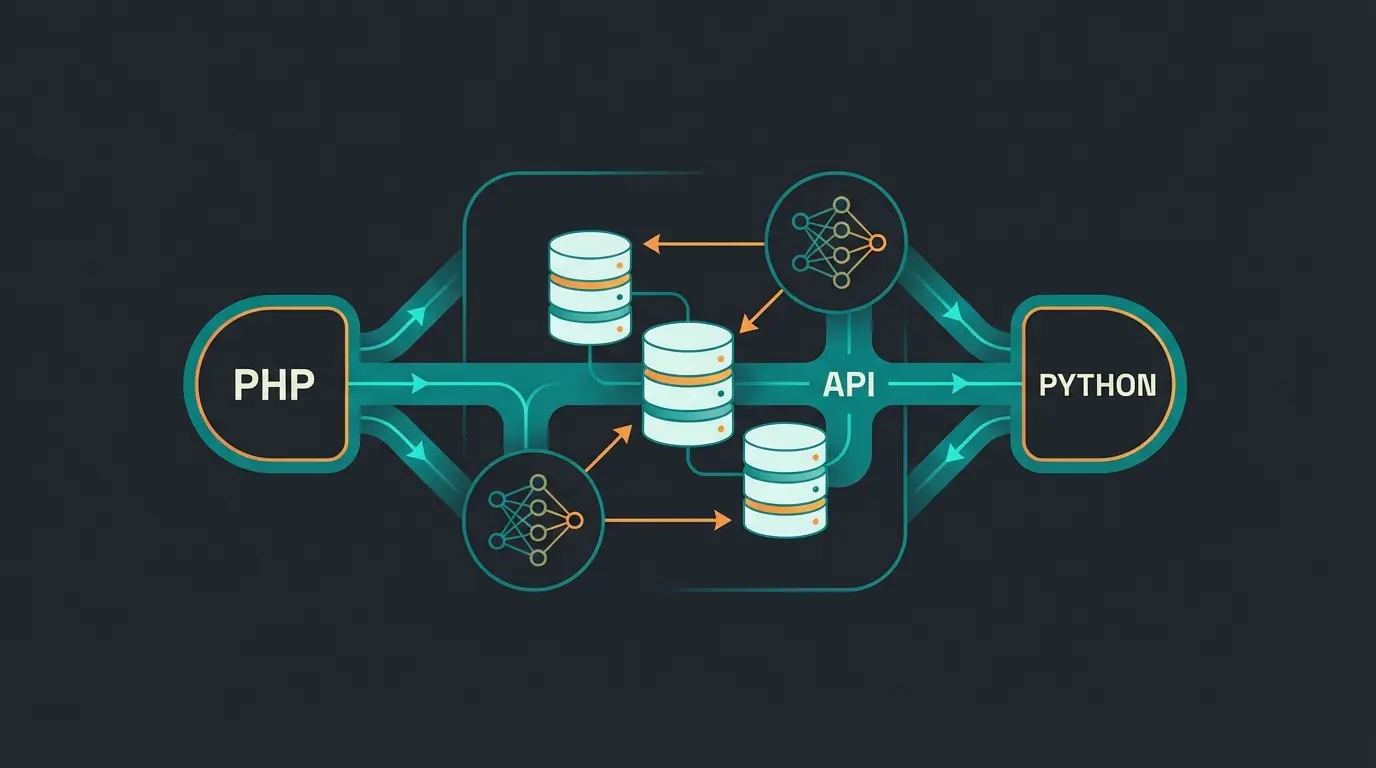
Magento is PHP. Modern AI is Python. To connect both worlds, you need a host that doesn't just run PHP scripts but also allows Python daemons or Node.js services. Technical resources from StackExchange and GitHub document various integration approaches.
Scenario: A customer asks: "Do you have this in red?"
- Magento (PHP) sends request to Python service
- Python queries Vector DB for product variations
- Python returns structured response to Magento
- Magento delivers formatted answer to customer
Requirement: If your host doesn't allow long-running Python processes (often the case with shared hosting), this chain breaks down. This is why understanding how an AI chatbot for e-commerce works helps inform hosting decisions.
Practical Tips & Checklist for Your Hosting Choice
Before signing a contract, ask the provider these questions. If they hesitate at "vector database," keep looking. This checklist also applies when optimizing your Shopware product page for AI-enhanced experiences.
The AI-Ready Checklist
- Container Support: "Can I run my own Docker containers (e.g., for Weaviate or Python middleware) on the server?" According to HostAdvice, container support is increasingly essential for modern applications.
- Redis/Valkey Version: "Do you support Redis 7.x/8.x or Valkey for vector similarity search?" (Newer Redis versions have built-in vector functions).
- Outbound Connections: "Are there limits or firewalls for outgoing API calls to OpenAI/Azure/AWS?"
- RAM Flexibility: "Can I scale RAM on short notice if my AI models need more memory?"
- PHP Worker Limits: "How many PHP workers are available to me?" (AI requests block workers longer than static page requests).
Conclusion: Invest in Intelligence, Not Just Storage Space
Magento 2 hosting in 2026 is more than just renting storage space. It's about providing infrastructure that can compute. A slow server makes your expensive AI integration worthless because customers have no patience for a "thinking" website.
Our Recommendations:
- For beginners with AI ambitions: A Managed vServer from Timme Hosting (due to container flexibility).
- For established shops: A dedicated cluster from maxcluster (due to raw computing power and stability).
- For Enterprise: A Kubernetes solution on AWS or Creoline to ensure maximum scalability.
Don't let poor hosting silence your best salesperson—your AI.
Frequently Asked Questions About Magento 2 Hosting
AI-ready Magento 2 hosting requires container support for vector databases, 30-50% more RAM than standard configurations, high-clock CPUs for PHP performance, persistent database connections, and the ability to run Python middleware services alongside PHP. The hosting must also handle concurrent API calls to external AI providers without throttling.
No, shared hosting is unsuitable for AI-powered shops. AI requests create extreme CPU and RAM spikes that trigger resource limits on shared servers, resulting in timeouts and failed AI interactions. You need at minimum a VPS, ideally managed dedicated hosting or clusters for production AI implementations.
AI-ready hosting typically costs €€€-€€€€ monthly, significantly more than standard hosting. Managed VPS solutions start around €100-300/month, while dedicated clusters for serious AI workloads range from €500-2000+/month. The investment pays off through improved conversion rates from responsive AI consultations.
Time to First Token (TTFT) measures how long until the first word of an AI response appears. Unlike page load time, TTFT determines the perceived responsiveness of AI interactions. High TTFT makes AI feel sluggish and robotic, damaging customer trust. Target TTFT under 500ms for natural-feeling conversations.
For shops operating in Germany, Austria, or Switzerland, hosting with German data center locations (Frankfurt, Berlin) is strongly recommended for GDPR compliance. This ensures customer data remains in German jurisdiction and also provides lower latency for DACH-region customers interacting with AI features.
Your Magento store deserves hosting that can think as fast as your customers expect. Our AI consultation platform is designed to work seamlessly with properly configured hosting infrastructure, delivering instant, intelligent product advice that converts browsers into buyers.
Discover AI Consultation
Kevin is CTO and co-founder of Qualimero. As an AI architect with over 15 years of experience as CTO and CPO in the tech industry, he designs the AI systems that automate tens of thousands of customer interactions daily for Qualimero's clients — reliably, securely, and at scale.