
Introduction: The Misunderstood Reality of Shopware Support
When you search for "Shopware support" as an online retailer, you'll find almost exclusively offers for technical maintenance contracts. Agencies promise you updates, security patches, and uptime guarantees. This is important—even vital for survival, especially after the end-of-life of Shopware 5 in July 2024, as reported by digitalmanufaktur.com and arboro.de.
But let's be honest: A technically perfect shop is worthless if it doesn't sell.
The traditional definition of "support" in e-commerce is outdated. It's reactive. It waits for something to break before fixing it. In 2025, when customer expectations are shaped by giants like Amazon, that's no longer enough. Customers don't expect "maintenance"—they expect genuine support in the literal sense: a helping hand that guides them to the right product.
This guide redefines the concept of "Shopware support." We'll show you why you need to expand your strategy from pure technical maintenance (backend) to active customer guidance (frontend), and how a hybrid strategy combining agency services with AI automation increases your revenue while reducing support costs. Understanding the fundamentals of AI Customer Service is the first step toward this transformation.
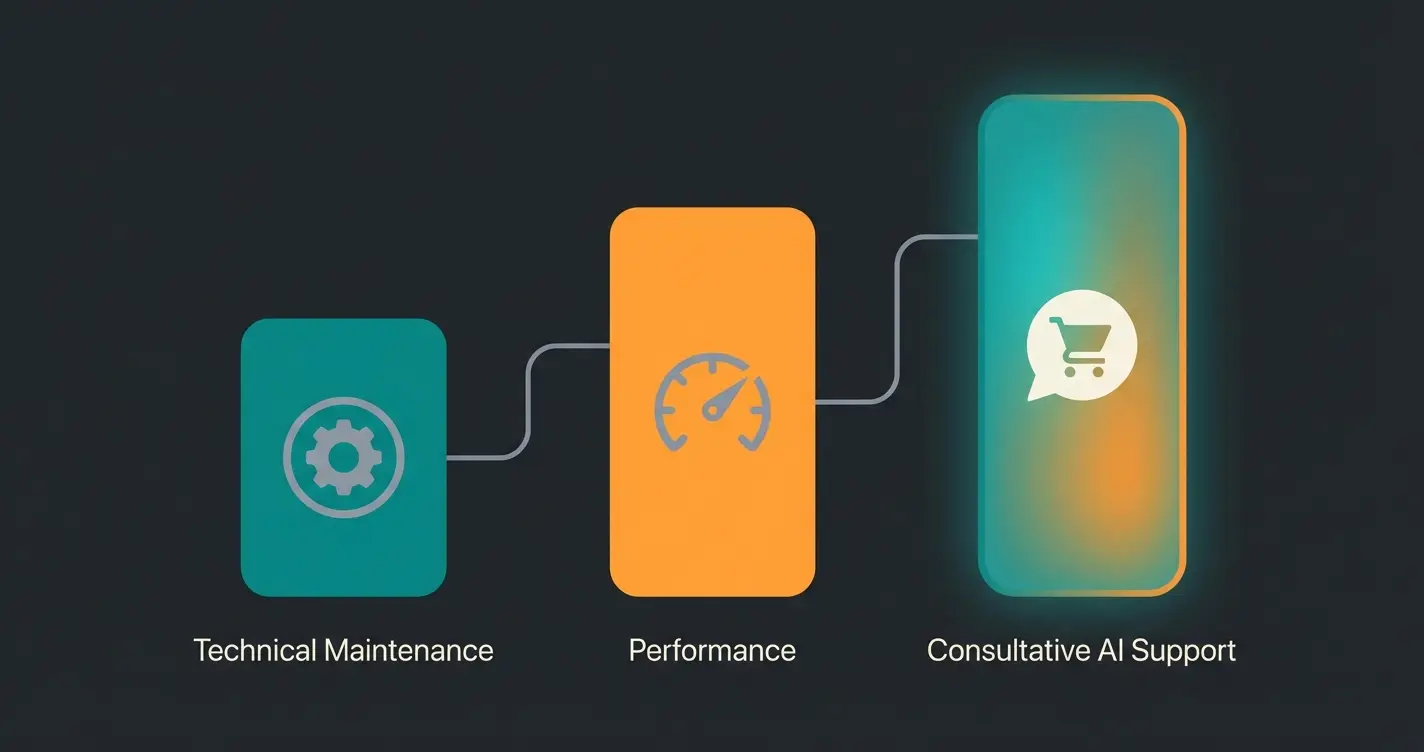
The Three Pillars of Modern Shopware Support
To compete in today's market, your support strategy must rest on three pillars. Most retailers—and agencies—focus 90% on the first pillar and neglect the rest.
Pillar 1: The Technical Foundation (Technical Care)
This is the foundation. Without this pillar, you risk security vulnerabilities and outages. Shopware agencies excel in this area. According to official Shopware documentation, regular updates are essential for maintaining security and performance.
- Updates & Patches: Regular installation of minor releases (e.g., Shopware 6.6.x to 6.7.x) and security plugins
- Backups & Security: Daily backups and protection against attacks
- Monitoring: Server availability monitoring (uptime)
For comprehensive guidance on technical aspects, check out our Shopware 6 support guide that covers maintenance best practices in detail.
Pillar 2: Performance & User Experience (UX)
A fast shop ranks better and converts better. This pillar ensures your technical foundation translates into a smooth customer experience.
- Loading Time Optimization: Improving Core Web Vitals
- Mobile Optimization: Ensuring the theme works on all devices
- Bug Fixing: Resolving errors in checkout or display issues
Our comprehensive Shopware SEO guide provides detailed strategies for optimizing your shop's technical performance and search visibility.
Pillar 3: The Strategic Gap – Consultative Care
Here lies the untapped potential. While Pillars 1 and 2 ensure the shop functions, Pillar 3 ensures the customer buys. This is where modern Shopware AI features come into play.
- Product Consultation: Help with selection ("What size do I need?", "Does Part A fit with Part B?")
- Cart Abandonment Prevention: Intervening before the customer leaves their cart
- Instant Answers: No waiting for email tickets
Status Quo Analysis: The Problem with Classic Agency Models
Don't get me wrong: you need an agency or experienced developers for the technical side. But the classic model has weaknesses when it comes to scaling your customer service. When comparing Shopware vs OXID, both platforms face similar challenges in traditional support models.
The Cost Trap: Trading Time for Money
Hourly rates for Shopware agencies in the DACH region typically range between €90 and €160 net in 2025, according to qualimero.com. A maintenance contract often costs between €150 and €500 monthly, as noted by byte-networks.de, but typically only covers updates and a small number of support hours.
When you ask your agency to address strategic conversion optimization questions or manually support processes, it gets expensive quickly. Every hour of consultation costs money. Understanding the full scope of Shopware alternatives comparison helps contextualize these investment decisions.
The Response Time Trap
Classic support SLAs (Service Level Agreements) often guarantee response times of 4 to 24 hours, as documented by scoopex.de and inter-medien.com.
- Scenario: A customer has a product question on Friday evening
- Agency/Support: Responds Monday morning
- Result: The customer has long since bought from the competition
Statistics from Zendesk show that 50% of consumers switch brands after just one bad experience. Even more alarming: 96% of customers leave a company due to poor service, according to research published by Forbes.
The Scaling Problem
Human support is linear. When your traffic doubles, your support requests double. You have to hire more staff or pay higher agency retainers. This eats into your margin and limits growth potential.
Average cost per hour for Shopware agencies in DACH region
Typical SLA response times leave customers waiting
Percentage of customers who leave due to poor service
Consumers who switch after one bad experience
The Game Changer: AI-Powered Product Consultation
Here's where the innovation comes in that's currently revolutionizing the "Shopware support" market. Instead of seeing "support" only as fixing errors, we define it as automating success. This shift toward Shopware intelligent e-commerce represents the future of online retail.
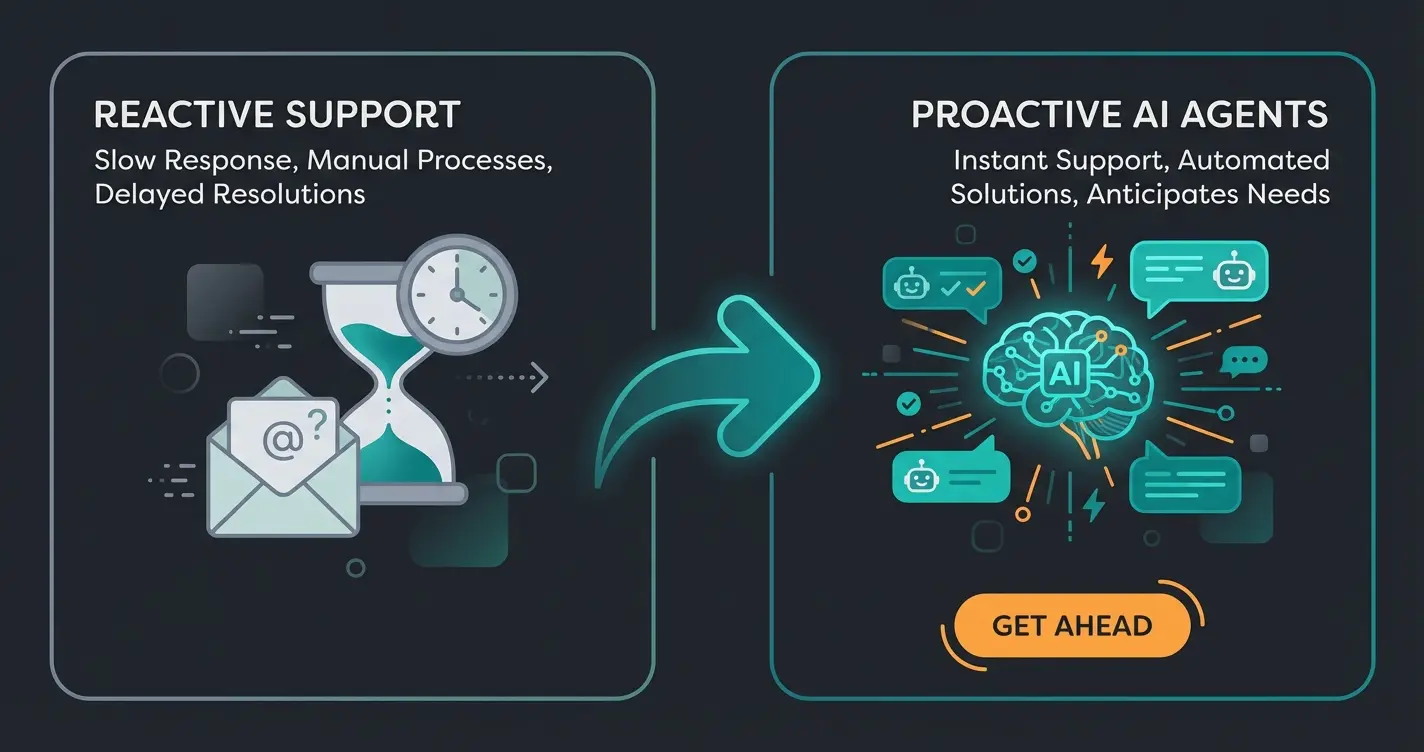
From Reactive to Proactive Support
Traditional support is reactive (create ticket → wait → solution). AI-powered support is proactive. Modern AI tools integrate into your Shopware shop and act like an experienced salesperson in a retail store. They don't wait for an email—they offer help, analyze behavior, and answer questions in real-time.
This is exactly what Shopware 6 chatbots enable: intelligent, always-available assistance that transforms how customers interact with your shop.
Shopware AI Copilot vs. Specialized AI Consultation
Shopware itself introduced strong features with the AI Copilot starting in version 6.6, as detailed on Shopware.com and d-i-s.de. However, these focus heavily on the backend and merchant efficiency:
- AI-generated product descriptions
- Review summaries
- Customer classification for marketing
- Export assistants
What's missing? The direct, dialogue-based interaction with the end customer to conduct sales conversations. This is where specialized AI solutions close the gap that the standard Copilot leaves open. Implementing effective AI product consultation addresses this critical need.
The ROI of AI Support
While a human support ticket costs on average between $2.70 and over $30 (depending on complexity and industry) according to livechatai.com, the costs for an AI interaction are in the cent range.
- Availability: 24/7/365 without vacation or sick days
- Knowledge: Knows every detail from your product descriptions and technical data sheets
- Patience: Answers the 100th question about delivery times just as friendly as the first
Comparison: Agency vs. In-House vs. Hybrid AI Strategy
Which model fits your shop? A direct comparison shows why the hybrid approach wins. Understanding how AI in sales functions helps clarify the strategic advantages.
| Feature | Classic Agency (Maintenance Contract) | In-House Team (Support Staff) | Hybrid Model (Agency + AI) |
|---|---|---|---|
| Focus | Technical stability, updates, code | Customer inquiries, order processing | Technology + Sales |
| Costs | High (€100-160/hr) | Very high (payroll costs, training) | Efficient (fixed costs + low AI fee) |
| Availability | Mon-Fri (except emergency packages) | Mon-Fri, 9am-5pm | 24/7 Instant Response |
| Scalability | Low (more hours = more costs) | Low (hiring takes months) | Unlimited (AI scales instantly) |
| Response Time | 4 - 24 hours | Minutes to hours | Milliseconds |
| Primary Goal | "Shop runs error-free" | "Customer is satisfied" | "Shop runs AND actively sells" |
Conclusion: The hybrid model uses the agency for what it does best (complex technology, updates) and AI for what humans cannot scale (instant 1:1 consultation for every visitor). Learning to automate Shopware support is the key to unlocking this potential.
See how AI-powered product consultation can reduce your support costs by up to 70% while increasing conversions. Join forward-thinking e-commerce businesses already using intelligent automation.
Start Your Free TrialCost Deep-Dive: What Does Shopware Support Cost in 2025?
Transparency is rare in the agency business. Based on current market data from qualimero.com, vierpunkt-commerce.de, and shopwareagentur.info, you can expect the following budgets:
1. Technical Maintenance (The Essentials)
- Basic Packages (Updates & Backups): approx. €150 - €300 per month
- Premium Packages (incl. response time guarantee & minor adjustments): €400 - €800 per month
- Enterprise Support: From €1,000 per month
2. Variable Costs (The Extras)
- Hourly Rates: €90 (freelancer) to €160 (top agency)
- Major Updates: A jump from one main version to the next (e.g., Shopware 5 to 6) is a project, not maintenance. Costs for this often range between €15,000 and €70,000
3. The Hidden Costs of Doing Nothing
Here's where it gets interesting. If you have no automated consultation (Pillar 3):
- Lost Carts: Approximately 70% of all shopping carts are abandoned
- Support Tickets: With 1,000 tickets per month at €5 cost per ticket, you're burning €5,000 monthly on questions that an AI could have solved
Average cost of handling a support ticket manually
Fraction of human support costs
Reduction in support costs with AI automation
Shopping carts left behind without intervention
The Calculation: Invest €300 in technical maintenance and, for example, €200-500 in an AI tool. You save thousands of euros in manual support costs and gain revenue through higher conversion. That's the economic logic of modern support.
The Pyramid of Shopware Support Needs
Understanding the hierarchy of support needs helps prioritize your investment. Most shops get stuck at the bottom, focusing solely on technical maintenance. The winners optimize all levels, with particular emphasis on the top—where AI-powered consultation drives actual revenue.
Technical maintenance foundation—keeping your shop online and secure
Optimizing load times and user experience for better rankings
AI-powered customer guidance that converts browsers into buyers
The caption for this pyramid is clear: Most shops get stuck at the bottom. The winners optimize the top.

Checklist: Setting Up Your Shopware Support Strategy
Want to take your Shopware support to the next level? Follow this roadmap for comprehensive coverage across all three pillars.
Step 1: Secure Technical Foundation (Outsourcing)
- Review maintenance contract: Do you have guaranteed response times? Are security patches included?
- Check Shopware version: Are you on the current version (6.6.x or higher)? If you're still on Shopware 5: Act immediately (Safefive or migration)
- Backups: Test once per quarter whether restoring a backup actually works
Step 2: Analyze Support Load
- Ticket analysis: Which questions come up repeatedly? (Shipping, returns, product consultation)
- Calculate costs: How many hours does your team spend answering standard questions?
Step 3: Introduce Automation (Your AI Advantage)
- Integrate AI tool: Use a solution that understands product data and provides consultation
- Feed knowledge base: Ensure the AI has access to FAQs, shipping conditions, and product details
- Test run: Let the AI run parallel to human support and measure quality
Step 4: Monitoring & Optimization
- Track KPIs: Measure not just uptime, but also "automation rate" (how many inquiries does the AI solve?) and "conversion rate after consultation"
- Continuous improvement: Regularly update the AI's knowledge base with new products and policies
- Scale strategically: Expand AI capabilities as you identify new automation opportunities
The Evolution of Shopware Support: A Comparison
The following table illustrates the fundamental shift from traditional to next-generation support models:
| Aspect | Traditional Support (Agency Only) | Next-Gen Support (Agency + AI) |
|---|---|---|
| Response Time | 24 hours (business days) | Instant (24/7/365) |
| Cost Structure | High hourly rates, linear scaling | Flat fees, unlimited scalability |
| Primary Focus | Technical uptime | Sales conversion |
| Customer Experience | Reactive problem-solving | Proactive guidance |
| Knowledge Consistency | Varies by agent | 100% consistent |
| Scalability | Limited by headcount | Unlimited by design |
Conclusion: Rethinking Support for 2025
The term "Shopware support" has evolved. In the past, it was about keeping servers running. Today, it's about creating customer experiences so seamless that technology becomes secondary.
The market leaders of tomorrow don't rely solely on agencies billing hours. They build hybrid systems:
- A reliable agency for technical security and complex development
- An intelligent AI solution for scaling customer consultation and driving conversions
If you want to not just manage your shop but grow it, now is the time to activate the third pillar of support. The combination of technical excellence and AI-powered consultation creates a competitive advantage that purely manual operations cannot match.
Costs vary depending on scope. Basic packages start at approximately €150/month, while comprehensive enterprise solutions can exceed €1,000/month. Pay attention to what's included—just updates, or also support hours and emergency response guarantees.
Even in the cloud (SaaS), you need support for theme customizations, individual apps, and strategic development—even though hosting is handled by Shopware. The technical maintenance burden is reduced, but optimization and consultation needs remain.
No, and it shouldn't. AI handles the 80% of standard inquiries and product consultations. Complex complaints or emotional cases still belong in the hands of empathetic employees. The AI keeps their backs free for high-value interactions.
Official support ended in July 2024. There are no more security updates from Shopware. You must either migrate to Shopware 6 or use paid extended support from providers like Safefive to remain secure.
Most modern AI consultation tools can be integrated within days, not months. The key is ensuring your product data and FAQs are well-structured. Initial setup typically takes 1-2 weeks, with ongoing optimization as the AI learns from customer interactions.
Transform your Shopware support strategy with AI-powered product consultation. Reduce costs, increase conversions, and deliver 24/7 customer experiences that drive growth.
Get Started Today