Introduction: The Giant with German Roots
Thinking about starting your own online store? Then you've certainly stumbled across the name [The Complete Shopify Guide](/blog/shopify). It's the buzzword that comes up when successful e-commerce brands like Gymshark or Kylie Cosmetics are mentioned. But the local coffee roaster around the corner probably uses it too.
But what is Shopify exactly? Is it just a website builder? A point-of-sale software? Or a massive technology company? And most importantly: Is this Canadian software even suitable for markets with strict regulations like GDPR and legal disclosure requirements?
In this comprehensive 2025 guide, we'll clear things up. We'll look behind the scenes of the hype, analyze the true costs (that nobody else tells you about), and show you how modern stores today don't just list products, they actively sell using AI sales consultants.
Before we dive into the technical details, here's an interesting fact: Shopify is a Canadian company, but its DNA is German. The founder, Tobias Lütke, programmed the first version of the software in Koblenz, Germany, before emigrating to Canada to sell snowboards online. Because he was dissatisfied with the existing shop systems at the time, he built his own. That was the birth of Shopify.
Today, Shopify is no longer a niche solution. According to Doofinder, with approximately 25% market share, Shopify is now the leading shop system in Germany and has overtaken classics like WooCommerce or Shopware in many areas. The platform facilitated sales of goods worth over $292 billion (GMV) in 2024, as reported by Thunderbit.
Leading e-commerce platform in Germany
Total merchandise value sold through the platform
Businesses running on Shopify worldwide
Shopify Explained: Short & Simple
Shopify is a cloud-based complete e-commerce solution (SaaS - Software as a Service). This means you don't buy the software and install it on your own server, instead, you rent it for a monthly fee. Shopify handles the technical aspects (hosting, security, updates) while you focus on designing your store and selling your products.
How Does Shopify Work? (The Modular Principle)
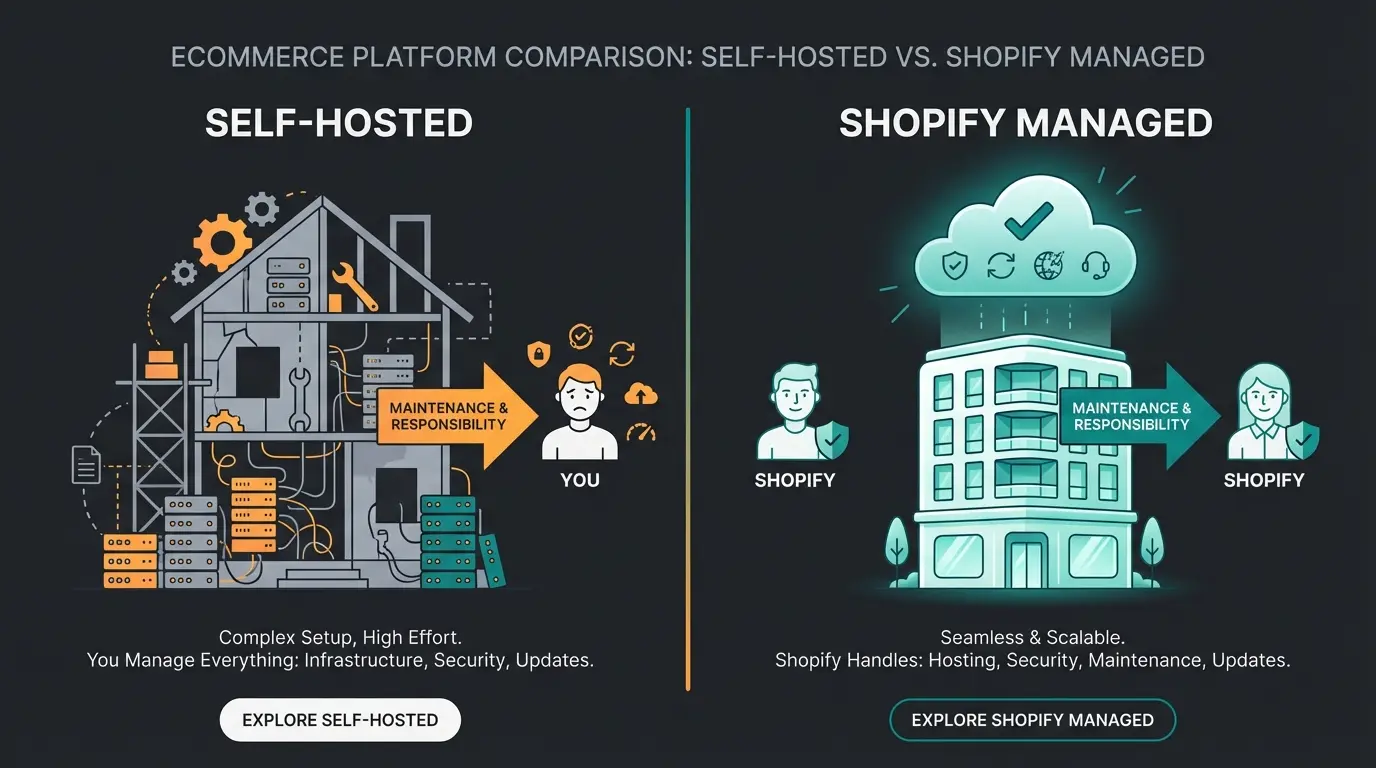
To understand what Shopify is, a simple comparison from the real estate world helps:
- Open-source systems (e.g., WooCommerce, Magento, Shopware Self-Hosted): This is like building a house on your own land. You have absolute freedom but must take care of everything yourself: the foundation (server), security (alarm system/SSL), maintenance (updates), and plumbing (databases). If the roof leaks (server failure), it's your problem.
- Shopify (SaaS): This is like renting a fully furnished luxury apartment in a high-rise. The landlord (Shopify) takes care of the building, elevator, security, and maintenance. You pay rent (monthly fee) and can furnish your apartment as you like (design/themes), but you can't tear down walls (modify core code).
The Core Components
When you sign up for Shopify, you gain access to a central dashboard. From here, you control your entire business:
- Storefront (Your Shop Window): What the customer sees. You choose from thousands of "themes" (design templates) and customize them via drag-and-drop. No programming knowledge required.
- Product Management: Here you set prices, variants (size, color), inventory, and product descriptions.
- Payment Processing (Shopify Payments): An integrated system to accept credit cards, Klarna, PayPal, Apple Pay, and Google Pay without having to sign contracts with banks.
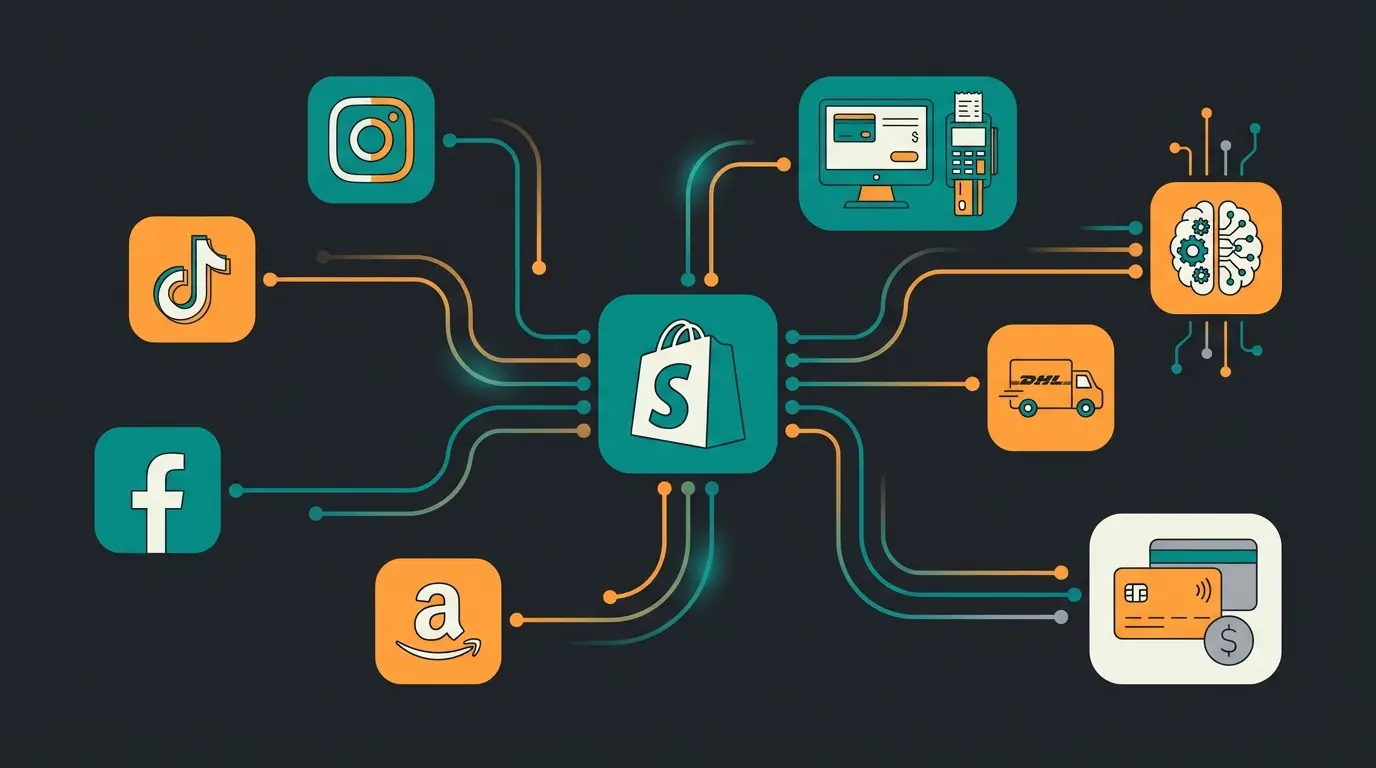
- Sales Channels: Shopify isn't just for your online store. You can sell your products with one click on Instagram, TikTok, Facebook, or through the Shopify POS (Point of Sale) system in a physical retail location.
Shopify Legal Compliance: Is It Safe? (Important!)
This is where many founders hesitate. "What about GDPR? The servers are in the USA/Canada!"
Here's the reassurance, but also the action items. Shopify is aware of the importance of the European market and has made massive improvements. Nevertheless, Shopify "out of the box" (in its default state) is not 100% legally compliant for markets with strict regulations. You need to configure it properly.
The Legal Compliance Checklist for Shopify
To avoid legal issues, you need to close the following gaps that aren't included in the US default settings:
- Legal Texts (Imprint, Terms & Conditions, Right of Withdrawal): Shopify offers placeholders but no legally reviewed texts. Solution: Use apps like the IT-Recht Kanzlei Munich or the Händlerbund, as detailed on Shopify's App Store and demonstrated in various YouTube tutorials. These apps automatically synchronize current legal texts into your store—whenever a law changes, your shop is automatically updated.
- Cookie Banner (Consent Management): Shopify's default banner often doesn't meet strict European legal requirements (opt-in obligation). Solution: Install a specialized cookie app (e.g., Consentmo or Usercentrics) that only activates tracking after the user has consented.
- Price Indication Regulations: In many European countries, the base price (e.g., "100ml = €2.99") and the note "incl. VAT plus shipping" must be displayed directly on the product. Status 2025: Most modern Shopify themes (especially the free 2.0 themes like "Dawn") now have these features integrated. You just need to activate them in the settings.
- The Buy Button: The final button in the checkout must be clearly labeled (e.g., "Order with payment obligation"). Shopify has this correctly configured by default for German merchants.
Conclusion on Legal Compliance: Yes, Shopify can be used in a legally compliant manner in Germany and Europe if you follow the steps mentioned above (especially the legal texts app and cookie banner). Thousands of European merchants do this daily without problems.
The True Costs: Shopify Pricing 2025 in Detail
Many articles only mention the entry price. This is dangerous for your calculations. Let's look at the Total Cost of Ownership (TCO).
The New 2025 Plans
Shopify has adjusted its pricing structure and naming conventions. The middle plan is no longer called "Shopify" but "Grow", according to HuraApps and Propero.
| Plan | Monthly Price* | Annual Price* | Target Audience | Transaction Fee (Shopify Payments)** |
|---|---|---|---|---|
| Basic | ~€36 | ~€27/mo | Beginners, Solopreneurs | 2.9% + €0.30 |
| Grow (formerly Shopify) | ~€105 | ~€79/mo | Growing teams (up to 5 employees) | 2.7% + €0.30 |
| Advanced | ~€384 | ~€289/mo | Scaling brands, International | 2.5% + €0.30 |
| Plus | from $2,300 | individual | Enterprise / Corporations | negotiable |
Prices are net estimates and may vary depending on exchange rate and offers. Annual payment saves approximately 25%. **Fees for credit card payments vary depending on card type (EU vs. International/Amex), as noted by Coding9 and Latori.*
The "Hidden" Costs (Content Gap Analysis)
A shop costs more than just the basic fee. Here's a realistic calculation for a starter shop in the first month:
Table: The True Monthly Costs (Example Calculation)
| Cost Item | Description | Estimated Cost (Month) |
|---|---|---|
| Shopify Basic Plan | Software rental | €36.00 |
| Domain | Your .de or .com address (~€14/year) | €1.20 |
| Legal Texts App | e.g., IT-Recht Kanzlei (protection against legal warnings) | €9.90 |
| Cookie App | Professional consent tool | ~€5.00-10.00 |
| Email Marketing | e.g., Klaviyo (up to 250 contacts often free, then increasing) | €0.00 (start) |
| Accounting | Interface to Lexoffice/SevDesk (e.g., Lexware App) | ~€10.00 |
| Transaction Fees* | At €1,000 revenue (~20 sales) | ~€35.00 |
| TOTAL | Realistic fixed costs at start | ~€97.00-105.00 |
Pros and Cons: An Honest Look
Is Shopify suitable for everyone? No. Here's the unvarnished truth.
Advantages (Pros)
- Time-to-Market: You can build a functioning store in a weekend.
- Ecosystem: The App Store is gigantic. There's an app for every problem (upselling, reviews, SEO).
- Performance: Shopify servers are extremely fast and can handle the rush during TV appearances or Black Friday.
- Omnichannel: Sell simultaneously on Instagram, TikTok, Amazon, and in-store. Everything syncs to one inventory.
Disadvantages (Cons)
- Monthly Fixed Costs: Unlike WordPress (free, but with hosting fees), you have higher monthly fixed costs here.
- Dependency: You're renting the platform. If Shopify raises prices (as happened in 2024), you either go along or move out.
- URL Structure: From an SEO perspective, some professionals are bothered by the rigid URL structure (e.g., always `/products/` or `/pages/` in the URL), although this is not a ranking obstacle for 99% of merchants.
- Customization Limits: You can barely customize the checkout process in the Basic plan (except colors/logo).
For a deeper analysis of these trade-offs and when Shopify might not be the right fit, see our dedicated guide on Shopify disadvantages. Wondering whether the investment pays off? Our guide Is Shopify worth it? breaks down the numbers.
Apps & AI: The Secret Weapon for More Revenue
Now we come to the point that truly explains Shopify as it's used in 2025. Most beginners see apps only as tools for design ("I need falling snowflakes in the header"). That's a mistake.
Successful stores use apps and AI not for gimmicks, but as sales machines.
The Problem with Classic Chatbots
You might know this: You install a free chatbot. The customer asks: "Which cream helps with dry skin?" The bot answers: "Our business hours are 9am-5pm." Result: The customer is frustrated and buys from Amazon instead.
This is where modern AI customer service solutions come into play, transforming how online stores handle customer interactions.
The Solution: AI as Product Consultant
In 2025, it's no longer enough to just put products on the shelf. The e-commerce trend is moving away from pure "self-service" toward digital consultation.
This is where specialized AI apps come into play (like AskTimmy, Tidio Lyro, or specialized sales AIs), as documented by CartCoders and AskTimmy.AI.
Comparison: "Basic Bot" vs. "AI Sales Consultant"
| Feature | Classic FAQ Bot (Old School) | AI Product Consultant (2025 Standard) |
|---|---|---|
| Main Task | Avoid support tickets | Generate revenue (Conversion) |
| Knowledge | Only knows pre-programmed answers | Knows your entire product catalog |
| Interaction | Responds to keywords ("shipping") | Understands context & needs |
| Example | Customer: "Do you have running shoes?" → Bot: "Here's the shoe category." | Customer: "I run marathons and have wide feet." → AI: "I recommend Model X in the Wide version, as it offers extra cushioning." |
| Added Value | Saves time in support | Replaces the salesperson in the store |
The difference is clear: AI product consultation goes beyond simple FAQ responses to actually drive sales and improve customer satisfaction. Many successful stores now employ AI product consultants that can handle complex purchase decisions.
For inspiration on what's possible, leading retailers have transformed product consultation with AI employees, revolutionizing how they engage customers and drive sales.
Keyword-based responses, limited to pre-programmed answers, frustrates complex queries
Slightly improved responses, still lacks product knowledge, handles simple inquiries only
Understands customer needs, knows entire product catalog, recommends specific products
Actively guides purchase decisions, reduces returns, increases average order value
Stop losing customers to frustrating chatbot experiences. Deploy intelligent AI product consultants that understand your catalog and drive conversions like a real sales expert.
Start Your Free TrialShopify vs. The Competition: Alternatives Compared
To fully answer the question "What is Shopify," we need to distinguish it from alternatives.
Shopify vs. WooCommerce (WordPress)
- WooCommerce is a free plugin for WordPress.
- Advantage: No monthly platform fees, full control over the code.
- Disadvantage: You're responsible for hosting, security, updates, and backups yourself. If a plugin update breaks your store, you have to fix it.
- Conclusion: WooCommerce is for tinkerers and tech-savvy people with small budgets. Shopify is for merchants who want to sell, not program.
Shopify vs. Shopware (The German Powerhouse)
- Shopware (especially Shopware 6) is very strong in the German market.
- Advantage: Extremely powerful in the B2B sector (individual price lists, complex workflows) and data protection "Made in Germany." For a deeper look at this platform, see What is Shopware?.
- Disadvantage: Significantly more expensive to set up and maintain. An agency is often required. The "Community Edition" is license-free but requires expensive hosting and maintenance.
- Conclusion: Shopware is often the choice for complex companies with >€1-5M in revenue or special B2B requirements. For D2C brands (Direct to Consumer), Shopify is usually more agile and cost-effective.
For businesses using Shopware, AI sales assistants offer similar benefits to what we've discussed for Shopify stores.
| Feature | Shopify | WooCommerce | Shopware |
|---|---|---|---|
| Type | SaaS (Cloud) | Open Source (WordPress) | Open Source / SaaS Hybrid |
| Setup Time | Hours to Days | Days to Weeks | Weeks to Months |
| Technical Skills | None Required | Moderate to High | High (Agency Often Needed) |
| Monthly Cost | €36-384+ | €10-100+ (Hosting) | €0-2,500+ (Licensing) |
| Best For | D2C, Fast Launch, Scaling | Tech-Savvy, Budget-Conscious | B2B, Complex Requirements |
Maximizing Your Shopify Store with AI
Understanding how to leverage AI product consultants within your Shopify store can be the difference between average and exceptional performance. The integration possibilities are vast, and the ROI can be substantial.
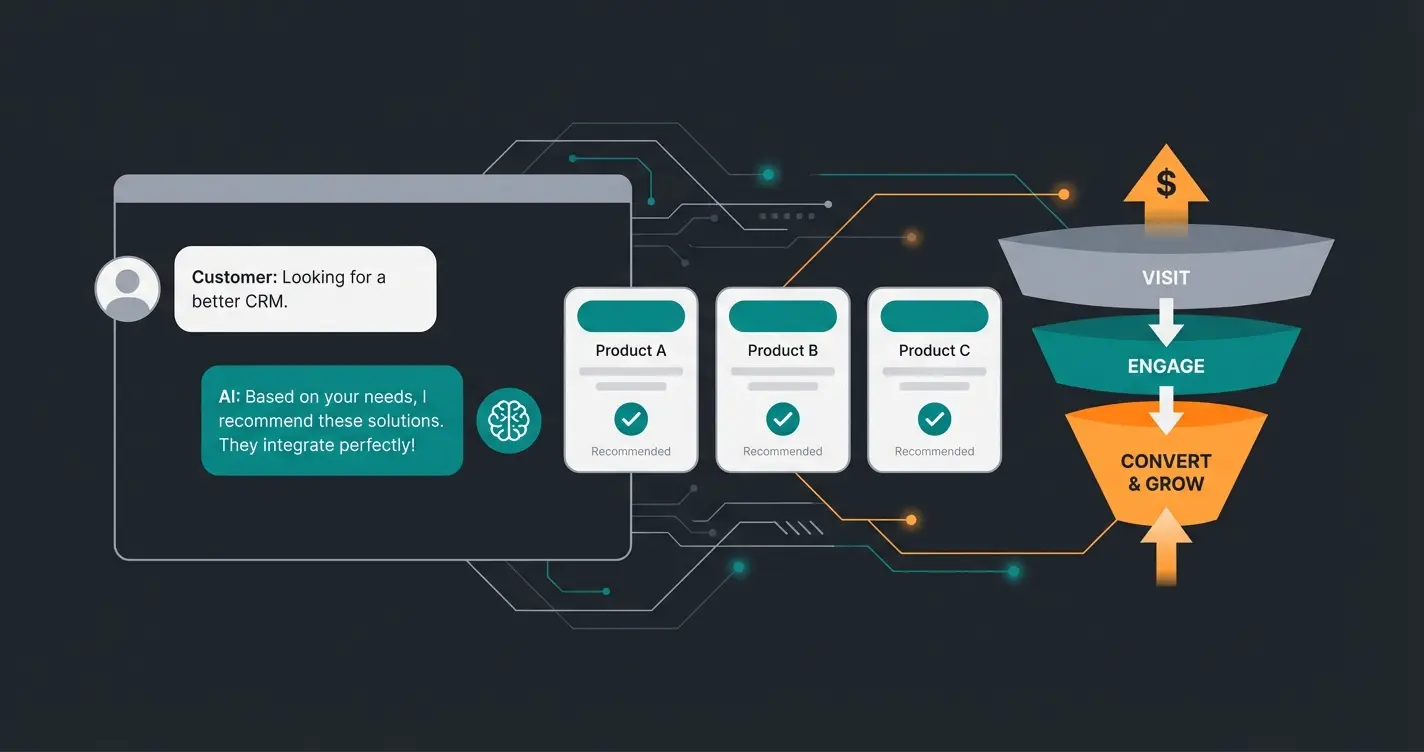
Modern AI solutions don't just answer questions—they actively engage customers, understand purchase intent, and guide them through the buying journey. This represents a fundamental shift in how e-commerce operates, moving from passive product listing to active selling.
Conclusion & Checklist for Getting Started
So what is Shopify? It's currently the most powerful platform for building a professional business without a technical degree. It takes the technical burden off your shoulders but demands a monthly rent in return.
For the German and European markets, it's absolutely mature in 2025—provided you take care of the basic legal settings.
Your Starter Checklist
- ✅ Use the trial period: Start with the free trial (there are often offers like "3 months for €1").
- ✅ Choose a plan: The Basic plan is completely sufficient for starting. Only upgrade to Grow when you need more employee accounts.
- ✅ Establish legal compliance: Immediately install an app for legal texts (e.g., IT-Recht Kanzlei) and a cookie manager.
- ✅ Set up payments: Activate Shopify Payments (including credit card, Klarna, Apple Pay) and link your PayPal business account.
- ✅ Use AI: Think from day 1 about how you want to not just inform visitors, but advise them. A Sales AI can be your competitive advantage over large, anonymous marketplaces.
Shopify is more than just software—it's your toolbox for entrepreneurial freedom. The best time to start is now.
Frequently Asked Questions About Shopify
Shopify is a cloud-based e-commerce platform (SaaS) that allows you to create and run an online store without technical expertise. You pay a monthly subscription fee, and Shopify handles all the technical aspects like hosting, security, and updates. You focus on designing your store, adding products, and selling—everything is managed through a central dashboard.
Shopify can be used in a legally compliant manner in Europe, but it requires configuration. Out of the box, Shopify doesn't meet all European legal requirements. You need to add legal text apps (for imprint, terms, withdrawal rights), install a proper cookie consent manager, and ensure price indication compliance. Thousands of European merchants operate compliant Shopify stores by using specialized apps from providers like IT-Recht Kanzlei or Händlerbund.
While the Basic plan advertises at €36/month, the real cost for a European starter shop is typically €97-105/month. This includes the subscription (€36), domain (€1.20), legal texts app (€9.90), cookie app (€5-10), and transaction fees on sales. Annual payment can reduce the subscription portion by about 25%.
Shopify is a fully-managed SaaS platform—easy to start, monthly fees, limited customization. WooCommerce is a free WordPress plugin offering full control but requiring you to manage hosting, security, and updates. Shopware is a German platform strong in B2B with complex features, typically requiring agency support and higher setup costs. Shopify suits D2C brands wanting speed; WooCommerce suits tech-savvy budget shoppers; Shopware suits complex B2B operations.
Absolutely. In 2025, leading Shopify stores use AI product consultants instead of basic FAQ chatbots. These AI tools understand your entire product catalog, interpret customer needs contextually, and actively recommend products—like a knowledgeable salesperson in a physical store. This approach increases conversion rates, raises average order values, and reduces returns because customers purchase the right products.
Join thousands of successful merchants using intelligent AI consultation to transform browsers into buyers. Get started with a platform that understands modern e-commerce.
Get Started Free
Lasse is CEO and co-founder of Qualimero. After completing his MBA at WHU and scaling a company to seven-figure revenue, he founded Qualimero to build AI-powered digital employees for e-commerce. His focus: helping businesses measurably improve customer interaction through intelligent automation.