Introduction: Are You Still Managing or Already Advising?
Imagine your best sales representative had a perfect memory. They wouldn't just know what a customer purchased three years ago—they would understand the connections between yesterday's email, this morning's technical support inquiry, and a market trend that becomes relevant tomorrow.
In reality, things often look quite different in businesses. Sales teams struggle with isolated data silos, manual maintenance of Excel spreadsheets, and outdated software. According to recent studies from Routine Automation, sales representatives often spend nearly 70% of their time on non-selling activities such as administration and research. This isn't value creation—it's waste.
This is where the modern CRM system comes into play. However, the CRM system definition has fundamentally changed. It's no longer just about customer relationship management in the sense of passive administration. We're entering an era that industry experts describe as the "Age of Intelligence." A modern CRM is no longer a digital filing cabinet—it's an active advisor that empowers your team to sell complex, explanation-intensive products more intelligently.
In this comprehensive guide, you'll learn not just the classic CRM system definition, but we'll take a deep dive into the future of cognitive CRM systems that are revolutionizing businesses worldwide. Whether you're exploring AI product consultation for your e-commerce platform or looking to enhance your sales processes, understanding modern CRM capabilities is essential.
What Is a CRM System? Definition & Meaning
The Classic Definition
The acronym CRM stands for Customer Relationship Management. A CRM system is a software solution that helps companies capture, store, and analyze interactions with potential and existing customers.
At its core, it serves as a "Single Source of Truth" (the one authoritative data source). Whether marketing, sales, or customer service—all departments access the same dataset:
- Who is the customer? (Master data including contact information, company details, demographics)
- What have they purchased? (Transaction data, order history, revenue figures)
- When did we last communicate? (Interaction history, touchpoints, conversation notes)
The Extended CRM Meaning: From Storage to Intelligence
While the classic CRM meaning focused on storing historical data, modern systems concentrate on shaping the future. Organizations implementing AI-powered customer service are experiencing this transformation firsthand.
The market is ready for this transformation. According to Bitkom Research, 91% of companies (with 20 or more employees) now use a CRM application. However, usage doesn't equal efficiency. Many of these systems are essentially data graveyards—information goes in but rarely comes out in useful ways.
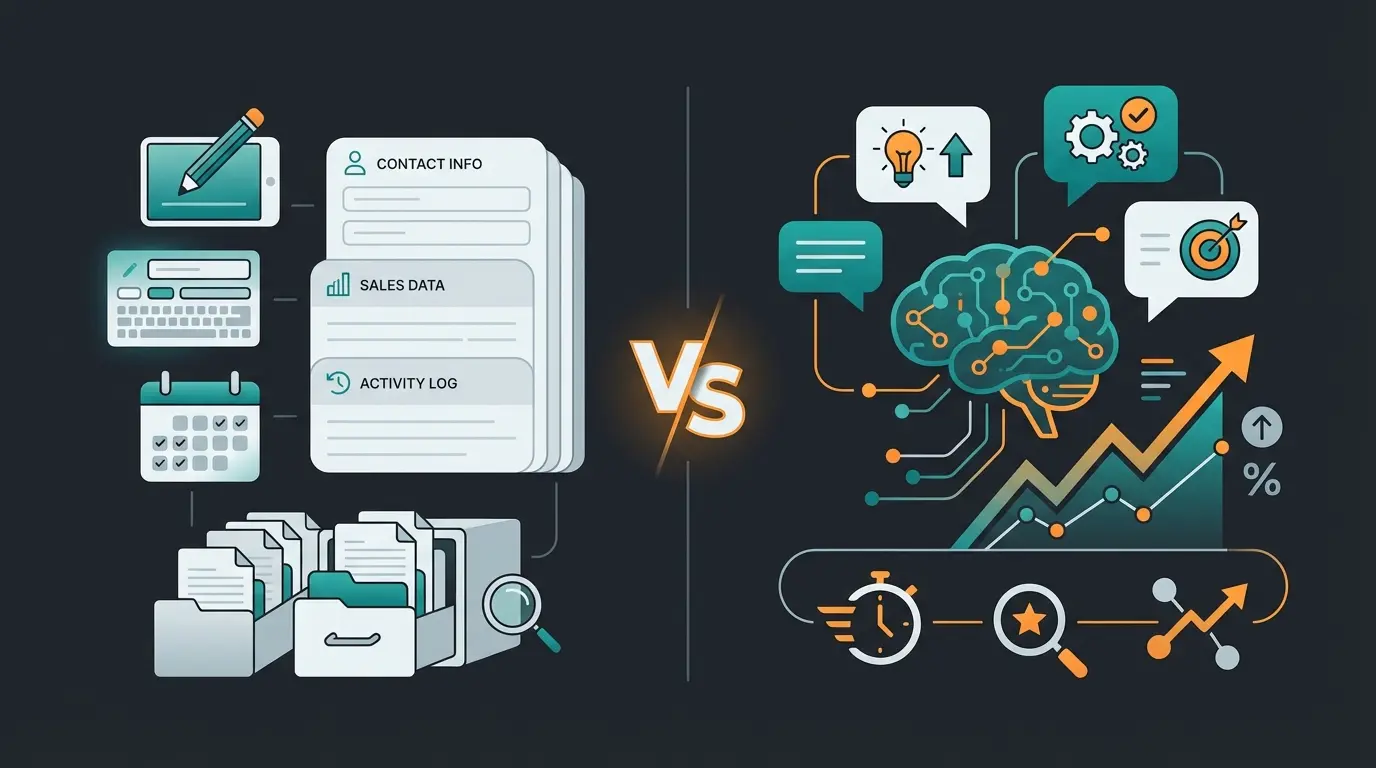
| Feature | Classic CRM (Administration) | Modern AI-CRM (Consultation) |
|---|---|---|
| Role | Passive data storage | Active assistant / Co-Pilot |
| Data Maintenance | Manual entry (time-consuming) | Automated capture & enrichment |
| Focus | "What happened?" (History) | "What should happen next?" (Prediction) |
| User Experience | Filling out forms | Guided dialogs & recommendations |
| Primary Benefit | Control & Reporting | Revenue growth & consultation quality |
The CRM system definition must therefore be updated: A system that uses data to make human interactions more intelligent, personalized, and effective. Companies leveraging AI lead generation are already seeing the benefits of this evolved approach.
Why Do I Need a CRM? Benefits Explained
The question of CRM system benefits can be divided into two categories: classic efficiency gains and the new strategic competitive advantages through AI and consultation competence.
1. Centralization of Knowledge (The End of Scattered Information)
In many small and medium-sized enterprises, customer knowledge often resides in the heads of individual employees or in personal Outlook mailboxes. When an employee leaves the company, the knowledge leaves with them. A CRM centralizes this knowledge in one accessible location.
2. Efficiency Gains Through Automation
Studies consistently show that administration is the greatest enemy of sales productivity. According to research from RunWise, routine tasks consume the majority of a sales rep's day. A CRM automates these routine tasks effectively:
- Automatic creation of follow-up tasks ("Follow up on quote in 3 days")
- Email templates and automated sequences for nurturing
- Appointment booking tools that eliminate back-and-forth scheduling emails
- Automated data entry from emails, calls, and web forms
- Pipeline updates and deal stage progression based on activities
3. Better Product Consultation (The "Consultation" Approach)
This is the decisive advantage for companies with explanation-intensive products (such as machinery manufacturing, IT services, specialized software, or complex B2B solutions).
An AI-powered CRM doesn't just store that a customer is interested—it analyzes why. This is where solutions like the AI employee Kira demonstrate their value in real business environments.
- Scenario: A customer calls and asks about a specific component.
- Standard CRM: Shows price and availability—nothing more.
- Consultation CRM: Recognizes from the customer's history and industry that this component is often purchased with accessory Y or isn't compatible with use case Z. It "whispers" the right consultation strategy to the sales representative in real-time.
4. Analytics and Forecasting
Gut feeling is valuable, but data is better. A CRM delivers reports at the push of a button that transform decision-making:
- Which marketing channels bring the best quality leads?
- How long is the average sales cycle from first touch to close?
- Why do we lose deals to competitors at specific stages?
- Which products are most frequently cross-sold together?
- What's the customer lifetime value by segment or industry?
Percentage of companies (20+ employees) using CRM applications
Average time sales reps spend on administration vs. active selling
CRM projects that fail within the first 10 years of deployment
Companies considering changing their CRM due to inadequate functionality
Real-World CRM System Examples
To make the theory tangible, let's examine concrete CRM system examples. We distinguish between the classic approach and the modern, AI-driven approach that's transforming how businesses operate.
Example A: The Classic Scenario (B2B Trade)
The Miller Company sells office furniture.
- Lead Intake: A prospect fills out a contact form on the website.
- Data Storage: The CRM automatically creates a record ("John Smith, ABC Corporation").
- Task Assignment: The sales manager receives a notification and assigns the lead to a team member.
- Interaction: The team member calls, manually notes the conversation outcome ("Interested in 50 chairs, needs quote by Friday"), and sets a follow-up reminder.
Assessment: Efficient but reactive. The system only manages what the human inputs—it provides no guidance, no insights, no proactive assistance.
Example B: The AI-Powered Scenario (Complex Engineering)
TechSolution AG sells specialized industrial equipment.
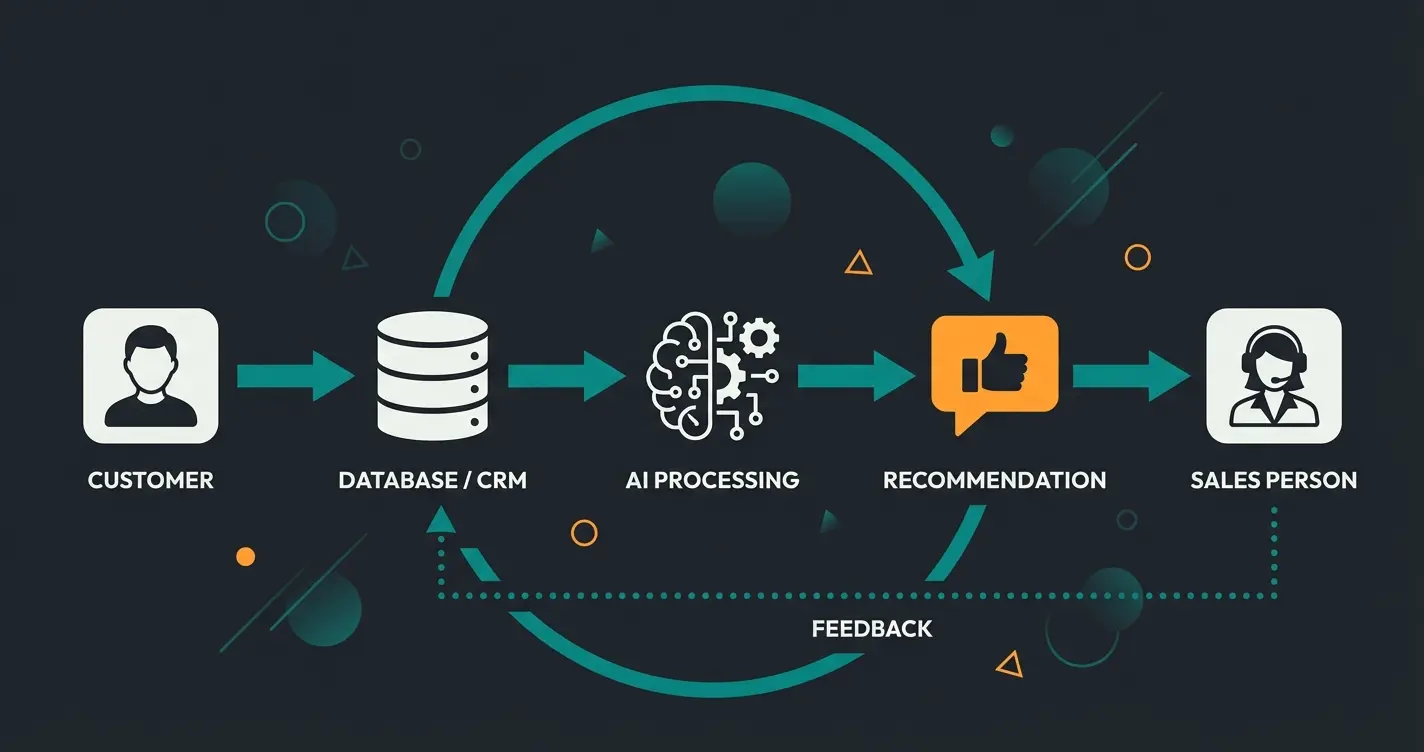
- Signal Detection: The CRM (utilizing AI capabilities similar to those used by AI product consultation) registers not just the form submission but enriches the data automatically: company revenue, current news (e.g., "Planning facility expansion"), technologies currently in use.
- Intelligent Scoring: The AI evaluates the lead. Since the company is expanding, purchase probability is rated high and prioritized accordingly.
- Preparation: Before the sales rep picks up the phone, the system provides a summary: "Customer currently uses competitor product X but recently reported problems with Y (identified through support ticket analysis). Focus the conversation on our solution for Y."
- Real-Time Consultation: During the call, the system transcribes the conversation (live notes) and displays relevant technical documentation when the customer mentions a specific problem or use case.
Assessment: The CRM acts as a Co-Pilot. It massively increases the competence and effectiveness of each team member. This is the same principle demonstrated by the AI Assistant Sophie in healthcare consultation scenarios.
The Evolution: From Storage to Intelligence (AI & Consultation)
The market for CRM software is in upheaval. According to a study from Adito, 43% of companies are planning to switch their CRM system, often due to insufficient functionality. The reason: the old systems are "data graveyards" that collect information but fail to deliver actionable insights.
Closing the "Consultant Gap"
Traditional CRMs were built for administrators, not for consultants. They request data ("Fill out the mandatory fields!") but rarely provide knowledge back to the user in useful ways.
The gap that exists today is the "Consultant Gap": How can software help conduct a better sales conversation? How can it guide representatives through complex product configurations? How can it ensure customers receive expert-level consultation every time? Organizations implementing AI employees are directly addressing this challenge.
AI Beyond Chatbots
When we talk about AI in CRM today, many people think of chatbots on the website answering basic FAQs. But the real revolution is happening internally, transforming how sales and service teams work:
Generative AI for Email Communication
Instead of typing emails themselves, AI (in platforms with advanced capabilities) generates personalized messages based on CRM data ("Reference the last meeting and suggest Product Z based on their expressed needs"). According to NevoLearn's analysis, this can reduce email composition time by up to 80%. HubSpot's AI features exemplify these capabilities in modern CRM platforms.
Automated Meeting Summaries
After a Teams, Zoom, or phone call, the CRM summarizes the conversation, extracts action items, and automatically updates the deal status. According to Orchestry and Dynamics Communities research, this feature alone can save sales teams several hours per week. This is similar to how the AI Chat captures and processes customer interactions automatically.
Predictive Forecasting
Instead of sales managers having to ask their team members for pipeline numbers and manually compile forecasts, AI predicts the monthly close based on thousands of data points more precisely than any human could. As Achieva AI research demonstrates, predictive AI can improve forecast accuracy by 20-40% compared to traditional methods.
Stop managing data and start building intelligent customer relationships. See how AI-powered consultation can increase your team's effectiveness by automating routine tasks while enhancing sales conversations.
Get Your Free DemoCRM Types: Operational, Analytical, Collaborative & Cognitive
To choose the right system, you need to understand the different CRM types. Technical literature typically distinguishes three types—we add the fourth, forward-looking type that represents the future of customer relationship management.
1. Operational CRM
The "workhorse" in daily operations, handling the day-to-day interactions with customers.
- Focus: Automation of marketing, sales, and service processes
- Functions: Contact management, lead scoring, campaign management, sales pipeline tracking
- Goal: Efficiency in customer-facing processes and consistent execution
2. Analytical CRM
The "brain" working in the background, transforming raw data into strategic insights.
- Focus: Evaluation of data for strategy optimization
- Functions: Data warehousing, data mining, customer lifetime value (CLV) analyses, segmentation
- Goal: Recognize patterns and support data-driven decisions
3. Collaborative CRM
The "bridge" between departments and external stakeholders, ensuring information flows freely.
- Focus: Networking of suppliers, partners, sales, and service teams
- Functions: Partner portals, integrated communication tools (Slack/Teams integrations), shared workspaces
- Goal: Break down information silos and enable seamless collaboration
4. Cognitive CRM – The New Era
Here, CRM and AI merge to create something greater than either alone. It represents the step from "administration" to "consultation intelligence." According to research from Avanza Solutions and academic studies on ResearchGate, this represents the next evolutionary step in CRM technology.
- Focus: Proactive assistance and decision support in real-time
- Functions:
- Sentiment Analysis: Detects the customer's mood in emails or calls ("Customer seems frustrated, escalation to manager recommended")
- Next Best Action: Concretely suggests what to do next to win the deal
- Automated Data Maintenance: The system keeps itself clean by syncing data from signatures, business registries, and LinkedIn
Goal: Free humans from routine so they can focus on the relationship—the human element that no AI can replace. This is the approach embodied by AI Paul in creative consultation scenarios.
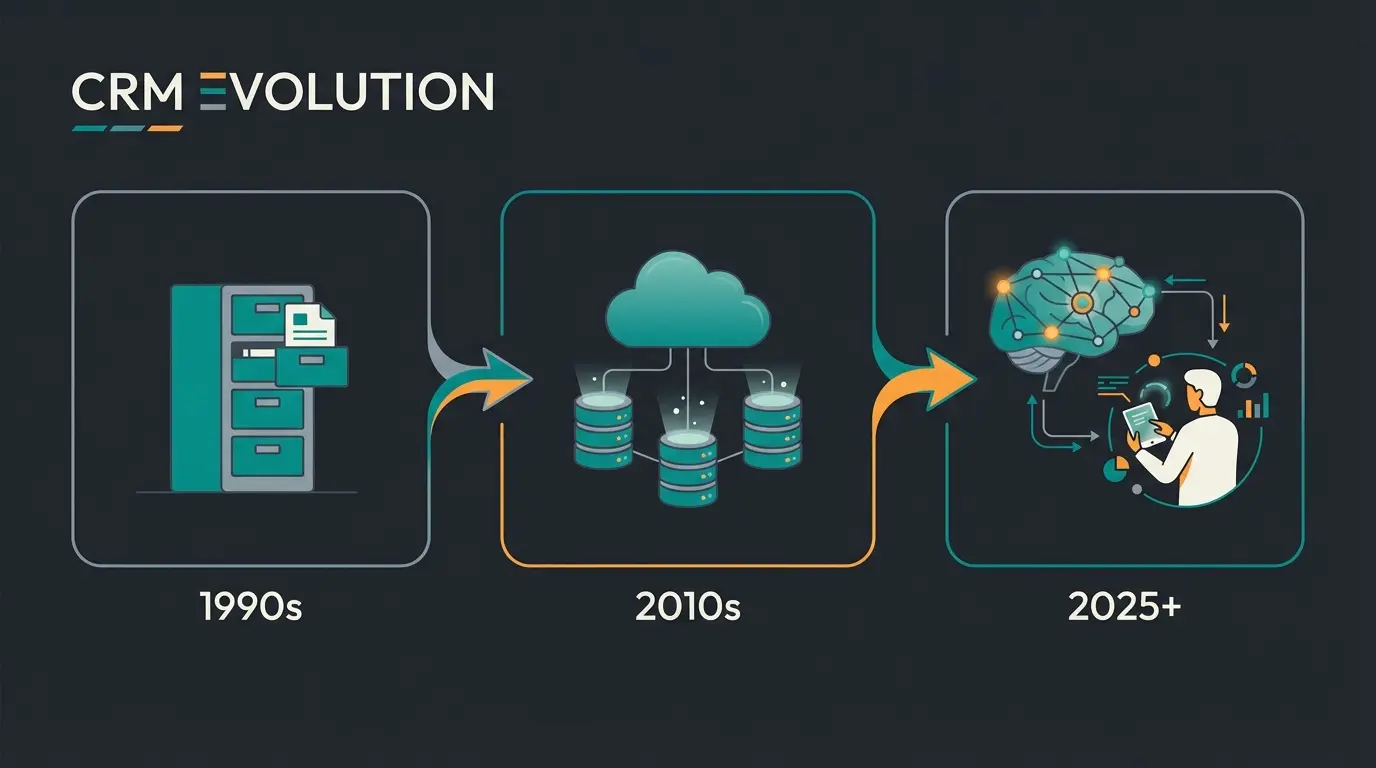
Basic contact storage replacing paper files and Rolodex cards. Focus on digitizing customer information.
Centralized databases with reporting capabilities. Introduction of sales pipeline tracking and basic automation.
SaaS platforms enabling anywhere access. Social CRM integration and marketing automation features.
AI-powered insights, predictive analytics, and real-time consultation assistance. The CRM becomes an intelligent co-pilot.
Content Gaps & Implementation: The Reality for SMEs
Many guides hide why CRM projects fail. According to Adito's research, 38% of CRM implementations have failed over the past 10 years. The reasons are often not technical but human and organizational.
Why "Out-of-the-Box" Often Doesn't Fit
American standard software is often designed for "High Volume Sales" (many small deals, little consultation). Many businesses, particularly "Hidden Champions" in manufacturing or specialized services, often have sales cycles of 18 months and highly complex technical requirements that standard CRM workflows simply cannot accommodate.
The Solution: A CRM must be customizable without requiring a computer science degree to configure it (Low-Code/No-Code approaches). Modern platforms offer visual workflow builders, drag-and-drop customization, and flexible field structures that business users can modify without IT involvement.
Time-to-Value Matters
A 6-month IT project for implementation is hardly justifiable today. Modern cloud systems (SaaS) can be started in days or weeks, not months.
The German Market Context
Germany's business culture emphasizes deep consultation (Beratung) for complex products. This creates unique CRM requirements that US-centric "move fast" sales methodologies don't address. Companies selling industrial equipment, specialized software, or technical services need CRM systems that support longer relationship-building cycles and detailed technical documentation.
The KI Mitarbeiterin Flora success story demonstrates how AI can be adapted to support this consultation-heavy sales approach in practice.
Data Protection & Security (The GDPR Factor)
With all the advantages of AI and cloud technology, one question remains central for businesses: "Is this GDPR-compliant?"
Data security is a massive decision factor. Bitkom studies show that data protection concerns are often the biggest hurdle for cloud and AI adoption. Organizations handling customer data must ensure compliance with increasingly stringent privacy regulations.
AI and Data Protection – A Contradiction?
Many companies fear that their customer data will be used to train public AI models (like ChatGPT or other large language models). Here, providers have responded with sophisticated security architectures:
- Einstein Trust Layer (Salesforce): A security mechanism as described by SalesforceBen that ensures data sent to the AI is masked and not stored in the provider's model.
- EU Hosting: Ensure your CRM provider guarantees server locations in the EU (ideally your home country) with clear data residency commitments.
- Fair.digital & Made in Europe Certifications: Seals like these provide confidence that local legal standards are being met and data remains under appropriate jurisdiction.
CRM Selection Security Checklist
- Where is the data hosted? (Look for EU/EEA data centers)
- Is my data used to train public AIs? (Answer must be "No" with contractual guarantee)
- Is there a Data Processing Agreement (DPA) according to GDPR requirements?
- What encryption standards are used for data at rest and in transit?
- What access controls and audit logging capabilities are available?
- How is data handled when the contract ends (data portability and deletion)?
Conclusion: From Administrator to Architect
The question "What is a CRM system?" can no longer be answered with simply "A customer database."
A modern CRM is the operating system for your company's growth. It's evolving from a passive storage medium to a cognitive intelligence that enables your employees to be better advisors, consultants, and relationship builders.
In a world where products are becoming increasingly comparable and commoditized, the quality of consultation is the decisive differentiator. If your sales team spends 70% of their time on data maintenance, you're losing this competitive battle before it begins. If an AI-powered CRM takes away this burden while simultaneously delivering real-time consultation impulses, you win.
The future doesn't belong to those who *have* the most data, but to those who *use* it best. Companies that embrace this transformation through free initial consultation sessions are positioning themselves for success in the AI-enhanced CRM era.
Your CRM Implementation Checklist
- Status Quo Assessment: Where does your team lose the most time? (Data entry, search, reports, context switching?)
- Goal Definition: Do you want to just manage contacts or actively consult and advise customers?
- Technology Evaluation: Does the CRM offer modern AI functions (Generative AI, Call Analysis, Predictive Scoring)?
- Security Audit: Is the AI model GDPR-secure with zero retention policy for training data?
- Culture Readiness: Is your team prepared to accept a "digital colleague" as a co-pilot rather than a threat?
- Integration Planning: How will the CRM connect with your existing tools (ERP, marketing automation, communication platforms)?
Ready to take the step from data administrator to customer advisor? The technology is here—use it to transform your customer relationships and drive sustainable growth.
Frequently Asked Questions About CRM Systems
While both systems manage business data, they serve different purposes. A CRM system focuses specifically on customer-facing activities: sales, marketing, and service interactions. An ERP (Enterprise Resource Planning) system manages internal business processes like inventory, manufacturing, accounting, and human resources. Many organizations use both systems integrated together, with the CRM handling the customer relationship front-end while the ERP manages back-office operations and fulfillment.
CRM pricing varies widely based on features and scale. Entry-level cloud solutions start at €12-25 per user per month with basic contact management features. Mid-tier solutions with automation and reporting typically cost €50-100 per user monthly. Enterprise solutions with advanced AI capabilities can exceed €150 per user. Many vendors offer free tiers for very small teams (2-3 users) to get started, and annual billing usually provides 15-20% discounts.
Implementation timelines vary significantly based on complexity. A basic cloud CRM for a small team can be operational within 1-2 weeks with minimal customization. Mid-sized implementations with data migration and workflow automation typically take 1-3 months. Complex enterprise deployments with extensive integrations, custom development, and change management may require 6-12 months. The key is starting with a focused MVP approach and expanding iteratively.
Yes, research consistently shows significant improvements. AI-powered CRM features can increase lead conversion rates by 30-50% through better scoring and prioritization. Predictive analytics improve forecast accuracy by 20-40% compared to manual methods. Automated data entry and meeting summaries save 5-10 hours per sales rep weekly. The key is proper implementation with clear use cases rather than expecting AI to be a magic solution without strategic deployment.
Leading cloud CRM providers often have more robust security than on-premise solutions. They invest heavily in encryption, access controls, compliance certifications (SOC 2, ISO 27001), and security monitoring that most individual companies cannot match. The critical factors are choosing providers with appropriate certifications, ensuring data residency meets your regulatory requirements (especially for GDPR), confirming the vendor's data processing agreements, and implementing proper access controls within your organization.
Discover how AI-powered customer consultation can revolutionize your sales and service operations. Join forward-thinking companies already leveraging intelligent CRM capabilities to build stronger customer relationships and drive measurable growth.
Start Your Free Trial