What Is Good Customer Service?
What is good customer service? Is it the friendly voice on the phone processing a return? Is it the chatbot that responds within seconds? Or is it perhaps something entirely different that we often overlook in e-commerce?
For a long time, customer service was viewed as pure 'firefighting': A customer has a problem, and support puts out the fire. But the rules of the game have changed. In an era where products are interchangeable and the next competitor is just a click away, reactive support is no longer enough.
Good customer service today means not just solving problems efficiently, but proactively preventing them and guiding customers to the right product through excellent consultation. It's about the transformation from a cost center to a profit center—turning customer service into revenue.
In this comprehensive guide, you'll discover why the classic definition of service has become obsolete, how to close the 'consultation gap' in online retail, and which 7 concrete tips will help you improve your customer service—supported by current data, psychological insights, and cutting-edge AI strategies.
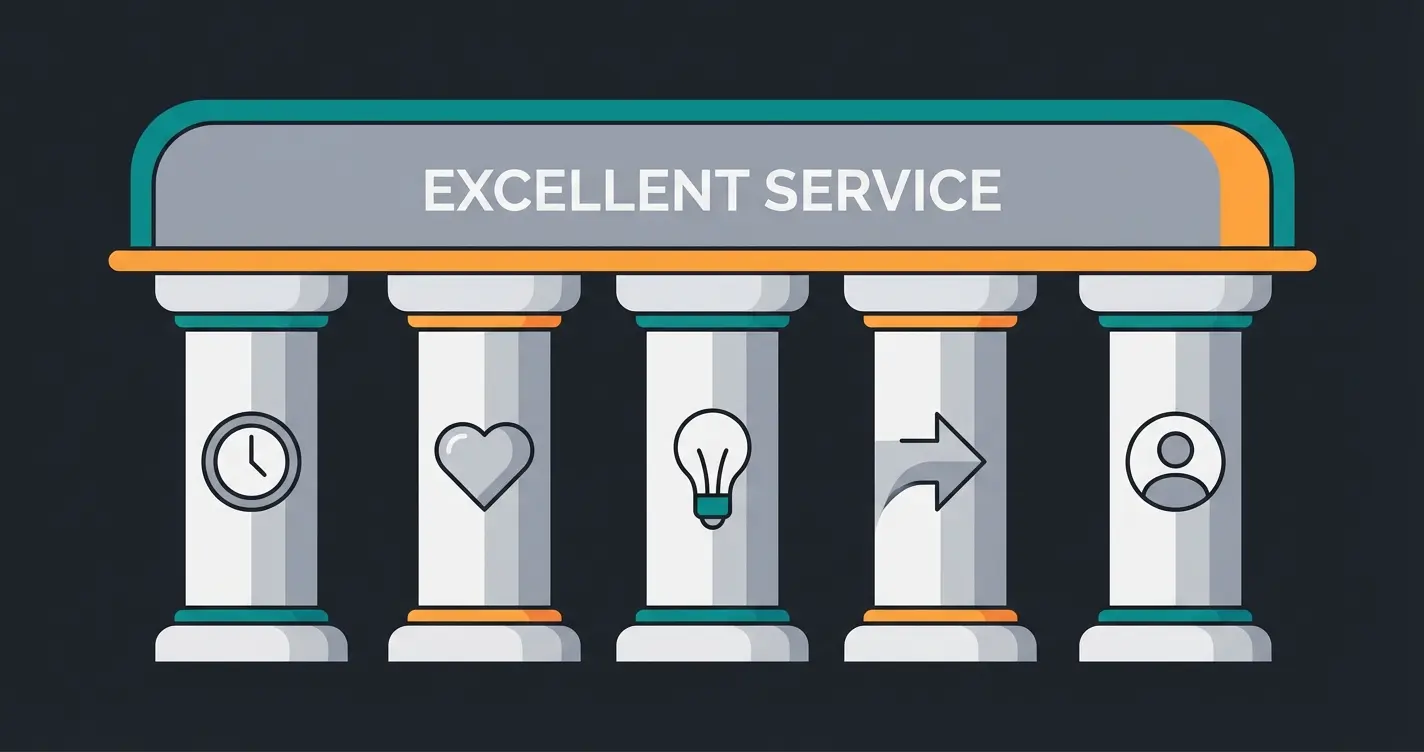
The 5 Pillars of Excellent Customer Service
When we search Google for 'good customer service,' we often get lists of soft skills. These are important but form only the foundation. To remain competitive in 2024 and beyond, companies must master five central pillars. These are based on current market research and customer expectations.
1. Speed & Accessibility: The Hygiene Factor
Nothing frustrates customers more than waiting. Speed is no longer a bonus—it's a basic requirement.
- Customer expectations: According to TextExpander and Zendesk, customers expect a live chat response in less than one minute. For emails, the tolerance threshold is often under an hour, although the average in retail frequently exceeds 12 hours.
- Omnichannel presence: Customers don't think in channels. They start an inquiry on Instagram and expect email support to know the context. A break in communication forces the customer to repeat themselves—one of the biggest frustration factors according to Khoros research.
- 24/7 availability: In a globalized world, online retail knows no opening hours. Anyone shopping at 11 PM with a question doesn't want to wait until 9 AM. Modern Shopware customer service solutions can bridge this gap effectively.
2. Empathy & Friendliness: The Human Factor
Technology can do many things, but genuine empathy remains (for now) a human domain.
- Emotional intelligence: A customer who complains often doesn't just want a solution—they want to be heard. Empathy means validating the customer's frustration ('I understand that's frustrating') before moving to the solution.
- Tone matters: Even negative news (e.g., 'Item sold out') can be softened through friendly, solution-oriented communication. Studies from GrooveHQ show that customers forgive mistakes when service is perceived as warm and genuinely helpful.
3. Solution Competence: Knowledge Is Power
This is where the wheat is separated from the chaff. Friendliness without competence is useless.
- First Contact Resolution (FCR): The goal must be to resolve the issue on first contact. A friendly agent who has to transfer five times doesn't provide good service.
- Product knowledge: Customers expect service representatives (or bots) to know the products better than they do. 'I don't know, let me check' is a conversion killer. Understanding what customer service truly means in today's context is essential.
4. Proactivity: Act Instead of React
This is the biggest lever for excellent customer service.
- Anticipation: Why wait until the customer asks 'Where's my package?' Proactive service informs the customer about a delay before they even notice it, and ideally offers an option directly (e.g., discount on the next order). Research from Trengo and HireHoratio confirms the positive impact of proactive communication.
- Prevention: If data shows that customers often order the wrong size for a particular product, good service warns before the purchase (e.g., with a note 'Runs small' or a size guide).
5. Personalization: The Customer Is Not a Number
The days of 'Dear Customer' are over.
- Leverage data: According to Salesforce research, 73% of customers expect companies to understand their unique needs and expectations. This means: Service knows the purchase history, preferences, and last interaction.
- Individual approach: It's not just about using the name. It's about giving relevant recommendations. If a customer buys vegan products, the service shouldn't recommend leather shoes.
The Hidden Part of Customer Service: Consultation Over Support
Most companies focus their customer service optimization on the support area. This is important, but it's only half the battle—and often the less profitable part.
The Misconception: Support vs. Consultation
Let's sharply distinguish two terms that are often used synonymously:
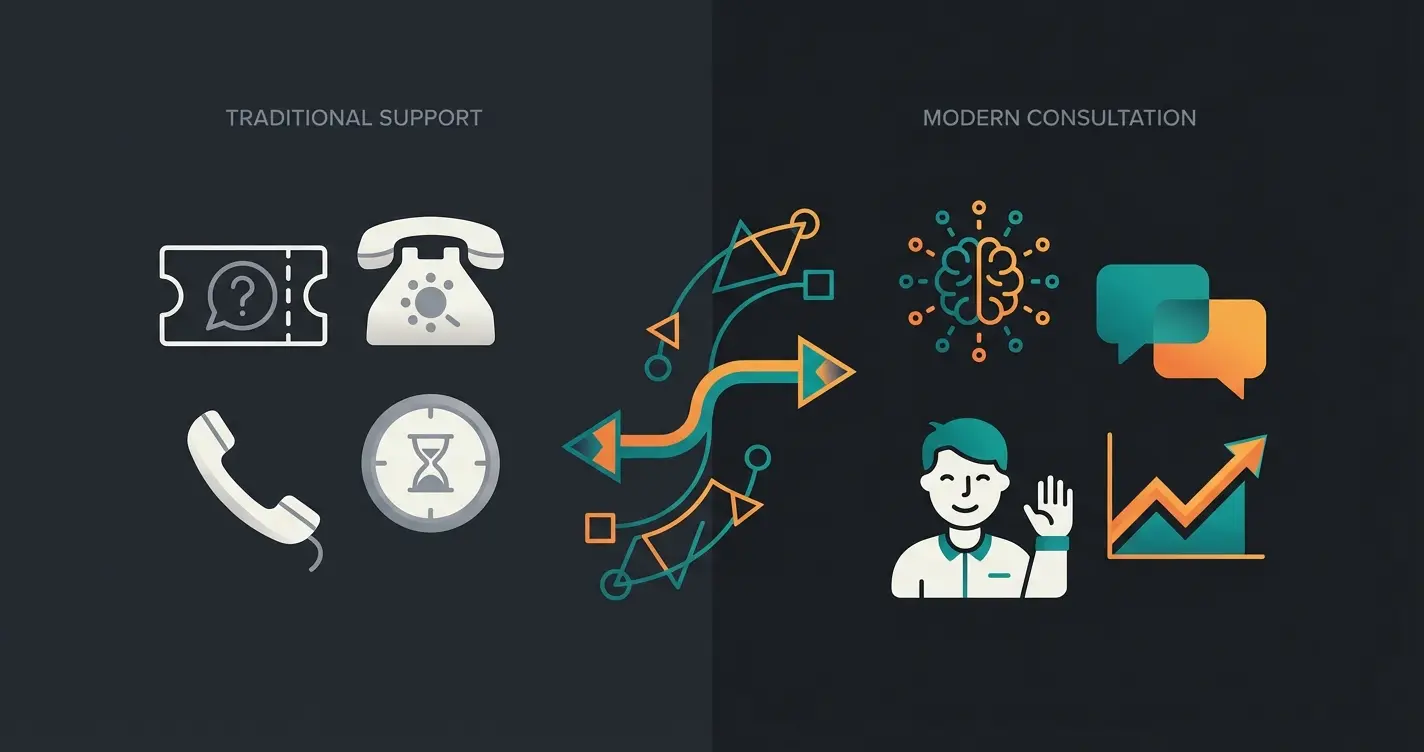
- Support (Reactive): The customer has a problem after the purchase (defect, return, delivery). The service must neutralize a negative state.
- Consultation (Proactive/Consultative): The customer has a need before the purchase but is uncertain. The service helps them make the right decision.
The reality in e-commerce: In a physical specialty store, you go to a salesperson and say: 'I'm looking for running shoes for marathon training on asphalt, but I have wide feet.' The salesperson (expert) reaches into the shelf and hands you the perfect pair.
In online retail, however, customers are often left alone. They have to click through filters ('Color: Blue', 'Size: 42') but don't know if the shoe really fits their running style. They might order two sizes or the wrong model. The result: Returns and dissatisfaction. This is where AI product consultation makes all the difference.
The 'Consultation Gap' in E-Commerce
Here lies the biggest untapped potential for good customer service. Most online shops offer support chats, but these are often just glorified FAQ search engines.
- The problem with classic FAQ bots: They're trained to answer questions like 'What are your return deadlines?' But when a customer asks: 'What tent do I need for a camping trip in Norway in October?', these systems fail. They don't understand the context.
- The opportunity: Excellent customer service closes this gap. It functions as a digital sales consultant. It asks follow-up questions ('How many people?', 'How much weight can you carry?') and guides the customer to purchase completion.
Why Consultation Increases Revenue
Studies from The Future of Commerce and OvationCXM show that customers who interact and receive consultation before purchasing have a significantly higher conversion rate and higher cart value.
- Trust: Competent consultation builds trust. The customer feels understood.
- Return avoidance: Those who buy the right product don't send it back. Consultation is the most effective return brake.
| Feature | Classic Support (Reactive) | Excellent Consultation (Proactive) |
|---|---|---|
| Timing | Mostly after purchase (Post-Purchase) | Before and during purchase (Pre-Purchase) |
| Trigger | Customer reports a problem | Customer shows interest or uncertainty |
| Goal | Fix the problem (damage control) | Fulfill the need (wish fulfillment) |
| Metrics | Average Handling Time (AHT), Ticket Volume | Conversion Rate, Cart Value, Customer Satisfaction |
| Role | Cost Center | Profit Center |
| Technology | FAQ Bots, Ticket Systems | Guided Selling AI, Conversational Commerce |
Discover how AI-powered product consultation can close your consultation gap, reduce returns, and increase conversions by guiding customers to the right products.
Start Your Free Trial7 Tips to Improve Your Customer Service (And Boost Revenue)
Want to improve your customer service and transition from pure problem-solving to value-creating consultation? Here are seven strategic and tactical customer service tips.
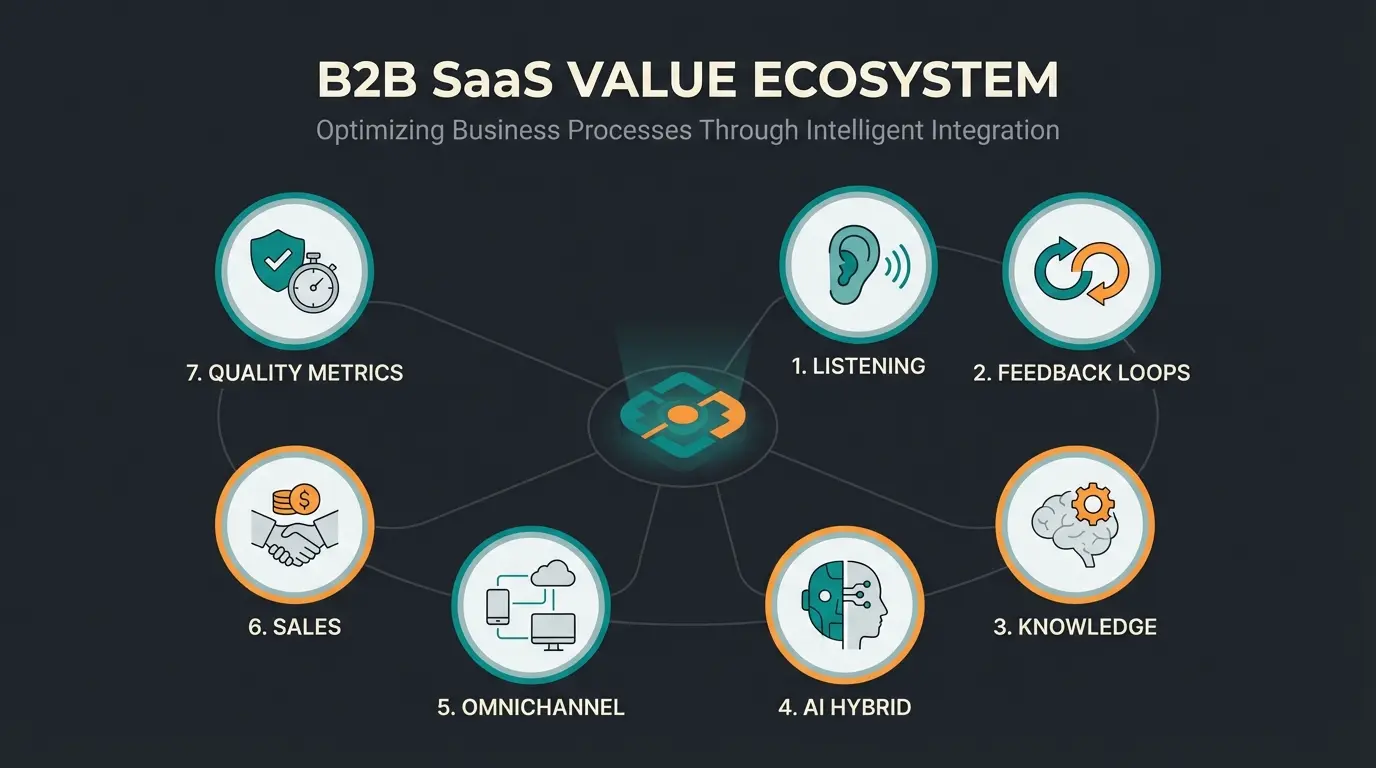
1. Listen Actively (And Read Between the Lines)
Active listening is an art. In written support (chat/email), this means analyzing the customer's text precisely.
- Tip: Pay attention to emotional signal words. If a customer writes 'I'm disappointed again', this indicates a history. Address it before solving the current problem.
- Method: Use the 'mirroring' technique. Briefly summarize the customer's problem in your own words to ensure you've understood correctly. This prevents misunderstandings and shows appreciation.
2. Use Feedback Loops Systematically
Customer feedback is gold but is often ignored.
- Voice of the Customer (VoC): Implement systems that don't just collect feedback but analyze it. According to BusinessDasher, if 20% of tickets are questions about the fit of a particular pair of pants, that's not a support problem—it's a content problem on the product page.
- Tip: Close the loop. When you change something based on customer feedback (e.g., adjusting the size chart), inform customers about it. This creates enormous loyalty.
3. Train Product Knowledge, Not Just Friendliness
A friendly agent who has no clue is more frustrating than a grumpy expert.
- The reality: Support teams are often outsourced and have never physically seen the product.
- Tip: Give every service employee access to your products. Let them test them. Create an internal knowledge base that goes beyond pure FAQs and contains 'expert knowledge' (e.g., 'Which cable fits which monitor?'). Competence is the key to excellent customer service.
4. Automate FAQs, But Simulate Consultation
This is where your differentiation comes in. Use AI not just to deflect tickets, but to sell. AI Chatbots revolutionize the way businesses interact with customers.
- Guided Selling: Deploy AI tools that act like a salesperson. Instead of letting the customer search, the AI asks: 'What would you like to do?' and suggests products based on the answers. Resources from BigCommerce and AIMultiple confirm the effectiveness of this approach.
- Hybrid model: Let simple questions ('Where's my package?') be handled by bots. But as soon as it gets complex ('I'm unsure which product fits'), the AI should either provide competent consultation or seamlessly hand over to a human who already knows the context.
5. Be Where the Customer Is (True Omnichannel)
Customers don't want to switch channels.
- Conversational Commerce: Integrate service into WhatsApp or Instagram DMs. When a customer sees a story about a product, they should be able to ask questions and buy right there. Learn more about AI product consultation via WhatsApp.
- Tip: Synchronize the data. A phone agent must see what the customer previously asked in chat. According to research, 77% of customers are frustrated when they have to repeat their story.
6. Transform Service Into Sales
View every service interaction as a sales opportunity (but with sensitivity).
- Cross-selling through help: When a customer asks how to care for their leather shoes, offering the matching care spray isn't aggressive selling—it's helpful service.
- Tip: Train your team to recognize needs. A customer who registers a return because the product 'doesn't fit' is open to an alternative. Offer an exchange for the right product instead of just refunding the money.
7. Measure Quality, Not Just Speed
Many companies are obsessed with 'Average Handling Time' (AHT)—how quickly a ticket is closed. This is dangerous.
- The problem: An agent who hangs up quickly has good AHT but perhaps an unsatisfied customer who has to call again.
- Better metrics: First Contact Resolution (FCR)—Was the problem solved immediately? Customer Satisfaction Score (CSAT)—Was the customer satisfied? Net Promoter Score (NPS)—Would the customer recommend us? Conversion Rate after contact—Did the customer buy after consultation? (Important for the consultation approach).
Handle complaints and issues after they occur—cost center mentality
Implement speed optimizations and FAQ automation—reduce costs
Anticipate issues and communicate before customers notice—prevent problems
Guide purchase decisions with expert advice and AI—drive revenue
The Role of AI: More Than Just Chatbots
When we talk about customer service tips, we can't avoid Artificial Intelligence. But the discussion is often superficial. It's not about replacing humans with cheap bots. It's about augmentation (enhancement) and consultation. Understanding AI Customer Service fundamentals is crucial for modern businesses.
Standard AI vs. Next-Gen AI
The old world (Standard Chatbots): These systems are based on rigid decision trees.
- Customer: 'My internet isn't working.'
- Bot: 'Have you restarted the router?'
- Benefit: Good for simple, repetitive processes.
- Limitation: Fails at nuances and complex purchase decisions.
The new world (Generative & Agentic AI): These systems understand context, language, and intent. According to Route101 and Salesforce AI research, this represents a fundamental shift in customer service technology.
- Customer: 'I'm looking for a gift for my wife, she likes photography and travels a lot, budget around €200.'
- Next-Gen AI: 'That's a great idea. For travelers, light luggage is important. How about this compact carbon travel tripod or this special camera bag that also serves as a backpack?'
- Benefit: This is excellent customer service. The AI acts as a consultant, not a defense mechanism.
Case Study: The Difference in Experience
Imagine you run an online store for hardware supplies.
- Scenario A (Classic Bot): The customer is looking for a drill. The bot asks: 'Which brand?' The customer doesn't know. The bot shows a list of all 500 drills. -> Customer is overwhelmed and abandons.
- Scenario B (Consultation AI): The customer is looking for a drill. The AI asks: 'What do you want to drill? Concrete, wood, or just hanging pictures?' The customer answers: 'Concrete walls in my apartment.' The AI says: 'For that, you need a hammer drill—a regular impact drill often isn't enough for reinforced concrete. Here are our top 3 recommendations for DIY enthusiasts.' -> Customer feels advised and buys.
This is the power of implementing an AI product consultant that understands customer needs at a deeper level than traditional solutions.
of customers expect companies to understand their unique needs
of customers frustrated when they must repeat their story
expected live chat response time from customers
higher conversion rates with pre-purchase consultation
The Pyramid of Customer Service Needs
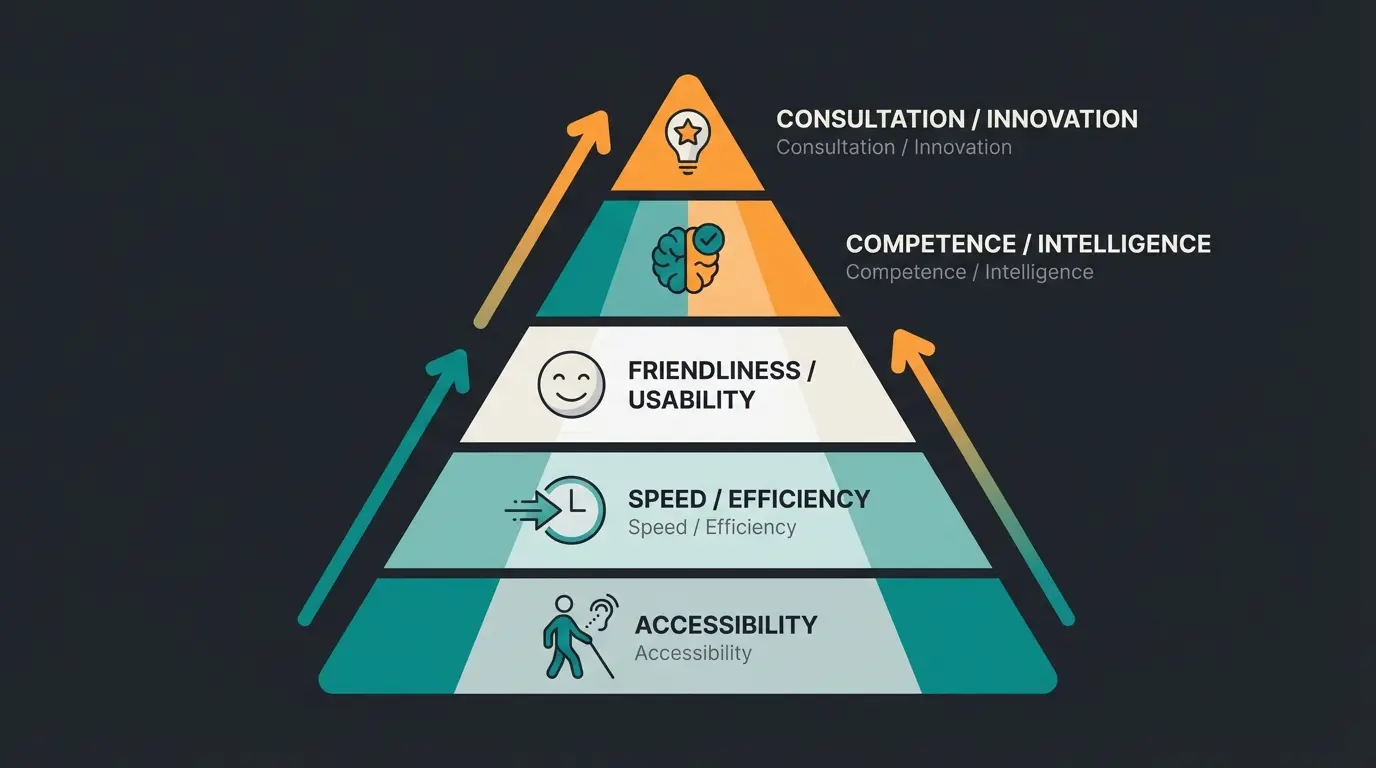
Think of customer service needs like a hierarchy (similar to Maslow's pyramid):
- Base - Accessibility: I can contact someone.
- Safety - Speed: I get a quick answer.
- Social - Friendliness: I am treated nicely.
- Individual - Competence: I get the right answer.
- Self-Actualization (Peak) - Proactive Consultation: I am inspired and guided to success.
Most companies are stuck at level 2 or 3. Good customer service reaches level 4. Market leaders operate at level 5. The integration of KI E-Commerce solutions is what enables this leap.
Checklist: Are You Providing Excellent Service?
Use this short checklist to evaluate your current status. The more boxes you can check, the closer you are to the ideal of modern customer service.
- ☐ Accessibility: Are we present on the channels our customers prefer (WhatsApp, Chat, Social Media)?
- ☐ Speed: Is our First Response Time in chat under 2 minutes and for email under 4 hours?
- ☐ Knowledge: Do our agents (and bots) have deep product knowledge, or do they just read scripts?
- ☐ Proactivity: Do we inform customers about problems before they contact us?
- ☐ Consultation: Do we offer online purchase consultation that goes beyond simple filters (e.g., through Guided Selling)?
- ☐ Personalization: Do we use customer data to personalize the conversation (e.g., knowledge of the last order)?
- ☐ Feedback: Do we actively change processes based on customer feedback?
Implementing AI in customer support can help you check more of these boxes while actually reducing operational costs.
Frequently Asked Questions About Good Customer Service
Good customer service in 2024 combines five essential pillars: speed and accessibility across all channels, empathy and friendliness in every interaction, deep product competence that solves problems on first contact, proactivity that anticipates customer needs before they become issues, and personalization that treats each customer as an individual. The key differentiator is shifting from reactive support (fixing problems) to proactive consultation (guiding customers to success).
AI improves customer service by handling routine inquiries instantly (tracking, FAQs, basic questions) while freeing human agents to focus on complex, high-value interactions. The best approach is a hybrid model where AI gathers context and provides initial consultation, then seamlessly hands off to humans when needed—with all the conversation history intact. Modern AI consultation tools can also guide purchase decisions by asking clarifying questions, something traditional chatbots cannot do.
Move beyond just Average Handling Time (AHT). The most important metrics are: First Contact Resolution (FCR)—was the issue resolved immediately without follow-ups? Customer Satisfaction Score (CSAT)—how satisfied was the customer with the interaction? Net Promoter Score (NPS)—would they recommend you? And for consultation-focused service: Conversion Rate after contact—did the customer make a purchase after receiving advice?
Proactive service prevents problems before they escalate into support tickets. By notifying customers about delays, suggesting the right product size before purchase, or alerting them to potential issues, you reduce returns, complaints, and repeat contacts. Additionally, consultation-driven service transforms support from a cost center into a profit center by guiding uncertain customers toward purchases they're confident about—increasing conversion rates and reducing return rates simultaneously.
The consultation gap refers to the absence of expert guidance in online shopping that customers receive in physical stores. While you can ask a store employee for advice, online shops typically only offer product filters and basic FAQ bots. Closing this gap requires implementing AI-powered guided selling tools or chat consultations that ask clarifying questions about customer needs and recommend specific products—mimicking the experience of talking to a knowledgeable salesperson.
Conclusion: The Future Is Empathetic and Competent
Good customer service in 2024 is no longer a cost factor to minimize. It's the most important differentiator in a saturated market. While products and prices can be copied, an excellent service experience is unique.
The key to success lies in combining human empathy with technological precision. Don't use AI to keep customers at arm's length—use it to advise them better than ever before. Close the gap between anonymous online shopping and personal expert consultation.
If you want to improve your customer service, start today by understanding it not as 'support' (help with problems) but as 'success' (guidance to achievement). Your customers—and your revenue—will thank you. Explore how AI chatbot product consultation can transform your customer interactions into revenue-generating conversations.
Transform your customer service from a cost center into a revenue driver with AI-powered product consultation. Help customers find exactly what they need—before they even know they need help.
Get Started Free Today