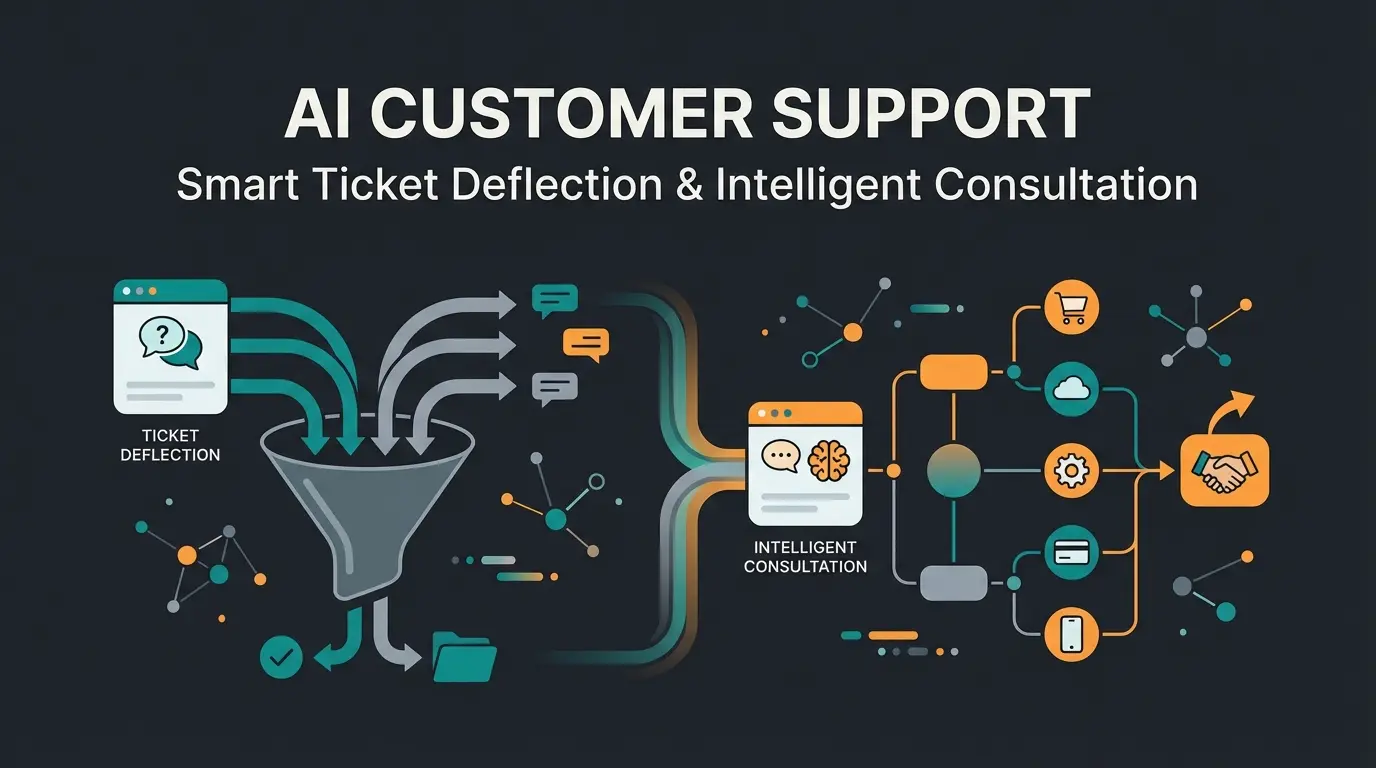
Have You Wondered Why Your AI Bot Closes Tickets But No Sales?
Intercom Fin revolutionized the AI customer support market. With an elegant interface and GPT-4 integration, it was one of the first tools that promised to massively reduce support workload. However, for many companies, especially in the DACH region (Germany, Austria, Switzerland), the initial excitement quickly gave way to disillusionment.
The problem is threefold:
- The Cost Trap: The pricing model of $0.99 per "resolution" makes costs unpredictable and punishes companies for growth, as noted by GPTBots.ai and SaaS Price Pulse.
- The "Deflection" Mentality: Most Intercom Fin alternatives—and Fin itself—are designed to deflect customers (ticket deflection) rather than advise them (conversion).
- The Data Privacy Nightmare: For German companies, US hosting and complex sub-processor lists are often dealbreakers regarding GDPR compliance, as analyzed by Intercom's own documentation.
In this comprehensive guide, we analyze not only the best Intercom AI alternatives for 2025 but also reveal a paradigm shift: away from pure support bots toward intelligent AI product consultation. Understanding the fundamentals of AI Customer Service is essential before diving into specific alternatives.
At a Glance: The Top 5 Intercom Fin Alternatives
Before we dive deep, here's the quick comparison for decision-makers. This table highlights where the wheat separates from the chaff—especially regarding pricing models and data privacy.
| Tool | Best Use Case | Pricing Model | AI Type | Server Location / GDPR |
|---|---|---|---|---|
| Qualimero AI | Product Consultation & Sales | Flat Rate / Value-Based | Generative + Sales Logic | EU/DE (GDPR-compliant) |
| Zendesk (Advanced AI) | Enterprise Support & Ticketing | Per Agent + Add-on Fees | Generative (OpenAI) | USA/EU (plan dependent) |
| Tidio (Lyro) | SMBs & Simple Shops | Quota-based | Generative (Claude) | EU (Poland) / USA |
| Gorgias | E-Commerce (Shopify) | Ticket Volume + AI Fee | Generative | USA |
| Userlike | German Mid-Market | Flat Rate (Package Prices) | Generative + Script | Germany |
Why Most "Alternatives" Are Just Clones (And What You're Missing)
When you search for Fin alternatives, you'll mostly encounter tools that do exactly the same thing as Intercom: they read your FAQ articles and spit out answers. That's "Support AI." The evolution from basic Conversational AI to true consultation requires understanding this fundamental difference.
The Problem with "Support AI"
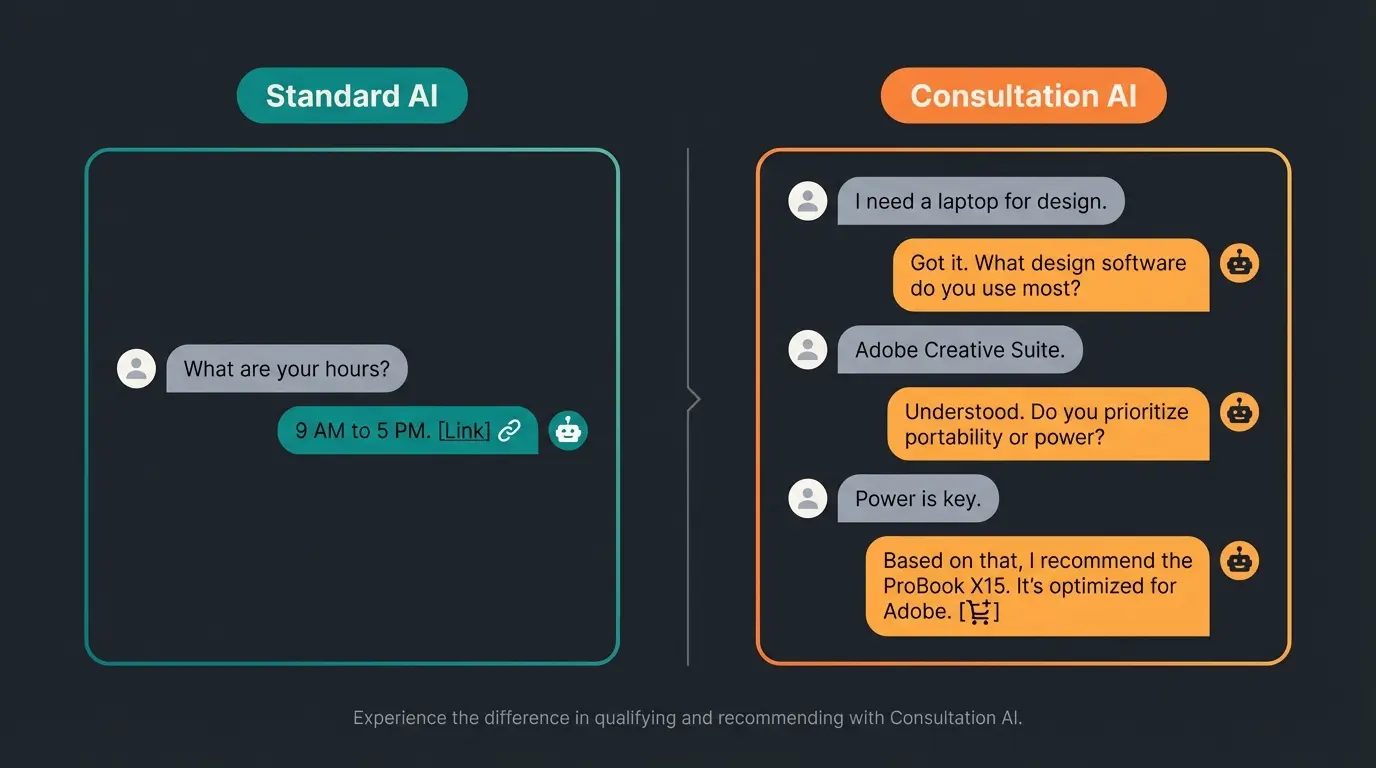
Support AI is reactive.
- Customer: "How can I return this?"
- Bot: "Here's the link to the returns portal."
This saves time but doesn't generate revenue. It's a cost brake, not a revenue driver. Traditional AI employees in customer service often fall into this reactive pattern.
The Solution: "Consultation AI" (Product Intelligence)
What the market lacks—and what you need for 2025—is an AI that proactively advises. This represents the next evolution in chatbot evolution to conversational AI.
- Customer: "I'm looking for a laptop for image editing."
- Bot: "For image editing, you need lots of RAM and a color-accurate display. I recommend Model X over Model Y because it has 100% sRGB coverage. Would you like me to show you the specs?"
The Difference: Intercom Fin and its clones understand text. A true product consultant understands attributes, nuances, and buying intent. While competitors deflect tickets, a Consultation AI guides customers to the shopping cart. This is the core principle behind effective AI guided selling.
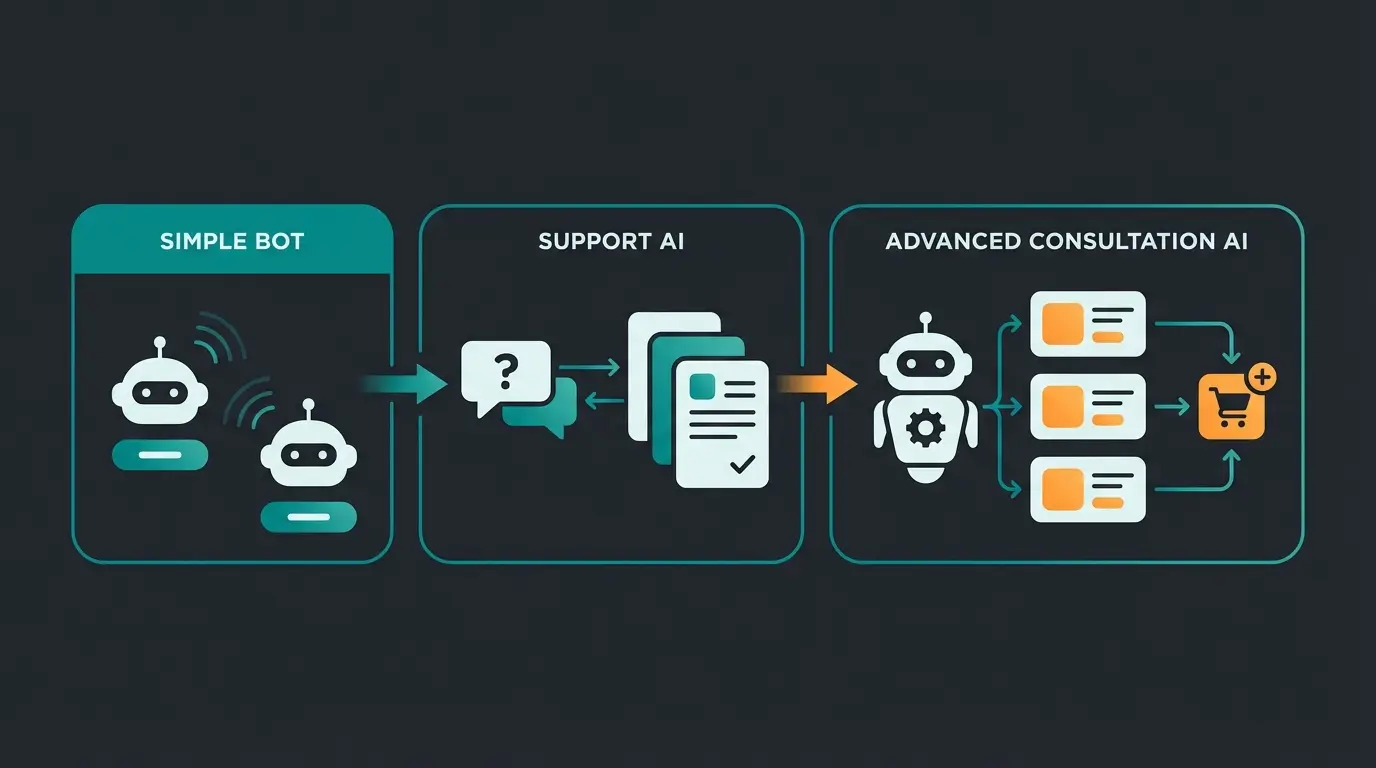
Pre-defined buttons, no understanding, simple menu navigation
Reads FAQs, answers 'Where is my order?', reactive ticket deflection
Understands products, asks qualifying questions, recommends based on needs, drives conversions
The Top Intercom Fin Alternatives in Detailed Review
Based on our analysis of current market leaders and hidden champions, these are the most relevant solutions for 2025. Understanding how AI in customer service creates savings is crucial when evaluating these options.
1. Qualimero AI: The Product Consultant (Best for Sales & Consultation)
While other tools pride themselves on how many conversations they prevent, Qualimero AI is designed to encourage conversations and convert them into sales. It's the only solution on this list conceived not as a pure support bot but as a virtual sales consultant—a true example of AI product consultants in action.
Why it's better than Intercom Fin:
- Product Understanding: Instead of just scanning help articles, our AI understands your product catalog, technical data sheets, and nuances. It can compare products and make recommendations—functioning as intelligent AI sales agents.
- No Cost Trap: We rely on transparent pricing models instead of unpredictable "pay-per-resolution" fees. You won't be punished when your customers enjoy talking to the AI.
- Made for DACH: Full GDPR compliance, servers in the EU, and an AI that masters the difference between formal and informal address as well as German technical terminology.
Ideal for: E-commerce brands and complex services that are consultation-intensive. Learn more about implementing AI product consultation for Shopware and similar platforms.
2. Zendesk (Advanced AI): The Enterprise Giant
Zendesk is the market leader in the support space. With the introduction of "Advanced AI" and the "Copilot" add-on, it aims directly at Intercom Fin.
How it works: Zendesk uses OpenAI models to summarize tickets, generate responses, and recognize customer "intent," as detailed by Voiceflow. It's deeply integrated into the Zendesk ticketing system.
Pricing Model & Costs: Here's the catch. Zendesk is known for complex pricing structures.
- Base: You need at least the "Suite Professional" plan (~$115/agent/month).
- Add-on: The "Advanced AI" add-on costs an additional $50 per agent/month according to Salto.io.
- Automation: For fully automated resolutions (similar to Fin), additional per-resolution fees often apply (approx. $1.50 - $2.00) when certain limits are exceeded, as noted by Eesel AI analysis.
Advantages:
- Extremely powerful for large support teams (50+ agents).
- Omnichannel (email, chat, phone in one).
Disadvantages:
- Enormous Costs: For a team of 10 agents, costs can quickly exceed $20,000 per year just for the software.
- Complexity: Setup often requires external consultants or dedicated admins.
3. Tidio (Lyro): The Small Business Solution
Tidio has created a strong competitor for the SMB (Small and Medium Business) market with "Lyro." Lyro is based on Claude (Anthropic) and advertises itself as particularly safe and "harmless," according to Eesel AI's comparison.
How it works: Lyro scans your website FAQs and responds to them. It's very easy to set up and visually appealing.
Pricing Model:
Tidio uses a quota system as documented on Tidio's pricing page.
- Free: 50 conversations (one-time, not monthly renewable) for testing.
- Lyro AI Plan: Starts at approximately €39/month for a package of conversations.
- Limitation: When your limit is reached, the bot simply stops or falls back to standard flows.
Advantages:
- Very quick setup (under 15 minutes).
- Affordable entry price.
Disadvantages:
- Rigid Limits: The quota system can be problematic during seasonal peaks (e.g., Black Friday).
- Little Depth: Lyro is good for FAQs ("Where's my package?") but weak on complex product consultation.
4. Gorgias: The E-Commerce Specialist (With Double Billing)
Gorgias is deeply integrated into Shopify and Magento, making it very popular among online shops. The AI features focus heavily on order status and simple e-commerce questions, as detailed by Eesel AI.
How it works: Gorgias can process orders directly in chat (e.g., cancellation, address changes).
Pricing Model: Gorgias often receives criticism for its "double billing" on AI tickets as reported by Featurebase and Eesel AI.
- You pay for ticket volume in the base plan.
- You pay additionally an "Automation Fee" (approx. $0.90 - $1.00) for each ticket the AI resolves.
This means an AI-resolved ticket costs you double: it counts against your plan limit and costs the extra fee.
Advantages:
- Best Shopify integration on the market.
- Can execute actions (modify orders), not just talk.
Disadvantages:
- Pricing Structure: Very expensive at high volume.
- Focus: Purely focused on support processes (after-sales), less on pre-sales consultation.
5. Userlike / Moin.ai: The German Data Privacy Fortresses
For companies where the data protection officer has the final say, these two tools are often the first choice.
Userlike:
- Specialty: "AI Automation Hub." Offers a central knowledge database that feeds chatbot, FAQ pages, and contact forms simultaneously, according to Tooltester and Lime Technologies.
- Location: Servers in Germany, extremely high focus on GDPR.
- Price: Starts at approximately €90 (Team) to €290 (Corporate) per month. The AI Hub is often only available in higher plans or as an add-on, as shown on Userlike pricing.
Moin.ai:
- Specialty: "Dreaming" feature (AI suggests what it should learn). Very strong in the enterprise segment.
- Price: High entry barrier. Starter packages often begin at approximately €475 monthly according to OMR Reviews and WebChatAgent.
- Focus: More toward marketing & lead generation for larger mid-market companies.
Advantages:
- Legal certainty in Germany.
- Support in German.
Disadvantages:
- Often more expensive entry than US tools.
- UI/UX sometimes appears more conservative than Intercom or Tidio.
Stop deflecting customers—start converting them. Qualimero's consultation AI understands your products and guides buyers to purchase with flat-rate pricing that protects your margins.
Start Your Free TrialThe Cost Trap: Why "Pay-Per-Resolution" Is Dangerous
One of the main reasons companies search for Intercom Fin alternatives is the pricing model. Intercom charges $0.99 per resolution according to Eesel AI's analysis.
That sounds fair ("I only pay when it works"), but it's a business risk.
The Cost Calculator: Real-World Scenario
Imagine you have an e-commerce shop with seasonal business. Here's what your costs could look like:
| Scenario | Intercom Fin Costs ($0.99/Res) | Flat-Rate Alternative (Example) | Savings |
|---|---|---|---|
| Normal Month (1,000 resolutions) | $990 | $299 | $691 |
| Holiday Season (5,000 resolutions) | $4,950 | $299 | $4,651 |
| Annual Costs (conservative estimate) | ~$18,000 | ~$3,600 | ~$14,400 |
For a growing e-commerce business with seasonal peaks
Predictable pricing that doesn't punish success
Money you keep to reinvest in growth
The Problem: With Intercom, you're punished for your success. The more customers you have, the more exponentially your support costs rise. With a flat-rate solution, your costs don't scale with traffic, protecting your margin.
Additionally, Intercom often defines a "resolution" when the customer simply stops responding or says "thanks"—even if the problem wasn't deeply resolved, as noted in Eesel AI's pricing analysis.
Selection Criteria for German Companies (GDPR & Beyond)
When evaluating an Intercom AI alternative, you should check these three criteria that are often ignored in US reviews. Implementing a solid AI training strategy ensures your team maximizes the chosen solution.
1. Data Sovereignty and Server Location
Intercom hosts data by default in the USA. While there is an "EU Data Hosting" option, it's often tied to conditions and doesn't exclude all sub-processors according to Intercom's privacy documentation and Fin.ai analysis.
- Check: Does the provider guarantee hosting in Frankfurt/EU?
- Check: Is there a DPA (Data Processing Agreement) according to German law?
2. Linguistic Nuance (Formal vs. Informal Address)
American AI models often translate literally. In German, however, the difference between formal address ("Sie") and informal ("Du") is brand-defining.
3. Integration Depth
A bot that only outputs text is 2023 technology. A bot for 2025 must be integrated with your systems. This is where AI Agents truly differentiate themselves from basic chatbots.
- Question: Can the bot actually check delivery status (API connection) or does it just send a link to the DHL page?
- Question: Can the bot recommend products based on inventory levels? (Consultation AI)
- Question: Does it integrate with your CRM for personalized recommendations?
Implementation Reality: What Others Don't Tell You
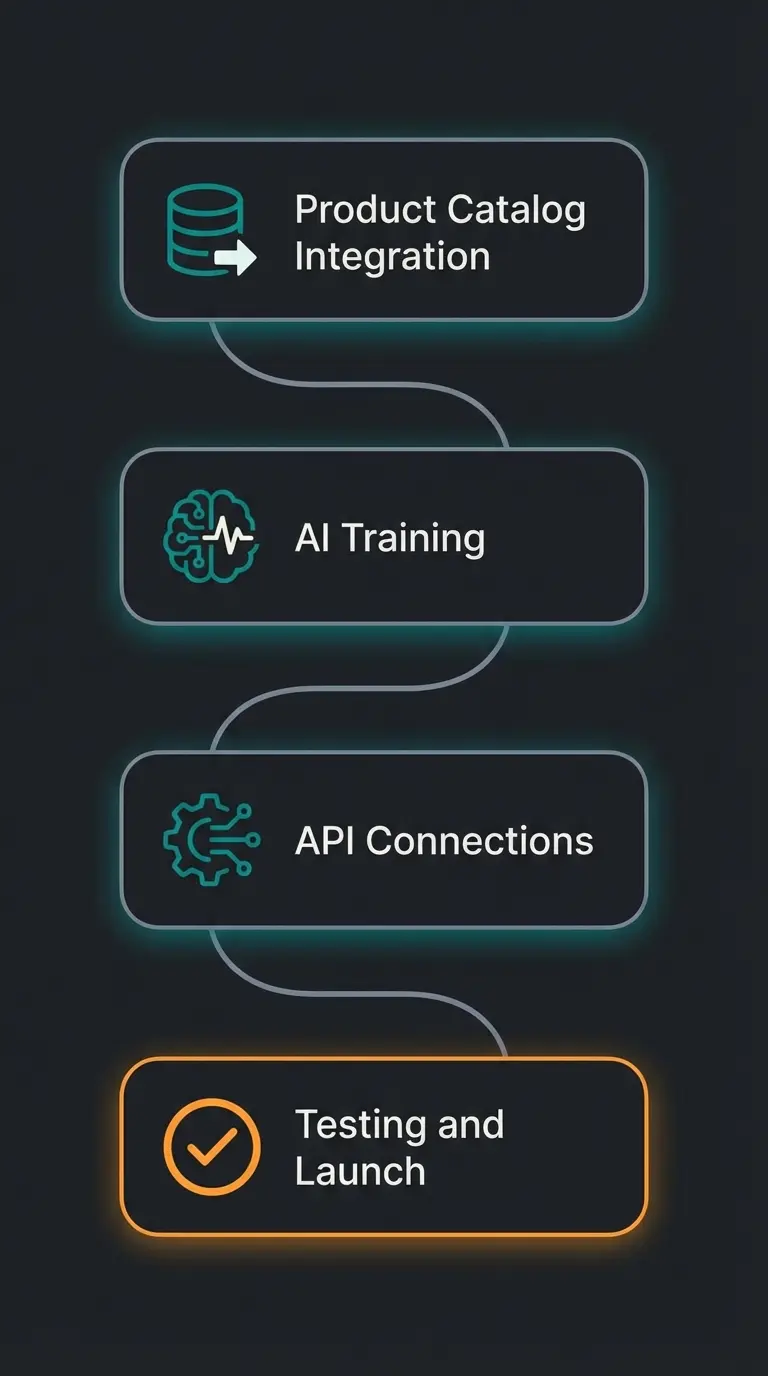
Most comparison articles skip how to actually set up AI on a complex product catalog. They say "easy setup" but don't show the process of training AI on nuanced product data.
A true consultation AI requires:
- Product Data Integration: Not just FAQ text, but actual product attributes, specifications, and comparison points
- Knowledge Base Depth: Understanding why Product A is better for outdoor use than Product B
- Intent Recognition: Distinguishing between 'I want to buy' and 'I have a problem with my order'
- Contextual Memory: Remembering earlier conversation points to provide coherent recommendations
This is particularly important for businesses leveraging AI Chatbot for E-Commerce across multiple channels.
Conclusion: Support Is Good, Consultation Is Better
The market for Intercom Fin alternatives divides in 2025 into two camps:
- The Ticket Killers: Tools like Zendesk, Tidio, or Gorgias, designed to reduce support costs and deflect inquiries.
- The Revenue Drivers: Solutions like Qualimero AI, which use AI to improve the shopping experience and actively advise customers—true AI selling in action.
If your goal is only to stop the ticket flood, tools like Tidio (for small teams) or Zendesk (for enterprises) are solid options.
However, if you're seeking growth and want to transform your website visitors into customers rather than just "managing" them, you need more than a support bot. You need an intelligent product consultant that speaks your language, protects your data, and doesn't eat into your margins.
FAQ: Common Questions About Intercom Fin Alternatives
Intercom offers GDPR compliance features and is part of the Data Privacy Framework. However, data is often processed in the USA by default, and the list of sub-processors (like OpenAI) is extensive. For strict German compliance requirements, many companies prefer providers with pure EU hosting (like Userlike or Qualimero AI) according to Intercom's compliance page.
A classic chatbot (or Support AI) reacts to questions with predefined answers from a knowledge base (reactive). A Consultation AI actively guides the customer through a process, asks follow-up questions about needs, and recommends specific products based on this data (proactive). This represents the evolution in conversational AI technology.
For very small teams, Tidio's free plan is a good start. For growing companies seeking cost control, flat-rate models (like Qualimero AI or Userlike) are usually significantly cheaper than the volume-based models from Intercom or Gorgias.
Yes, Intercom Fin can theoretically be placed as a "standalone" solution in front of another helpdesk (like Zendesk). However, you still pay the $0.99 per resolution and often lose seamless integration of customer data.
Most enterprise solutions support multiple languages, but quality varies. Userlike and Qualimero AI are specifically optimized for German, including formal/informal address handling and technical terminology. US-based tools often struggle with German compound words and industry-specific jargon.
Join companies that switched from pay-per-resolution to consultation-first AI. Flat-rate pricing, EU hosting, and AI that actually sells your products.
Book Your Demo Today
Lasse is CEO and co-founder of Qualimero. After completing his MBA at WHU and scaling a company to seven-figure revenue, he founded Qualimero to build AI-powered digital employees for e-commerce. His focus: helping businesses measurably improve customer interaction through intelligent automation.