Introduction: The Intercom Fin Hype vs. DACH Reality
The launch of Intercom Fin marked a turning point in customer support automation. As one of the first major helpdesk systems to integrate a GPT-4-based AI model, Intercom promised to resolve up to 50% of support inquiries instantly. For Heads of Support and Customer Experience Managers, this initially sounded like the holy grail: fewer tickets, lower personnel costs, happier customers.
However, in 2025, a more nuanced picture emerges, especially when examining the demanding German market (DACH region). While Intercom Fin AI is undoubtedly a powerful tool for handling standard questions like 'Where is my package?' or 'How do I reset my password?', German brands are increasingly encountering strategic limitations that affect their bottom line.
The core problem doesn't lie in the technology itself, but in its fundamental objective. Fin was built to reduce costs through deflection. Yet modern e-commerce and SaaS companies in Germany need more than just cost reduction—they need revenue growth through intelligent consultation. This is where the distinction between an Intercom support bot and a true intelligent sales consultant becomes critical.
In this comprehensive review, we analyze Intercom Fin from a distinctly German perspective. We examine GDPR compliance beyond marketing promises, the pitfalls of the German language ('Du' vs. 'Sie'), and why a 'support bot' is fundamentally different from a 'product consultant.' Understanding these distinctions is essential for any brand serious about customer experience in the European market.
What is Intercom Fin? The Technical Foundation
Before diving into the critical analysis, it's essential to understand what Fin by Intercom actually delivers from a technical standpoint. Unlike legacy chatbots that relied on rigid decision trees (If customer says X, respond with Y), Fin represents a genuine leap forward as a true AI agent.
How It Works: RAG Technology Explained
Fin utilizes modern Large Language Models (LLMs), primarily OpenAI's GPT-4, in combination with a technology called RAG (Retrieval-Augmented Generation). According to eesel.ai, this approach significantly improves answer accuracy compared to pure generative models.
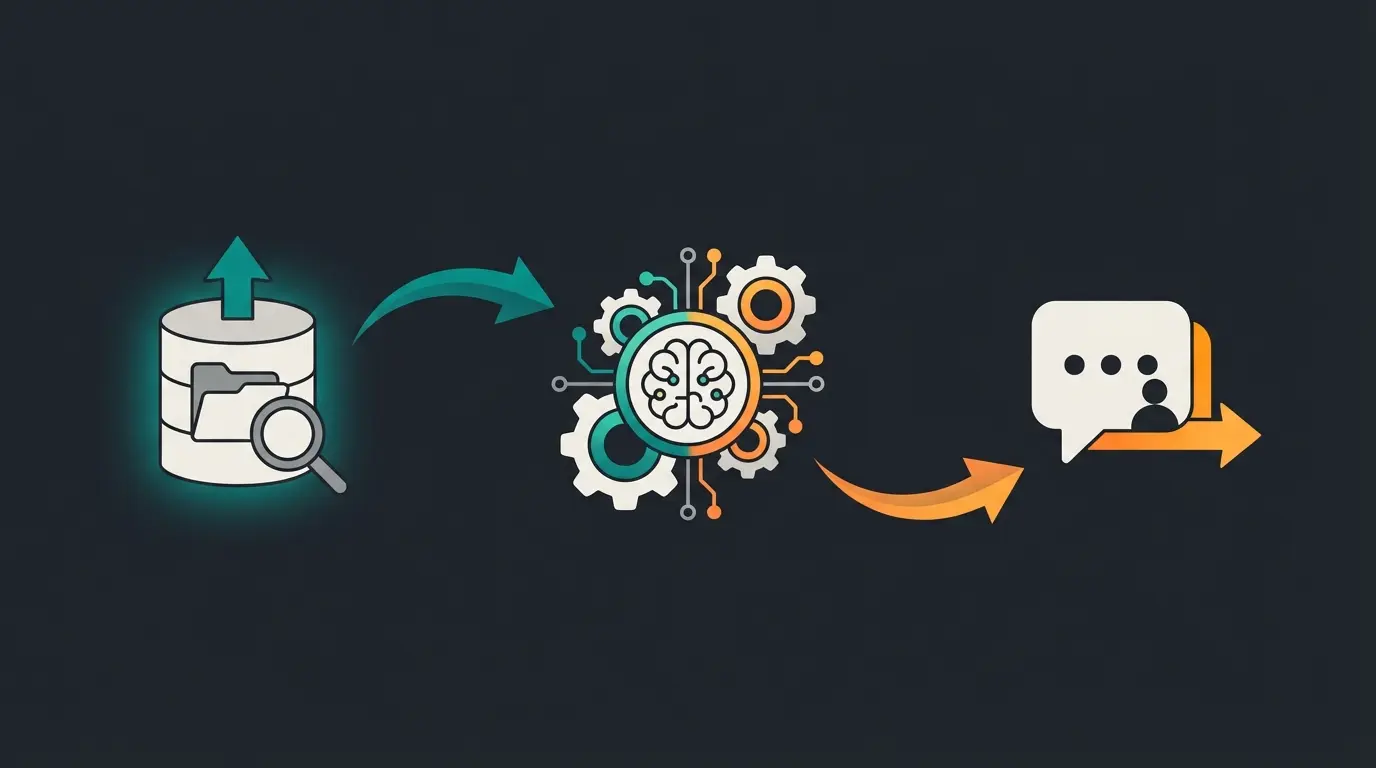
- The Process: When a customer asks a question, Fin doesn't simply 'hallucinate' an answer from the general knowledge of the internet. Instead, the bot searches your specific Intercom Knowledge Base (Help Center), extracts the relevant sections, and formulates a natural-sounding answer from those sources.
- The Integration: Fin is deeply integrated into the Intercom ecosystem. It can seamlessly hand off to human agents when it reaches its limits or when the customer explicitly requests human assistance.
- The Limitation: Fin's intelligence is entirely dependent on the quality and completeness of your Knowledge Base content—a critical factor many companies underestimate.
The Marketing Promise
Intercom aggressively promotes a 'Resolution Rate' of 50%, as highlighted on their official product page. This theoretically means that half of your support tickets should never reach a human employee. For companies with high volumes of repetitive questions, this represents a massive operational lever.
But how does this US-centric model perform in German reality? The answer involves complex considerations around data privacy, language nuances, and fundamentally different customer expectations that the American market simply doesn't share.
The German Context Test: Where Fin Hits Its Limits
For software buyers in the US, Fin might seem like a no-brainer decision. For German companies operating under strict data protection laws (GDPR/DSGVO) and high cultural expectations for communication, the challenges lie in the details that can make or break customer trust.
1. Data Privacy & GDPR: A Minefield Despite EU Hosting
A decisive criterion for every German company is server location and data processing. Understanding the full Intercom pricing breakdown requires looking beyond the sticker price to these compliance considerations.
- The Status Quo: By default, Intercom hosts data in the USA (AWS Region us-east-1), as documented by fin.ai.
- The EU Option: Intercom does offer 'Regional Data Hosting' in Europe (Dublin, AWS eu-west-1). However, this is often tied to more expensive plans and requires manual migration—existing data cannot simply be 'moved,' but often a new workspace must be created.
- The Legal Problem: Even with EU hosting, Intercom remains a US company (Intercom R&D Unlimited Company and the US parent company). According to assessments from German procurement chambers and data protection experts (keyword: Schrems II ruling), there remains a latent risk with US providers that US authorities could force access to data via the CLOUD Act, even when servers are physically located in Frankfurt or Dublin, as noted by continum.net and idgard.com.
- The Gap: For strictly regulated industries (FinTech, HealthTech, Insurance) in Germany, a 'server in Dublin' often isn't sufficient when legal access from the US isn't technically impossible. This is where local providers operating purely within Europe have a massive trust advantage.
For companies concerned about EU AI Act requirements and broader regulatory compliance, these data residency questions become even more critical as AI governance frameworks continue to evolve across the European Union.
2. Language Nuances: The 'Du' vs. 'Sie' Dilemma
The German language strictly distinguishes between formal (Sie) and informal (Du) address forms. This nuance is extremely difficult for AI models primarily trained on English to master consistently, creating potential brand damage with every customer interaction.
- Intercom's Solution: Intercom offers a setting 'Let Fin decide' or the explicit choice between Formal/Informal, as documented in their help center.
- The Risk: The technology is 'non-deterministic.' Intercom themselves warn: 'We can't guarantee that it will always use the correct pronouns.'
- The Scenario: Imagine you're a conservative private bank. Your bot begins the conversation with 'Guten Tag, wie kann ich Ihnen helfen?' (formal Sie), but slips mid-explanation to 'Klicke einfach hier, um dein Konto zu öffnen' (informal Du). Such inconsistencies appear unprofessional and massively damage brand trust. Specialized German AI agents often offer more rigid control mechanisms ('System Prompts') that enforce the 'Sie' form throughout every interaction.
This linguistic challenge is particularly relevant for AI consulting in e-commerce contexts where maintaining consistent brand voice directly impacts conversion rates and customer confidence in the buying process.
Core Comparison: Support Agent vs. Product Consultant
Here lies the biggest strategic gap in current market analysis. Most companies compare Intercom Fin with other support bots. But the real potential of AI lies not in support (reducing costs), but in consulting (increasing revenue). This distinction fundamentally changes how businesses should evaluate AI customer service solutions.
The 'Librarian' Model (Intercom Fin)
Fin operates like an extremely fast librarian, efficient at finding information but limited in its ability to guide or advise customers toward optimal decisions.
- Trigger: The customer must have a specific question.
- Action: Fin searches the 'book' (Knowledge Base) for the answer.
- Goal: Answer the question as quickly as possible so the customer leaves ('Resolution').
- Example: Customer: 'What are the return deadlines?' → Fin: 'You have 30 days.' → End.
The 'Sales Consultant' Model (Consultation AI)
A specialized AI product consultation solution operates like an experienced sales associate in a physical store, actively engaging customers to understand their needs and guide them to the right purchase.
- Trigger: The customer shows interest or uncertainty about products.
- Action: The AI asks follow-up questions to analyze needs (Diagnostic Logic).
- Goal: Guide the customer to the right product and increase cart value ('Conversion').
- Example: Customer: 'I'm looking for a night cream.' → Consultation AI: 'Happy to help. Do you have dry or oily skin? And do you prefer fragrance-free products?' → Recommendation: 'Based on that, I recommend Cream X for your specific skin type.'
| Feature | Intercom Fin (Support AI) | Product Consultation AI |
|---|---|---|
| Primary Goal | Ticket Deflection (End Chat) | Purchase Completion & Advice (Conversion) |
| Data Source | Static Help Articles (FAQs) | Product Data, Attributes & Sales Playbooks |
| Interaction Style | Reactive (Q&A) | Proactive (Diagnostic/Question-Asking) |
| Success Metric | Resolution Rate (Conversation Ends) | Add-to-Cart Rate / Conversion Rate |
| Best Scenario | 'Where is my order?' | 'Which product is right for me?' |
Why this matters: If you deploy Fin on a product page, it will fail when the customer asks: 'What's better for me?' Fin finds no help article containing this subjective consideration. It will respond with: 'Here's an article about our products,' instead of actually consulting the customer. This is where AI chatbots designed specifically for consultation create measurable business value.
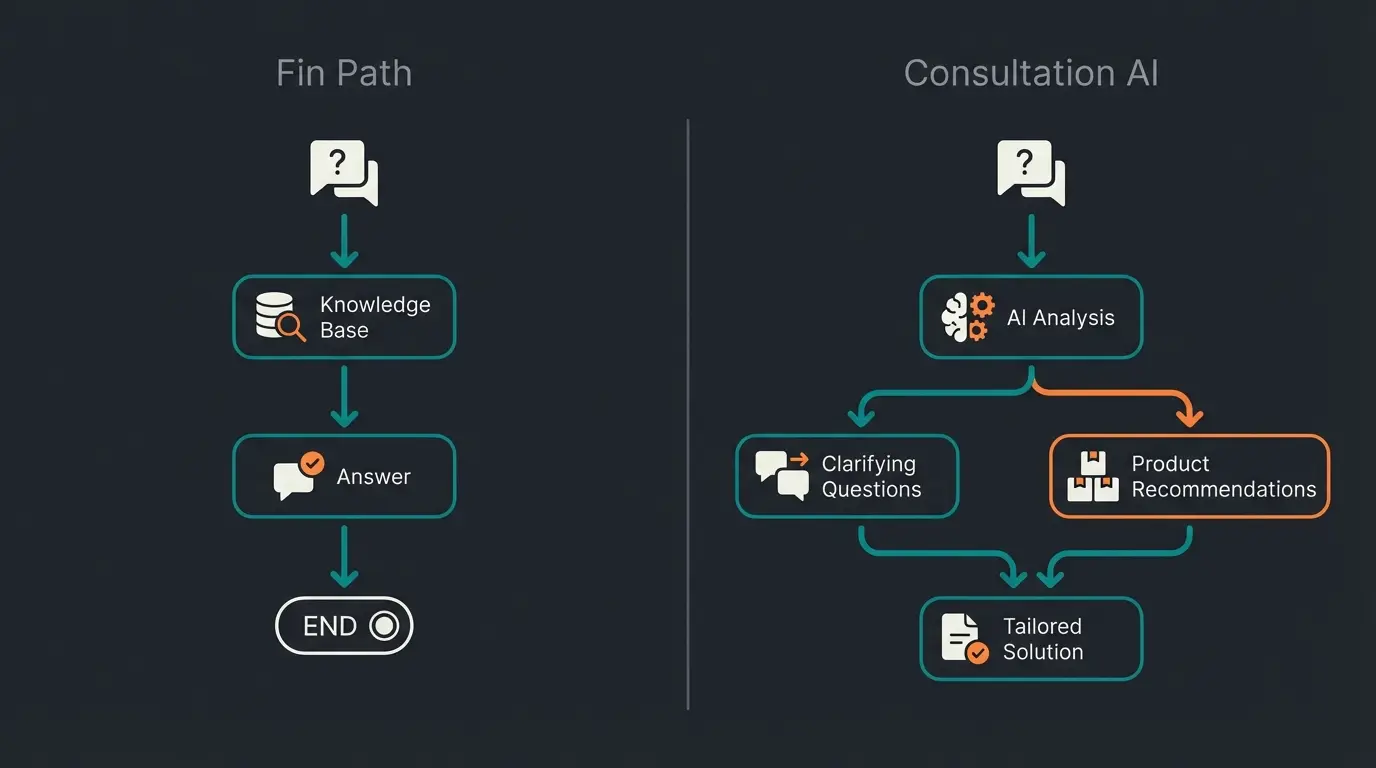
User shows interest or asks about product suitability
AI analyzes underlying needs beyond the surface question
AI proactively asks diagnostic questions to understand preferences
User provides additional context about their specific situation
AI recommends specific products with reasoning tailored to user needs
Discover how consultation-focused AI drives conversions while handling support—experience the difference between deflecting customers and guiding them to purchase.
See Consultation AI in ActionThe True Costs: Analyzing the $0.99 Resolution Model
At first glance, the pricing model of Intercom Fin appears transparent: $0.99 per resolved conversation (Resolution), as confirmed by SaaSworthy. But for German mid-market and enterprise customers, hidden cost traps can lurk beneath this simple pricing structure.
1. What Counts as a 'Resolution'?
Intercom doesn't define a resolution only as 'customer says thank you.' Even when a customer simply leaves the chat after the AI's last response (Assumed Resolution), you get charged, according to eesel.ai analysis.
- The Problem: If the AI gives a mediocre answer and the customer gives up frustrated (without asking for a human), you pay $0.99 for an unsatisfied customer. You're paying for 'silence,' not necessarily for success.
- The Hidden Impact: These 'assumed resolutions' can represent a significant portion of your monthly bill while actually representing failed customer interactions that damage your brand.
2. The Scaling Trap
There are no volume discounts in the standard pricing structure, which can create significant budget challenges for growing companies:
- 1,000 Resolutions = $990
- 10,000 Resolutions = $9,900
- 100,000 Resolutions = $99,000
- Seasonality: During the holiday shopping season (Q4), costs for e-commerce shops can explode without budget planning having anticipated this. A SaaS-based flat-rate model or a value-based model (commission on sales) is more predictable for many retailers.
3. The Hidden Costs of Hallucinations
Current benchmarks show that AI models can still exhibit hallucination rates between 20% and 40% when not extremely strictly guided, according to research published by Voronoi. This creates downstream costs that far exceed the per-resolution fee.
Standard Intercom Fin pricing per 'resolved' conversation
AI models can provide incorrect information without strict guardrails
Even well-configured systems can give wrong answers that create follow-up costs
Frustrated customers citing AI misinformation create expensive service recovery situations
The Calculation: If Fin 'resolves' 1,000 inquiries, but 5% of them are factually wrong (e.g., wrong return address provided), follow-up costs in support arise that far exceed the $0.99. An angry German customer who cites a false AI statement ('But your chatbot promised me that...') is an expensive problem for the goodwill budget. Tracking these outcomes through proper sales performance analytics becomes essential.
Setup & Integration: Reality vs. Marketing Promises
Intercom advertises 'Setup in minutes.' This is technically correct (press button, activate), but operationally misleading for any company expecting meaningful results from day one.
The 'Garbage In, Garbage Out' Principle
Fin is only as smart as your Help Center content, which creates a significant upfront investment that many companies fail to anticipate.
- The Reality: Most companies have outdated, contradictory, or incomplete FAQs that were never designed for AI consumption.
- The Effort: To use Fin effectively, you must audit your entire knowledge database. Intercom recommends optimizing content specifically for AI ('AI-ready content'), as detailed in their documentation. This means weeks of editorial work before the first bot goes live.
- The Difference to Consultation AI: A Product Consultation AI often feeds directly from the product feed (PIM) or structured data. This data is typically much better maintained in e-commerce companies than the text deserts of FAQ pages. Proper AI Chatbot Training methodologies can significantly improve outcomes.
Technical Hurdles in Integration
While Fin runs seamlessly within Intercom, connecting to external data sources (e.g., Shopify order status in real-time) is possible through 'Fin Tasks' but often requires technical configuration of APIs and webhooks, according to Intercom's integration documentation. Without developer resources, Fin often remains 'blind' to actual customer status (e.g., 'Is this customer a VIP?').
This technical complexity is one reason why many companies exploring AI-Produktberatung solutions find that purpose-built consultation platforms offer faster time-to-value with less engineering overhead.
Native German vs. Translated Solutions
One of the most overlooked aspects of evaluating Intercom Fin for the DACH market is the difference between truly localized solutions and translated American products. The distinction affects everything from customer satisfaction to legal compliance.
Most 'German' results in search engines are clearly translated from English. They miss local nuances, such as the cultural preference for data privacy (DSGVO/GDPR) beyond just a compliance badge, or the tone of voice (Du vs. Sie) which is critical in German customer service contexts.
Consider the success story of AI Employee Kira, which demonstrates how a natively German AI solution can deliver consistent brand voice while maintaining the consultative approach that German customers expect. This type of deep localization goes far beyond simple translation.
For companies also exploring AI applications beyond customer service, similar localization considerations apply to KI Personalwesen implementations where cultural nuances in communication style are equally critical.
Conclusion & Recommendation: When Fin? When Alternative?
Intercom Fin is an excellent tool for a specific task: freeing human support from repetitive burdens. It's the 'gatekeeper' for your support team. But it's not a salesperson and not a product expert. Understanding this distinction is crucial for making the right technology investment.
Who Should Use Intercom Fin?
- Companies already deeply rooted in the Intercom ecosystem with significant sunk costs
- Teams 'drowning' in tickets (high volume of 'How do I change my email?' inquiries)
- Firms where data privacy nuances (US access) aren't deal-breakers for their customer base
- Organizations primarily focused on cost reduction rather than revenue growth through customer interaction
Who Should Use a Specialized Product Consultation AI?
- E-Commerce Brands: Those wanting not just to reduce support costs, but to increase conversion rates through intelligent product guidance
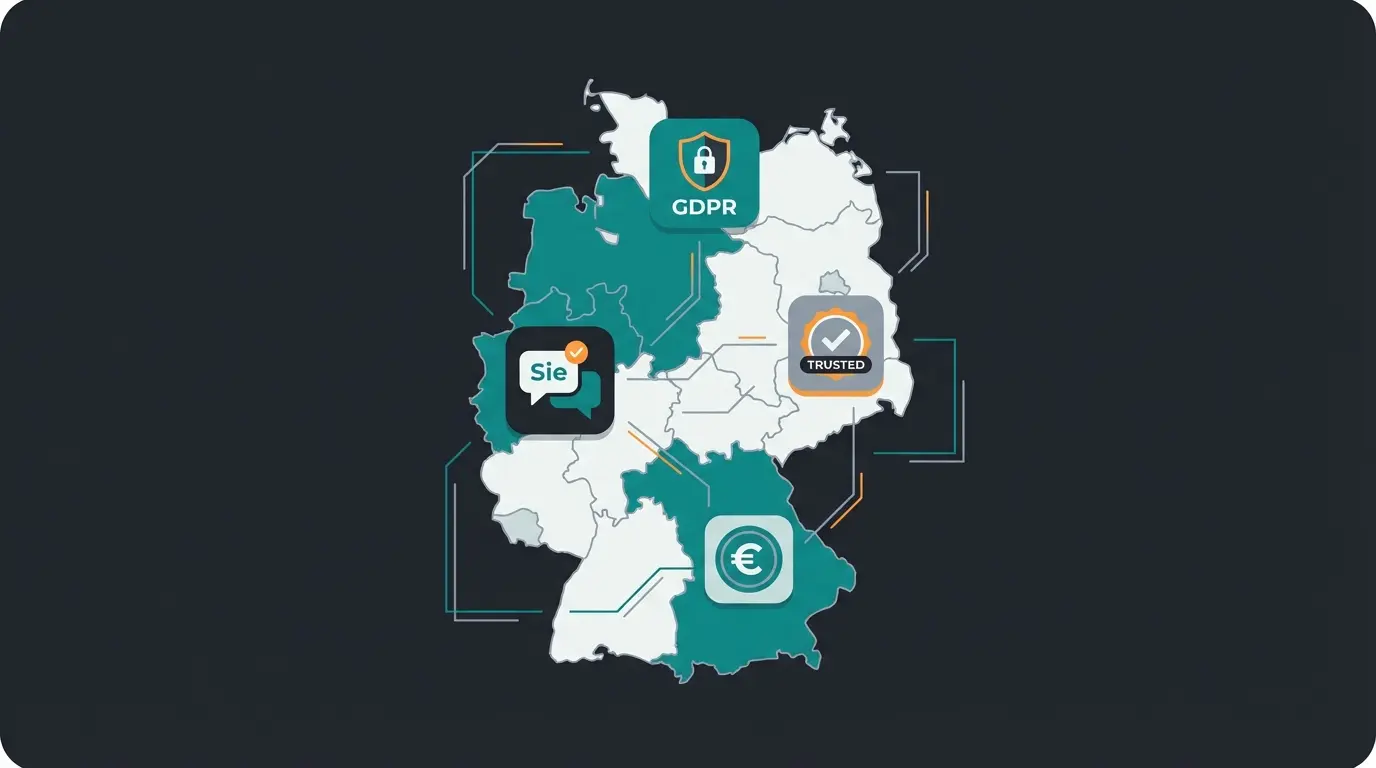
- German Mid-Market & Enterprise: Those needing 100% GDPR security (servers in Germany, no US access) and guaranteed formal 'Sie' address for brand consistency
- Advisory-Intensive Products: If your product needs explanation (e.g., cosmetics, electronics, B2B software), you need an AI that asks questions, not just answers them
- Revenue-Focused Teams: Organizations that see customer interaction as a revenue opportunity, not just a cost center
The Verdict: Don't rely on a support tool to conduct your sales conversations. Use Fin for support if you're already in the Intercom ecosystem, but invest in specialized AI solutions when it comes to the core of your business: consulting your customers and guiding them toward purchase decisions.
FAQ: Common Questions About Intercom Fin in the DACH Region
Intercom offers features for GDPR compliance (deletion deadlines, encryption) and EU hosting options. However, legally, the risk of data transfer to the US parent company remains, which many German data protection officers view critically due to CLOUD Act implications. For strictly regulated industries, purely European solutions may be necessary.
Yes, Fin supports German and 44 other languages according to fin.ai documentation. The quality is high, but consistency in formal address ('Sie') is not 100% guaranteed. Intercom explicitly states they cannot guarantee correct pronoun usage at all times, which can create brand consistency issues.
Beyond the basic Intercom subscription fee, you pay $0.99 per Resolution. Budget for 'Assumed Resolutions' (customers who don't respond) and note that there are no volume discounts in standard pricing. A company with 10,000 monthly resolutions pays approximately $9,900 in Fin fees alone.
Fin focuses on deflecting support tickets by finding answers in your knowledge base (reactive). Product Consultation AI proactively guides customers through purchase decisions by asking diagnostic questions and recommending products based on individual needs—driving revenue rather than just reducing costs.
While Intercom advertises 'setup in minutes,' achieving meaningful results requires 4-8 weeks of knowledge base optimization. Your FAQs must be audited, restructured for AI readability, and gaps filled before Fin can effectively answer customer questions accurately.
See how consultation-focused AI transforms customer interactions into revenue opportunities while maintaining perfect GDPR compliance and native German language support.
Start Your Free Consultation
Lasse is CEO and co-founder of Qualimero. After completing his MBA at WHU and scaling a company to seven-figure revenue, he founded Qualimero to build AI-powered digital employees for e-commerce. His focus: helping businesses measurably improve customer interaction through intelligent automation.