Which Email Do Your Customers Actually Open Most?
Have you ever wondered which email your customers open most frequently? It's not your newsletter with the 10% discount. It's not your welcome email either. It's the shipping confirmation.
According to Pushwoosh, transactional emails like shipping confirmations achieve open rates of 60% to 80%. Research from Influencer Marketing Hub confirms these exceptional engagement rates. For comparison: an average marketing email often languishes at around 20%. This means your customers are most attentive during the phase between "Buy" and "Receive."
But what do most Shopify merchants do with this attention? They redirect their customers to a lifeless page from DHL or FedEx—or use a generic tracking app that at best shows a map and at worst displays irrelevant "Buy more" offers.
This is a missed opportunity of gigantic proportions.
In this comprehensive guide, you'll learn why Shopify tracking (shipment tracking) is far more than just logistics. We'll show you how to use this touchpoint to reduce returns, eliminate support tickets, and build a real relationship through AI-powered consultation—even before the package arrives. Discover how AI customer service can transform your entire post-purchase experience.
Transactional emails like shipping confirmations
WISMO inquiries as percentage of all tickets
Average handling cost for support requests
Depending on industry, especially fashion
The Reality: Why WISMO Is Draining Your Budget
In e-commerce, there's an acronym that sends shivers down the spine of every support manager: WISMO (Where Is My Order).
The Hard Facts About Support Costs
Current research from WISMOLabs and Shiprocket shows that WISMO inquiries account for 30% to 50% of all incoming support tickets. If you receive 1,000 support requests per month, your employees deal up to 500 times with the simple question: "Will my package arrive tomorrow?"
This isn't just annoying—it's expensive. According to Kustomer, processing a single support ticket costs a company on average between €5 and €7 in personnel and tool costs. Implementing AI chatbots can dramatically reduce this burden while improving customer satisfaction.
The Paradox of Order Anxiety
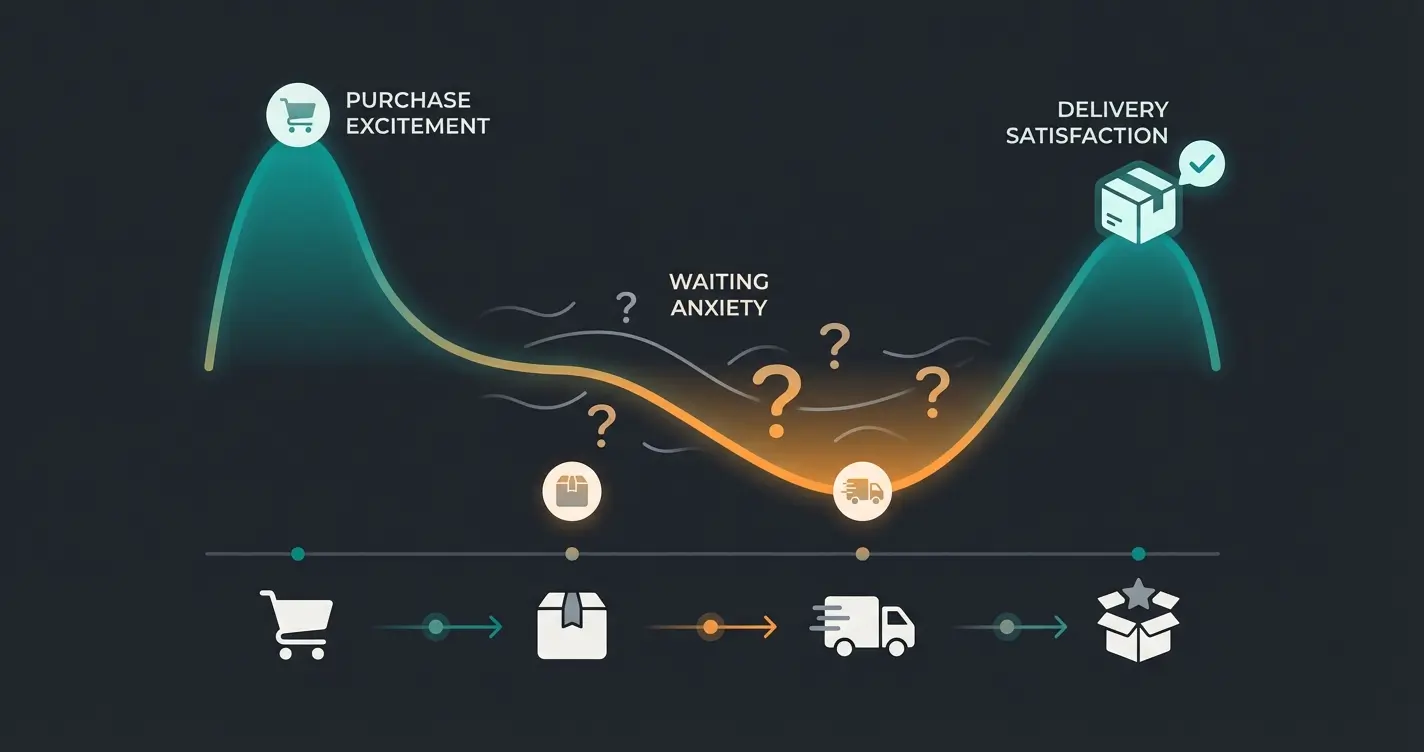
Why do customers ask so often? Because the time between purchase and delivery is a phase of uncertainty. The customer has paid money (pain) but hasn't yet received the reward (product).
- Phase 1 (Purchase): Dopamine high. Excitement peaks at the moment of buying.
- Phase 2 (Waiting): "Order Anxiety" sets in—buyer's remorse, uncertainty, impatience.
- Phase 3 (Delivery): Relief and joy (or disappointment if expectations aren't met).
Most Shopify tracking solutions treat Phase 2 purely informatively ("Package is at distribution center"). While this alleviates the symptoms (fewer tickets), it doesn't cure the cause (missing engagement and connection).
The Basics: Setting Up Standard Shopify Tracking
Before we dive into advanced strategies, we need to ensure your technical foundation is solid. Shopify offers robust native features to track Shopify orders.
Leveraging Native Shopify Features
Shopify allows you to add tracking numbers directly during fulfillment. Here's a quick walkthrough:
- Access the order: Go to Orders in your Shopify admin panel.
- Start fulfillment: Click on the order number of an unfulfilled order, then click Fulfill items.
- Enter tracking info: Input the tracking number from your shipping carrier (e.g., DHL, Hermes, UPS). Shopify usually recognizes the carrier automatically.
- Send notification: Ensure the checkbox for Send shipping details to customer now is selected.
Understanding the Shopify Shop App
Shopify heavily promotes the use of its own Shop App. This is a consumer app that consolidates orders from all Shopify stores.
- Advantage: Free, automatic push notifications, convenient for customers.
- Disadvantage: You lose the traffic. The customer checks the status in the Shop App, not on your website. You have no control over branding or upselling opportunities within the app.
For merchants serious about building customer relationships, exploring Shopify chatbot apps provides far more control and engagement opportunities than the basic Shop App.
The German Gap: Logistics Challenges in DACH Markets
Many guides on Shopify tracking are mere translations from American English. However, the German market operates differently. To succeed here, you must close the "German Gap." This section is particularly relevant for merchants targeting Germany, Austria, and Switzerland.
The Dominance of DHL and Packstations
In the US, UPS and FedEx dominate with home deliveries. In Germany, DHL is the market leader. A crucial difference: the Packstation (automated parcel locker).
A good tracking solution for Germany must recognize when a package has been redirected to a branch or Packstation.
- Problem: Many international apps only show "Delivered," even when the package is sitting at a pickup location.
- Consequence: The customer searches at home, finds nothing, and writes angry emails demanding to know where their package is.
Data Privacy and GDPR Requirements
This is the elephant in the room. When you use an external app for Shopify shipment tracking (e.g., ParcelPanel or AfterShip), you're transferring personal data (name, address, email) to a third-party provider.
According to Globeria Datenschutz and Decareto, there are critical considerations:
- Server Location: Many tracking apps host data in the US or China. After the fall of "Privacy Shield," this is legally complex.
- Data Processing Agreement (DPA): You must conclude a DPA with the app provider.
- Consent: Strictly speaking, tracking data may only be shared if necessary for contract fulfillment. Marketing measures on the tracking page (like "Customers also bought") often require explicit consent.
Legal Notice Requirements on Your Tracking Page
If you create a "Branded Tracking Page," it's legally part of your telemedia offering.
As noted by Latori and IT-Recht-Kanzlei, cookie banners must also function on tracking pages if you're firing marketing pixels there.
Beyond Logistics: The Psychology of Waiting
Here lies the key to differentiation. Most merchants view tracking as a "necessary evil." We see it as a marketing channel.
The Gap Between Shipped and Delivered
Imagine you buy an expensive espresso machine.
- Day 0: Purchase. Anticipation is huge.
- Day 1: Shipping confirmation arrives.
- Days 2-3: Waiting. Doubts creep in: "Was that too expensive?", "Do I even know how to make milk foam?", "Should I have taken the other machine?"
Most tracking pages now only show: Package is in distribution center.
The Problem with Traditional Upselling
Many tracking apps (like ReConvert or AfterShip) suggest at this point: "Why not buy some coffee beans too!"
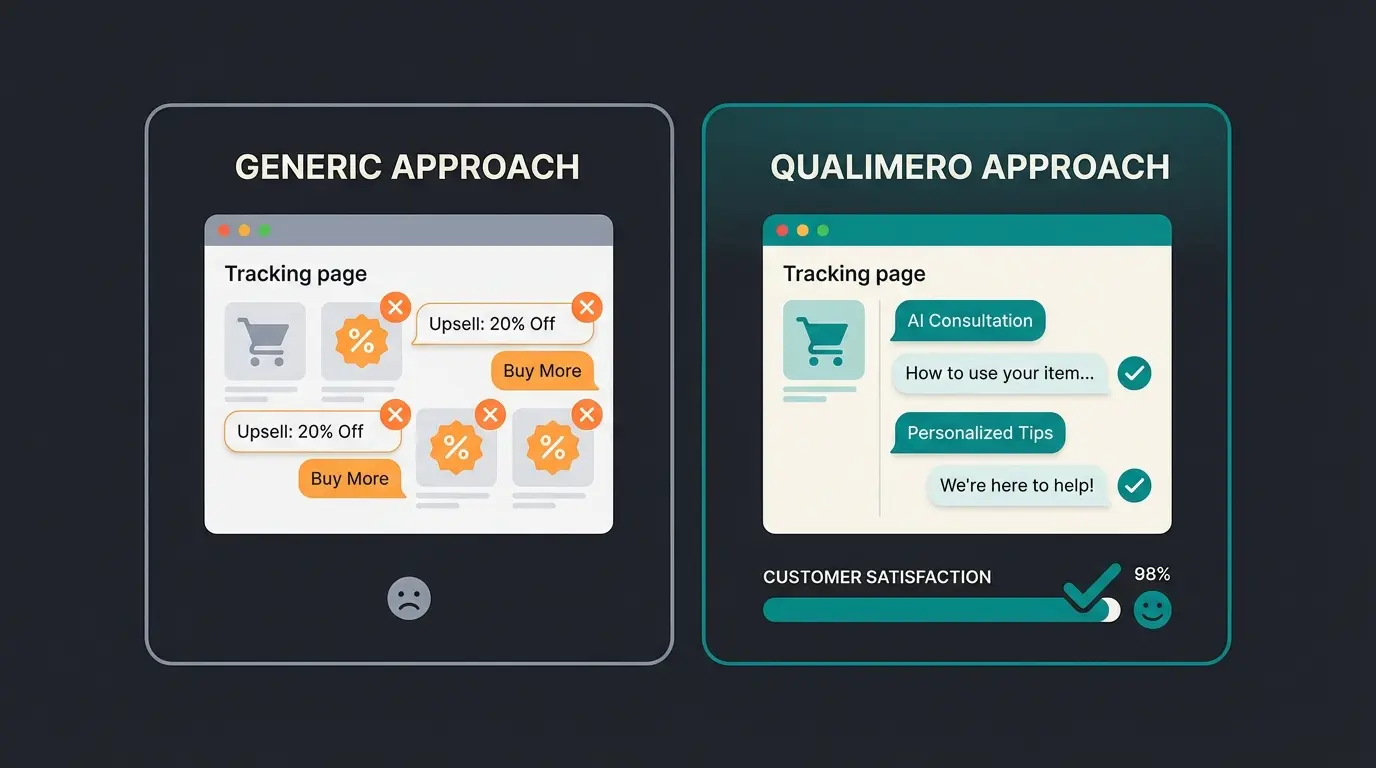
This is often counterproductive. The customer has just spent a lot of money and hasn't yet received the goods. Trying to sell even more now can come across as greedy and pushy. It doesn't address their underlying anxiety—it exploits it.
The Better Solution: Pre-Education
Instead of selling, you should advise. Use the tracking page to prepare the customer for success with the product. This is where AI product consultation becomes invaluable.
- Goal: When the package arrives, the customer should be ready to get started immediately.
- Effect: This reduces the "Time-to-Value" and drastically lowers the return rate.
The New Strategy: AI-Driven Post-Purchase Experience
Here we leave the field of traditional logistics and enter the future of e-commerce. If you're already using AI solutions for product consultation, this is the logical next step.
From Status Update to AI Consultation
Imagine a "Smart Tracking Page." Instead of a static map, the customer sees:
- The delivery status (of course).
- An AI chatbot that knows the context of the order and can provide personalized guidance.
Scenario: The Running Shoe Purchase
A customer has ordered a pair of high-end running shoes. They check the status.
- Traditional: "Delivery expected Tuesday."
- AI-Driven: "Hello Thomas! Your new running shoes arrive Tuesday. Ready for your first run? I can give you tips on how to break them in properly to avoid blisters. Should I create a quick plan for you?"
This approach aligns perfectly with how AI Selling is revolutionizing the entire customer journey, not just the pre-purchase phase.
Why This Strategy Works
- Anticipation instead of anxiety: The focus shifts from waiting to using. Customers become excited about what's coming rather than worried about when it arrives.
- Return prevention: According to E-commerce News Europe and Bitkom, return rates in Germany average around 11%, reaching up to 50% in fashion. Many returns happen because customers misuse products or have false expectations. When AI explains before arrival how the product works, the likelihood of return drops significantly.
- Data goldmine: The questions customers ask the AI during the waiting period (e.g., "Can I wear the shoes in the rain?") are pure gold for your marketing and product development teams.
Understanding different types of chatbots helps you choose the right consultative AI approach for your tracking page.
Customer receives order confirmation with anticipation-building content and initial product tips
Smart tracking page activates with AI consultation widget ready to engage
AI proactively offers product education, setup guides, and answers questions
Customer receives preparation checklist and knows exactly what to expect
Customer is ready to use product immediately, reducing confusion and returns
Stop wasting your highest-engagement moments on boring tracking pages. See how AI consultation can turn waiting customers into loyal fans.
Start Your Free TrialTop Tools for Shopify Order Tracking Compared
The market for Shopify tracking apps is vast. We categorize them by their primary benefit to help you make the right choice for your business.
Category A: Logistics Specialists (Focus: Maps & Status)
These apps are ideal if you ship hundreds of packages worldwide and want to technically solve the "WISMO" problem with comprehensive carrier coverage.
| App | Strengths | Weaknesses | Price |
|---|---|---|---|
| ParcelPanel | Very popular, automatically recognizes the correct carrier, "Hide Chinese Origin" feature (great for dropshipping) | Design often somewhat outdated, upselling features are basic | Freemium / from $9/month |
| AfterShip | The market leader. Supports 1000+ carriers, extremely reliable data. Strong API integration | Expensive at high volume. Data privacy (US servers) must be verified for GDPR compliance | Freemium / from $11/month |
| Track123 | Affordable alternative, good drag-and-drop design for the tracking page | Fewer integrations than AfterShip, smaller carrier network | Freemium / from $9/month |
Category B: Customer Experience Platforms (Focus: Branding)
Here the focus is on making the tracking page look exactly like your shop with full brand control.
- Wonderment: Strongly focuses on design and Klaviyo integration. If a package is delayed, Wonderment can automatically trigger a "Sorry" flow in Klaviyo, turning a negative experience into a relationship-building moment.
- Malomo: Very design-focused, allows complete control over the tracking page appearance with custom templates and branded experiences.
Category C: Innovation Leaders (Focus: AI & Retention)
Here, new solutions position themselves—including AI consultation approaches that go beyond traditional tracking.
- AI Consultation Integration: Adding an AI widget directly to the tracking page.
- Advantage: You don't compete with ParcelPanel for the map—you complement the tracking page with intelligence.
- USP: While AfterShip says "Your package is there," AI consultation says "Here's how to use your package successfully."
Learn how AI consulting in e-commerce is becoming a competitive necessity, not just a nice-to-have feature.
Logistics Apps vs Experience Platforms Comparison
| Feature | Standard Tracker (e.g., AfterShip) | AI Consultation Platform |
|---|---|---|
| Shows Package Location? | Yes | Yes (via integration) |
| Reduces Support Tickets? | Yes | Yes (more effectively) |
| Educates Customer on Product? | No | Yes |
| Reduces Returns Proactively? | No | Yes |
| Builds Customer Relationship? | Minimal | Significant |
| Captures Customer Intent Data? | Basic | Comprehensive |
Step-by-Step: Building the Perfect Tracking Page
Regardless of which tool you choose, a high-converting tracking page for your target market must contain the following elements. Use this as your implementation checklist.
1. Design Excellence (Trust is Key)
- Never use carrier pages directly: Never redirect directly to dhl.de or ups.com. You lose the traffic and the branding opportunity.
- Maintain corporate identity: Logo, fonts, and colors must exactly match your shop. A break in design creates distrust ("Am I on a phishing site?"). Consistency builds confidence.
2. Clear Information Architecture
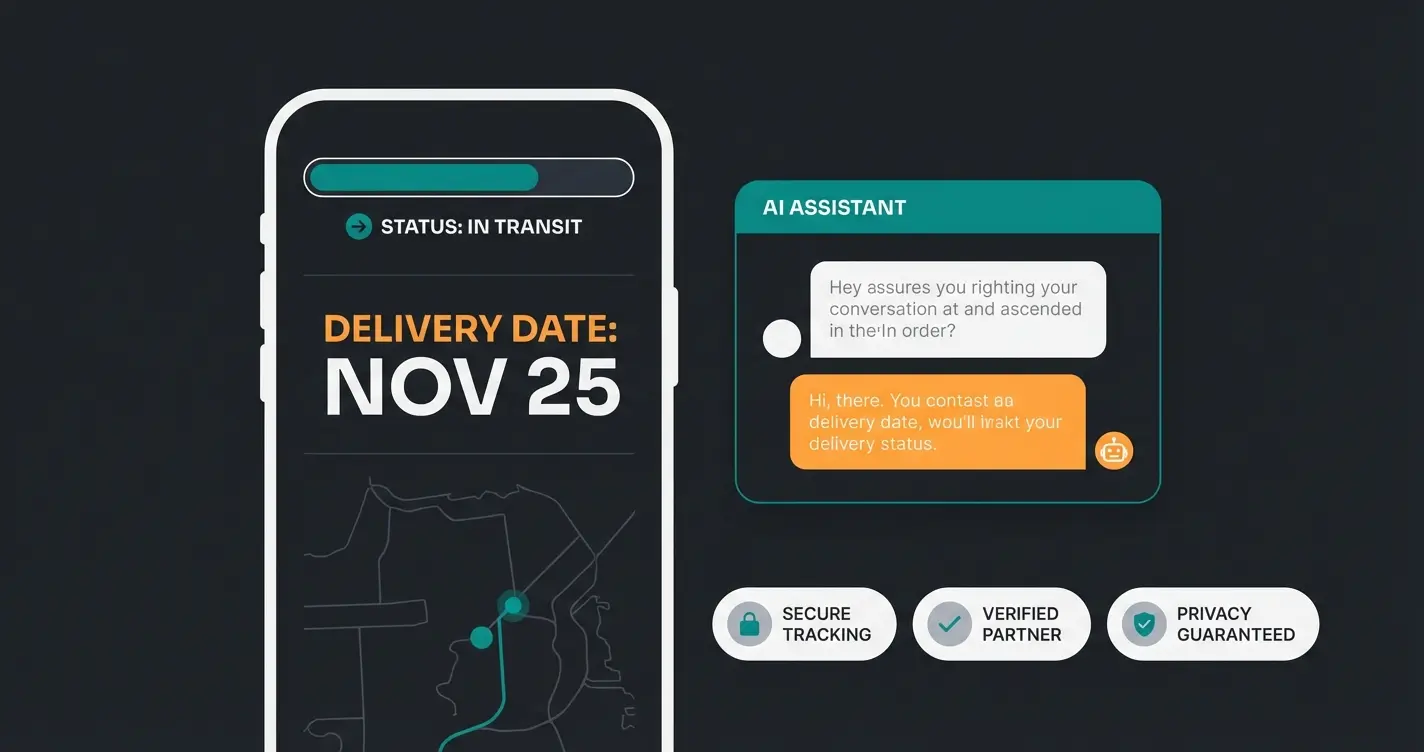
- Visual status bar: Show progress visually (Ordered → Shipped → In Transit → Delivered) so customers can understand at a glance.
- Estimated delivery date (ETA): More important than the current location is the question "When?" Use apps that employ AI to estimate the date (e.g., "Tuesday, May 14th").
- Carrier info with translation: Show who's delivering (DHL, UPS, FedEx), but hide cryptic messages like "Hub Scan 34a." Translate status messages into understandable language your customers can actually comprehend.
3. Legal Compliance (Critical for DACH Markets)
- Legal notice & Privacy policy: Link these in the footer of the tracking page without exception.
- Cookie banner: If you're firing marketing pixels (Meta, Google) on the tracking page, the cookie banner must also work here—not just on your main site.
4. The Engagement Element (Your Competitive Edge)
This is where you integrate AI consultation for maximum impact.
- Placement: Prominent position next to or below the status bar where customers will naturally see it.
- Contextual Call-to-Action: Instead of generic "Start chat," use context-aware triggers based on the product category.
Consider these product-specific approaches:
- For cosmetics: "Create your skincare routine now for Day 1 when your products arrive."
- For electronics: "Questions about setup? Get instant answers before your device arrives."
- For fashion: "Which accessories pair perfectly? Ask our AI Stylist."
Explore how conversational commerce principles apply perfectly to post-purchase engagement.
5. Proactive Communication Strategy
Don't wait for the customer to check the tracking page—reach out to them proactively.
- Delay alerts: If the package has been sitting at a distribution center for 2 days, send a proactive email: "We see there's a delay. We're on it. Here's a €5 voucher for the wait." This transforms frustration into loyalty.
- Pre-delivery preparation: 24 hours before expected delivery, send tips on what to expect and how to get started with the product.
This proactive approach aligns with best practices for AI prevention strategies that address customer concerns before they become problems.
The E-Commerce Emotion Curve: Visual Framework
Understanding the emotional journey your customers experience helps you optimize every touchpoint. The key insight: the shipping phase represents a massive opportunity most merchants completely ignore.
Dopamine high when clicking 'Buy Now'
Where standard tracking leaves customers alone
Excitement returns when package arrives
Keeps engagement elevated throughout waiting
The critical insight: Traditional tracking lets customer emotion plummet during the waiting phase. AI consultation maintains that excitement by transforming passive waiting into active preparation. This is where AI Chatbots for E-Commerce create their greatest impact.
Advanced Integration: WhatsApp and Beyond
For maximum engagement, consider extending your tracking communications beyond email. AI consultation via messaging channels like WhatsApp can dramatically increase engagement rates, especially in European markets where WhatsApp dominates.
Key benefits of multi-channel tracking communication:
- Higher open rates: WhatsApp messages see 98%+ open rates compared to email's 60-80%
- Instant engagement: Customers can respond immediately to AI consultation prompts
- Conversational context: Previous conversations inform future recommendations
- Reduced friction: No need to visit a tracking page—updates come to the customer
Measuring Success: KPIs That Matter
Implementing AI-driven tracking isn't just about feeling good—it's about measurable results. Research shows that AI consultation consistently outperforms traditional support approaches. Track these metrics:
- WISMO ticket reduction: Measure the decrease in "Where is my order?" support requests
- Return rate by engagement: Compare return rates between customers who engaged with AI consultation versus those who didn't
- Customer satisfaction scores: NPS and CSAT specifically for the delivery experience
- Repeat purchase rate: Track whether AI consultation during shipping correlates with higher repeat purchases
- Time to first use: Measure how quickly customers start using products after delivery
The Shopify automation guide provides additional context on measuring AI implementation success across your entire store.
Conclusion: From Status Update to Brand Experience
Shopify tracking has been treated as an afterthought for far too long. In an era where click costs (CAC) are rising and competition is fiercer than ever, you cannot afford to ignore the phase with the highest attention—the time between shipping and delivery.
Summary of the Winning Strategy
- Technology Foundation: Use a solid app (like ParcelPanel or AfterShip) for base data and GDPR compliance. Don't reinvent the wheel for basic tracking.
- Psychological Understanding: Comprehend your customers' anxieties during the waiting phase. They need reassurance and engagement, not silence.
- Innovation Layer: Deploy AI Consultation instead of crude upsells. Use the tracking page to educate, advise, and delight customers before their products even arrive.
The difference between a one-time buyer and a loyal repeat customer often doesn't lie in the product itself, but in how well cared for they feel throughout the entire journey. An intelligent tracking page is the first step in transforming a logistics process into a genuine customer relationship.
Whether you're just starting to optimize your tracking experience or ready to implement advanced AI consultation, the opportunity is clear. Every package you ship is a chance to build loyalty—don't waste it on a boring map.
FAQ: Common Questions About Shopify Tracking
For getting started, ParcelPanel offers a solid free plan with good carrier coverage. Shopify's native Shop App is also free but offers fewer branding options and takes customers away from your site. For serious merchants, the investment in a paid solution typically pays for itself through reduced support costs and improved customer experience.
You can enter tracking numbers manually during fulfillment, and Shopify usually recognizes DHL automatically. For automatic synchronization and label creation, apps like EasyDHL or Sendcloud are recommended—they integrate deeply with DHL's business customer portal and automate the entire process from label creation to tracking updates.
Shopify itself provides tools for compliance. However, with third-party apps, you must verify where data is stored and whether a Data Processing Agreement (DPA) is in place. Use consent management tools (cookie banners) that also function on the tracking page. Pay special attention to apps that store data outside the EU.
Yes, with programming knowledge (Liquid, HTML/CSS) you can customize Shopify's native "Order Status Page." However, the options are limited compared to specialized apps, especially regarding interactive elements like AI chats, branded designs, and proactive notification triggers.
AI consultation addresses the root causes of returns: misunderstanding how to use products and misaligned expectations. By educating customers before delivery—explaining features, providing setup tips, and answering questions—AI ensures customers are prepared for success. This proactive approach can reduce return rates by 15-30% depending on the product category.
Join thousands of Shopify merchants who've turned their tracking pages from cost centers into relationship builders. Start your AI consultation integration today.
Get Started Free
Lasse is CEO and co-founder of Qualimero. After completing his MBA at WHU and scaling a company to seven-figure revenue, he founded Qualimero to build AI-powered digital employees for e-commerce. His focus: helping businesses measurably improve customer interaction through intelligent automation.