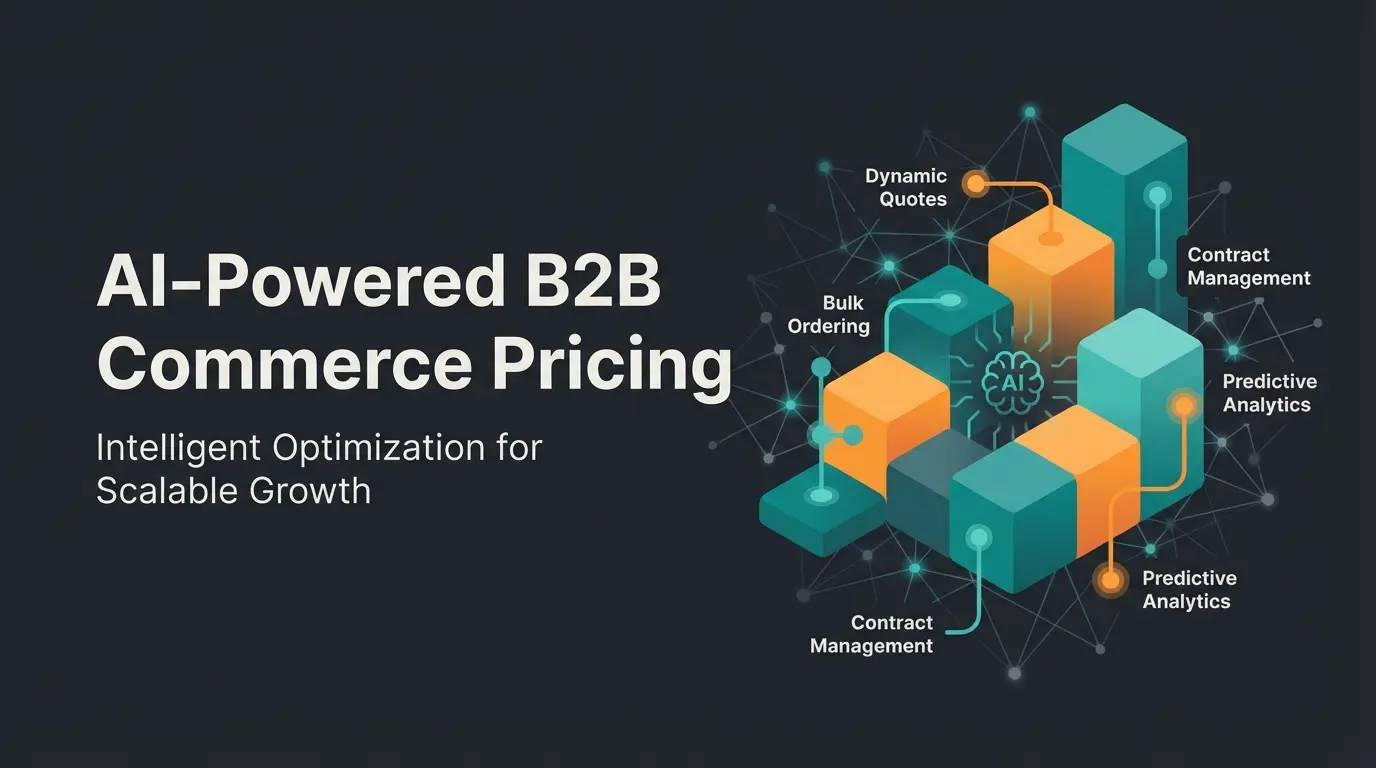
The Transformation of German B2B E-Commerce
German B2B commerce stands at a turning point. For years, the digitalization mantra in wholesale was simple: efficiency. The focus was on eliminating fax orders, importing Excel lists into shopping carts, and correctly displaying individual price lists. Anyone searching for 'Shopware wholesale' today finds dozens of agencies promising exactly that: the perfect technical representation of your ERP processes on the web.
But in 2025, that's no longer enough. According to IFH Köln, the B2B internet trade from manufacturers and wholesalers continues to grow in 2024/2025. However, the growth is shifting. It no longer comes solely from simply having an online shop available, but from the quality of the user experience (UX).
While the technical foundation – the 'order management' – has become a hygiene factor thanks to systems like Shopware 6, a massive gap remains in online wholesale: the missing consultation element. Understanding how AI e-commerce transforms traditional sales processes is now essential for competitive wholesalers.
In this comprehensive guide, we don't just analyze the current state of technology around Shopware B2B Components and ERP integrations. We go one crucial step further. We show you how to transform your Shopware shop from a passive order portal into an active, digital sales consultant.
Shopware for Wholesale: Beyond Simple B2B Order Lists
Shopware 6 has established itself as the market leader for the German mid-market in the B2B e-commerce space. Why? Because it masters the balancing act between 'enterprise functionality' and 'mid-market flexibility' better than monolithic systems. This makes it the ideal foundation for wholesalers looking to digitize their operations comprehensively.
However, many wholesalers fall into a trap: they replicate their analog processes 1:1 digitally. The customer knows the article number? Quick order. The customer knows their conditions? Individual price list. But what happens when the customer doesn't know exactly what they need?
In the warehouse, they call the field sales representative. In the online shop, they stare at an empty search bar. This is precisely where competition is decided in 2025. The Shopware AI features alone won't solve this problem – you need a comprehensive consultation strategy.
Wholesale shops that only handle existing demand
B2B buyers who need guidance for complex products
Hours your digital consultant can advise customers
The Basics: Shopware's Out-of-the-Box Capabilities
Before we discuss the advanced capabilities (AI consultation), we need to clarify the fundamentals (infrastructure). To be relevant for 'Shopware wholesale' searches and be technically well-positioned, you must understand Shopware's current architecture. There's often confusion between 'Suite' and 'Components' here.
The Paradigm Shift: B2B Suite vs. B2B Components
For a long time, the Shopware B2B Suite was the gold standard. It was an 'all-in-one' extension that taught Shopware 5 and early version 6 releases B2B functions. But those times are over. As Atwix and Shopware have confirmed, the classic B2B Suite is now a 'legacy' product.
What Are the B2B Components?
Instead of one massive, rigid plugin (Suite), Shopware now offers modular building blocks (Components) that are deeply integrated into the software core. According to into-commerce.de, this means for you:
- Modularity: You only activate what you need (e.g., only role management, but no budget approvals).
- API-First: The Components are 'headless-ready.' You can use B2B functions in an app or external portal, not just in the shop frontend.
- Availability: These functions are included in the commercial plans Shopware Evolve and Shopware Beyond according to scope01.com.
The key out-of-the-box functions of the Components include company structures for mapping complex customer hierarchies, rights and roles management, quote management for requesting individual offers, and quick orders via CSV uploads or article number list entry (Grid View). Understanding Shopware automation in 2025 helps maximize these features.
ERP Integration: The Backbone of Wholesale Operations
A Shopware wholesale project stands or falls with ERP connectivity. Shopware pursues a strict API-first approach here. This means: every function in the shop can be accessed via an interface (API). As noted by Shopware's official documentation, this enables seamless data synchronization.
Common scenarios in the German mid-market include SAP / SAP S/4 HANA, where middleware solutions (like Alumio or SynQup) are often used to prepare complex SAP data structures for Shopware. For Microsoft Dynamics 365 (Business Central / NAV), numerous standard connectors exist that synchronize inventory and prices in real-time, as Ziffity demonstrates.
Additionally, for Sage / Weclapp / JTL and other mid-market ERPs, ready-made interfaces exist that enable 'near-realtime' synchronization according to WebMeridian. A Shopware full service agency can help navigate these complex integrations.
The Critical Point: Customer-Specific Pricing
In B2B wholesale, almost every customer has their own price. Shopware solves this technically via the 'Rule Builder' engine or through direct live retrieval (Live-Price-Call) from the ERP. When a customer logs in, they see their price, not the recommended retail price. This is standard but essential for any serious wholesale operation.
The Core Problem: Missing Consultation in B2B E-Commerce
We now have a technically perfect shop: ERP data flows, B2B Components regulate rights, and customers can order via CSV. But why do shopping carts often stagnate regardless?
The problem lies in the nature of B2B product ranges. Wholesalers often sell products requiring explanation (complex products). Which valve fits this 20-year-old pressure pipe? Which insulation complies with the new DIN standard for fire protection? Is this spare part compatible with Series X from 2019?
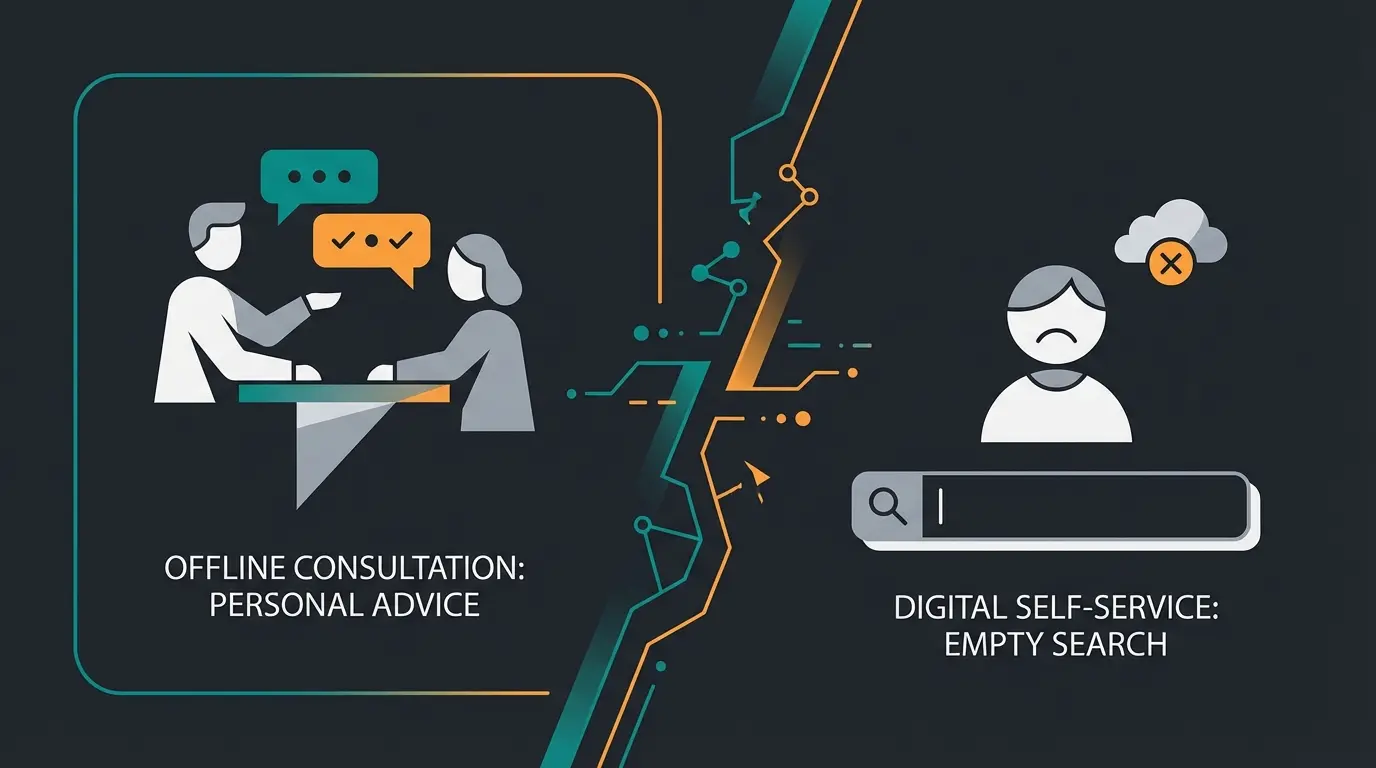
The 'Consultation Gap' in Digital Wholesale
In classic sales, field service or technical inside sales solve this problem. The customer calls: 'Hey Thomas, I have machine XY here, what do I need?' This personal interaction drives sales and builds relationships.
In the online shop, the customer is alone. They have: a search bar (requires exact terms), category filters (require technical knowledge about attributes), and PDF datasheets (require time and patience). The history of chatbots shows how digital assistance has evolved, but most wholesale shops haven't caught up.
The result: When the customer is uncertain, they abandon and call (high process costs) or order from a competitor where they find the part faster. The online shop only functions as 'order entry' for already-made purchase decisions; it doesn't help with decision-making. This is where Conversational Commerce becomes essential.
| Sales Channel | Consultation Capability | Scalability | Availability |
|---|---|---|---|
| Field Sales Rep | High (personal advice) | Low (1:1 only) | Business hours only |
| Phone Support | Medium (limited by knowledge) | Low (queue times) | Business hours only |
| Standard Webshop | None (search bar only) | High (unlimited users) | 24/7 |
| AI Sales Consultant | High (trained on all products) | High (unlimited parallel) | 24/7 |
The Solution: AI-Powered Product Consultation in Shopware
Here lies your chance for differentiation in 2025. While your competitors are still arguing about whether to use the 'B2B Suite' or 'Components,' market leaders are implementing AI-powered sales consultants. Implementing AI Product Consultation is becoming the new competitive standard.
This doesn't mean the classic 'support chatbot' that answers questions like 'Where is my package?'. We're talking about Guided Selling – active product advice that helps customers find exactly what they need.
How Does a 'Digital Technical Advisor' Work?
Imagine an AI trained on your product data, technical datasheets, and application information, integrated into Shopware via API. Unlike standard Shopware 6 chatbots that handle basic queries, this system understands technical requirements.
The Scenario: A tradesperson is looking for a pump. They don't know the article number, but they know the requirements.
- Customer: 'I need a submersible pump for dirty water, delivery head about 8 meters, but it must fit through a 30cm opening.'
- Standard Search: '0 results' (because '30cm opening' isn't an attribute).
- AI Advisor: Understands the context. Scans pump dimensions in the attributes. Checks the delivery head curves.
- AI Response: 'For this narrow opening, I recommend the SlimLine series. For 8m delivery head, the following 2 models qualify: [Product A] and [Product B]. Product A is immediately available.'
Technical Integration in Shopware
This solution can be realized today by connecting specialized AI models (based on LLMs like GPT-4o or Claude, but 'grounded' on your data). The technical process involves multiple layers working together seamlessly. You can explore this concept through the AI-powered consultation hub approach.
- Data Basis: Shopware delivers product descriptions, properties, and availability via API.
- Vectorization: Your technical PDFs and instructions are made searchable (RAG - Retrieval Augmented Generation).
- Frontend: A chat interface in the Shopware frontend (e.g., as overlay or on the category page) guides the customer.
- Cart Handover: The AI can add products directly to the Shopware cart or create a 'B2B Shopping List.'
The Business Case: Scalability. Your best technical salesperson can perhaps advise 20 customers per day. The AI can advise 2,000 customers simultaneously – 24/7, in 15 languages. This transforms how AI in sales operates at scale.
See how AI-powered product consultation can bridge the gap between efficient order processing and revenue growth in your Shopware B2B shop.
Get Your Free DemoComparison: Shopware Standard AI vs. Specialized Sales AI
It's important to be precise here. Shopware heavily promotes its own 'Shopware AI Copilot.' Many wholesalers think: 'Great, I already have that then.' This is a misconception.
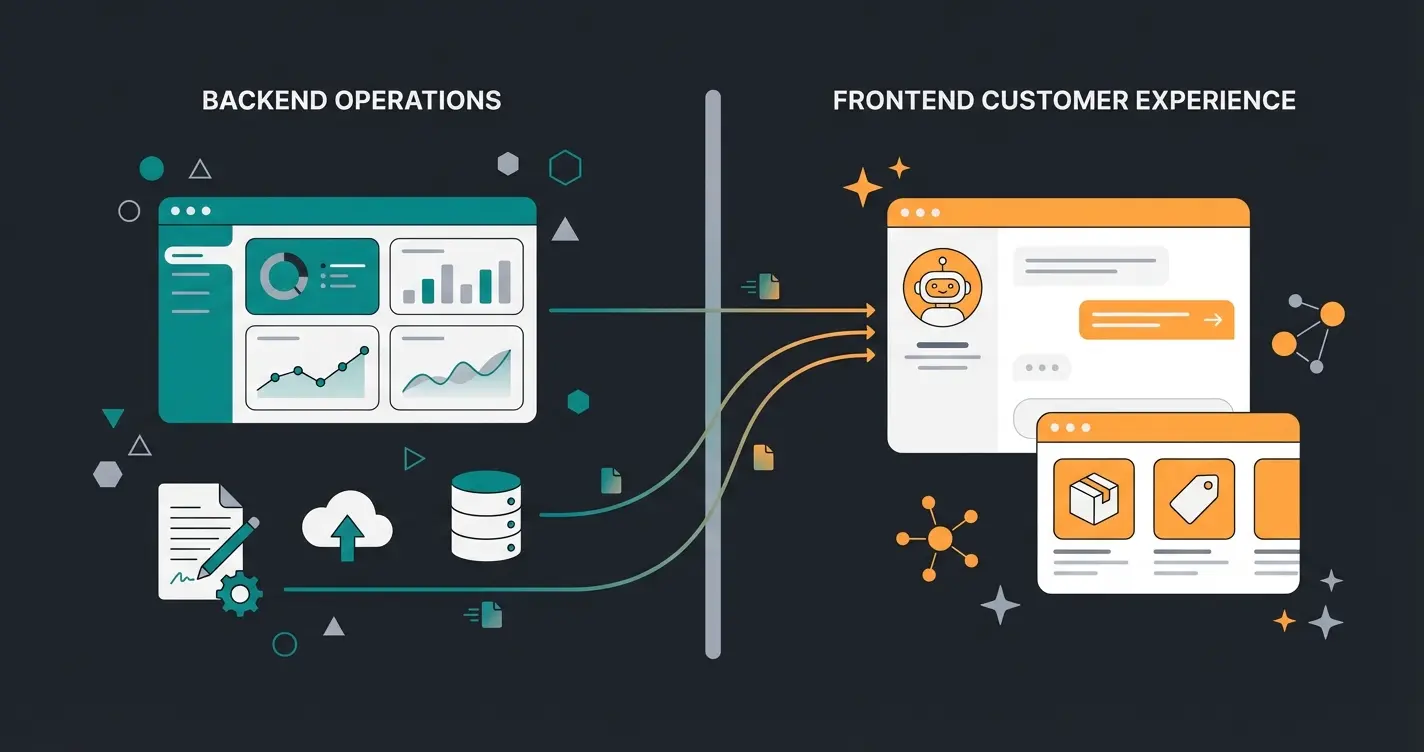
The Shopware AI Copilot is an excellent tool for backend efficiency, but it's (still) not a salesperson in the frontend. According to Shopware's official documentation and analysis from scope01.com, here's the detailed comparison:
| Feature | Shopware AI Copilot (Standard) | Specialized Sales AI (Your Competitive Edge) |
|---|---|---|
| Primary Goal | Efficiency for the merchant (save time) | Effectiveness for the customer (increase revenue) |
| Deployment Location | Mainly in backend (Admin) | In frontend (Storefront / Customer Account) |
| Key Functions | Creates product texts & experience worlds, generates image keywords (SEO), summarizes reviews, export assistant (SQL queries) | Conducts needs analysis, advises on technical compatibility, suggests cross-selling based on application, explains complex products |
| Interaction | Merchant ↔ AI | Customer ↔ AI |
| Data Basis | Uses existing fields for generation | Uses PDFs, CAD data, expert knowledge |
| Example Query | 'Write a description for article 123' | 'Which cable do I need for this system?' |
Conclusion: Use the Shopware AI Copilot to maintain your data (keywords, texts). But don't rely on it for selling. For that, you need a frontend strategy with an AI product finder approach.
Practical Example: The Future of Wholesale in Action
Let's translate theory into a user journey. We'll follow Marcus, a buyer at a mid-sized industrial company, through two different scenarios.
Status Quo: The Frustration
Marcus is standing in production. A gasket on an older filling system has burst. The system is down. He goes to your online shop. He enters 'gasket filling system.' 500 results. He filters by 'rubber.' 200 results. He's annoyed, picks up the phone. Hold music plays.
The Future with Shopware + Sales AI: The Solution
Marcus opens your shop on his tablet directly at the machine. What happens next demonstrates the power of modern AI Employee 'Kira' style consultation:
- Entry: He opens the 'Technical Assistant.'
- Input: He types (or speaks): 'I need a flat gasket, approx. 50mm outer diameter, must be acid-resistant for citric acid.'
- Analysis: The AI checks resistance lists in the background (stored as PDFs in the shop but not previously filterable).
- Follow-up Question: The AI asks: 'For citric acid, we recommend EPDM or FKM. What temperature is in the line?'
- Completion: Marcus answers: 'About 80 degrees.'
- Result: The AI shows exactly one article: 'Gasket EPDM, 50mm, up to 120°C, acid-resistant. Article number 88291. In stock.'
- Upsell: 'Tip: Customers who replace this gasket often also order mounting grease X.'
- Order: Marcus clicks 'Add to Cart.' Thanks to B2B Components, his cost center is already stored. He checks out.
Fax & phone orders, manual data entry, slow processing, error-prone, only during business hours
Current Shopware standard with B2B Components, efficiency & self-service focus, but no consultation - customer needs article numbers
Shopware + specialized AI providing guided selling, 24/7 technical consultation, increased revenue through intelligent upselling, fewer returns
Result: Time spent: 2 minutes. Support costs for you: €0. Customer satisfaction: Maximum. Return rate: Minimal (because technically verified). The system completely bridges the consultation gap.
Implementation Comparison: Platform Capabilities
To help you understand where the gaps lie and how to fill them, here's a comprehensive comparison of what different Shopware configurations offer:
| Capability | Shopware Community | Shopware Evolve (B2B Components) | Shopware + Specialized AI Solution |
|---|---|---|---|
| Order Management | Basic | Advanced with approvals | Advanced with AI assistance |
| Price Lists | Standard | Customer-specific | AI-optimized recommendations |
| Technical Consultation | None | None | Full AI-powered guidance |
| 24/7 Sales Support | Self-service only | Self-service only | AI consultant available |
| Guided Selling | None | None | Intelligent product matching |
| Complex Product Advice | Manual PDF lookup | Manual PDF lookup | Automated AI analysis |
| Cross-Selling Intelligence | Rule-based | Rule-based | Context-aware AI suggestions |
Success Checklist for Wholesale Operations
B2B e-commerce is evolving from transaction to interaction. Shopware 6 offers the perfect foundation with B2B Components and API-first architecture to map complex wholesale processes. But technology alone doesn't sell.
Anyone who wants to be a market leader in 2025 must close the 'consultation gap.' The combination of Shopware (as transaction engine) and specialized AI (as consultation engine) is the key to achieving this.
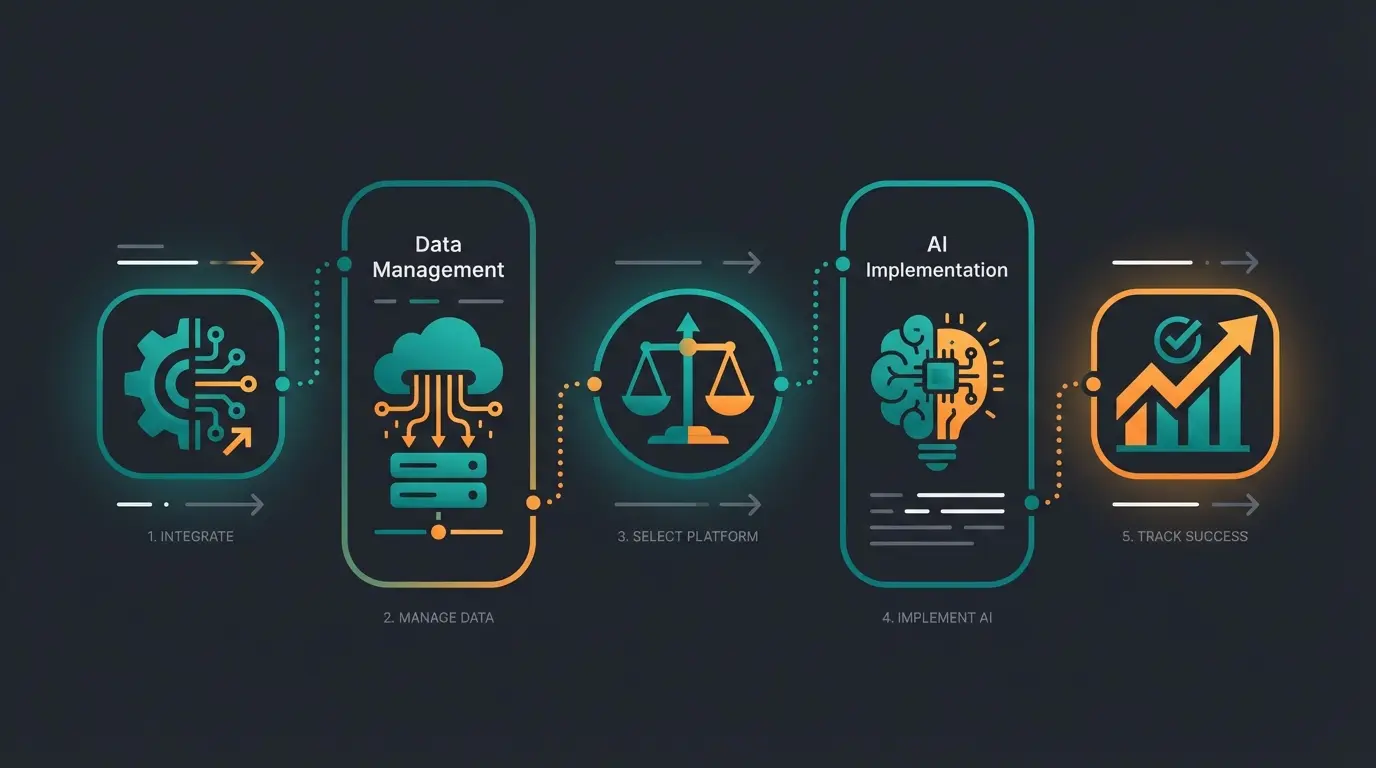
- Check Update Strategy: Are you still on the old B2B Suite? Plan migration to B2B Components now before support ends with Shopware 6.8.
- Complete ERP Homework: Ensure clean data. An AI can only advise as well as the data basis (attributes, datasheets) allows. Use connectors for real-time sync as recommended by Atwix.
- Verify Shopware Plan: For B2B Components, you need at least the Evolve or Beyond plan according to Splendid Internet. Check if your current plan is sufficient.
- Identify Consultation Potential: What questions does your phone support receive most frequently? Those are the first use cases for your Sales AI.
- Distinguish Backend vs. Frontend AI: Use Shopware Copilot for product texts, but invest in a frontend solution for your customers.
Frequently Asked Questions About Shopware Wholesale
No. Shopware has announced that support for the B2B Suite will end with version 6.8. New features are only being developed for the B2B Components. A migration is urgently recommended to ensure you can access the latest functionality and security updates.
Yes. Shopware can map complex price rules via the 'Rule Builder' or retrieve prices in real-time (Live-Price-Call) directly from your ERP (SAP, Microsoft, etc.) via API interfaces, so each customer sees their individual price when logged in.
No. A Sales AI automates 'Level 1 support' and standard consultation. This relieves your sales team of repetitive questions ('Does part A fit part B?') so your experts can focus on complex major projects and key accounts.
For professional wholesale operations, the plans Shopware Evolve or Shopware Beyond are recommended. The Community Edition or the 'Rise' plan don't include the essential B2B Components like rights/roles or quick orders.
Implementation timelines vary based on your product catalog complexity and data quality. Typically, initial setup takes 4-8 weeks including data integration, AI training on your product specifications, and frontend deployment. The key factor is having well-structured product data and technical documentation.
Transform your Shopware wholesale shop from passive order entry into an intelligent digital sales advisor. See how AI-powered consultation drives revenue growth 24/7.
Start Your Transformation
Lasse is CEO and co-founder of Qualimero. After completing his MBA at WHU and scaling a company to seven-figure revenue, he founded Qualimero to build AI-powered digital employees for e-commerce. His focus: helping businesses measurably improve customer interaction through intelligent automation.