Introduction: The Silent Sales Floor and Untapped Potential
Imagine walking into a physical specialty store. The shelves are perfectly organized, the lighting is optimal, and the prices are competitive. But there's not a single employee in sight. When you have a question—'Does this replacement part fit my model?' or 'Which running shoes are best for asphalt?'—you're met with silence. What do you do? Most likely, you leave the store and head to a competitor where you can actually get advice.
This exact scenario plays out millions of times daily in online retail. We've technically perfected our shops, optimized logistics for high-speed delivery, and polished the design. Yet e-commerce customer service is often treated as an afterthought—a necessary evil, a cost center to be minimized at all costs.
The reality in 2025/2026 looks quite different: Service is the new sales channel.
In an era where products become interchangeable and price wars rage on, online shop customer service represents the last major differentiator. But the definition of 'service' has radically transformed. It's no longer just about processing tickets and sending return labels. It's about closing the 'consultation gap' that has plagued e-commerce for two decades. As highlighted in research on how conversational AI evolves, the shift toward intelligent, context-aware customer interactions is reshaping the entire industry.
This article shows you how to transform your customer service from a reactive cost factor into a proactive revenue driver. We'll analyze why traditional chatbots have become obsolete, how AI-powered sales consultants boost conversion rates, and why reducing return rates begins in the chat window.
What is Modern E-Commerce Customer Service? A Redefinition
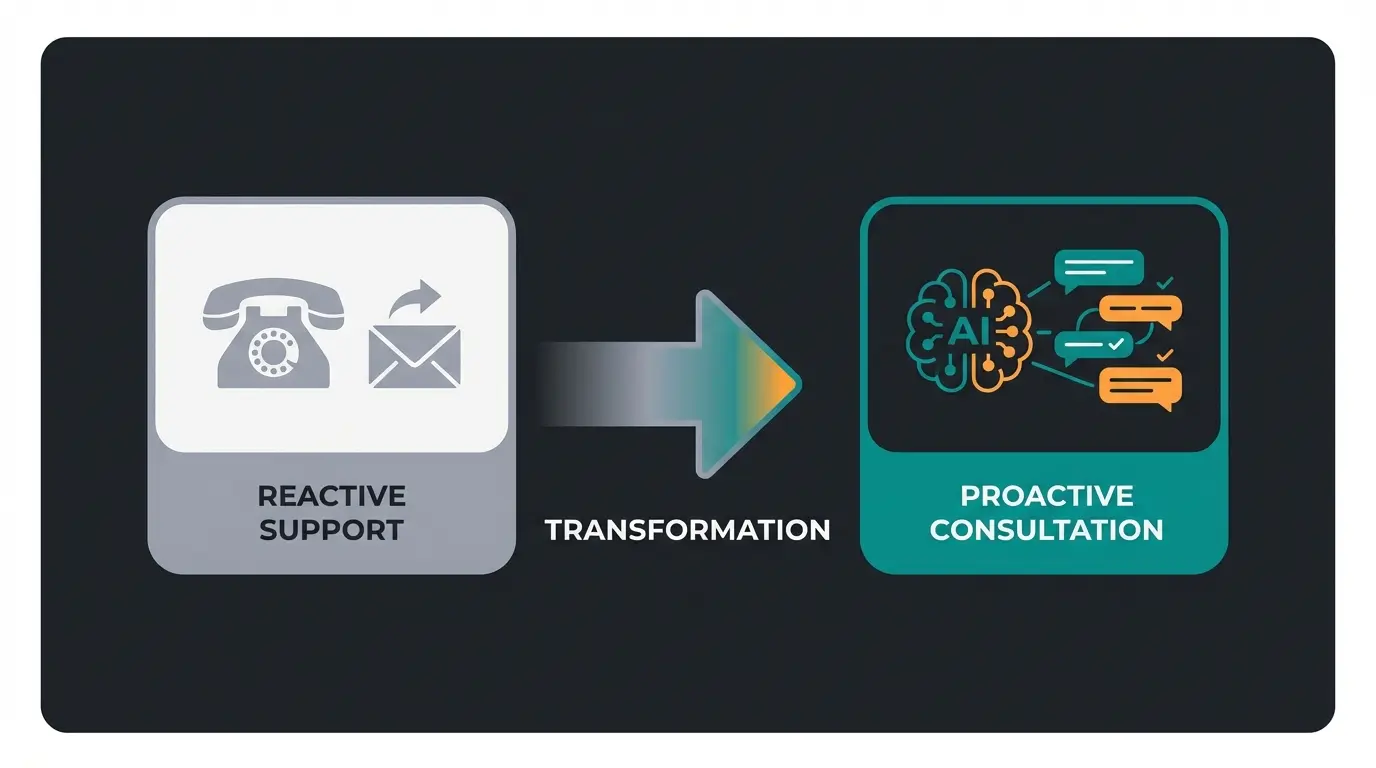
When we talk about online store customer service, most retailers still picture a call center fielding complaints. This view is outdated and dangerous for business results. To compete in 2026, we must redefine the concept entirely.
Traditional Approach vs. Modern Approach
| Feature | Traditional Support (Old School) | Modern E-Commerce Service (2026) |
|---|---|---|
| Focus | Reactive (responding to problems) | Proactive (anticipating needs) |
| Timing | Post-purchase (after the sale) | Pre-purchase & purchase (during decision-making) |
| Goal | Close tickets (cost reduction) | Complete sales & upsell (revenue growth) |
| Technology | Email, phone, rigid FAQ bots | AI agents, live consulting, WhatsApp |
| Metrics | Processing time, ticket volume | Conversion rate, cart value, CLV |
From Support to Customer Success
Modern customer service in online retail no longer means just playing firefighter when things go wrong. It's about shopping assistance. Today's customers are often overwhelmed by the sheer selection available (decision paralysis). A modern service functions as a guide through the product catalog.
According to current analyses from Zendesk, customers increasingly expect AI interactions that feel 'human.' The trend is moving away from pure efficiency toward empathy and personalization. A customer who asks, 'Which cream helps with dry skin in winter?' doesn't want a link to the terms and conditions—they want a product recommendation, just like in a physical store.
Understanding the different types of chatbots available helps businesses choose the right technology for their specific customer service needs, whether that's simple FAQ handling or complex product consultation.
The 3 Pillars of E-Commerce Customer Support
To make customer service profitable, we must view it along the entire customer journey. Most companies invest 90% of their service budget in Pillar 3. However, the greatest revenue potential lies in Pillar 1.
Pillar 1: Pre-Purchase (The Consultation Gap)
This is where the game is decided. The customer is on your site, interested, but uncertain.
- The Problem: Filter functions often aren't enough. Customers have specific application questions that filters can't answer.
- The Opportunity: This is where the AI sales consultant shines. Through proactive engagement ('Can I help you find the right size?'), uncertainties are eliminated before they become obstacles.
- Business Impact: This is the strongest lever for conversion rate. Data from Salesforce shows that AI recommendations and service interactions significantly influence revenue shares.
Learning how AI product consultation transforms e-commerce reveals why leading retailers are prioritizing this pre-purchase consultation capability.
Pillar 2: Purchase (Checkout Support)
The customer has products in their cart but hesitates at checkout.
- Common Hurdles: Unclear delivery times, questions about payment methods, technical errors.
- The Solution: Real-time support at checkout. An 'exit-intent' chatbot can provide the decisive push.
- Business Impact: Reduction of cart abandonment rate, which according to Cleverence still averages nearly 70%.
Pillar 3: Post-Purchase (Customer Retention)
The classic area: 'Where is my package?' and 'I want to return this.'
- The Strategy: Here, automation is king. Status updates and return labels should be handled completely automatically via self-service portals or AI bots, freeing human resources for Pillar 1.
- Business Impact: Customer loyalty (retention) and efficiency gains.
Implementing AI customer service automation for post-purchase inquiries allows your team to focus on high-value pre-sales consultation that directly drives revenue.
Customer browses products, needs guidance through options
Proactive AI assistant helps find the perfect product match
Real-time checkout support reduces abandonment
Automated order tracking and returns handling
Personalized follow-up builds lasting relationships
Why FAQ Bots No Longer Cut It: The Technology Gap
In recent years, many online shops have introduced 'chatbots.' Usually, these were rule-based systems (decision trees) that clicked users through a frustrating menu ('Press 1 for shipping').
The End of 'Dumb Bots'
These systems often fail because they don't understand context. A customer who writes, 'My package was supposed to arrive yesterday, I urgently need it for a wedding,' doesn't feel served by a standard response ('Delivery time is 2-3 days').
The Rise of AI Product Consultants (Agentic AI)
We're in the midst of a transition to Agentic AI—AI systems that act autonomously and understand complex relationships. The Zendesk CX Trends Report 2025 clearly shows: 70% of CX leaders plan to integrate generative AI into their touchpoints, and consumers increasingly trust 'friendly and human' AI agents.
The evolution of AI chatbots in customer service represents a fundamental shift from simple query deflection to intelligent sales assistance that understands customer intent and context.
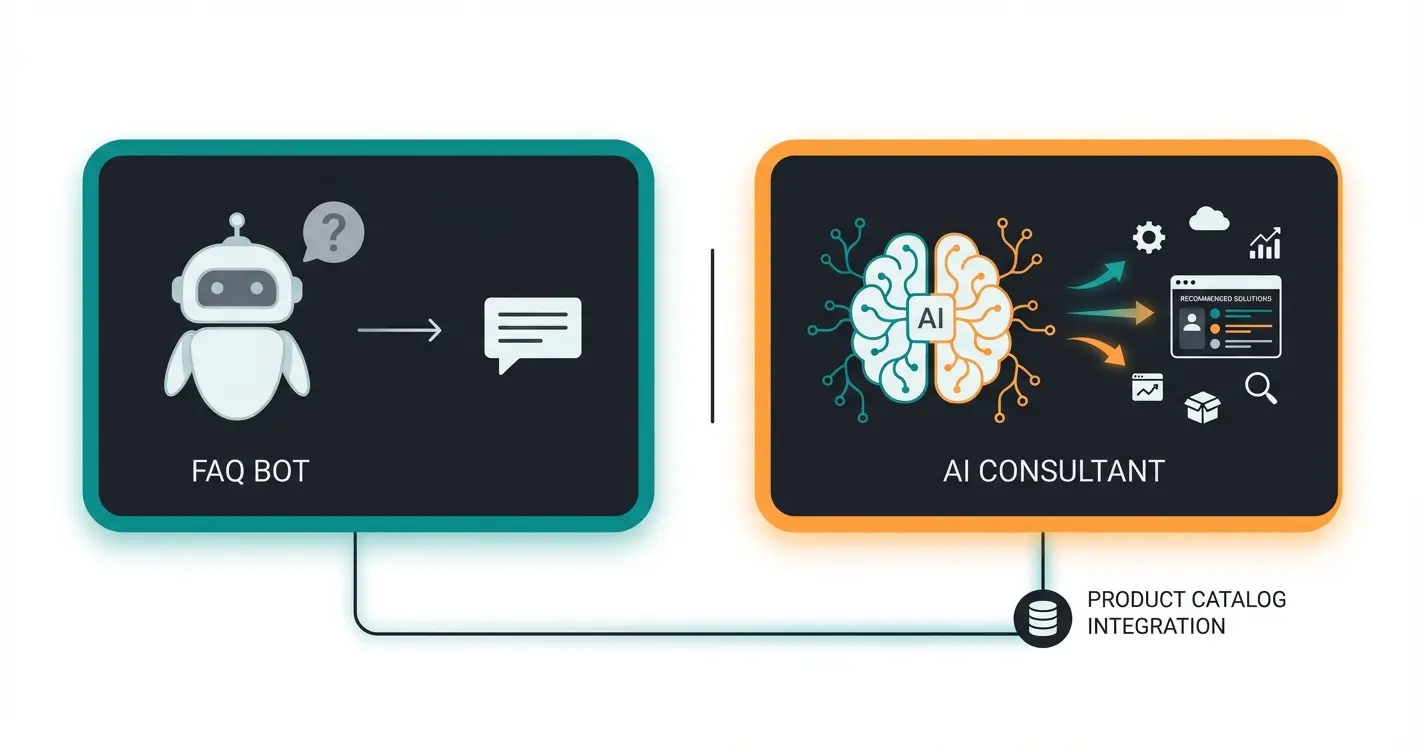
Comparison: Support Bot vs. AI Sales Consultant
| Feature | Classic Support Bot | AI Sales Consultant (GenAI) |
|---|---|---|
| Technology | Keywords & scripts | Large Language Models (LLM) & RAG |
| Understanding | Recognizes only exact phrases | Understands context, nuances & typos |
| Capability | Delivers links to FAQs | Conducts consultation conversations & recommends products |
| Objective | Ticket avoidance (deflection) | Sales completion (conversion) |
| Example | 'Our return period is 30 days.' | 'Since you're between size M and L: This model runs a bit small, I recommend L. Should I add it to your cart?' |
Understanding AI in customer service helps businesses distinguish between basic automation and true intelligent consultation capabilities.
Channels & Strategy: Where Does Consultation Happen?
Excellent e-commerce customer service must happen where the customer is. In 2026, that primarily means one thing: Mobile First.
The Dominance of Mobile Commerce
Statistics from eDesk and Shopify project that by 2025/2026, mobile e-commerce (M-Commerce) will account for nearly 60% to 70% of all online sales worldwide.
- Implication: Anyone shopping on their smartphone doesn't want to write an email and wait 24 hours for a response. The channel must be 'instant.' Live chat and messenger are essential for this.
The Channel Mix for 2026
- On-Site Live Chat & AI Assistants: The most important channel. It's directly at the 'point of sale.' Here, the AI agent intercepts the visitor before they bounce.
- WhatsApp & Social Messaging: For Gen Z and Millennials, shopping and social media are blurring. 'Conversational commerce' via WhatsApp or Instagram DMs is becoming standard for inquiries and order updates, as highlighted by Melibo.
- Email (The 'Slow Channel'): Remains relevant for formal matters, invoices, or very complex complaints, but loses importance for quick purchase advice.
For Shopware users specifically, implementing Shopware support automation creates seamless integration between your e-commerce platform and customer service channels.
Projected share of all online sales from mobile devices by 2026
Maximum wait time mobile shoppers tolerate for customer service
Chat interactions vs. email for mobile shoppers
KPIs: How to Measure Success (Beyond CSAT)
If you want to view your customer support in online retail as a profit center, you need to stop measuring it like a cost center. Classic 'first response time' is important, but it says nothing about whether you actually made money.
Here are the metrics you need to track in 2026:
1. Conversion Rate After Service Contact (CR)
What percentage of users buy something after chatting with the AI agent or a team member?
- Benchmark: According to Enhencer and Captains and Cowboys, the average e-commerce conversion rate worldwide is approximately 2.5% to 3.7%.
- Goal: Through good consultation in chat, this rate can often be increased to 10-20% among interacting users.
2. Average Order Value (AOV) – Cart Value
Can the service increase cart value through intelligent cross-selling ('This belt goes perfectly with that')?
- Top performers use AI to suggest matching additional products in conversation, directly increasing revenue.
3. Return Rate Reduction
This is one of the most underestimated levers.
- Fact: According to a study from EHI and Gabot, 42% of retailers see 'contact options for personal consultation' as one of the most important measures for reducing return rates.
- Logic: If a customer asks before buying, 'How does this pant fit?' and the AI correctly answers 'Take one size larger,' a return is actively prevented. This saves logistics costs and protects margins.
4. Deflection Rate vs. Resolution Rate
- Deflection: How many inquiries could the AI handle completely without human intervention?
- Resolution: Was the customer's problem actually solved? (Important to not just close tickets, but actually satisfy customers).
Implementing AI for personalized customer service ensures your KPIs reflect both efficiency gains and customer satisfaction improvements.
See how AI-powered product consultation can boost your conversion rates by up to 20% while reducing returns. Get started with intelligent customer service today.
Start Free TrialBest Practices for 2026: Implementing the Strategy
How do you put this into practice? Here are actionable tips for your e-commerce customer support strategy.
Tip 1: Be Proactive, Not Reactive
Don't wait until the customer searches for the chat button.
- Trigger Example: If a customer dwells on a product page for more than 60 seconds or switches back and forth between two variants, the AI agent should engage: 'I see you're looking at the running shoes. Are you unsure about the cushioning?'
Tip 2: The Hybrid Model (Human + Machine)
Use AI for scaling (80% of inquiries), but keep humans for empathy (20% of inquiries).
- Level 1: AI handles product consultation, FAQs, order status (available 24/7).
- Level 2: For complex issues (e.g., angry customer, individual B2B offers), the AI seamlessly escalates to a human expert.
- Data: According to BrainSell, 64% of consumers trust AI agents as long as they appear friendly and competent, but the human touch remains vital for complex problems.
The success story of AI Employee 'Kira' demonstrates how this hybrid approach works in practice, with AI handling routine inquiries while humans focus on complex consultations.
Tip 3: Use Product Data for Consultation
Your AI agent is only as smart as the data it has. Connect the bot to your PIM (Product Information Management). It needs to know that 'Sneaker XY' runs small or isn't waterproof. Only then does true consultation competence emerge.
For shops running on Shopware, the guide on Shopware 6 chatbots explains exactly how to integrate AI consultation with your product catalog.
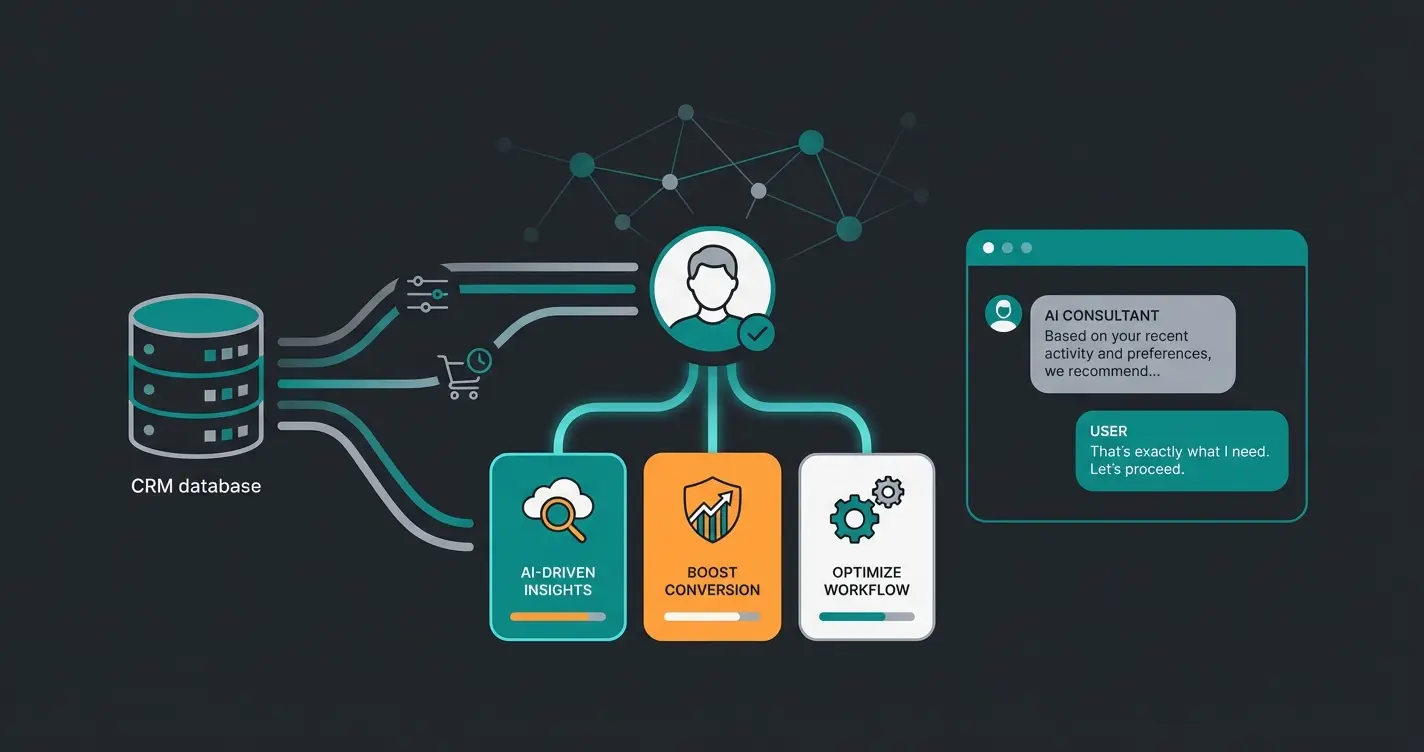
Tip 4: Personalization Through CRM Integration
When a returning customer enters the shop, the service should know them.
- 'Hello Thomas, great to see you again. Looking for accessories for the coffee machine you bought last year?'
- This hyper-personalization is, according to Norisk Group and Salesforce, one of the strongest drivers for customer loyalty.
Exploring AI consultation in e-commerce reveals how personalization creates competitive advantages that pure price competition can never match.
ROI Calculator: Why Consultation Pays Off
Many retailers shy away from investing in high-quality AI tools. But the math is simple.
Sample Calculation for a Medium-Sized Online Shop:
- Monthly Visitors: 100,000
- Conversion Rate (without consultation): 3.0% = 3,000 orders
- Average Cart Value: $80
- Revenue: $240,000
- Return Rate: 20% (600 returns at $15 cost each = $9,000 in costs)
Scenario with AI Sales Consultation:
- The AI interacts with 10% of visitors (10,000 chats).
- For these visitors, the conversion rate rises to 6% (conservative estimate).
- Additional Orders: +300
- Additional Revenue: $24,000/month
- Return Effect: Better consultation reduces the return rate among advised customers to 15%.
- Savings: Fewer return costs.
An AI product consultant serves as your tireless digital sales associate, engaging customers at scale while maintaining the personalized touch that drives conversions.
Conclusion: Service is the New Marketing
The e-commerce customer service of the future doesn't happen in the back office—it happens directly on the sales floor. It's loud, present, and helpful.
The days when online shops were pure self-service stores are coming to an end. In 2026, customers expect the convenience of the internet combined with the consultation expertise of specialty retail. Those who close this gap with intelligent AI solutions and empathetic service strategies will not only save costs but sustainably strengthen their brand.
Action Recommendations:
- Analyze your current service inquiries: How many are pure 'pre-sales' questions?
- Test an AI agent trained on your product data.
- From day 1, measure not just ticket time, but the revenue generated through chat.
Transform your shop from a silent catalog into a vibrant sales floor.
Frequently Asked Questions (FAQ)
Classic customer service (support) is usually reactive and handles problems after the purchase, such as returns or delivery delays. Customer consultation, on the other hand, takes place before the purchase. It's proactive and helps customers find the right product, similar to a salesperson in a physical store. Modern e-commerce strategies combine both to increase revenue and reduce returns.
AI improves customer service on two levels: 1) Efficiency: It automates recurring inquiries (WISMO - 'Where is my order') and relieves the team. 2) Revenue: Generative AI can act as a product consultant, understand customer needs, and suggest matching items, which increases conversion rates. Additionally, it's available 24/7 and eliminates wait times.
Beyond classic metrics like response time and Net Promoter Score (NPS), commercial KPIs are taking center stage. These include the conversion rate after chat interaction, Average Order Value (AOV), and the return rate. These numbers demonstrate the direct influence of service on company profits.
FAQ chatbots use keyword matching and decision trees to deflect common questions with pre-written answers. AI product consultants powered by Large Language Models understand context, nuance, and customer intent. They can conduct actual consultation conversations, make personalized product recommendations, and guide customers through complex purchasing decisions—functioning as digital sales associates rather than automated answering machines.
Most businesses see positive ROI within 3-6 months of implementing AI consultation. The return comes from multiple sources: increased conversion rates (typically 2-3x higher for customers who engage with AI), higher average order values through intelligent cross-selling, and reduced return rates through better pre-purchase guidance. Companies report 300-500% ROI within the first year when AI handles both consultation and routine support.
Join leading e-commerce brands using AI-powered customer consultation to boost conversions, reduce returns, and transform service into sales. Start your free trial today.
Get Started Now
Lasse is CEO and co-founder of Qualimero. After completing his MBA at WHU and scaling a company to seven-figure revenue, he founded Qualimero to build AI-powered digital employees for e-commerce. His focus: helping businesses measurably improve customer interaction through intelligent automation.