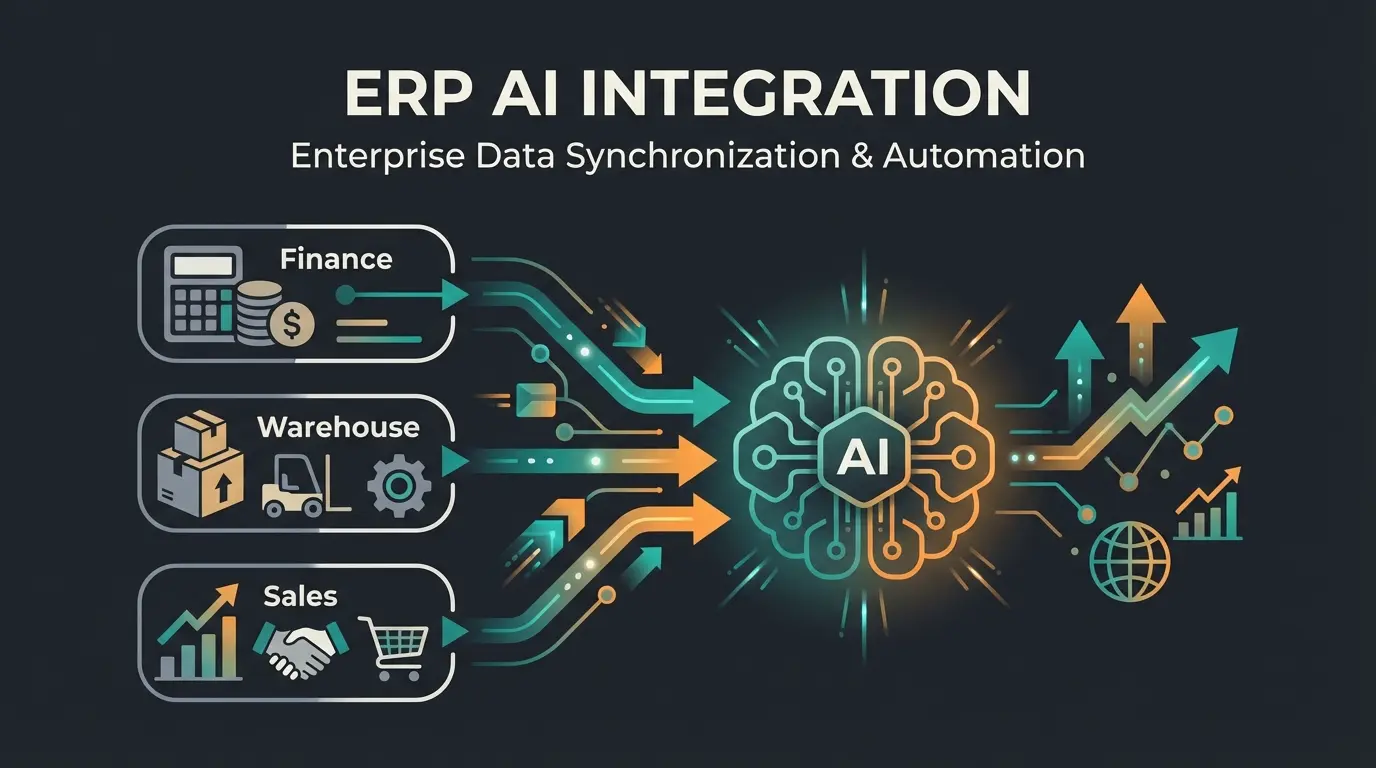
Introduction: Rethinking the Corporate Nervous System
Imagine if the human brain had access to every memory and fact from an entire lifetime but could only retrieve them through complex Excel spreadsheets. That's exactly how many employees feel when interacting with their ERP system today.
An Enterprise Resource Planning system is undeniably the "digital nervous system" of modern companies. It controls capital, personnel, equipment, materials, and IT systems. Yet while data volumes grow exponentially, the way we interact with these systems often remains stagnant. In an era where we privately converse with Alexa or ChatGPT, we still click through nested menu structures from the 2000s at work.
This article provides not only a comprehensive ERP system definition and overview of classic functions. We take a critical look at "user friction"—the efficiency loss from complex operation—and demonstrate how Artificial Intelligence (AI) transforms the ERP from a passive management tool into a proactive product consultant. Especially for German SMBs (Mittelstand) suffering from skilled labor shortages, this holds the key to competitiveness in 2025. As AI-powered customer service continues to advance, the same AI technologies are now revolutionizing how businesses interact with their core enterprise systems.
What is an ERP System? (Definition & Fundamentals)
ERP System Definition
An ERP system (Enterprise Resource Planning) is complex application software or a suite of integrated applications that a company uses to capture, store, manage, and interpret data from many different business activities.
At its core, it's about resource planning: How do I deploy my available resources (capital, personnel, machines, materials) as efficiently as possible to fulfill the company's purpose?
The Evolution: From MRP to AI-ERP
To understand today's state of technology, a brief look back is worthwhile. Development proceeded in clear phases:
- 1970s - MRP (Material Requirements Planning): Focus was purely on material requirements planning in production. 'Do I have enough screws for the order?'
- 1980s - MRP II (Manufacturing Resource Planning): Expanded to include capacity planning. 'Do I have enough screws and available machine time?'
- 1990s - ERP (Enterprise Resource Planning): The term was coined by the Gartner Group. Integration of 'back-office' functions like financial accounting and HR.
- 2000s - ERP II & Web-Enablement: Opening systems to suppliers and customers (SCM, CRM) via the internet.
- 2020s - Postmodern ERP & AI: Cloud-native architectures, microservices, and AI integration for predictive analytics and—most recently—generative consultation.
According to research from it-matchmaker.com and ClickUp, the latest generation of ERP systems is characterized by intelligent automation capabilities that go far beyond traditional process management.
Green screen terminals requiring memorized commands and transaction codes
Complex visual interfaces with click-and-search navigation through menus
Conversational AI enabling natural language queries and intelligent recommendations
Visualization: The ERP Ecosystem
You can think of an ERP system like a wheel with spokes:
- The Hub (Center): The central database. When accounting posts an invoice, sales immediately sees that the customer's credit limit has been charged.
- The Spokes: The various modules (see Chapter 3) that feed data into the hub and retrieve it from there.
Core Functions & Modules (ERP System Examples)
A modern ERP system is modularly constructed. Companies don't need to purchase the entire suite but often license only the areas they require. Here are the critical core modules:
Inventory Management & Supply Chain Management (SCM)
This is often the heart of operations for manufacturing companies and retailers.
- Functions: Inventory management, procurement, warehouse management, logistics
- The Value: Avoiding 'out-of-stock' situations while minimizing warehousing costs
- Current Trend: AI-powered demand forecasting that automatically considers seasonal fluctuations and market trends
Understanding how Shopware ERP integration works is essential for e-commerce businesses looking to streamline their supply chain operations.
Finance & Controlling
Without this module, an ERP is barely conceivable. It's the "numerical mirror" of the company.
- Functions: General ledger accounting, accounts receivable/payable, asset accounting, cost accounting
- Critical for 2025: Starting January 1, 2025, Germany mandates e-invoicing for B2B transactions. ERP systems must be capable of receiving and processing structured data sets (XML according to EN 16931, e.g., XRechnung or ZUGFeRD). A simple PDF is no longer sufficient.
According to the German Federal Ministry of Finance and the IHK Frankfurt, businesses must ensure compliance before the deadline. Additional guidance from DATEV confirms that native format support is essential.
Human Capital Management (HCM)
- Functions: Payroll, time management, recruiting, personnel development
- Integration: Vacation times from HCM flow directly into production capacity planning
Sales & Service (Sales & CRM)
This is often where revenue is decided—and where the greatest friction losses occur.
- Functions: Quote creation, order processing, pricing, customer service
- The Pain Point (Pivot Point): In classic ERP systems, quote creation for complex products (e.g., custom machinery) is extremely error-prone. Sales reps must wade through hundreds of item numbers. Errors happen here that become expensive later in production. This is precisely where the new generation of AI product consultation comes in.
This is where understanding the power of AI product consultation becomes crucial for modern sales teams seeking to reduce errors and accelerate deal cycles.
Cloud vs. On-Premise: What Fits SMBs?
The question "Cloud or own server?" is not just a technical decision for German SMBs (KMU) but a strategic one. For a long time, "On-Premise" (installation on own servers) was considered the gold standard for data security. However, the tide has turned.
Comparison Table: Operating Models
| Feature | On-Premise ERP | Cloud ERP (SaaS) | Hybrid ERP |
|---|---|---|---|
| Cost Model | CAPEX: High initial investment (licenses + hardware) | OPEX: Monthly subscription fees, predictable | Mixed form |
| Maintenance | Internal IT responsible for updates, backups, security | Provider handles maintenance, updates, and security | Shared responsibility |
| Data Privacy | Data resides in your own facility (perceived security) | Data resides in provider's data center (certified security) | Critical data internal, non-critical external |
| Access | Often only via VPN or company network | 'Anywhere, Anytime' via browser/app | Flexible |
| Implementation | Lengthy (months to years) | Faster (weeks to months) | Variable |
Why SMBs Are Moving to the Cloud
According to current studies, including the Techconsult ERP Barometer 2024, the share of cloud users among SMBs is expected to rise to 45% by 2025. The reasons are diverse:
- IT Talent Shortage: SMBs can barely find administrators who can maintain complex server landscapes. Cloud providers ('hyperscalers' or specialized German hosts) take on this burden. According to Dreher Consulting, this is one of the primary drivers of cloud adoption.
- Cyber Security: A professional data center (e.g., with C5 certification from BSI or IDW PS 880 certification) is often more secure today than an SMB's server room that's maintained 'on the side.'
- Flexibility & Scalability: In volatile markets, companies need to adjust licenses monthly—up or down.
- Prerequisite for AI: Modern AI functions (Copilots, Predictive Analytics) require computing power that's barely economically feasible on-premise.
Projected SMB cloud ERP usage by 2025
Employees unhappy with ERP usability
Decrease in unplanned stops with predictive maintenance
The Problem with Classic ERP Systems (The Gap)
If ERP systems are so powerful, why do employees often groan when they have to use them? Analysis of search results and user studies reveals a clear gap between technical functionality and actual usability.
The 'User Friction' Reality
Classic ERP interfaces are often 'form-oriented.' To find simple information (e.g., 'Is spare part X available for customer Y?'), users often must:
- Know the transaction code or search through the menu
- Look up the customer number
- Look up the material number
- Switch to inventory
- Check if stock is reserved
This leads to frustration. According to a study by Planat, 39% of employees are dissatisfied with their ERP system's usability. Similar findings from Trovarit confirm this widespread issue.
The 'Consultation Gap'
The biggest problem, however, isn't operation itself but the missing knowledge transfer:
- The system knows: 'We have 500 Type A screws in stock.'
- The user asks: 'Which screw do I need for this special outdoor installation?'
- The system stays silent.
Classic ERPs are data warehouses, not advisors. They assume the user already knows what they're looking for. In times when experienced employees ('Baby Boomers') are retiring, this process knowledge is being lost. New, young employees face a powerful system but don't know how to interpret the data to offer customers a solution.
This is precisely where AI chatbots transform the user experience—not just for customers, but for internal users navigating complex systems.
The Evolution: From Data Warehouse to AI Consultant
This is where the greatest paradigm shift in the history of enterprise software is currently taking place. We're moving away from 'Click & Search' toward 'Chat & Consult.'
Technology: RAG (Retrieval Augmented Generation)
The key to this evolution is a technology called RAG. Generative AI (like ChatGPT) is linguistically adept but sometimes hallucinates facts. An ERP system has the facts but is 'mute.'
RAG connects both:
- The user asks a question in natural language
- The AI searches the ERP (and manuals, previous orders, technical datasheets) for relevant facts ('Retrieval')
- The AI formulates a precise answer from these facts ('Generation')
According to Red Hat and research from Fraunhofer IESE, RAG technology represents a breakthrough in how enterprise systems can become truly intelligent assistants. Additional insights from IT-Finanzmagazin and IT-Daily confirm RAG's transformative potential.
This evolution mirrors how Conversational AI evolves across all business applications, fundamentally changing human-computer interaction.
Use Case: The 'Junior Sales Rep' and the Complex Machine
Imagine a new sales representative needs to create a quote for an industrial pump. The customer requires an 'acid-resistant seal for high-pressure applications.'
Scenario A (Classic ERP): The employee searches for 'seal.' They get 500 results. They must now open technical PDFs, call colleagues, or guess. Risk: They select a seal that's acid-resistant but can't withstand the pressure. Complaint guaranteed.
Scenario B (Intelligent ERP with AI Consultant): The employee types (or speaks): 'Customer needs Pump X with seal for hydrochloric acid and 200 bar pressure. What do we recommend?' The AI consultant responds: *'For hydrochloric acid and 200 bar, I recommend the PTFE-Pure seal (Item No. 12345). The standard seal (Item No. 98765) is cheaper but only withstands 150 bar. Should I add Item No. 12345 to the quote? By the way: We have 50 units in stock, 2-day delivery time.'*
This is where AI sales agents demonstrate their true value—turning complex product configurations into guided, error-free experiences.
Comparison: Standard Search vs. AI Product Consultation
| Feature | Standard ERP Search | AI Product Consultation |
|---|---|---|
| Input | Item numbers, exact terms, filter criteria | Natural language, problem description |
| Context | Ignores context (customer, history, application) | Understands context (e.g., 'Like the last order') |
| Result | List of data records | Concrete recommendation with reasoning |
| Target Audience | Experts who know the product range | Everyone (including juniors & career changers) |
| Value Add | Data provision | Decision support |
Discover how AI-powered consultation can reduce training time by 70% and eliminate costly configuration errors. See the future of enterprise resource planning in action.
Start Free TrialERP System Benefits of an Intelligent Approach
Integrating AI and consulting elements into the ERP system amplifies classic benefits and adds entirely new dimensions.
Classic Benefits (The Foundation)
- Efficiency Gains: Automation of routine tasks (e.g., invoice dispatch)
- Data Integrity: 'Single Source of Truth' prevents contradictory data across departments
- Transparency: Real-time insight into inventory levels and financial KPIs
Market analysis from Spherical Insights and Cargoson confirms that ERP market growth continues to accelerate, driven by these fundamental value propositions.
The New Benefits Through AI Consultation
- Reduced 'Time-to-Competency': New employees become productive much faster. Instead of learning item numbers for months, they can immediately handle complex inquiries because the system guides them (Guided Selling).
- Proactive Error Prevention: The system warns before an error occurs (e.g., 'Attention, this combination of components is technically not permissible').
- Higher Conversion Rate: Faster and technically correct quotes lead to more closings.
- Predictive Maintenance in Service: The ERP recognizes patterns in machine data (via IoT) and proactively suggests maintenance appointments to service technicians before the machine fails. This reduces unplanned downtime by up to 30%.
Research from PTC and APplus confirms the significant impact of predictive maintenance on operational efficiency. Additional analysis from AO-ITC highlights implementation best practices.
Understanding how AI agents evolution impacts business operations helps contextualize these transformative benefits.
Checklist: Is Your ERP Ready for AI?
Before thinking about AI consultants, the homework must be done. AI is only as good as its data foundation.
- ✅ Data Quality: Are your master data (items, customers) clean and duplicate-free?
- ✅ Cloud Readiness: Is your data in an accessible architecture (cloud or hybrid APIs)? On-premise silos are often difficult for modern AI to reach.
- ✅ Structured Product Information: Do your items have attributes (e.g., 'waterproof,' 'heat-resistant') or only free-text descriptions? AI needs attributes for precise filtering.
- ✅ Process Documentation: Does the system know which products belong together (bills of materials, compatibility matrices)?
- ✅ Legal Compliance: Has data protection (GDPR, EU Data Act) been clarified when AI models access company data?
Regarding compliance requirements, businesses should familiarize themselves with the EU AI Act to ensure their AI implementations meet regulatory standards. Additional guidance on data protection requirements can be found at Haufe and IT-Recht Hamburg, with security certifications explained by Fabasoft.
The Future of Customer Service Integration
The convergence of ERP systems with intelligent customer service creates unprecedented opportunities for businesses. When your ERP's product knowledge becomes accessible through natural conversation, both internal teams and customers benefit.
Learn more about building a solid foundation with AI Customer Service fundamentals before integrating these capabilities with your ERP infrastructure. For those ready to automate further, exploring AI Customer Service automation provides advanced implementation strategies.
Conclusion & Outlook: From Managing to Consulting
The ERP system of the future is no longer a passive accountant but an active business partner. The question for 2025 is no longer just 'Which ERP maps my processes?' but 'Which ERP empowers my employees to make better decisions?'
For German SMBs, this development offers a historic opportunity: The knowledge of the departing generation can be preserved in AI models and made available to the new generation as an interactive 'Senior Expert.'
Action Recommendation
If you're facing an ERP selection or modernization, don't just ask to see dashboards. Ask the provider: 'How does your system help my newest employee create an error-free quote for a complex product on their first day?' The answer separates the data warehouses of the past from the intelligent solutions of the future.
Frequently Asked Questions
An ERP (Enterprise Resource Planning) system is software that integrates all core business processes—finance, HR, supply chain, sales, and manufacturing—into a single unified database. Think of it as the 'Single Source of Truth' that replaces scattered spreadsheets and disconnected applications, enabling all departments to access the same real-time data.
Key benefits include: increased operational efficiency through automation, improved data accuracy with centralized information, better decision-making via real-time reporting, enhanced compliance with regulatory requirements, reduced IT costs by consolidating systems, and improved customer service through faster response times. Modern AI-enhanced ERPs add guided selling, proactive error prevention, and predictive maintenance capabilities.
For most SMBs in 2025, cloud ERP offers significant advantages: lower upfront costs (OPEX vs. CAPEX), automatic updates and security patches, anywhere-anytime access, easier scalability, and prerequisite compatibility for AI features. On-premise may still suit organizations with strict data sovereignty requirements or legacy integration needs. The hybrid approach offers flexibility for specific use cases.
AI transforms ERPs from passive data repositories into active business advisors. Using technologies like RAG (Retrieval Augmented Generation), AI-enhanced ERPs can understand natural language queries, provide contextual recommendations, prevent errors proactively, and guide employees through complex decisions. This dramatically reduces training time and enables junior staff to handle tasks previously requiring years of experience.
Essential prerequisites include: clean, duplicate-free master data; cloud-ready or API-accessible architecture; structured product attributes (not just free text); documented processes and compatibility matrices; and cleared legal compliance for GDPR and the EU AI Act. Data quality is paramount—AI amplifies both good and bad data, making data cleansing a critical first step.
Join leading SMBs using AI-powered consultation to reduce onboarding time, eliminate configuration errors, and boost sales conversion. The future of ERP is conversational—experience it today.
Get Started Free