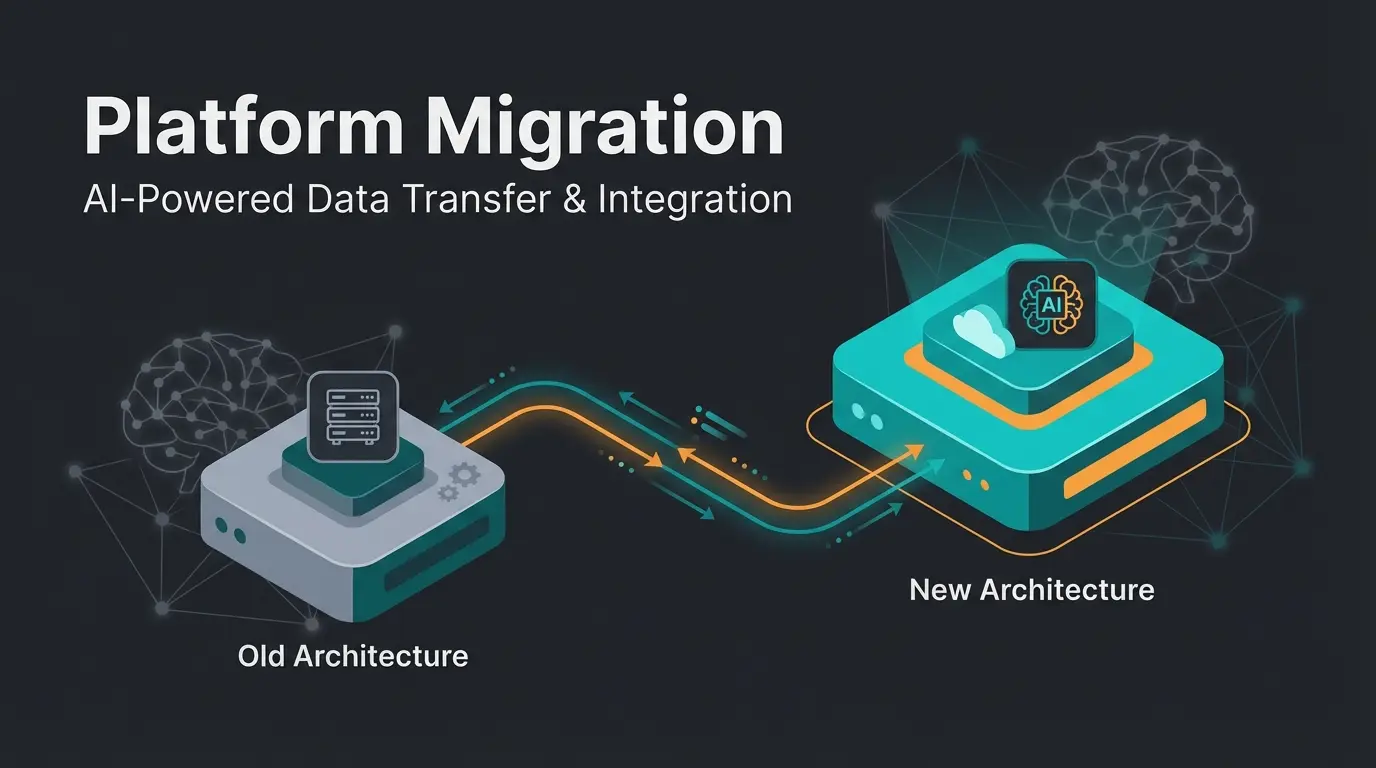
Introduction: Why Your CRM Is More Than a Data Graveyard
In the world of e-commerce, a paradoxical situation exists. Online retailers collect more data than ever before, yet often know the least about the customer currently browsing their store. Consider this typical scenario: A customer visits your Magento store. Over the past two years, they've purchased three high-end outdoor jackets and returned two of them because the fit wasn't right. Your CRM (Customer Relationship Management) knows this. Your email marketing tool probably knows it too. But your Magento store? For the store, this customer is often a stranger—or at best, a "login ID" with purchase history slumbering somewhere in a database.
Most e-commerce managers view Magento CRM integration as a purely technical necessity—a backend process ensuring orders land in Salesforce or HubSpot so customer service is informed and accounting is accurate. This is the status quo: passive data synchronization.
But the market is changing radically. With an average global e-commerce conversion rate of only about 2.5% to 3% according to Blend Commerce and Red Stag Fulfillment, it's no longer enough to simply manage data. Tomorrow's winners use that data to sell now.
This article shows you how to transform your strategy from mere Magento CRM connection to AI-powered sales consultation. We bridge the gap between the technical capabilities of Adobe Commerce (GraphQL, API Mesh) and the enormous revenue potential created through hyper-personalization—according to McKinsey, up to 40% more revenue for leaders in this space.
We'll not only illuminate the technical foundations but also show how, while respecting strict German data protection laws (GDPR) and the upcoming EU AI Act, you can create an integration that doesn't just store data—it actively sells.
The Basics: Why Connect Magento with a CRM?
Before we dive into the AI revolution, we need to understand the foundation. Why is integrating Magento (Adobe Commerce) with a CRM system considered "table stakes"—an indispensable prerequisite for every professional store?
The Single Source of Truth Principle
Without integration, data silos emerge. The marketing team works with newsletter lists, sales with Excel spreadsheets or the CRM, and fulfillment with the Magento backend. A clean integration creates a Single Source of Truth.
- 360-degree customer view: Customer service sees in Salesforce immediately which order was placed in the Magento shop, without switching between windows, as noted by Rolustech
- Efficiency: Manual data transfer is eliminated. This drastically reduces error rates and saves hundreds of work hours according to Amasty
- Automation: A purchase in Magento can immediately trigger a workflow in the CRM (e.g., "Send thank-you email" or "Create task for key account manager")
Top CRM Players in the Magento Ecosystem
When you search for Magento CRM integration, you'll inevitably encounter the big names. The choice of the right system often depends on company size and focus (B2B vs. B2C):
- Salesforce: The market leader. Particularly strong in B2B and for enterprise customers. The Magento Salesforce integration is one of the most frequently requested connections. It offers extremely deep analytics capabilities but is also complex to implement, as detailed by VDCstore
- HubSpot: Popular for its inbound marketing strength. Often the first choice for companies wanting to closely integrate content marketing and sales
- Microsoft Dynamics 365: Often established in corporations already deeply rooted in the Microsoft ecosystem
- Zoho CRM: A cost-effective solution for small to medium retailers still seeking comprehensive automation, with ROI of up to $8.71 per invested dollar according to Sellers Commerce
The Current State of Integration
Currently, the connection is usually realized through connectors (extensions) from providers like Amasty, Mageplaza, or integration platforms (iPaaS) like Zapier or MuleSoft, as explained by Codleo. These tools answer questions like: "Which field in Magento corresponds to which field in Salesforce?" or "How often is synchronization performed?"
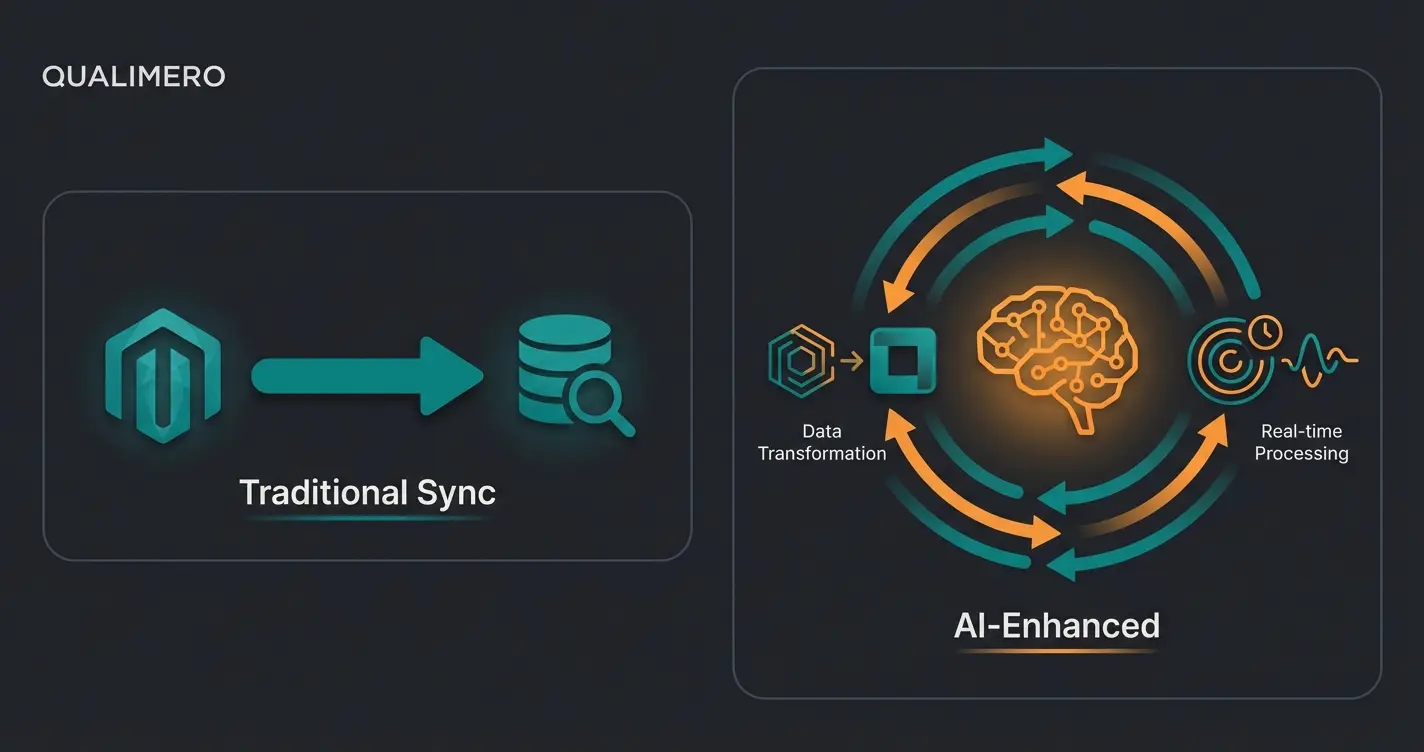
But here lies the problem: These integrations are mostly reactive. They look in the rearview mirror.
The Limitations of Standard Integration
Most companies that implement a Magento CRM connection celebrate success when the data is "cleanly transferred." But from a strategic perspective, that's just the beginning. Let's analyze why the conventional approach leaves revenue on the table.
The Passive vs. Active Problem
In a standard integration, data flows from A to B:
- Scenario: Customer purchases product X
- Integration: Sends data to CRM
- Result: The CRM now knows that customer has product X
- Action: Perhaps the customer receives an automated email in 7 days
The problem is timing. The customer is in the shop now. They have buying interest now. An email in a week is good for customer retention, but it doesn't help increase the cart value (AOV) in the current session.
The Missed Pre-Purchase Opportunity
Most CRM data is used for post-purchase service (support, returns, loyalty). But what about the phase before purchase?
If a customer who is known to be price-sensitive (info from CRM) lingers on a product page, a small discount could tip the scales. If a customer who values premium quality (info from CRM) views an entry-level product, that's the perfect opportunity for an upsell. Standard integrations can't deliver this because they only move data but don't interpret and act on it in real-time.
Comparison: Standard vs. AI-Enhanced Integration
Here you can see the difference between what most agencies offer and what's technologically possible:
| Feature | Standard CRM Integration (Passive) | AI-Enhanced Integration (Active) |
|---|---|---|
| Primary Goal | Data storage & synchronization | Revenue increase & conversion optimization |
| Data Direction | Magento → CRM (mostly) | CRM → AI → Magento (Bidirectional real-time) |
| Timing | Post-purchase (after the sale) | Pre-purchase (during shopping) |
| Customer Approach | Generic or segment-based (newsletter) | Hyper-personalized (1:1 consultation) |
| Technology | Batch sync / Cron jobs | Real-time API / GraphQL / Vector databases |
| Key Metric | Data quality / Sync error rate | Conversion Rate / Average Order Value (AOV) |
Personalization can boost revenue by up to 15% according to ecomposer.io and Nouva Company
Companies actively using CRM data achieve this return according to Sellers Commerce
Share of revenue from personalized recommendations according to Envive.ai
AI-powered personalization improvement according to research
The New Standard: AI-Driven Product Consultation
Here we leave the field of classic IT administration and enter the realm of modern revenue-generating digital sales. Imagine your Magento CRM integration not as a cable connecting two machines, but as the brain of a digital product consultant.
The Concept: The Digital Specialist Consultant
In a physical store, a good salesperson remembers you: "Hello Mr. Smith, how was the hike last week? Do you need the matching waterproofing spray for the shoes you bought?" In e-commerce, this was previously impossible. Chatbots were dumb FAQ machines. But through the combination of Magento, your CRM, and Generative AI (like GPT-4 or specialized e-commerce models), this becomes reality.
This represents a fundamental shift from traditional chatbots to what we call autonomous digital consultants—systems that understand catalog complexity and can provide professional AI consulting based on real customer data.
Scenario: How It Works in Practice
Let's revisit the example from the introduction.
The Process:
- Recognition: The customer logs in (or is recognized via cookies)
- Real-time query: The AI queries the CRM in the background via API Mesh as documented by Webkul. CRM Data: Customer bought a tent 12 months ago. Customer returned clothing due to 'too tight'
- Context analysis: The customer is currently viewing sleeping bags in the Magento shop
- AI Intervention (The 'Active' Part): Instead of a generic pop-up ('Sign up for our newsletter'), a chat window or dynamic notice appears
The Result:
- The customer feels understood (personalization)
- The cross-selling (sleeping bag to tent) is logical and helpful
- The return rate decreases preventively (size recommendation)
Why AI Is More Than Marketing Automation
Many agencies sell "marketing automation" (e.g., email sequences) as AI. That's incorrect. True AI in the context of Magento CRM integration delivers AI-powered sales consultation that goes far beyond simple automation:
- Understands unstructured data: It can read support tickets in the CRM ('Customer complained about complicated assembly') and proactively offer help in the shop ('Should I show you the assembly video?')
- Learns in real-time: If the customer rejects the sleeping bag, the AI immediately learns for the next recommendation without an admin having to write a rule ('If X then Y')
- Scales consultation: A human consultant handles 50 customers per day. The AI handles 50,000 simultaneously
Statistics support this: Personalized recommendations can account for up to 31% of e-commerce revenue according to Envive.ai, and AI-powered personalization can increase marketing efficiency by up to 30% according to Ecomposer.
Stop letting valuable customer insights sleep in your database. Our AI solution turns your Magento CRM integration into a revenue-generating digital sales consultant that knows your customers and products.
Start Your Free TrialTechnical Implementation: Integration for DACH Markets
For German companies (and the entire DACH region), special rules apply. We love efficiency, but we fear data protection violations. A Magento CRM connection must be "bulletproof" here.
The Architecture: API Mesh and GraphQL
Forget old, slow SOAP interfaces or shaky PHP scripts. The modern architecture for Adobe Commerce (Magento) is based on GraphQL and API Mesh as detailed by Adobe.
What is API Mesh? Imagine API Mesh as an interpreter. On one side, Magento speaks, on the other Salesforce, and in between perhaps an ERP like SAP. API Mesh bundles all these languages into a single interface (GraphQL Endpoint) according to Webkul.
Why is this important for AI? AI needs speed. When the customer clicks on the page, the AI can't wait 3 seconds for Salesforce to respond. API Mesh enables parallel queries and caching. It fetches product data from Magento and customer data from the CRM simultaneously and delivers them in milliseconds to the frontend, as explained by Sigma Info and Blue Acorn.
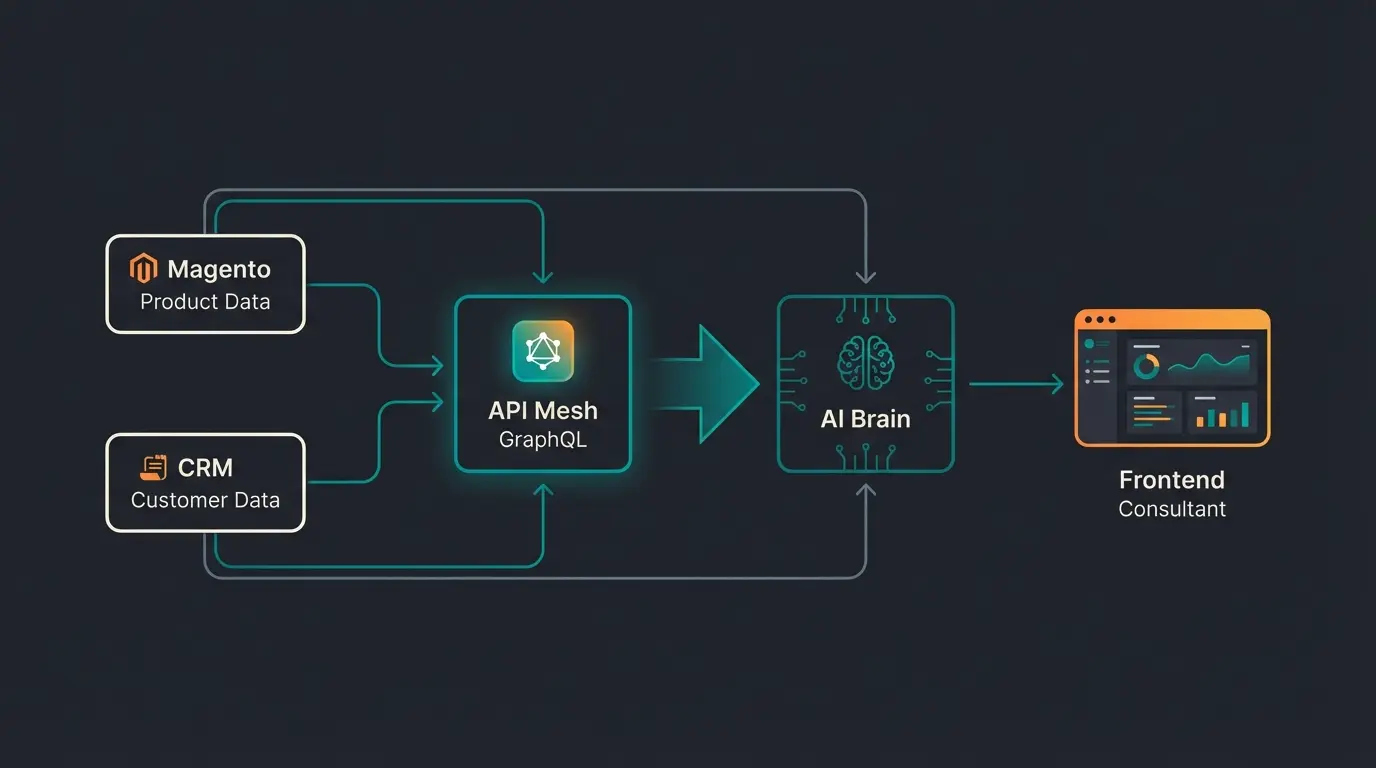
Magento (Product Data) and CRM (Salesforce/HubSpot) hold separate but connected information
Adobe App Builder / API Mesh creates a unified GraphQL endpoint for real-time queries
The AI 'Brain' analyzes context and customer history in real-time using vector databases
The Digital Consultant displays personalized messages and product recommendations instantly
GDPR and the EU AI Act: Compliance as a Feature
In the US, it may be enough to simply use data. In Germany, data protection is a competitive advantage ("Privacy as a Feature"). This is where proactive Guided Selling meets regulatory compliance.
The Challenge: You cannot simply send personal data from the CRM to a "black box" AI (like a public ChatGPT).
The Solution:
- Pseudonymization: Before data goes to the AI, names and emails are replaced with placeholders (e.g., 'Customer_123'). The AI analyzes the behavior but doesn't know the identity, as detailed by Pressebox
- Server Location: Use AI models hosted in the EU (e.g., via Azure OpenAI Europe or local open-source models)
- EU AI Act Compliance: From 2025, new rules apply. Chatbots and recommendation systems often fall under 'Limited Risk' or transparency obligations. You must inform the user that they're interacting with an AI ('I am your digital assistant') according to Amio and E-Commerce Europe
- Consent Management: The integration must respect cookie consent. If the customer declines tracking, the AI must not access CRM history but must advise purely context-based (based on current click behavior) as noted by Seers
Performance Optimization Strategies
A real-time CRM query on every page load can slow down the shop.
Solution: Use "Edge Caching" and asynchronous loading. The shop loads immediately. The personalized recommendation ('Hello Name]...') loads 200ms later. This doesn't affect Core Web Vitals but massively increases relevance. This approach enables [powerful digital sales consultants to operate without compromising user experience.
Checklist: What a Modern Magento CRM Solution Must Offer
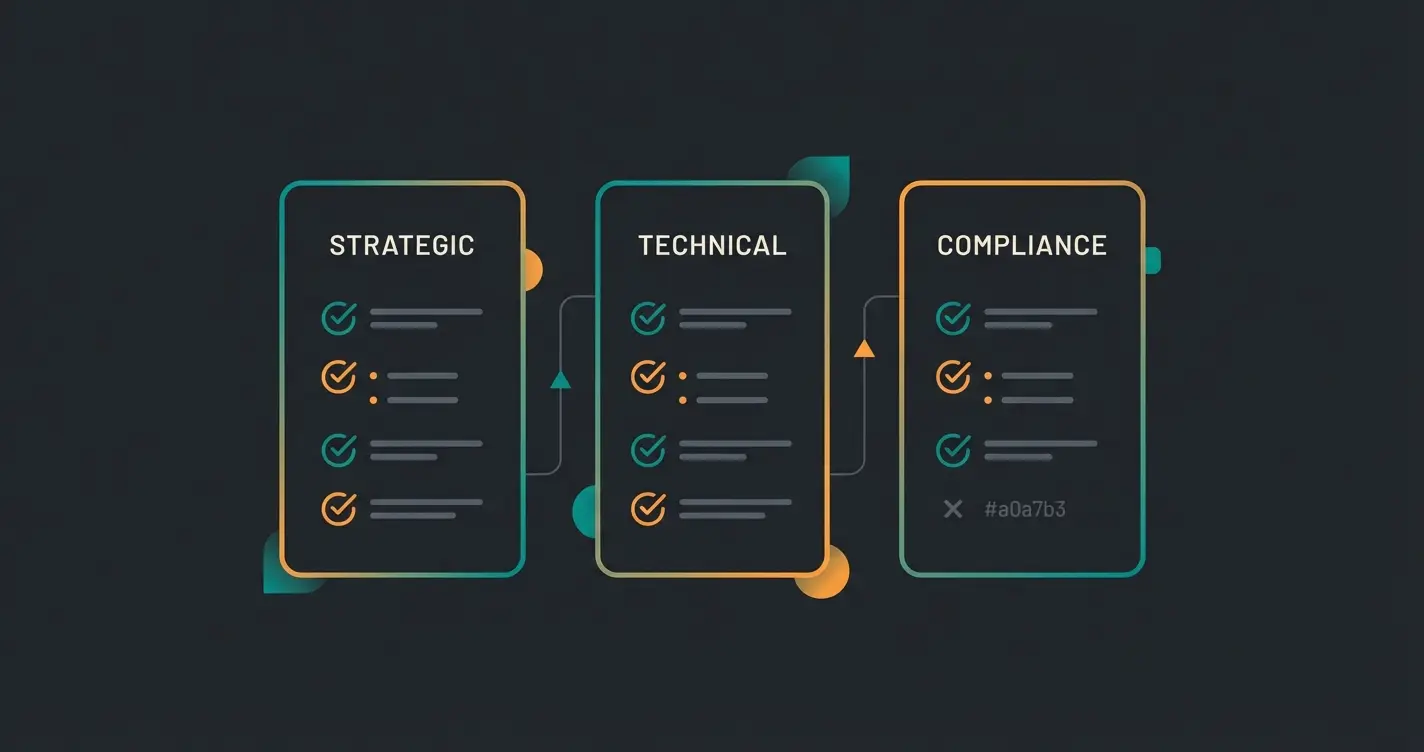
If you're evaluating an agency or software provider for your Magento CRM integration today, don't settle for 'We synchronize your orders.' Use this checklist to ensure you're getting active revenue generation capabilities:
Strategic Requirements
- Real-time capability: Can the system retrieve data during the user session, or only sync at night?
- Bi-directionality: Does data flow not only to the CRM but also back to the shop for personalization?
- AI Integration: Is there an interface for AI models (e.g., OpenAI, Adobe Sensei) to interpret the data?
Technical Requirements
- GraphQL Support: Does the integration use modern GraphQL endpoints for performance as recommended by Adobe?
- Fault Tolerance: What happens when Salesforce is down? The shop must continue running (Graceful Degradation)
- Scalability: Can the integration handle a Black Friday when thousands of queries come simultaneously?
Compliance Requirements for DACH Markets
- GDPR Conformity: Is data transferred encrypted? Where are the servers located?
- AI Act Ready: Is the system transparently labeled? This aligns with requirements for digital expert consultants
- Consent Awareness: Does the integration respect the settings of the Consent Manager (e.g., Usercentrics)?
Passive vs. Active Integration: Complete Framework
To help you understand the full scope of what differentiates traditional approaches from AI-enhanced solutions, here's a comprehensive framework based on AI Product Consultation best practices:
| Dimension | Standard CRM Integration | AI-Enhanced Integration |
|---|---|---|
| Data Usage | Storage and archiving | Real-time activation and action |
| Customer Experience | Generic or segment-based | Hyper-personalized 1:1 consultation |
| Revenue Impact | Indirect (supports marketing) | Direct (increases conversion and AOV) |
| Implementation Focus | Data mapping accuracy | Business outcome optimization |
| Technical Approach | Batch synchronization | Event-driven real-time processing |
| Language Support | Often English-only platforms | Native German and DACH language support |
| Privacy Handling | Basic compliance | Privacy as competitive feature |
This framework illustrates why proactive sales consultation represents the evolution beyond traditional data synchronization approaches.
Conclusion: Activate Your Data Gold
The times when a Magento CRM integration was a pure IT project are over. Today, it's a strategic revenue project.
Most of your competitors still use their CRM as a passive archive. They've created "data graveyards" where valuable knowledge about customer wishes lies unused. By taking the step from pure data synchronization to AI-powered sales consultation, you gain a decisive advantage.
You transform your Magento shop from a silent self-service store into a flagship store with excellent, personal sales staff—scalable, around the clock, and privacy-compliant. This is the essence of multilingual AI chatbots done right.
Action Recommendation: Start Your Pilot Project
Don't start by trying to automate everything. Begin with a pilot project:
- Connect Magento and your CRM via API Mesh
- Choose one scenario (e.g., 'Repeat buyers from Category A')
- Have an AI play out one specific recommendation based on purchase history on the homepage
Measure the uplift in conversion rate. The results will convince you to continue on the path to fully integrated AI consultation.
FAQ: Magento CRM Integration Questions Answered
Costs vary significantly based on complexity. Basic connector implementations start around €2,000-5,000, while enterprise-level integrations with Salesforce including custom development can range from €20,000-100,000+. AI-enhanced solutions typically add 20-40% to base integration costs but deliver significantly higher ROI through increased conversions.
Yes, Salesforce offers GDPR-compliant configurations, but implementation matters. You need to ensure data processing agreements are in place, leverage EU data centers, implement proper consent management, and configure data retention policies correctly. The integration layer must also handle pseudonymization for any AI processing.
A basic synchronization setup takes 2-4 weeks. A full implementation with custom field mapping, workflow automation, and testing typically requires 6-12 weeks. Adding AI-powered consultation capabilities extends this by another 4-8 weeks for proper training and optimization.
Yes, modern AI solutions integrate via API Mesh and GraphQL, which work with both Magento 2 Open Source and Adobe Commerce (formerly Magento Enterprise). The key requirement is proper API access to both your Magento instance and your CRM system.
Studies show personalization can boost revenue by up to 15%, with AI-driven CRM activation delivering $8.71 ROI per dollar invested. Companies see typical conversion rate improvements of 10-25% and average order value increases of 5-15% when implementing real-time AI consultation based on CRM data.
Join forward-thinking e-commerce leaders who are turning passive data archives into active sales engines. Our AI-powered solution integrates seamlessly with your Magento store and existing CRM to deliver personalized consultation at scale—GDPR-compliant and EU AI Act ready.
Start Your Free AI Consultation Trial
Lasse is CEO and co-founder of Qualimero. After completing his MBA at WHU and scaling a company to seven-figure revenue, he founded Qualimero to build AI-powered digital employees for e-commerce. His focus: helping businesses measurably improve customer interaction through intelligent automation.