Why GDPR Has Changed in 2025
Are you worried that your next shop update could trigger a wave of legal warnings?
You're not alone. For a long time, the GDPR (General Data Protection Regulation) was synonymous with annoying cookie banners and endless privacy policies for shop owners. But in 2025, the playing field has fundamentally changed. It's no longer just about whether you've correctly integrated Google Analytics.
The new challenge—and simultaneously the greatest opportunity—lies at the intersection of e-commerce and artificial intelligence. Understanding the basics of artificial intelligence has become essential for modern shop operators navigating this landscape.
While many Magento shop owners hesitate to use modern AI tools for product consultation because they fear data leaks to US servers, the bold ones are already pulling ahead of the competition. The key isn't ignorance, but technical intelligence.
In this comprehensive guide, we don't just clarify the status quo of Magento GDPR compliance for versions 2.4.7 and the upcoming 2.4.8. We also show you how to bridge the massive gap between strict German data protection requirements and powerful AI product consultation.
We answer the questions that other agency blogs often sidestep:
- How do I integrate AI without "feeding" customer data to OpenAI?
- What does the new EU AI Act mean for my Magento shop?
- How do I truly delete data in Magento 2 cleanly (and not just superficially)?
Is Magento GDPR-Compliant by Default?
The short answer is: No.
The nuanced answer is: Magento (Adobe Commerce) is a tool that must be *configured* for compliance.
Adobe delivers powerful data protection tools with current versions (especially since 2.4.x), but "out-of-the-box," a standard installation is a legal pitfall. When you install a fresh Magento shop, it collects data by default, sets cookies, and logs IP addresses in ways that are not permissible in the EU without adjustments.
The "Big 3" Deficits of a Standard Installation
1. Cookie Management & Consent Mode V2: Magento does have a native "Cookie Restriction Mode" (more on that in the practical section), but this often doesn't meet 2025 requirements. Since March 2024, Google Consent Mode V2 is mandatory for anyone using Google Ads or Analytics, as confirmed by Amasty and CookieYes. A standard Magento installation doesn't offer this granular control of consent signals to Google natively. Without external modules or a Consent Management Platform (CMP), you risk massive marketing data losses or legal warnings.
2. Data Deletion vs. Database Integrity: The "Right to be Forgotten" (Art. 17 GDPR) sounds simple in theory. In Magento practice, it's complex. If you simply delete a customer in the backend, fragments often remain in logs, quotes (shopping carts), or reports. Additionally, GDPR often conflicts with GoBD (German principles for proper bookkeeping), which requires you to retain invoice data for 10 years. Magento's default deletion often removes too little or leaves connections intact.
3. Third-Party Data Flow (Third-Party Leaks): The biggest risk often isn't Magento itself, but what you add to it. Every installed module, every tracking pixel, and—quite new—every AI chatbot can be a potential data leak. Many shop owners don't know that simple chat widgets often transfer IP addresses and inputs directly to US servers before the customer has even said "Hello." This is where understanding the history of chatbots helps you make informed decisions about modern solutions.
Of Magento shops have at least one GDPR configuration issue
Google's mandatory requirement since March 2024
Required by German GoBD vs. GDPR deletion rights
Or 4% of annual revenue for GDPR violations
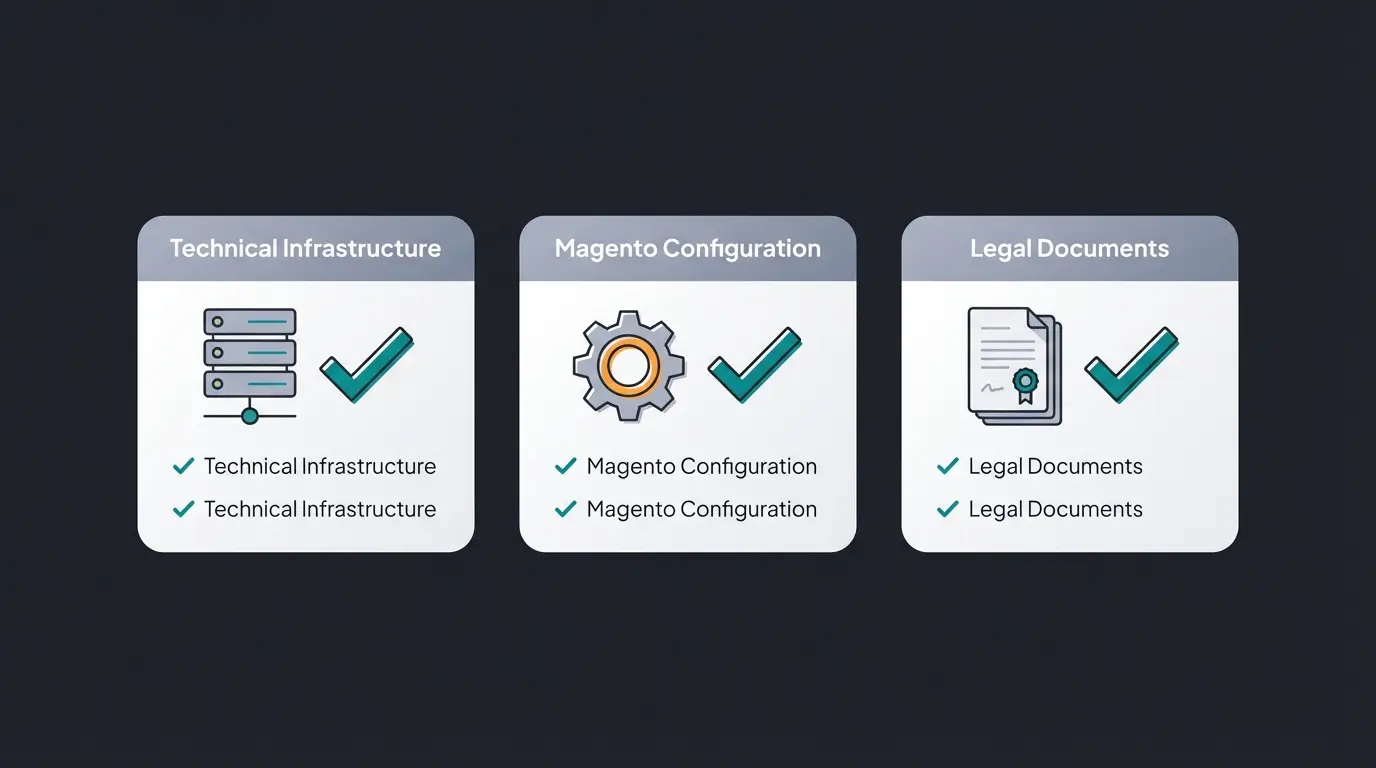
The Ultimate Magento GDPR Checklist
Before we dive into advanced AI topics, the basics must be solid. Use this list to check your current status. This comprehensive approach aligns with best practices for Shopware data protection as well.
1. Technical Infrastructure & Hosting
- EU Server Location: Ensure your hosting provider (and their backups!) are physically located in the EU, ideally in Germany.
- SSL/TLS Encryption: An absolute must. Check that all subdomains and admin access are also encrypted.
- Access Logs: Are server logs (IP addresses) anonymized or deleted after a maximum of 7 days? (Clarify this with your host).
2. Magento Configuration
- Cookie Restriction Mode: Activated under Stores > Configuration > Web > Default Cookie Settings, as detailed by Meetanshi.
- Google Consent Mode V2: Is your CMP (e.g., Cookiebot, Usercentrics) correctly configured to send the signals `ad_user_data` and `ad_personalization` to Google? Digital-Loop provides detailed implementation guides.
- Data Minimization at Checkout: Only request data strictly necessary for contract fulfillment (e.g., no mandatory phone number for purely digital products).
- Guest Orders: Allow purchases without permanent account creation.
3. Legal Documents & Processes
- Privacy Policy: Updated to 2025 standards (including references to AI tools, Consent Mode V2).
- DPA (Data Processing Agreements): Have you concluded a Data Processing Agreement with your agency, host, and all tool providers (including the chatbot provider!)?
- Processing Records: Document internally which data is processed where.
AI Tools and Data Protection in Magento
This is where the wheat separates from the chaff in 2025. While most shop owners see GDPR as a brake, market leaders use it as a quality mark for their AI strategy. See how AI chatbots are revolutionizing customer interactions while maintaining compliance.
The Problem: Customers today expect immediate answers and intelligent product consultation. A simple search field is no longer enough. But shop owners have panic-inducing fear of integrating an AI chatbot because they read headlines about "ChatGPT data leaks."
The Solution: You need to understand that there are two completely different types of AI integrations.
Simple Chatbots vs. AI Product Consultants
| Feature | Simple "Support Chatbot" (Risk) | AI Product Consultant (GDPR-Optimized) |
|---|---|---|
| Focus | "Where is my package?", "Complaint" | "Which bike fits my body height?" |
| Data Requirement | Needs order number, email, full name (Personal Data) | Only needs context: "height", "budget", "use case" (Factual Data) |
| Technology | Often direct API connection to OpenAI/Google without filter | Anonymization layer between shop and AI |
| Risk | High. Personal data often ends up in the AI's training set | Low. The AI only sees anonymous parameters, no identities |
Why is this important for you? When you deploy an AI product consultant, you can massively increase conversion rates without falling deep into the GDPR trap. Since a product consultant doesn't need to know who the customer is, but only what they need, the principle of data minimization applies here.
This fundamental difference in data handling is why specialized AI product consultants represent the future of compliant e-commerce assistance.
Discover how our AI product consultant helps you boost conversions while keeping customer data protected with built-in anonymization.
Start Your Free TrialHow to Integrate AI Consultation GDPR-Compliantly
Using AI in e-commerce is not a legal gray area. With the EU AI Act, which has been in force since August 2024 and whose transition periods run until 2026, new obligations are coming your way. According to Europa.eu and McCannFitzgerald, understanding these regulations is essential. But don't worry: for e-commerce, these are manageable if you know them. Our comprehensive EU AI Act guide provides detailed insights into these new requirements.
1. Transparency Obligation (Labeling)
The EU AI Act prescribes that users must know when they are interacting with a machine.
- To-Do: Your chat window must not pretend to be "Employee Michael".
- Best Practice: Call the bot "Digital Product Advisor" or "AI Assistant" and add a brief note: "I am an AI helping you with product selection."
2. The "Anonymization Layer" (Technical Firewall)
This is the most important technical aspect that most "plug & play" plugins conceal. You may not send customer inputs unfiltered to a US-based AI (like ChatGPT).
Customer asks: "I'm looking for marathon running shoes, I'm a beginner."
Your shop receives the message within your legal jurisdiction.
Scans for PII (names, emails, phone numbers), replaces or removes sensitive data, strips IP addresses.
Cleaned request goes to the LLM (Large Language Model) with only product parameters.
AI returns product recommendation back to Magento for display.
Through this intermediate step, you ensure that no personal data leaves the EU legal area or is stored by third-party providers. This approach demonstrates how conversational AI evolves to meet modern privacy requirements.
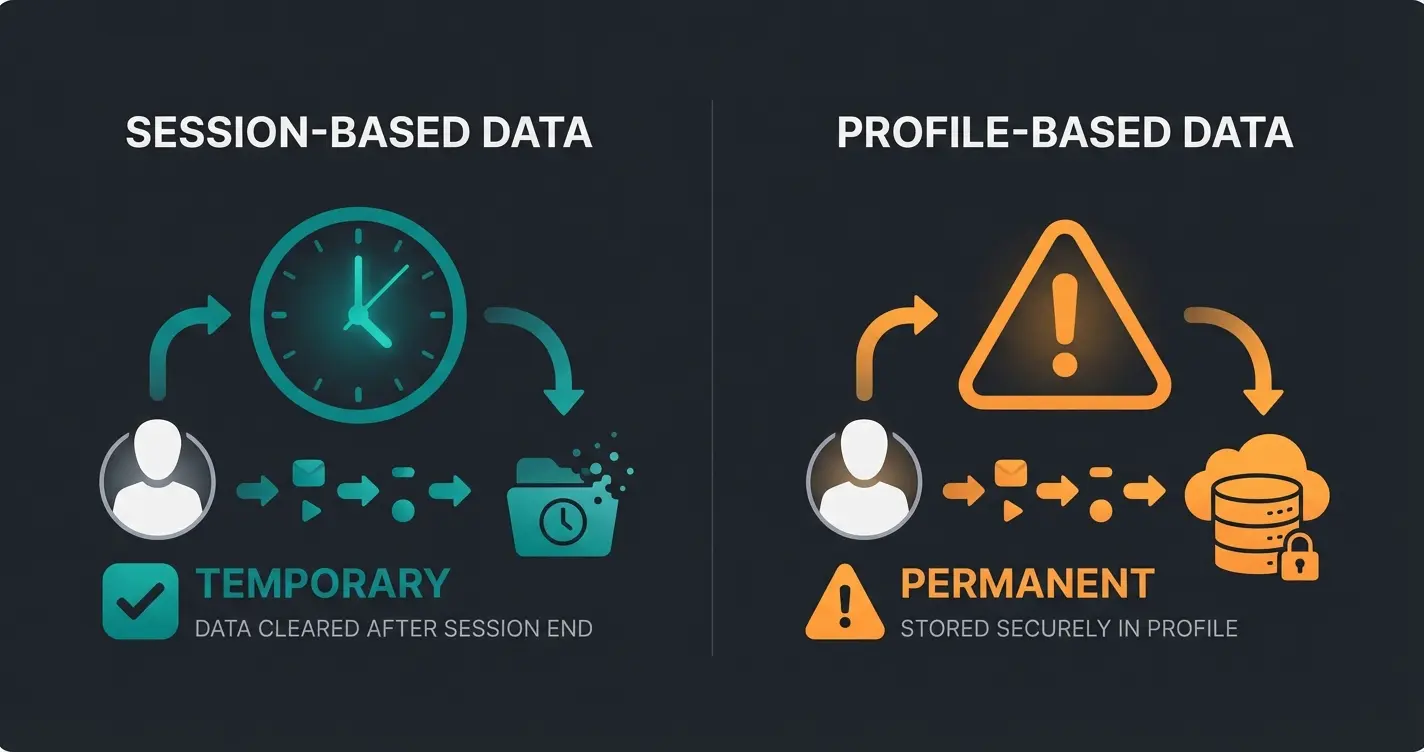
3. Session-Based vs. Profile-Based
Avoid storing permanent profiles for product consultation.
- Good: The AI remembers preferences only for the duration of the current browser session (Session Storage). As soon as the customer closes the window, the AI's "memory" is deleted.
- Bad: The AI creates a shadow profile of the customer that is stored for months. This requires explicit, informed consent (opt-in), which hardly any customer gives.
Practical Guide: Handling Customer Data in Magento 2
Enough theory. How do you implement data protection requirements in the Magento backend concretely? Here are instructions for the most common scenarios. These principles also apply when implementing AI sales consultation across different platforms.
Scenario A: Customer Requests Data Deletion
A customer writes you an email: "Please delete all my data according to GDPR."
The Conflict: If you delete everything, you violate tax law (invoice retention requirement). If you delete nothing, you violate GDPR.
The Manual Process in Magento 2.4.x:
- Check: Does the customer have open orders? If yes, the account cannot be fully deleted yet.
- Delete Customer Account: Go to Customers > All Customers, select the customer, click Delete. Caution: This deletes the login and master data, but not the order history in the database (Sales Tables).
- Anonymize Orders (The Pro Trick): Magento doesn't natively offer "one-click anonymization" for old orders. Using modules (e.g., from Amasty or Mageplaza) or an SQL script is recommended to overwrite the fields `customer_email`, `customer_firstname`, and `customer_lastname` in the `sales_order` and `sales_order_grid` tables (e.g., with "Deleted" or "Anonymous"). Note: The invoice address on the PDF invoice (in the file system) remains for tax audits, but the database is clean.
Scenario B: Customer Requests Data Access (Art. 15 GDPR)
The customer wants to know: "What do you know about me?"
The Path in Magento:
- Go to System > Data Transfer > Export.
- Select Customers Main File as Entity Type.
- Filter by the customer's email address.
- Export the CSV.
- Important: Repeat this for Customer Addresses.
- Summarize this data in a readable format (don't just send the raw CSV—no end customer understands that).
AI Integration Comparison: Standard vs. GDPR-Compliant
When evaluating AI solutions for your Magento B2B shop, understanding the differences between standard implementations and GDPR-compliant solutions is crucial.
| Feature | Standard GPT Wrapper | GDPR-Compliant Product Consultant |
|---|---|---|
| Server Location | Mostly USA (without control) | EU Hosting / Anonymized |
| Data Training | Your data may train the AI | No training with customer data |
| Contract | Often just Terms of Service click | German DPA available |
| Consultation Quality | Often hallucinates facts | Accesses your live product catalog |
| Data Retention | Indefinite storage possible | Session-based only |
| Compliance Support | Minimal documentation | Full GDPR documentation package |
This comparison highlights why businesses seeking AI customer service automation must carefully evaluate their options beyond just functionality.
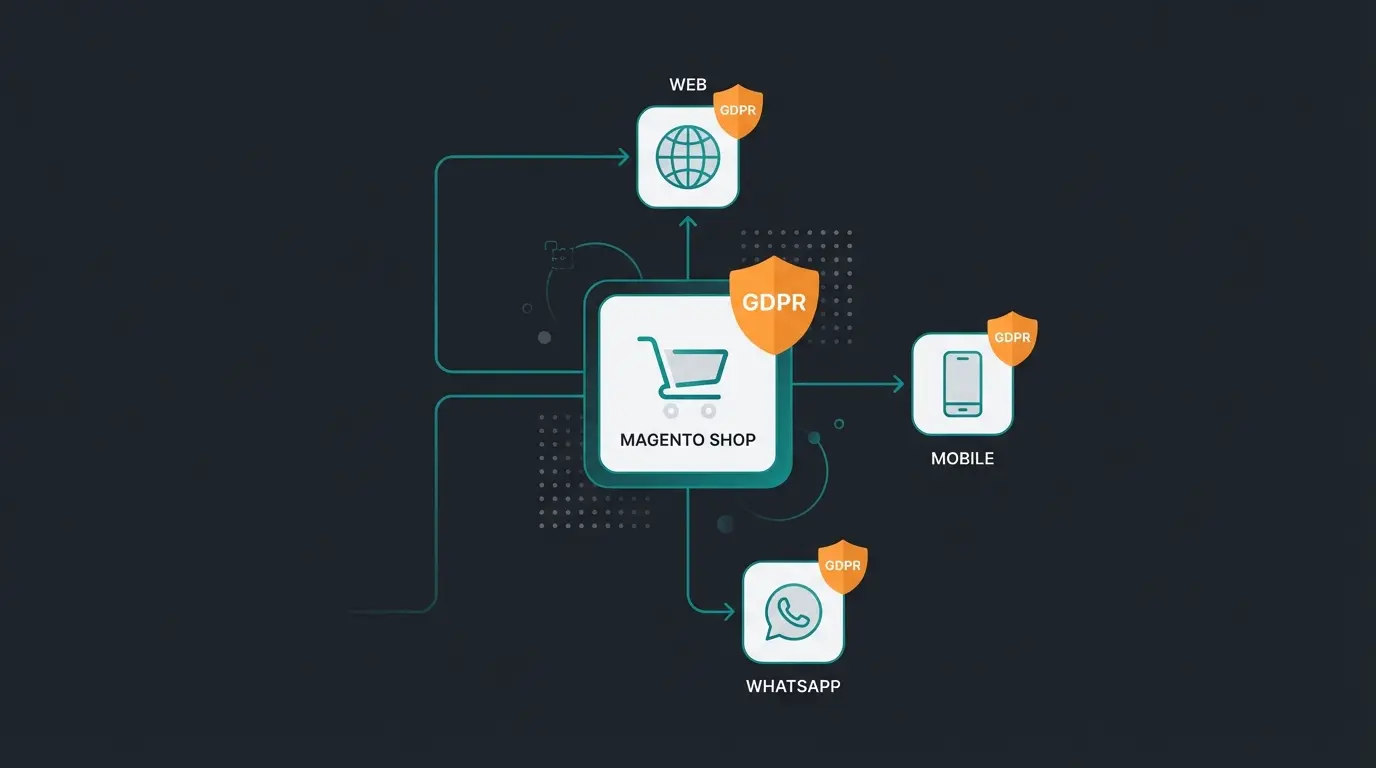
WhatsApp and Multi-Channel Compliance
As e-commerce expands beyond traditional web shops, ensuring WhatsApp Business GDPR compliance becomes equally important. The same principles of data minimization, anonymization layers, and transparent AI labeling apply across all customer touchpoints.
Data Privacy as a Quality Feature
In 2025, Magento GDPR compliance is no longer a tedious chore, but a competitive advantage. Customers have become sensitive. A shop that transparently communicates: "We use AI to advise you, but we protect your data through anonymization" builds massive trust.
The combination of a clean Magento base (version 2.4.7+), correct consent management (V2), and an intelligent, anonymized AI strategy makes your shop future-proof—even against upcoming regulations like the EU AI Act.
Consider how our AI employee Flora demonstrates the perfect balance between helpful AI consultation and stringent data protection.
Bonus: Supporting Resources for Your Shop
To make implementation easier for you, we've compiled useful templates and overviews here.
Visual Guide: The Secure Data Flow
Use this concept to create a graphic for your "About Us" or Privacy Policy page:
- Left (The Customer): User symbol. Arrow goes to the right.
- Center (Your Shop): Magento logo. Order data is stored securely here (encrypted).
- Right (The Firewall): A shield symbol with the label "Anonymization Layer".
- Far Right (The AI): A robot symbol.
- The Highlight: The arrow from shop to AI is red and stops at the shield. Only a green arrow with "Anonymous Product Parameters" continues to the AI.
- Caption: "How we protect your identity during AI consultation."
Download Template: Sample Response for Data Access Request
Copy this text for your customer service:
Frequently Asked Questions About Magento GDPR
No, Magento (Adobe Commerce) requires configuration to be GDPR-compliant. A standard installation collects data, sets cookies, and logs IP addresses in ways not permitted in the EU without adjustments. You need to configure cookie consent, implement proper data deletion workflows, and audit third-party integrations.
Google Consent Mode V2 is a framework that communicates user consent choices to Google services. Since March 2024, it's mandatory for all websites using Google Ads or Analytics. It requires sending specific signals (ad_user_data and ad_personalization) to Google. Without proper implementation, you risk either massive marketing data losses or legal warnings.
Yes, but you need the right approach. AI product consultants that work on anonymized, session-based data are much safer than support chatbots that require personal information. The key is implementing an anonymization layer that strips personally identifiable information before sending queries to the AI system.
This requires a balanced approach. You can delete the customer account and personal data while anonymizing (not deleting) order records. Replace personal details in the database with generic values like 'Deleted' while keeping the invoice PDFs intact for tax compliance. This satisfies both GDPR's right to be forgotten and GoBD's 10-year retention requirement.
The EU AI Act, in force since August 2024, requires transparency when customers interact with AI systems. You must clearly label AI assistants (not pretend they're human employees) and ensure AI systems don't manipulate customers. For e-commerce product consultation, this means adding clear disclosures and ensuring your AI provides accurate, non-manipulative recommendations.
Stop choosing between powerful AI consultation and GDPR compliance. Our solution delivers both with built-in anonymization, EU hosting, and full documentation.
Get Started TodayDisclaimer: This article does not constitute legal advice. GDPR is complex and case-dependent. For a legally secure review of your shop, please consult a specialized IT law attorney.

Lasse is CEO and co-founder of Qualimero. After completing his MBA at WHU and scaling a company to seven-figure revenue, he founded Qualimero to build AI-powered digital employees for e-commerce. His focus: helping businesses measurably improve customer interaction through intelligent automation.