WhatsApp Business GDPR Compliance: AI Consultation Guide 2025
Learn how to use WhatsApp Business GDPR-compliant with AI product consultation. Complete guide covering API setup, data protection & EU AI Act compliance.

The Dilemma: Customer Preferences vs. Data Protection
Your customers are where they feel comfortable: on WhatsApp Business. With open rates of up to 98% according to Mateo and near-universal adoption in the DACH region, the messenger is the most powerful channel for sales and service. However, for German companies, particularly in the area of complex product consultation (e.g., insurance, mechanical engineering, financial services), using it feels like dancing on a volcano.
The fear of warnings and fines is real. Ever since the Irish Data Protection Commissioner imposed a record fine of 225 million euros against WhatsApp, as reported by Dr. Datenschutz and Proliance, CEOs and data protection officers know: the grace period is over.
But 2025 brings a new dimension into play: Artificial Intelligence. It's no longer just about whether you can chat, but how an AI conducts sensitive consultation conversations without committing data protection violations or delivering hallucinated incorrect advice. Understanding whatsapp data protection requirements is the starting point for modern businesses.
This article is not a superficial overview. It is an in-depth guide for companies that want to use WhatsApp Business GDPR-compliant – not just for simple FAQs, but as a high-performance, AI-powered sales channel. We bridge the gap between technical feasibility (API) and legal necessity (GDPR & EU AI Act).
The Core Problem: Why the Standard App Is a Compliance Trap
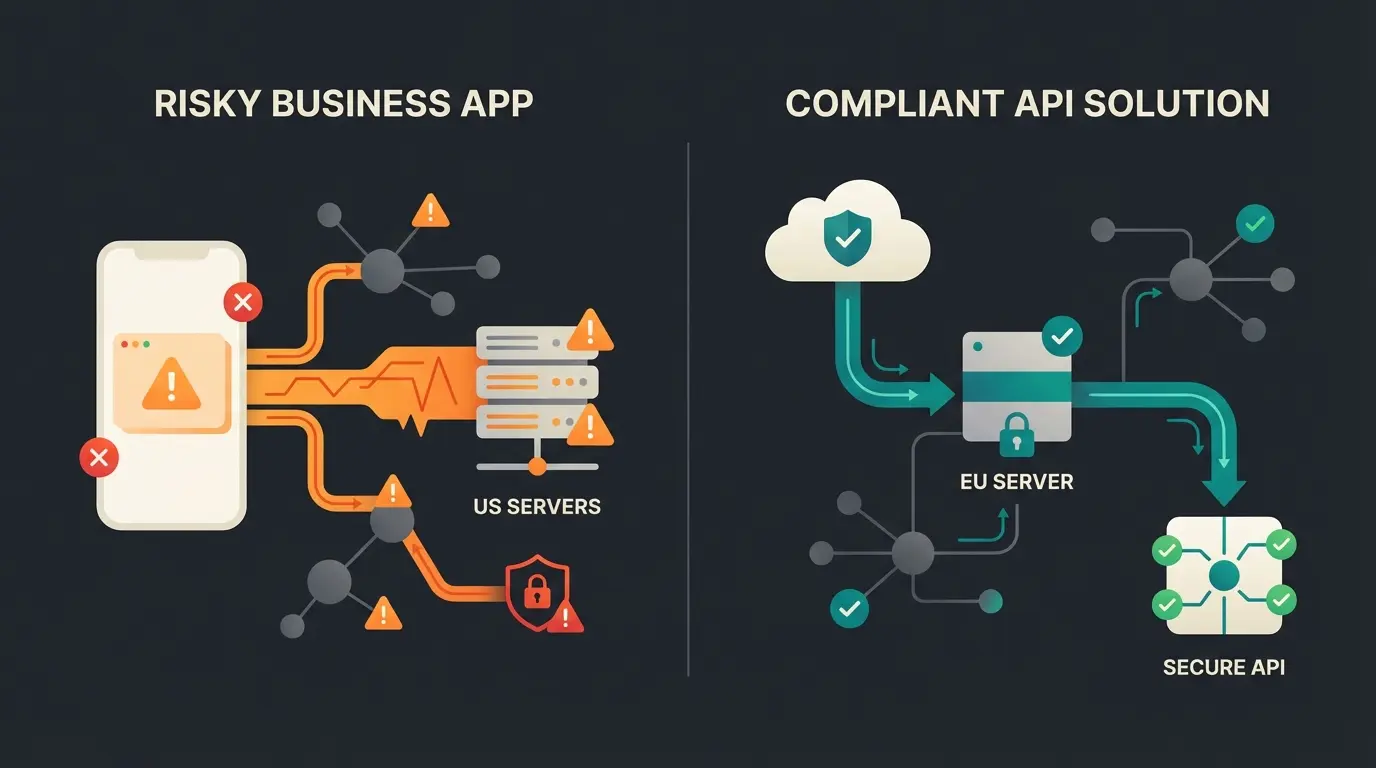
Many small business owners and salespeople reflexively reach for the free "WhatsApp Business App" from the App Store. This is understandable, but fatal from a GDPR and WhatsApp Business perspective. Before diving into proper WhatsApp Business setup, you need to understand why the standard app fails compliance requirements.
The Address Book Synchronization (The Knockout Criterion)
The main problem with the standard app (and the private app) is how it manages contacts. After installation, the app requests access to the entire phone book of the smartphone.
- The Violation: The app reads all numbers – including those of contacts who don't even use WhatsApp. This data is transmitted to Meta servers in the US to match who is registered with WhatsApp, as confirmed by Superchat and Sofortdatenschutz.
- The Legal Consequence: This constitutes processing of personal data of third parties without their consent. A clear violation of Art. 6 GDPR.
Metadata and the US Server Conflict
Even if the content of chats is end-to-end encrypted, so-called metadata is generated. According to Heydata, this metadata includes:
- Who communicates with whom?
- When?
- From which location (IP address)?
- Which device is being used?
This data is processed by Meta as a Data Controller, partly for their own purposes. Since Meta is a US company, this data is subject to access by US authorities (Cloud Act). Although the EU-US Data Privacy Framework (DPF) has been in place since 2023 as an adequacy decision, it stands on shaky legal ground and is already being challenged by data protection activists like Max Schrems (NOYB), as documented by The Firewall Blog and Lawfare Media.
The Solution: The WhatsApp Business API (Platform)
To use WhatsApp Business data protection-compliant, there is no way around the WhatsApp Business API (officially "WhatsApp Business Platform" since 2022).
What Makes the API Different?
The API (Application Programming Interface) is not an app that you install on your phone. It is an interface that connects your business software with the WhatsApp network.
- No Access to the Phone Book: The API technically has no access to your smartphone's contacts. You only import the data of customers who have explicitly consented (opt-in), as explained by Tyntec.
- Data Separation: Communication runs through so-called Business Solution Providers (BSPs) or software providers (such as Superchat, Userlike, Mateo, Chatarmin), who often host their servers in Germany or the EU.
The Role of Business Solution Providers (BSPs)
Since the API has no user interface, you need software that operates this interface. Here lies the key to compliance:
- Data Processing Agreement (DPA): You sign a contract with the software provider (e.g., a German company). This provider in turn signs contracts with Meta. This secures the chain of responsibility according to Art. 28 GDPR, as detailed by Sofortdatenschutz and Woztell.
- Server Location: Reputable providers guarantee the hosting of message logs and customer data on ISO-certified servers in the EU.
Cost Structure (2025 Update)
Security comes at a price. While the app is free, the API costs money. Understanding these costs is essential when building your WhatsApp marketing strategy.
- Conversation-based Model: Meta charges costs per 24-hour conversation.
- Prices (approximate values for Germany 2025): Service conversations (initiated by the customer) are often free or very inexpensive (partly free since Nov. 2024) according to Mateo. Marketing conversations cost approximately 11.31 cents per conversation, as noted by Chatarmin and Brevo. Utility (transactions) cost approximately 7-8 cents.
- Software Fees: Additionally, there are monthly license costs for the tool (from approximately €100 to several thousand euros, depending on scope).
AI & GDPR: The New Frontier of Product Consultation
Here we differentiate ourselves from the competition. Most guides stop at the API. But when you use AI for product consultation (e.g., "Which liability insurance is right for me?"), you enter new territory. AI Chatbots transform the way businesses interact with customers, but they require careful compliance considerations.
The Problem: "Is the AI Training on My Data?"
A standard chatbot (keyword-based) is uncritical from a data protection perspective. A generative AI (LLM like GPT-4), which answers customer questions individually, carries risks:
- Data Leak: Are customer data (names, insurance numbers) being sent to OpenAI or Anthropic to generate the response?
- Training: Is this data being used to improve the model?
The Solution: Zero-Data-Retention (ZDR)
For a GDPR-compliant AI consultation, you must ensure that your software provider has agreed to a "Zero-Data-Retention" policy with the AI providers, as emphasized by GC.AI and Panto AI.
- How It Works: The data is sent to the AI, processed, and the response is returned. Afterwards, the input data is immediately deleted from the AI's working memory. It never lands in any training set.
- Enterprise Level: Do not use private ChatGPT accounts for business purposes! Only through the API (Enterprise access) do providers like OpenAI guarantee that data is not used for training, as confirmed by CodeParrot and NextTechToday.
End-to-end encrypted transmission to Meta servers
Meta decrypts briefly to transfer to your BSP's HTTPS interface. Metadata is separated from the address book
Provider's server (e.g., in Frankfurt) receives text. Personal data (PII) can be masked here
Anonymized text sent to LLM API (e.g., Azure OpenAI in Europe). Zero-Retention Policy applies - no storage
Generated answer flows back: BSP → Meta → User's device. All temporary data deleted
The EU AI Act: Transparency Is Mandatory
Since August 2024, the EU AI Act has been in force, with transition periods until 2026. Article 50 is crucial for WhatsApp bots, as explained by Ecovis:
- Labeling Requirement: Users must know that they are interacting with an AI, as detailed by Itequia.
- Implementation: The bot must introduce itself: "Hello, I am the digital assistant of [Company]. I am an AI."
- Deepfakes & Audio: If you send AI-generated voice messages, they must be mandatorily labeled as artificial, according to Allen & Overy Shearman.
Advisory Liability and Human-in-the-Loop
When an AI advises a customer: "Buy Machine X, it's compatible with your system", and that's incorrect, you as a company are liable. Implementing AI Customer Service requires understanding these liability implications.
- Legal Classification: AI systems (still) do not count as legal entities. The operator is liable for errors (product or service liability), as explained by German Law International and Härting.
Strategy for Mitigating Liability:
- Disclaimer: The AI must indicate that responses are legally non-binding.
- Human Handover: For critical keywords (e.g., "contract conclusion", "damage report"), the AI must mandatorily hand over to a human employee.
- RAG (Retrieval Augmented Generation): The AI must not "invent freely" but must access a curated knowledge database of your company.
Deploy WhatsApp Business with enterprise-grade AI consultation that meets all GDPR and EU AI Act requirements. Zero-data-retention, human handover, and full transparency built-in.
Start Your Compliant SetupChecklist: 5 Steps to GDPR-Compliant AI Sales Channel
Follow these steps to implement WhatsApp Business GDPR-secure. Whether you're exploring AI Product Consultation or setting up WhatsApp AI chatbots, this checklist ensures compliance.
Step 1: Choose the Right API Provider (BSP)
Don't just search for "WhatsApp Tool", but check:
- Server location (Germany/EU preferred)
- ISO 27001 Certification
- Does a Zero-Data-Retention guarantee exist for the AI modules?
Step 2: The Data Processing Agreement (DPA)
Sign the DPA before the first message flows. Reputable providers make this available digitally in the dashboard. It regulates instruction rights and deletion deadlines, as outlined by Woztell.
Step 3: The Widget Opt-In (The Royal Path)
How do you obtain permission to contact the customer?
- Not Allowed: Simply contacting numbers from CRM (cold calling is prohibited!)
- The Clean Path (Inbound): The customer starts the chat.
The proper opt-in flow according to Mateo and Marketing Suite:
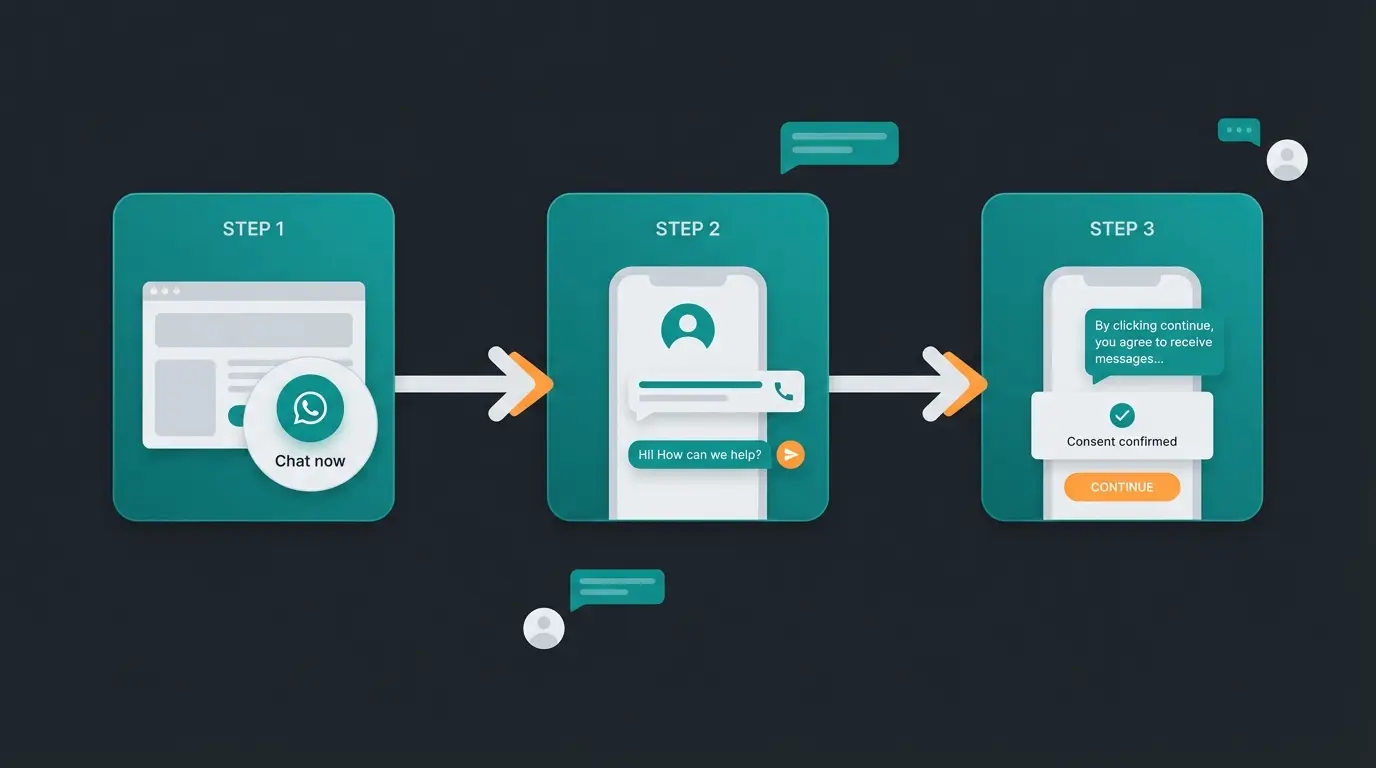
- User clicks on WhatsApp button on your website.
- A pre-formulated text appears: "Hello, I am interested in consultation. Please inform me according to your privacy policy."
- Double-Opt-In (Recommended): The bot automatically responds: "Thank you! To start the chat, please briefly confirm with 'Start' that you accept our privacy policy (Link)."
- Only after the "Start" click does the consultation begin.
Step 4: Privacy Policy & Legal Notice
Implementing proper documentation is crucial, as emphasized by IT-Recht Kanzlei:
- Privacy Policy: Add a section "WhatsApp Business" to your website privacy policy. Name the service provider (BSP), the purpose (consultation), and the legal basis (Art. 6 Para. 1 lit. a GDPR - Consent).
- Legal Notice in Chat: Link directly to your legal notice in the WhatsApp company profile. It must be reachable within a maximum of two clicks ("2-Click Rule").
Step 5: Configure AI Guardrails (Prompt Engineering)
Instruct your AI in the "System Prompt" (the secret work instruction). This is where AI-powered digital assistants differ from basic chatbots:
Comparison: App vs. Chatbot vs. Secure AI Solution
Here you can see at a glance why the investment in a professional solution is necessary. Understanding the difference between a chatbot and AI employee helps clarify which solution fits your needs.
| Feature | WhatsApp Business App | Standard FAQ Chatbot | Secure AI Product Consultation (API) |
|---|---|---|---|
| GDPR Status | ❌ High Risk (Address Book Sync) | ✅ Compliant (via API) | ✅ Compliant + AI Guardrails |
| Data Storage | Meta US Servers (Metadata) | Meta + Bot Provider (EU) | Meta + Zero-Retention AI |
| Use Case | Manual Chat (Small Business) | Simple FAQs (Business Hours) | Complex Product Consultation |
| Phone Book Access | Mandatory Required | Blocked (Technically Impossible) | Blocked (Technically Impossible) |
| AI Training | N/A | N/A | Excluded (Enterprise) |
| EU AI Act | N/A | Labeling Required | Labeling + Transparency |
Imposed on WhatsApp by Irish DPC for data protection violations
WhatsApp message open rates compared to 20% for email
Full enforcement of AI transparency requirements
Data points stored when using enterprise AI APIs properly
Technical Implementation of the Secure Data Journey
To prove security to internal stakeholders or the data protection officer, understanding the data flow helps. When implementing a WhatsApp AI bot, this technical understanding is essential.
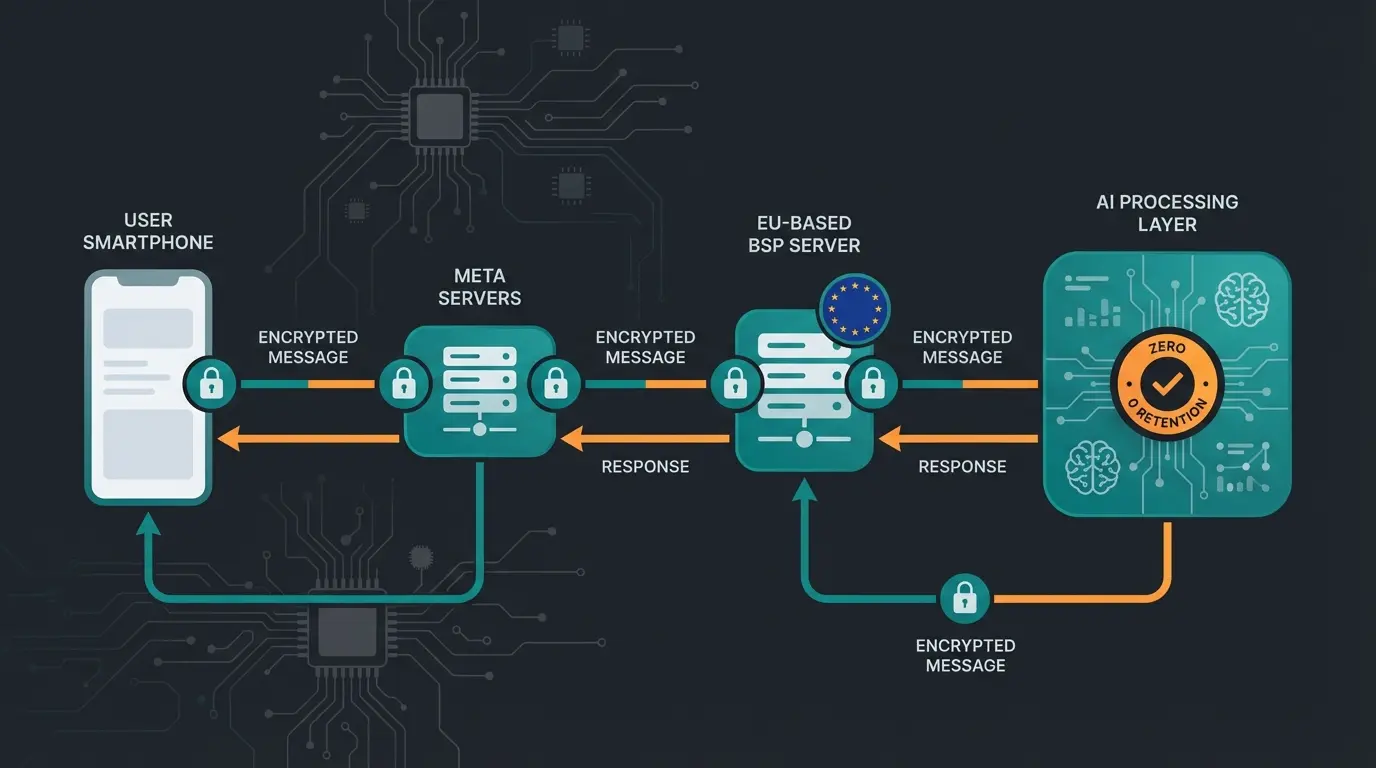
- User Sends Message: End-to-end encrypted to Meta servers.
- Handover to API: Meta briefly decrypts the message to pass it to the API interface (HTTPS) of your Business Solution Provider (BSP). Here, metadata is separated from the address book.
- Processing at BSP: The provider's server (e.g., in Frankfurt) receives the text. Personal data (PII) can already be masked here (Data Masking).
- AI Layer (The Intelligence): The anonymized text is sent to the LLM API (e.g., Azure OpenAI in Europe). Security Check: Zero-Retention Policy applies. No storage.
- Response: The generated answer flows back to BSP → Meta → User's device.
Advanced AI Privacy Considerations for Consultation
Most articles mention "Chatbots" superficially when discussing WhatsApp GDPR compliance. However, they rarely explain how the AI processes personal data. This is the critical gap that businesses need to understand. For a deeper dive, see our guide on whatsapp ai privacy risks.
Data Minimization in AI Consultation
The principle of data minimization (Art. 5 GDPR) requires collecting only what's necessary. For AI product consultation, this means:
- Configure your AI to ask only essential questions for the consultation
- Avoid collecting data "just in case" - every data point needs justification
- Implement automatic redaction of sensitive data before AI processing
- Use pseudonymization where possible to reduce risk
Context Window Management
A critical question often overlooked: What happens to the conversation history in the AI's context window? Our guide on whatsapp advanced chat privacy explores this topic.
- Session-based clearing: Ensure conversation data is cleared after each session ends
- No cross-session memory: Previous customer conversations should not influence new sessions
- Audit trails: Maintain logs for compliance without storing actual conversation content
Prompt Injection Protection
Malicious users might try to extract sensitive information through prompt injection attacks. Your AI guardrails must include:
- Input sanitization before processing
- Strict boundaries on what information the AI can reveal
- Detection mechanisms for manipulation attempts
- Fallback to human handover when suspicious patterns are detected
The Double-Lock Argument: Your Competitive Advantage
Don't just say "We use the API" (everyone says that). Position your solution with the Double-Lock Argument: "We use the API + a Zero-Retention AI Layer." This positions your solution as safer than a human agent who might accidentally screenshot a chat.
This approach shifts the conversation from "Efficiency" (Chatbots) to "Quality & Trust" (AI Consultation). Compliant data handling builds trust, which closes high-value deals. When exploring your AI consultation guide, keep this differentiation in mind.
FAQ: Common Questions About WhatsApp Business & GDPR
Using a private ChatGPT account to copy and paste customer responses is not GDPR-compliant (data leak risk). However, an integration of GPT models via the WhatsApp Business API, where a Data Processing Agreement and a Zero-Retention Policy exist, can be designed to be GDPR-compliant. Always use enterprise-level API access, not consumer accounts.
Yes, absolutely. You may never proactively contact customers without prior opt-in (consent) for outbound messaging. If the customer contacts you first (inbound), this counts as implied consent to begin the conversation, but should be secured through a Double-Opt-In for marketing communications.
Technically yes, but legally this is risky. We strongly recommend that the AI only provides preparatory information and that contract conclusions are always finalized by a human (Human-in-the-Loop) to keep advisory liability controllable.
Your system must be able to recognize this 'Right to be Forgotten' request (Art. 17 GDPR). Professional API solutions offer workflows that then automatically delete customer data from the BSP's database. On WhatsApp itself, chats remain on the user's device until they delete them.
The Business App requires mandatory phone book access and syncs contact data to Meta's US servers without consent of those contacts. The API has no phone book access, only processes data of customers who explicitly opted in, and can route through EU-based Business Solution Providers with proper Data Processing Agreements.
Conclusion: Trust Is the Currency of the Future
The question "Using WhatsApp Business GDPR-compliant" is no longer just a compliance exercise in 2025. It's a competitive advantage. While competitors are still fumbling with the insecure app or avoiding WhatsApp entirely out of fear of data protection, you can build a state-of-the-art sales channel with the right architecture (API + Zero-Retention AI).
Secure AI product consultation creates trust. And trust is the most important currency for successful business transactions in the digital age.
Ready for the next step? Review your current WhatsApp infrastructure now and switch to the API before the EU AI Act transition periods end in 2026.
Join forward-thinking businesses using GDPR-compliant WhatsApp AI for product consultation. Full API integration, Zero-Data-Retention, and EU AI Act compliance included.
Get Started Now
Lasse is CEO and co-founder of Qualimero. After completing his MBA at WHU and scaling a company to seven-figure revenue, he founded Qualimero to build AI-powered digital employees for e-commerce. His focus: helping businesses measurably improve customer interaction through intelligent automation.