Why Shopify Pricing Confuses Most Merchants
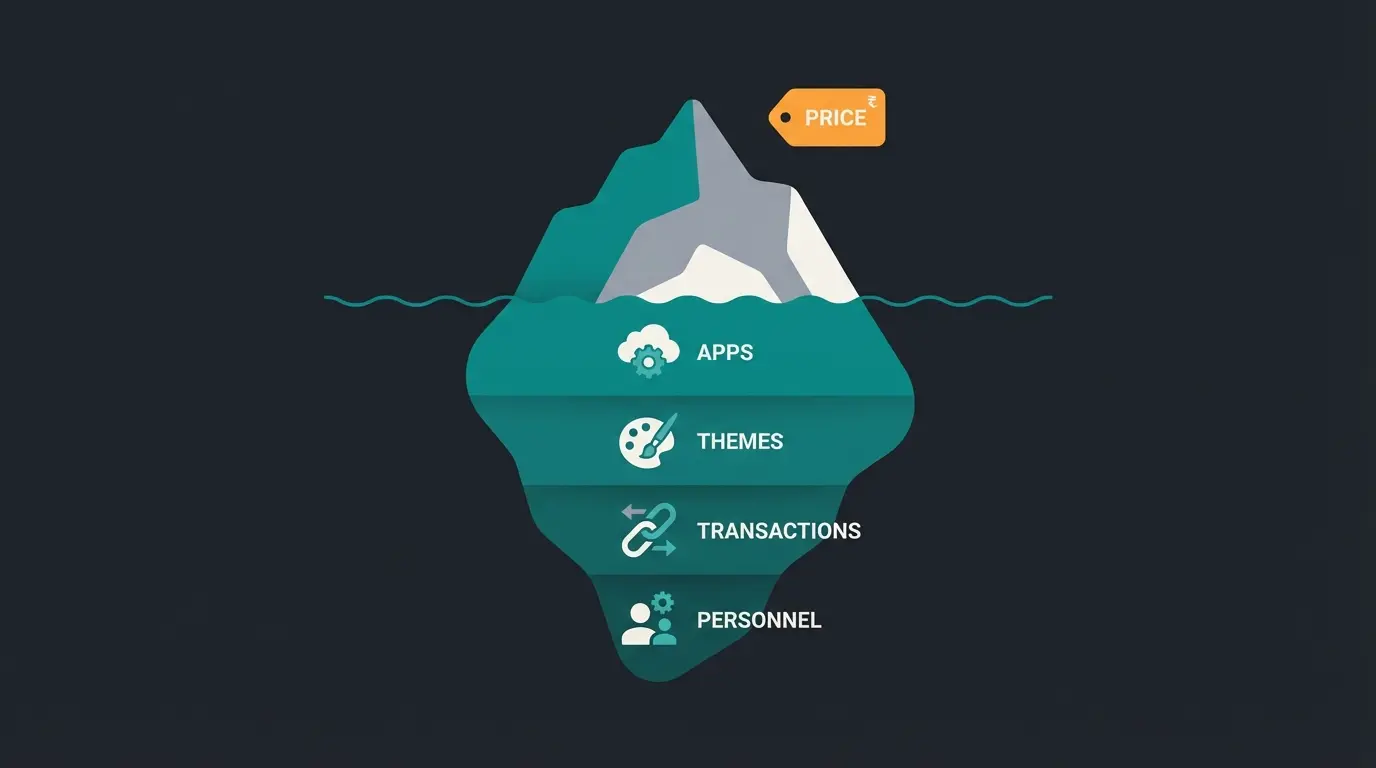
Choosing an e-commerce platform is often a decision that commits you for years to come. Shopify is widely regarded as the most beginner-friendly solution on the market, yet confusion frequently surrounds the topic of Shopify costs. For more details, see our complete Shopify fee breakdown. For more details, see our detailed Shopify POS pricing breakdown. At first glance, the pricing appears straightforward—you can get started from just €33 per month. However, experienced e-commerce managers know: the monthly base price is merely the tip of the iceberg.
Beneath the surface lurk transaction fees, credit card rates, app subscriptions, and theme costs. If you don't calculate precisely, you'll quickly face an unpleasant surprise when your margins start shrinking. According to online-shop-einfach.de, many new store owners underestimate these additional expenses by 40-60%.
In this article, we analyze Shopify prices for 2025/2026 in detail. For a focused answer to the question "How much does Shopify cost?", start with our dedicated Shopify cost guide. We'll not only uncover the obvious fees but also illuminate the often-forgotten content gaps: the costs of personnel versus automation, and how deploying modern AI solutions can drastically reduce the Total Cost of Ownership (TCO) of your store. For a broader overview of the platform, see our complete Shopify guide.
Before apps, fees, and personnel costs
Monthly spend on essential store extensions
What human customer service really costs
Standard stores without optimization
Shopify Base Plans: Which Tier Fits Your Business?
Shopify has adapted its pricing structure specifically for the German market. The good news upfront: there are specific Euro prices for the German market that differ slightly from the US Dollar prices. For a comprehensive breakdown, see our complete Shopify plans comparison. For a detailed monthly cost breakdown, see our recurring expense guide.
Here's the current overview of the three main tiers for 2025/2026:
| Feature | Basic | Shopify (Grow) | Advanced |
|---|---|---|---|
| Monthly Price | €33 (€25 annual) | €88 (€66 annual) | €384 (€279 annual) |
| Target Audience | Beginners & Solopreneurs | Growing Teams & Brands | Scaling Enterprises |
| Staff Accounts | — | 5 additional | 15 additional |
| Transaction Fee* | 2.0% | 1.0% | 0.5% |
| Credit Card Fee (Online) | 2.1% + €0.30 | 1.8% + €0.30 | 1.6% + €0.30 |
| Reports & Analytics | Standard | Professional | Extended / Custom |
Detailed Analysis of Each Plan
Basic Plan (The Entry Point)
For most new stores in Germany, the Basic plan (approximately €33/month) is entirely sufficient. It offers everything you need to get started: unlimited products, 24/7 support, and access to the complete App Store. This makes it comparable to entry-level options you might find when analyzing Shopware costs in 2025.
When should you upgrade? As soon as your monthly revenue exceeds approximately €5,000 to €7,000, switching to the next tier becomes worthwhile purely from the savings on credit card fees (see the Break-Even Analysis section below).
Shopify/Grow Plan (The Standard)
This plan (approximately €88/month) is often referred to as the "Grow" plan. It becomes necessary when you're building a team (5 staff logins) or need more detailed reports to optimize your marketing expenditures. The reduced payment processing fees are the primary argument here. As noted by coding9.de, professional reporting capabilities alone can justify the upgrade for data-driven merchants.
Advanced Plan (The Scaling Solution)
At €384/month, this plan represents a significant investment. It pays off for merchants with high volume (typically from €20,000 - €30,000 monthly revenue), as credit card fees are lowest here (1.6%). Additionally, you get third-party shipping rate calculations at checkout, essential for complex logistics setups.
Special Tiers: Starter and Plus
Shopify Starter (€5/month): This isn't a full-fledged online store. It's a solution for social media sellers (Instagram/TikTok) or bloggers who simply want to integrate a "Buy Button" on an existing website. There's no theme editing and no full shop functionality. According to Shopify's official documentation, it's designed purely for social commerce use cases.
[Shopify Plus](/blog/shopify-plus) (from approximately €2,300/month): The enterprise solution for corporations and brands with millions in revenue. Here you receive dedicated support, B2B functions, and a customizable checkout. Prices are often negotiable and depend on revenue (a variable fee of approximately 0.25% of turnover may apply). Atlasstudios.agency notes that Plus merchants often negotiate custom rates based on their specific business volume.
Variable Costs: The Silent Margin Killers
Many merchants only calculate the Shopify monthly costs (subscription) but forget about the variable costs that accrue with every sale. These divide into two categories that can significantly impact your bottom line.
Transaction Fees (The "Penalty Fee")
Shopify wants you to use their in-house payment gateway, Shopify Payments. If you don't (and instead only use external gateways like a direct bank connection), Shopify charges an additional fee on every transaction. Our full guide on Shopify transaction fees breaks down every rate tier:
- Basic: 2.0% per transaction
- Shopify: 1.0% per transaction
- Advanced: 0.5% per transaction
Payment Provider Fees (Processing Fees)
Even when the Shopify transaction fee is waived, the payment service providers (Visa, Mastercard, Amex) still need to be paid. These costs exist with every shop system (including WooCommerce or Shopware). For the full picture of all recurring charges, see our complete Shopify fees breakdown.
Current fees for Germany (via Shopify Payments):
- Credit Cards (EU): 1.6% to 2.1% + €0.30 per transaction
- Klarna Invoice: Approximately 2.99% + €0.35 per transaction
- Instant Bank Transfer: Approximately 1.4% + €0.25 per transaction
According to Latori's fee breakdown, these rates are competitive with other German e-commerce solutions.
The Hidden Costs: Apps, Themes & Personnel
Here lies the biggest lever in your calculations. While base fees are fixed, costs often explode in the area of extensions and operations. This is what most "Shopify costs" articles fail to adequately address.
Themes (Design)
Free Options: Shopify offers excellent free themes (e.g., "Dawn") that are absolutely sufficient for getting started. According to wedowebsites.de, the free themes have improved significantly and can compete with many premium options.
Premium Themes: A professional theme costs a one-time fee between €140 and €350. This is a one-time investment that pays off for branding and conversion optimization. Uptain.de recommends investing in premium themes for stores expecting over €10,000 monthly revenue.
The "App Trap": When €33 Suddenly Becomes €300
Shopify is modular by design. The base system is lean. For functions like email marketing, upselling, reviews, or subscriptions, you need apps. This is similar to what merchants experience with Shopware plugin costs.
- Average app costs per store: €50 - €200 monthly
- Many apps use a "freemium" model but become expensive once you grow
- Essential functionality gaps force merchants into paid solutions
The Problem: Many merchants install a separate app for every small feature (one for FAQ, one for chat, one for product recommendations). This not only drives up costs but also slows down the store. Learning how AI chatbots transform customer interactions can help consolidate these functions.
The Personnel Cost Gap (The Golden Gap)
Most "Shopify costs" articles ignore the biggest cost factor: human working time. An online store is not self-running. Customers have questions: "Does part X fit with part Y?", "When will my delivery arrive?", "How does the return process work?"
The Traditional Approach: You hire support staff or answer emails yourself.
- Costs for support staff (part-time/full-time): €2,000 - €4,000 per month
- Availability: Monday to Friday, 9 AM to 5 PM
- Training costs and turnover add additional hidden expenses
According to salary data from Jobvector and StepStone, qualified e-commerce support specialists in Germany command salaries of €35,000-€48,000 annually plus benefits.
The Automation Approach: This is where your greatest savings potential lies. Instead of paying personnel for repetitive questions, modern stores deploy AI solutions. Learn more about how you can transform your support operations with intelligent automation.
Investment Not Cost: How AI Saves Your Bottom Line
When we discuss "What does Shopify cost?", we must also discuss "What does Shopify deliver?" A store that doesn't convert visitors into buyers is always too expensive—regardless of how cheap the plan is.
The Problem of "Silent" Stores
Standard Shopify stores are like self-service retail outlets. There are shelves (collections) and products, but no consultation. This is a critical gap that impacts your revenue potential significantly.
- A simple search bar (standard app) might cost €0-20, but it doesn't sell. It only lists results.
- A customer who is uncertain abandons the purchase
- The average conversion rate lies at only 1.4% - 2.5%
According to research by BlendCommerce and TrueProfit, stores that implement consultation features see conversion improvements of 40-80%.
The Solution: AI Sales Consultants
Instead of paying for multiple apps for chat, FAQ, and search while also maintaining support personnel, smart merchants consolidate these functions into AI sales agents. Understanding how AI product consultation works is the first step toward this optimization.
Replace 3-5 separate apps (chat, FAQ, search, recommendations) with one intelligent AI solution
AI handles 70-80% of standard inquiries, reducing support staff requirements
Proactive product consultation boosts conversion rates by 40-80%
Handle peak traffic without hiring additional staff or paying overtime
| Feature | Human Support | AI Sales Agent (App) |
|---|---|---|
| Monthly Costs | €2,500+ (salary + benefits) | €30 - €400 (traffic-based) |
| Availability | 40 hours/week | 168 hours/week (24/7) |
| Response Time | Hours to days (email) | Instant (milliseconds) |
| Scalability | Expensive (more staff needed) | Unlimited (no wait times) |
| Function | Reactive (answers tickets) | Proactive (consults & sells) |
Why This Lowers Your Shopify Costs
1. App Consolidation: A good AI agent replaces the chat app, the FAQ app, and often the search app. This alone can save €100-150/month in app subscriptions. Explore how AI product consultants deliver this consolidation.
2. Personnel Savings: You need fewer support personnel for standard inquiries ("Where is my package?"). Many stores report 50-70% reduction in support tickets. See how this works in practice for Shopware customer service implementations.
3. Conversion Uplift: Unlike a "dumb" search, AI actively consults ("For dry skin, I recommend product X instead of Y"). This increases revenue per visitor, which reduces the relative costs of the store. An intelligent sales consultant can become your highest-ROI investment.
See how our AI sales consultant can replace multiple apps and reduce your support burden while increasing conversions. Join leading e-commerce brands already saving thousands monthly.
Start Your Free TrialCost Calculation Scenarios (TCO Analysis)
To make Shopify prices tangible, let's examine two realistic scenarios for 2026.
Scenario A: The "Hobby Starter"
Goal: Low risk, testing first sales.
- Shopify Plan: Basic (€25 with annual payment)
- Payments: Shopify Payments (approximately €20 in fees on €1,000 revenue)
- Theme: Dawn (Free)
- Apps: Legal texts (e.g., IT-Recht Kanzlei): ~€10, Email Marketing (Klaviyo Free): €0, Standard Review App: €0
- Total Monthly Costs: approximately €55 (fixed + variable)
Scenario B: The "Professional Brand"
Goal: Growth, branding, high service level, €50,000 monthly revenue.
- Shopify Plan: Advanced (€279 with annual payment – worthwhile due to 0.5% lower credit card fees!)
- Payments: Shopify Payments (approximately €800 in fees on €50,000 revenue)
- Theme: Premium (one-time €300, amortized over 2 years: €12.50/month)
- Apps (The Critical Block): Email Marketing (Klaviyo/Omnisend): €150, Legal texts: €25, Upsell App: €50, AI Sales & Support Agent: €200 (Replaces 1/2 support position)
- Total Monthly Costs: approximately €1,516
For merchants considering platform alternatives or omnichannel sales, understanding the full cost picture matters. If you sell in physical locations as well, check our guide to Shopify POS pricing before committing.
When Does Upgrading Pay Off? (Break-Even Calculator)
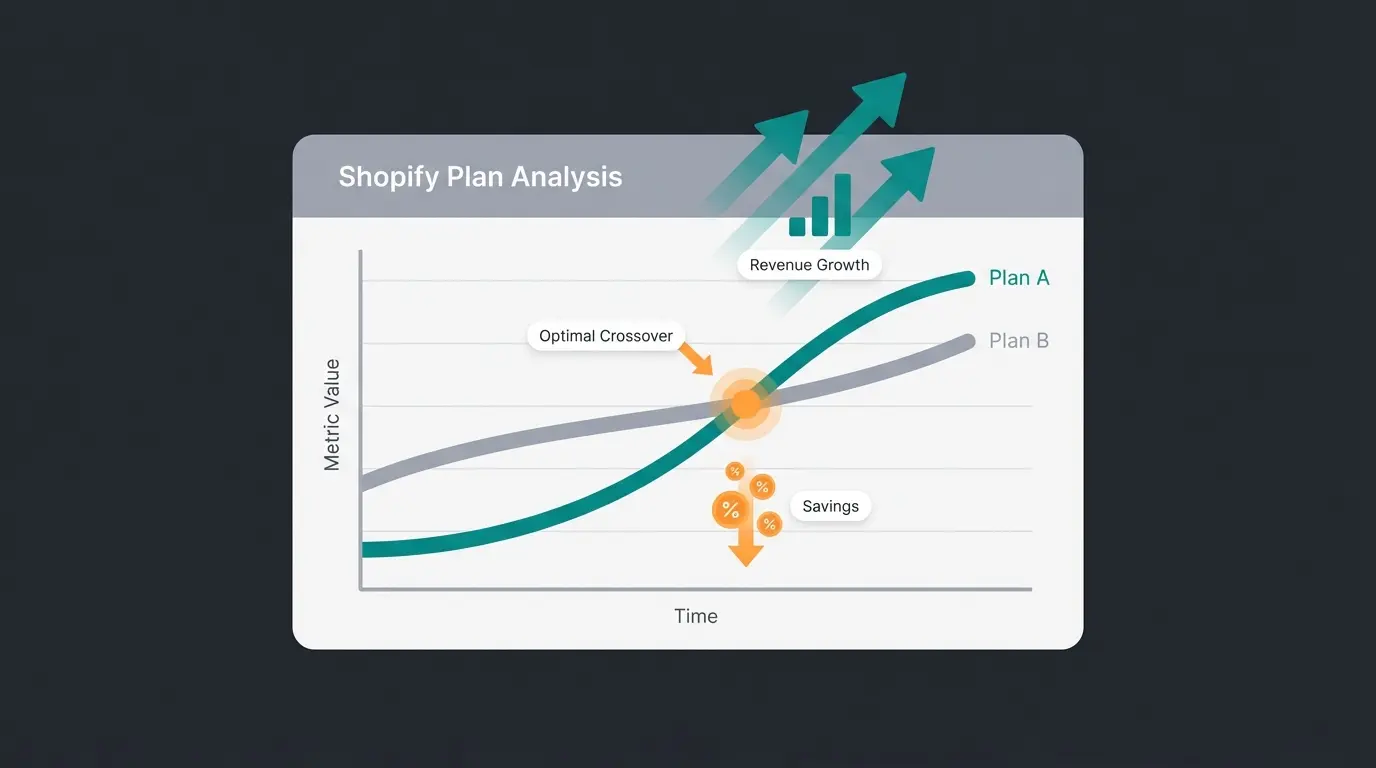
Many merchants ask themselves: "When should I switch from Basic to Shopify (Grow)?" The answer lies in the mathematics of credit card fees.
- Basic: 2.1% + €0.30
- Shopify (Grow): 1.8% + €0.30
- Difference: 0.3% savings per transaction
- Subscription Price Difference: €88 - €33 = €55 additional cost per month
The Calculation
You need to generate enough revenue so that the 0.3% savings covers the €55 additional cost.
`€55 / 0.003 = €18,333`
Money-Saving Tips: How to Reduce Your Shopify Costs
Based on our analysis of successful stores and recommendations from Hyghstreet and Apoio Digital, here are proven strategies:
1. Annual Payment: Shopify grants a 25% discount when you commit for a year. That's a guaranteed return you won't get at any bank. If you have liquidity concerns, start monthly and switch after your first profitable months.
2. Use Shopify Payments: Absolutely avoid the external transaction fee (up to 2%). In Germany, Shopify Payments is now very robust and covers the most important payment methods.
3. Audit and Consolidate Apps: Review your app list monthly. Are you paying for a "Wishlist app" that nobody uses? Paying for a "Chat app" that only creates tickets?
- Strategy: Replace "single-feature apps" with "multi-feature AI"
- An AI that handles product consultation, FAQ, and support often costs less than three separate apps
- You also save the time spent managing multiple app configurations
4. Shipping Labels Through Shopify: Use "Shopify Shipping" (in Germany often via Sendcloud or similar integrations) to benefit from negotiated shipping rates instead of paying retail prices at DHL/Hermes.
Conclusion: Shopify Costs Are Investment Costs
The question "What does Shopify cost?" can no longer be answered with a simple figure in 2026.
For beginners, it's extremely affordable at approximately €33 base fee + minimal app costs. For professionals, it's a scalable platform whose costs (Advanced Plan + Apps) may run into the hundreds but saves thousands in development costs and personnel expenses. And if Shopify turns out not to be the right fit, our guide on how to cancel Shopify walks you through the process.
The Most Important Takeaway
Don't be blinded by the monthly subscription fees. The true cost drivers are inefficient processes and missed sales.
A store that costs €100 per month but only converts 1% of visitors is more expensive than a store that costs €300 (including AI sales agent) but converts 3% of visitors.
Optimize not just your costs, but your value.
FAQ: Common Questions About Shopify Costs
In pure license costs, WooCommerce (free) appears cheaper. But: Once you factor in hosting, security, premium plugins, and developer hours for maintenance, Shopify is often more affordable and, above all, more stress-free (time-to-market). Most professional WooCommerce setups cost €150-300/month when properly maintained.
If you have Shopify Payments activated, no additional Shopify transaction fees (0.5-2%) apply to PayPal payments. You only pay PayPal's own fees. If you have NOT activated Shopify Payments, Shopify additionally charges the transaction fee on PayPal revenue. According to Shopify's official documentation, this is a common point of confusion for new merchants.
If you don't want to build the store yourself: Small setup: €1,500 - €5,000. Individual design & strategy: €10,000 - €50,000+. These are one-time costs. Ongoing operations remain at the monthly rates mentioned above.
Yes, Shopify typically offers a free trial period (often 3 days), followed by an introductory offer (e.g., €1 for the first month), so you can set up your store at leisure before full fees kick in. According to abilita.de, these promotional offers frequently change, so check the current terms.
AI sales consultants can consolidate multiple apps (chat, FAQ, search) into one solution, reduce support staff requirements by 50-70%, and increase conversion rates by 40-80%. This triple benefit means the AI often pays for itself within the first month while providing 24/7 customer service coverage.
Our AI sales consultant replaces multiple expensive apps while boosting your conversion rate. Calculate your potential savings and see why leading e-commerce brands trust our solution.
Calculate Your Savings Now
Lasse is CEO and co-founder of Qualimero. After completing his MBA at WHU and scaling a company to seven-figure revenue, he founded Qualimero to build AI-powered digital employees for e-commerce. His focus: helping businesses measurably improve customer interaction through intelligent automation.