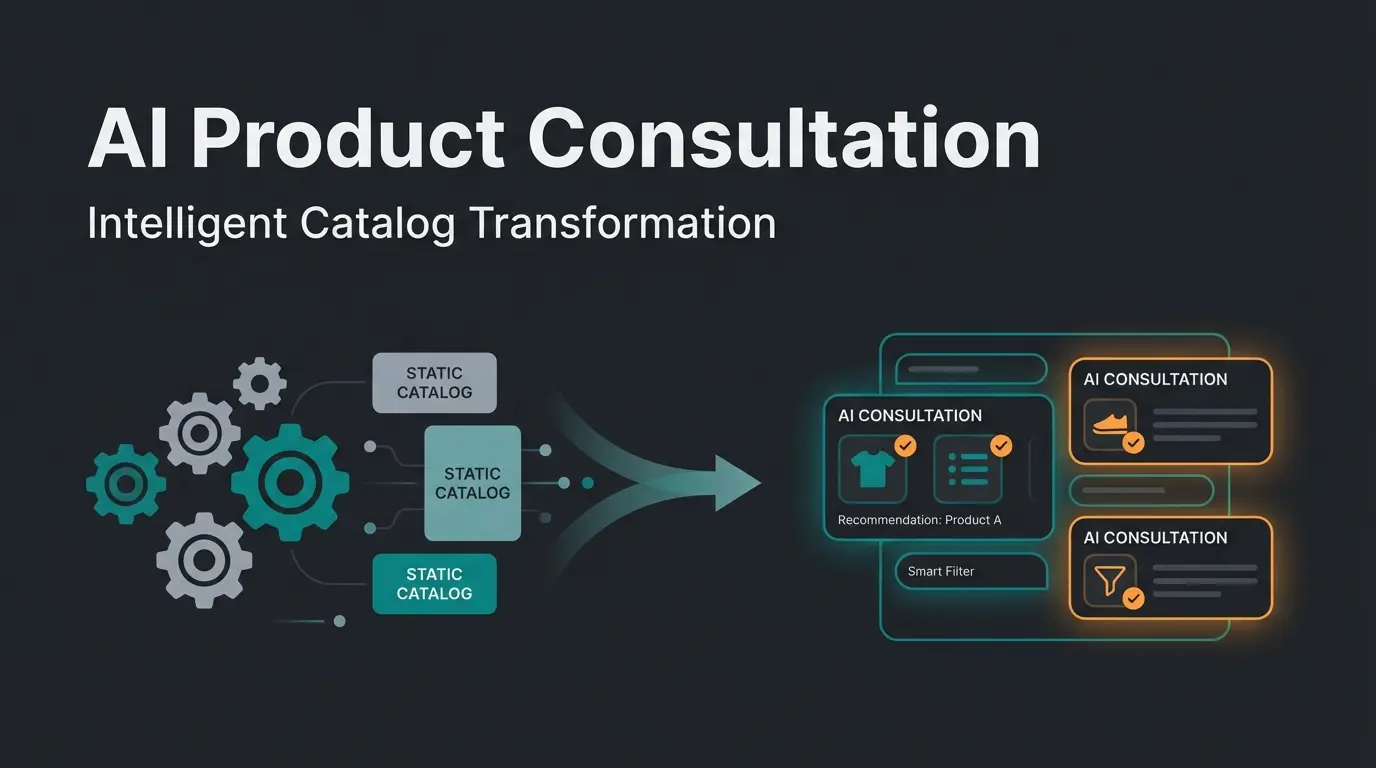
Introduction: The Shopware Landscape in 2025
For online retailers in the DACH region (Germany, Austria, Switzerland), the Shopware world has fundamentally transformed over the past 24 months. The days when you could purchase a one-time license for the "Professional Edition" and depreciate it over years are definitively over. Shopware has completely transitioned to a subscription-based (rental) model, changing how merchants approach their e-commerce infrastructure.
However, the biggest disruption came in March 2025: With the introduction of the Fair Usage Policy, Shopware has drawn a hard line for the popular Community Edition. Anyone generating more than €1 million in Gross Merchandise Volume (GMV) per year must now switch to a commercial plan. This policy shift has forced thousands of growing merchants to reevaluate their platform strategy and budget allocation.
For most ambitious merchants and growing B2B companies, the answer to this mandate is clear: Shopware Rise. With an entry price of €600 per month, Rise positions itself as the successor to the Professional Edition and the natural upgrade path for successful Community Edition users. But many merchants face a critical question: Is Rise really enough? Or will missing B2B features and limited search capabilities force them into the expensive Evolve plan (starting at approximately €2,400/month)?
In this comprehensive guide, we don't just analyze features and costs. We uncover the "Conversion Gap" – a strategic weakness in Shopware Rise that hardly any agency discusses – and show you how to close it with AI-powered product consultation without destroying your budget. Understanding this gap is essential for any merchant looking to maximize their return on platform investment.
What is Shopware Rise? (Definition & Target Audience)
Shopware Rise represents the commercial entry point into the Shopware universe for merchants who need professional support and advanced marketing tools but aren't (yet) running enterprise-level infrastructure. It's designed as the bridge between the free Community Edition and the feature-rich Evolve and Beyond tiers, offering a balanced combination of capabilities and cost.
Who is Rise designed for?
According to current market data and Shopware's official positioning, Rise targets two primary merchant segments. The first group consists of ambitious B2C brands – direct-to-consumer brands with revenue between €500,000 and €5 million GMV who need professional tools without enterprise complexity. The second segment includes smaller B2B scenarios – businesses selling to corporate customers who don't need to map complex rights-role structures or budget approvals within their shop.
When comparing Rise Evolve Beyond editions, Rise stands out as the sweet spot for growing businesses. It provides enough power to handle significant traffic and transaction volumes while maintaining manageable costs and complexity levels that don't require dedicated development teams.
The Difference from the Old Professional Edition
While the old Professional Edition was often understood as a "software purchase" with a one-time fee, Rise is fundamentally a service package. This distinction matters because it changes the value proposition entirely. The subscription includes manufacturer support with direct access to Shopware's support team with response times under 8 hours, as documented on Shopware's official support page. It also encompasses updates and maintenance through continuous development without major version jumps, and exclusive features including access to tools like the Flow Builder Professional and the AI Copilot that are missing or restricted in the Community Edition.
Feature Deep Dive: The Strengths of Shopware Rise
Before we discuss what's missing, we need to understand what Rise does extremely well. Shopware has integrated powerful tools that previously required expensive plugins, making Rise a genuinely capable platform for serious e-commerce operations.
The Flow Builder: Automation Without Code
The heart of Rise is the Flow Builder. It allows you to automate complex business processes using an "if-then" principle without writing a single line of code. This visual automation tool democratizes process optimization, making it accessible to marketing teams and shop managers rather than requiring developer resources.
Consider this practical example: If a customer from the "VIP" customer group places an order and the cart value exceeds €500, then send a Slack notification to the sales team and add a free gift to the order. According to Shopware's Flow Builder documentation, this type of multi-condition automation previously required custom development or expensive third-party solutions.
The Rise advantage is significant: In the Rise Edition, you can share flows between team members (Share Flows feature) and utilize more complex triggers than in the Community Edition. This collaborative capability means your team can build upon each other's work and standardize processes across departments, as detailed in Shopware's official documentation.
The Rule Builder: Granular Logic Engine
The Rule Builder works hand-in-hand with the Flow Builder, defining the conditions that trigger your automations. You can create rules such as: "Customers from Switzerland who have products from the 'Electronics' category in their cart." These rules then control prices, shipping methods, or content display throughout the customer journey.
Understanding how AI transforms rules within Shopware opens up powerful personalization possibilities. The Rule Builder's flexibility allows merchants to create sophisticated customer segmentation without complex coding, enabling personalized experiences that rival much more expensive enterprise solutions.
Shopware AI Copilot (Backend Focus)
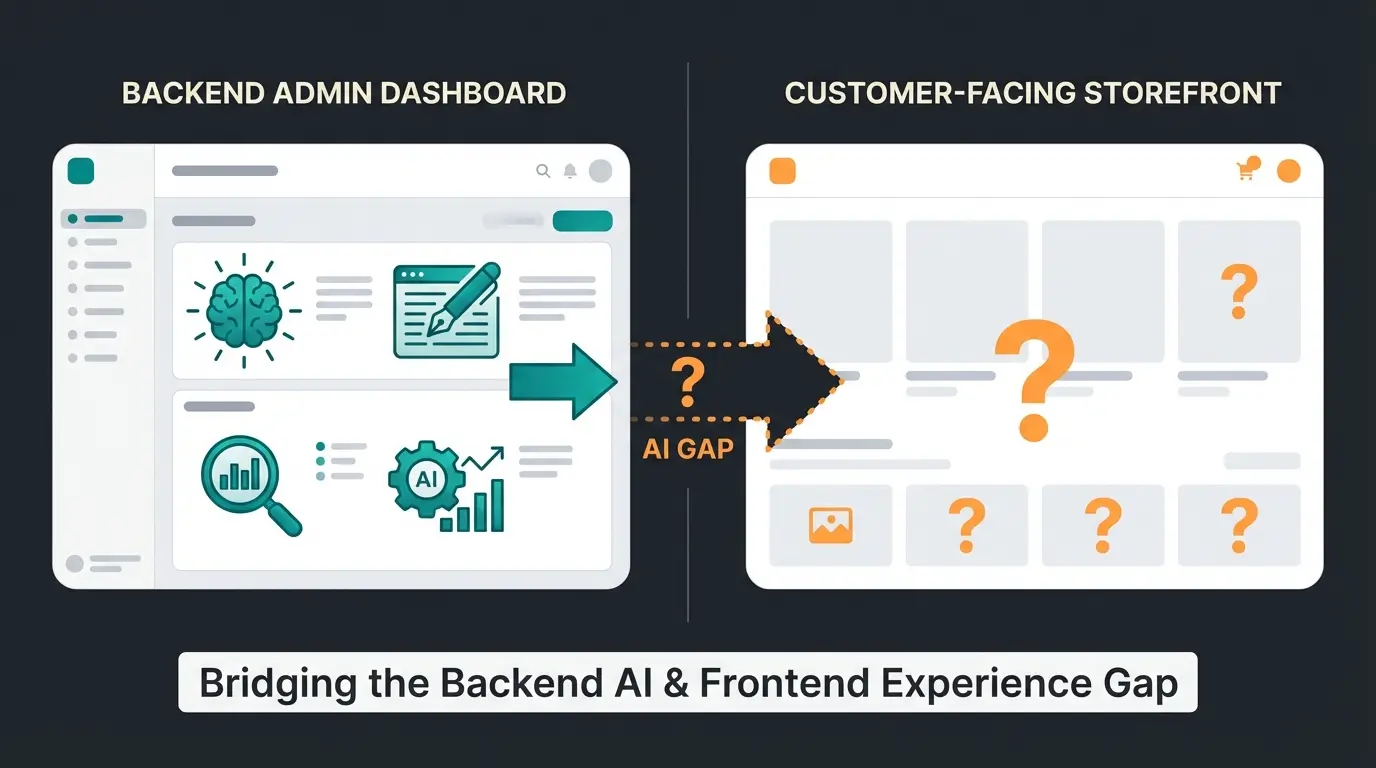
Shopware markets Rise heavily with its AI capabilities, and these features are genuinely impressive. However, they have a clear focus: efficiency for the merchant (backend operations) rather than customer-facing interactions. According to Shopware's AI documentation, the AI Copilot is designed to streamline administrative tasks and content creation.
The top AI features in Shopware Rise include AI-generated product descriptions that create compelling text based on bullet points and product attributes, an image keyword assistant that analyzes images and automatically sets alt-tags and keywords for SEO, review summaries that condense lengthy customer reviews into actionable insights, and an export assistant that helps with CSV exports through natural language commands.
Critical to understand: These tools help you manage the shop faster and more efficiently. They do not directly help the customer find the right product during their shopping journey. This distinction becomes crucial when we discuss the Conversion Gap later in this article.
The Comparison: Shopware Rise vs. Evolve vs. Beyond
The most common question in sales conversations is: "Do I really need to pay €2,400 for Evolve?" Here's a hard fact-check based on 2025 data from multiple sources including Qualimero's B2B pricing analysis and official Shopware documentation.
| Feature / Aspect | Shopware Rise | Shopware Evolve | Shopware Beyond |
|---|---|---|---|
| Price (starting) | €600 / month | ~€2,400 / month | ~€6,500 / month |
| Target Audience | B2C & simple B2B | B2B & Scaling | Enterprise |
| B2B Suite (Native) | ❌ (Plugins only) | ✅ (Budgets, Roles, Quotes) | ✅ |
| Search | Standard Search | Advanced Search (Elasticsearch) | Advanced Search |
| Support | 8h response time | 4h response time | 1h (24/7) |
| CMS Rules | ✅ | ✅ (Extended) | ✅ |
| Multi-Inventory | ❌ | ❌ | ✅ |
| Flow Builder | Professional | Advanced (Webhooks) | Advanced |
The "Evolve Trap" Explained
Many merchants get upsold to Evolve because they want one specific feature – often the Advanced Search or simple B2B functions (like net price lists). Understanding when this upgrade makes sense and when it doesn't can save your business thousands of euros annually.
The reality: For many of these functions, the Shopware Store offers excellent plugins that cost €500 one-time or €50 monthly, instead of permanently increasing your license cost by €1,800/month. As noted in the Qualimero B2B edition comparison, the math often favors a plugin approach unless you need multiple enterprise features simultaneously.
When Evolve is mandatory: If you need to map complex company structures for your customers (e.g., a purchaser can only order up to €500, above that the department head must approve), then Evolve's native B2B Suite is genuinely without alternative. The integrated approval workflows and budget management simply cannot be replicated cost-effectively with plugins.
Base subscription for professional e-commerce
License fees as percentage of total ownership costs
Compared to Evolve upgrade for similar capabilities
Potential uplift with AI consultation vs standard filters
The "Conversion Gap": Where Shopware Rise Hits Its Limits
Now we arrive at the critical point that official brochures often gloss over. Shopware Rise is a fantastic system for managing and displaying products with professional-grade tools. But it's inherently weak at actively selling products through guided customer experiences.
The Problem of "Silent Filters"
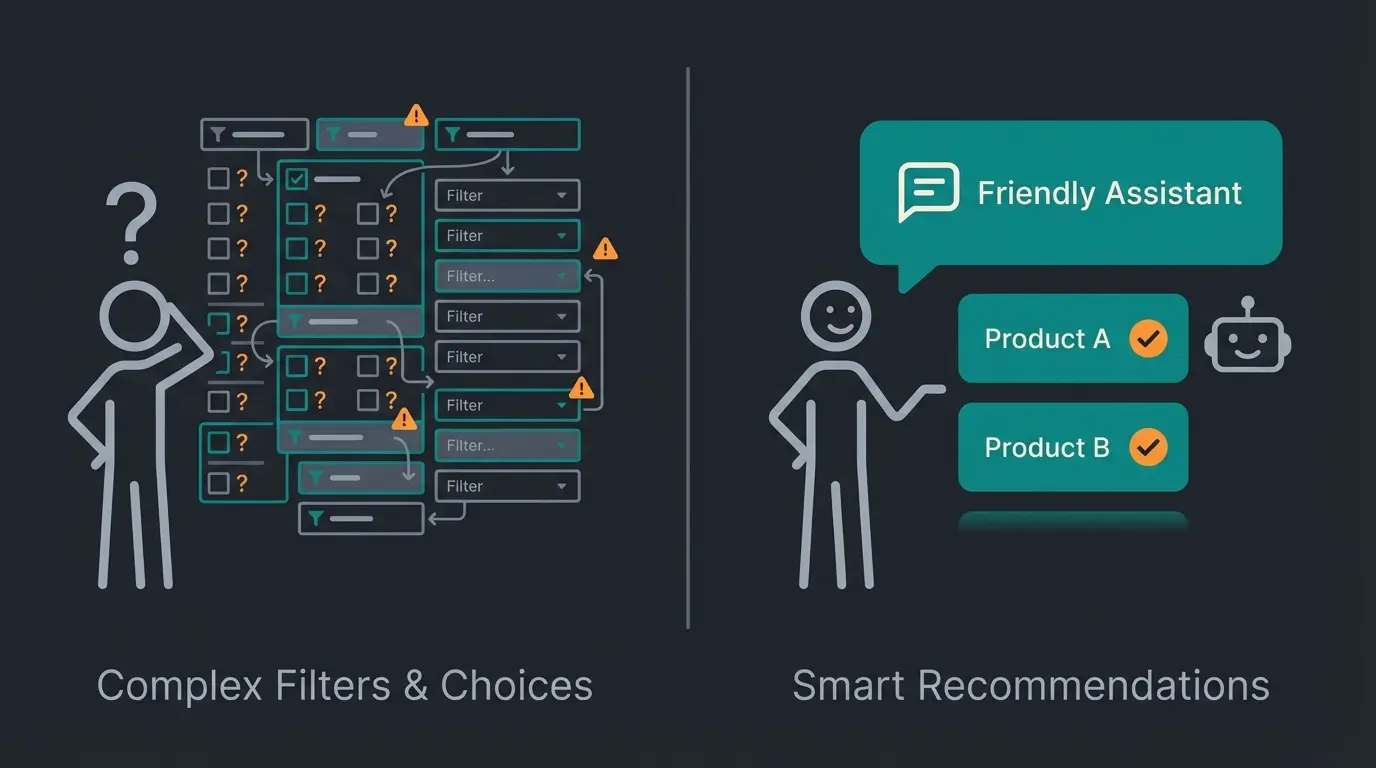
Imagine you sell e-bikes, premium cosmetics, or technical components – products where customers need guidance rather than just navigation. A customer arrives at your Shopware Rise shop. What do they see? First, a category page with product thumbnails. Second, a left column with filters: "Color", "Price", "Weight", "Brand". That's inventory management visualization, not sales consultation.
When the customer doesn't exactly know which technical specifications they need, they're lost in a sea of options. They either leave the shop (increasing bounce rate) or purchase the wrong item (driving up return rates). Both outcomes directly impact your bottom line and customer lifetime value.
This is where AI product consultation becomes essential. The gap between product availability and purchase decision represents lost revenue that traditional e-commerce tools simply cannot address. Standard search and filter interfaces assume customers know what they want – but complex products require consultation, not just navigation.
The Limitations of Native AI Copilot
As mentioned above, the Shopware AI Copilot is fundamentally a backend tool designed for merchant efficiency. It writes texts for you to publish, it classifies customers for you to segment, and it analyzes data for you to make decisions. However, it does not speak directly with the customer during their shopping journey.
There is no native "salesperson" in Shopware Rise (or even in Evolve) that asks the customer: "What will you be using this e-bike for? Mostly commuting to work or weekend trail adventures?" This conversational selling approach, standard in physical retail, is completely absent from the standard Shopware experience.
This creates the Conversion Gap: You have traffic (expensively acquired through marketing), you have products (expensively stored in inventory), but nobody to close the sale and guide customers to confident purchases. Addressing this gap through AI-powered consultation represents the highest-leverage investment most Rise merchants can make.
The Solution: Rise + Frontend AI (The "Smart Rise" Stack)
Instead of burning your budget on an upgrade to Shopware Evolve (which primarily brings backend features), you should invest in a Frontend AI solution. This is your "Blue Ocean" strategy for 2025 – differentiating through customer experience rather than competing on platform features.
The Concept: Backend AI vs. Frontend AI
Understanding this distinction is crucial for making smart technology investments. Backend AI (Shopware Native) focuses on efficiency and saves time in shop management and content creation. Frontend AI (Add-on) focuses on revenue generation by increasing conversion rates and average order values through guided selling experiences.
The AI capabilities available for modern e-commerce platforms have evolved dramatically. While native platform AI handles operational tasks, specialized frontend AI transforms how customers interact with your product catalog. Both are valuable, but they solve fundamentally different problems.
Why "Rise + Sales AI" Beats "Evolve Pure"
For a merchant with €2 million revenue, the calculation often looks like this, and understanding it can transform your technology budget allocation:
Scenario A: Upgrade to Evolve involves additional costs of +€1,800/month compared to Rise. The added value includes better search and B2B rights management. However, the impact on conversion is minimal – the search is faster, but it still doesn't advise customers or guide their decisions.
Scenario B: Keep Rise + Integrate Sales AI means costs of Rise (€600) plus AI tool (approximately €200-500). This creates savings of over €1,000/month compared to Evolve while providing a digital sales consultant available 24/7 on your site. The impact on conversion is high – studies show that guided selling (Guided Selling) can increase conversion rates by up to 4x compared to standard filter navigation.
How AI consultation drives ROI becomes clear when you shift from cost-focused to revenue-focused thinking. The question isn't "what does the software cost?" but "what does each visitor generate?" This paradigm shift unlocks dramatically better returns on platform investment.
Both journeys start identically with a customer clicking 'Running Shoes'
Customer sees 50 products and filters like 'Cushioning: Strong/Medium' - confusion sets in
AI Chat asks: 'Where do you usually run? Asphalt or trails?' - engagement begins
Uncertain customer googles 'cushioning meaning' - may not return to your shop
Customer answers 'Forest, often muddy' - AI recommends specific trail shoes with reasoning
Standard: Cart abandonment or random purchase. AI: Confident purchase plus relevant upsells
Case Study: The Difference in User Flow
| Standard Shopware Rise (Filters) | Shopware Rise + AI Consultant |
|---|---|
| Customer clicks on 'Running Shoes' | Customer clicks on 'Running Shoes' |
| Sees 50 products and filter 'Cushioning: Strong/Medium' | AI Chat/Widget asks: 'Where do you usually run? Asphalt or forest?' |
| Customer is unsure, googles 'cushioning meaning' | Customer answers: 'Forest, often muddy.' |
| Customer possibly doesn't return | AI recommends: 'Take the SpeedCross 5. It has the best tread for mud and is waterproof.' |
| Result: Abandonment or random purchase | Result: Purchase with confidence + Upsell (waterproofing spray) |
This comparison demonstrates why AI-powered product consultation represents the highest-impact investment for Rise merchants. The technology doesn't replace your product catalog – it makes your existing catalog dramatically more effective at converting browsers into buyers.
See how AI-powered product consultation transforms Shopware Rise into a high-converting sales machine – without expensive Evolve upgrades.
Start Free TrialImplementation Strategy: Your Roadmap for 2025
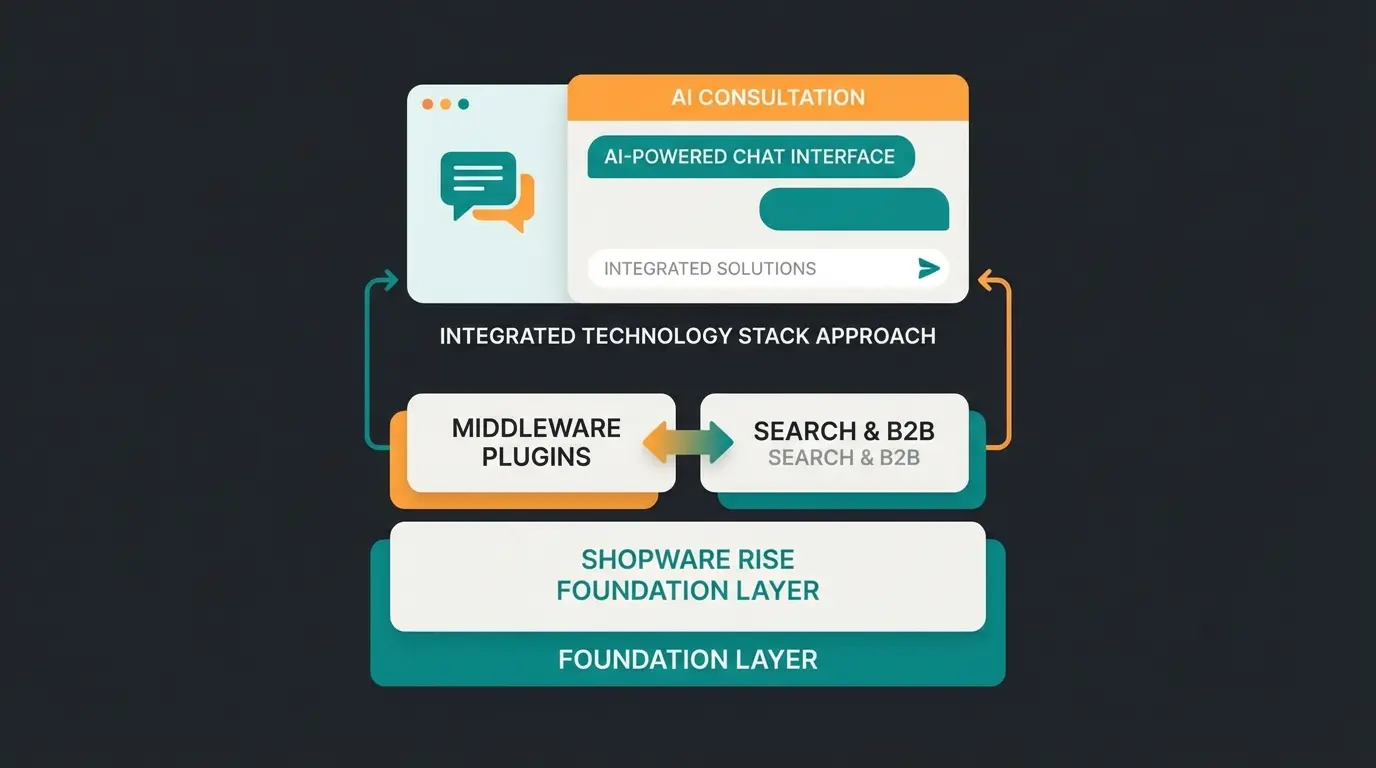
If you decide on Shopware Rise, you shouldn't use it "naked" without strategic enhancements. Build a technology stack that actively sells, not just displays products.
Step 1: The Foundation (Shopware Rise)
Use the €600 license as your solid foundation. Configure the Flow Builder to automate your internal processes (invoice creation, email sequences, inventory alerts). This saves personnel costs through operational efficiency and often pays for the license cost alone through time savings.
The AI sales assistants available in the market can complement these backend automations with customer-facing intelligence. Focus first on getting your operational house in order before adding sales acceleration tools.
Step 2: Fill the Gaps (Best-of-Breed Approach)
For Search Enhancement: If the standard search doesn't meet your needs, use specialized search plugins (e.g., Doofinder or Algolia) instead of switching to Evolve just for search capabilities. These dedicated solutions often outperform native platform search anyway.
For B2B Requirements: For simple B2B needs (net prices, quick order forms), according to ThemeWare.design, plugins in the Shopware Store can retrofit missing Evolve features for a fraction of the price. Only upgrade to Evolve when you need the full B2B Suite with approval workflows.
Step 3: The Turbo (AI Sales Agent)
Integrate an AI solution that acts as a Product Consultant for your customers. Ensure the AI has access to your product data via API so recommendations are always accurate and current. The AI should not just "chat" (like generic ChatGPT) but actively sell – suggesting products from your catalog and enabling direct add-to-cart actions.
The AI-powered consultation hub approach transforms passive browsing into active selling. Look for solutions that understand your specific product domain and can have genuinely helpful conversations about use cases, compatibility, and recommendations.
Step 4: Measure & Optimize (TCO vs. ROI)
Shift your focus from "What does the software cost?" to "What does each visitor bring in?" This mental model change transforms how you evaluate technology investments:
An Evolve upgrade costs you approximately €21,600 more per year than Rise. If you instead invest that money in traffic acquisition and a conversion AI, the ROI is almost always higher – unless you're a complex B2B corporation requiring native enterprise features.
Understanding this equation is why AI product consultation has become the priority investment for growth-focused merchants. The leverage on conversion improvements far exceeds the leverage on operational cost savings.
Total Cost of Ownership: Rise + AI vs. Evolve
To make the business case crystal clear, let's examine the actual cost comparison between upgrading to Evolve versus enhancing Rise with specialized AI tools. This analysis addresses the AI consultation gap that many merchants overlook when making platform decisions.
| Cost Category | Shopware Evolve | Shopware Rise + AI |
|---|---|---|
| Monthly License | €2,400 | €600 |
| AI Consultation Tool | Included (backend only) | €300-500 |
| Search Enhancement | Included | €100-200 (plugin) |
| Total Monthly | €2,400 | €1,000-1,300 |
| Annual Difference | Baseline | Save €13,200-16,800/year |
| Frontend Sales AI | ❌ Not included | ✅ Active customer consultation |
| Conversion Impact | Minimal improvement | Up to 4x conversion increase |
The numbers speak clearly: staying on Rise while investing in specialized tools delivers better ROI for most merchants. The AI-powered product consultation approach isn't just cheaper – it's actually more effective at the specific goal of increasing sales conversions.
Conclusion: Is Shopware Rise Enough?
Yes, for 90% of merchants, Shopware Rise is absolutely sufficient – if you supplement it correctly with the right tools and strategy.
The fear of missing features drives many merchants unnecessarily into expensive enterprise plans. The reality in 2025 is clear and should guide your decision-making:
- The Community Edition is effectively dead for professional players (over €1M GMV) due to the Fair Usage Policy enforcement
- Shopware Rise provides a solid foundation for logistics, checkout, and product management at a reasonable cost point
- The competitive advantage doesn't come from the Shopware edition itself, but from what you build on top of it: intelligent, automated customer consultation
Our recommendation: Stay with Rise. Use the saved budget (compared to Evolve) to transform your shop from a "self-service store" into a "high-end consultation experience." That's the lever that determines market share in 2025 and beyond.
The merchants who win aren't those with the most expensive platform licenses – they're the ones who close the Conversion Gap with smart technology choices. Shopware Rise provides everything you need for operational excellence; frontend AI provides everything you need for sales excellence.
FAQ: Common Questions About Shopware Rise
Yes. Considering that hosting, support, and updates are included or secured, the price is market-appropriate. Additionally, the automation tools (Flow Builder) are extremely powerful and save personnel costs that quickly amortize the €600. When you factor in the alternative costs of managing a self-hosted solution, Rise often represents better value than the Community Edition for businesses at scale.
Yes. Shopware Rise includes the native AI Copilot for backend tasks (texts, images, exports). However, for frontend AI (customer consultation that actively helps shoppers find products), you need to connect external tools, as Shopware doesn't natively offer this depth of customer-facing AI. The distinction between backend efficiency AI and frontend sales AI is crucial for understanding your options.
Since March 24, 2025, the Fair Usage Policy is in effect. You are contractually obligated to report your revenue. If you exceed the threshold, you must upgrade to Rise (or higher), otherwise you lose access to your Shopware Account, security updates, and the Plugin Store. This policy is actively enforced, so compliance is not optional.
Conditionally. For "Light B2B" scenarios (business customers simply ordering products), it's completely sufficient. However, once you need features like approval workflows, budget limits per employee, or individual price lists per customer, you either need plugins or must switch to Shopware Evolve. The native B2B Suite in Evolve handles complex corporate purchasing structures that plugins cannot fully replicate.
With Rise, you have a response time of 8 hours (business days). With Evolve, it's 4 hours. For most merchants, the 8-hour support is sufficient as long as they have a competent agency partner who can handle routine issues. The faster Evolve support becomes important primarily for high-volume merchants where every hour of downtime has significant revenue impact.
Don't let the Conversion Gap hold back your growth. Our AI-powered product consultation turns your Rise store into a 24/7 sales machine.
Get Started Free
Lasse is CEO and co-founder of Qualimero. After completing his MBA at WHU and scaling a company to seven-figure revenue, he founded Qualimero to build AI-powered digital employees for e-commerce. His focus: helping businesses measurably improve customer interaction through intelligent automation.