Introduction: The TCO Trap in B2B E-Commerce
When business executives and e-commerce managers consider a relaunch or migration to Shopware 6, one question typically dominates their meetings: "What will this cost us?"
Excel spreadsheets get scrutinized, license fees for Shopware editions get compared, and hosting costs get weighed against agency hourly rates. The result is a classic Shopware cost-benefit analysis with one critical flaw: it's one-sided. It views the online shop as a cost center to be optimized, rather than a sales engine to be scaled.
In the demanding DACH region, where B2B buyers expect technical precision and expert consultation, simply making products "available" is no longer enough in 2025. The market is saturated with "order taker" shops—digital catalogs that wait for customers to know exactly what they need.
The true Shopware ROI (Return on Investment) doesn't come from saving €200 on your license. It comes from closing the "Consultation Gap"—the advisory void that costs you sales every day. When your Shopware shop uses AI-powered guided selling to answer complex technical questions as competently as your best sales representative, your economic metrics change dramatically.
This article delivers no generic formulas. Instead, we present a detailed framework for recalculating your Shopware investment ROI—based on revenue uplift through AI, not just cost cutting.
The Traditional Approach: Classic TCO Analysis
To understand why we need to rethink ROI, let's first examine the status quo. Most companies calculate their Shopware Total Cost of Ownership (TCO) using a standardized approach. This is necessary for budget approval, but deadly for growth strategy when it remains the only metric.
Base Costs: Shopware Editions & Licenses
Since the licensing model change in September 2022 and the adjustments for 2025, companies must choose between monthly subscriptions. Notably, the free Community Edition is effectively eliminated for shops with more than €1M GMV (Gross Merchandise Volume) due to the "Fair Usage Policy" starting in 2025, according to Qualimero's analysis.
Here's the typical cost structure that appears in TCO calculations, with data confirmed by Shopware's official documentation:
| Cost Factor | Shopware Rise | Shopware Evolve | Shopware Beyond |
|---|---|---|---|
| License (monthly) | from €600 | from ~€2,400 | from ~€6,500 |
| Target Audience | B2C & smaller B2B | Ambitious B2B mid-market | Enterprise & corporations |
| Key Features | Flow Builder, AI Copilot | B2B Suite, Advanced Search | Multi-Inventory, Subscriptions |
| Support Level | Silver (8h response) | Gold (4h response) | Platinum (24/7, 1h) |
Hidden Operating Costs
In addition to license costs, TCO calculators typically include:
- Hosting: €150 to €1,000 per month (depending on traffic and performance requirements)
- Agency & Maintenance: Ongoing updates, security patches, and minor adjustments (often €1,000 - €5,000 monthly)
- Transaction Fees: Payment provider costs (PayPal, Stripe, etc.)
The Problem: The "Race to the Bottom" Mentality
Those who calculate Shopware ROI only as `(Revenue - TCO) / TCO` tend to minimize TCO. This leads to fatal decisions:
- Cutting corners on User Experience (UX) ("We'll take the standard theme")
- Forgoing intelligent search and consultation tools ("The default search is sufficient")
- The Result: A shop that's cheap to operate but has below-average conversion rates
In a market where B2B e-commerce volume is estimated to exceed $20 trillion by end of 2024, according to CommerceBuild research, "saving" is the wrong strategy. The opportunity costs of lost revenue due to poor consultation are many times higher than any license fee savings.
The New Approach: The Consultation Gap in B2B E-Commerce
Why do B2B shops often convert worse than B2C shops? The average conversion rate in B2B e-commerce lies between 1.8% and 2.9% according to current benchmarks from SerpSculpt and Predictable Profits. In comparison, top performers in B2C (e.g., cosmetics) achieve rates above 6%, as noted by Envive AI.
The reason isn't price—it's complexity.
The Iceberg Model of Lost Revenue
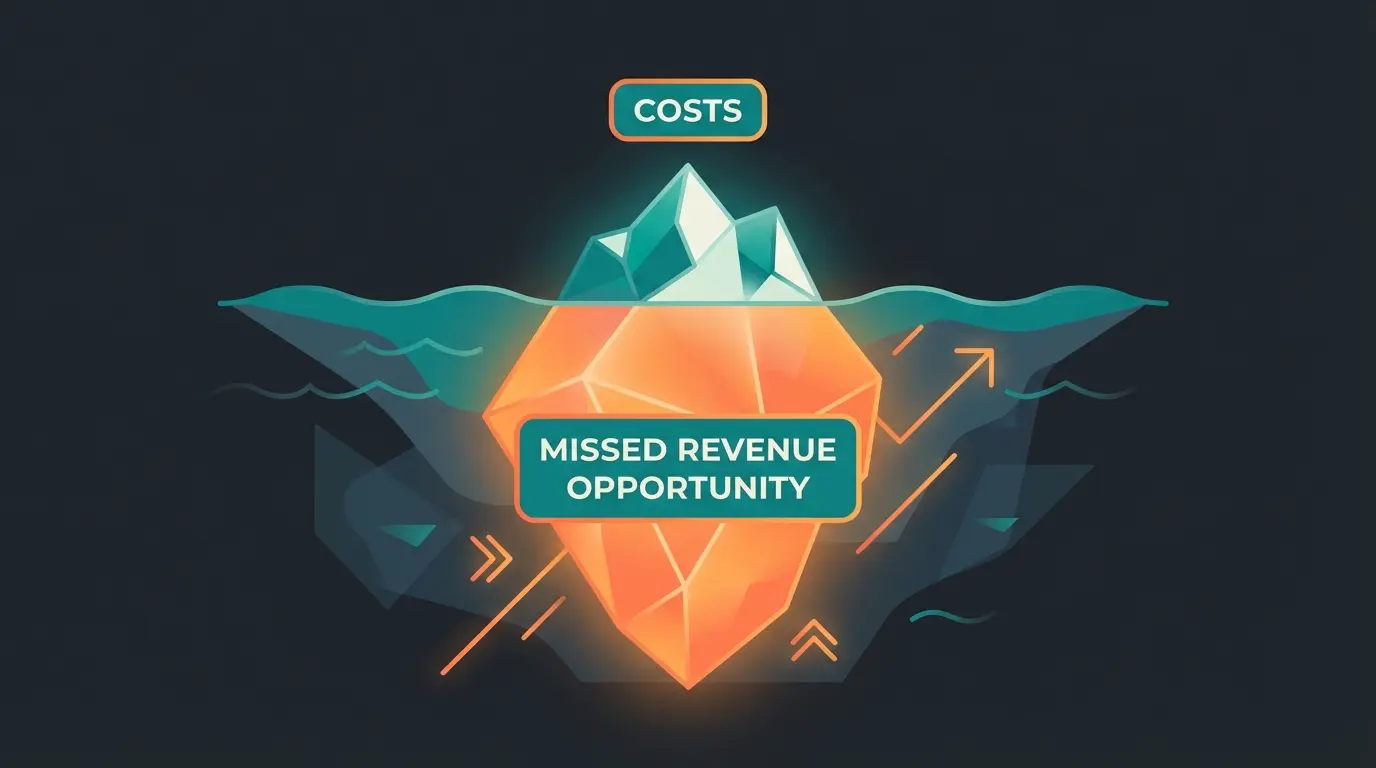
Imagine your Shopware ROI like an iceberg:
- Above water (visible): Platform license and project costs. This is what procurement discusses.
- Below water (invisible): The Consultation Gap. These are the 98% of visitors who leave your shop—not because the product was too expensive, but because they weren't sure which product was right for their technical problem.
Without making a purchase due to product uncertainty
B2B sales interactions will be digital by 2025
Industry benchmark conversion rate
B2B Buyers Want Self-Service, Not Abandonment
Studies show that by 2025, approximately 80% of B2B sales interactions will occur digitally, according to BookYourData research. At the same time, B2B products require explanation. A customer searching for an industrial pump needs to know:
- Does the flange connection fit the DIN standard?
- Is the seal resistant to acid X?
- What's the maximum flow rate at pressure Y?
A standard online shop (category tree + filters) often overwhelms customers here. They need to be experts themselves to set filters correctly. If they can't find the product within 30 seconds, they abandon and call sales (expensive for you) or go to a competitor (lost revenue).
The Solution: ROXA (Return on Experience Architecture)
Instead of TCO, we should consider ROXA—the Return on Experience, as described by AppsFlyer and Apptrove. ROXA measures how investments in customer experience (CX) impact Customer Lifetime Value (CLV) and conversion rates.
This is where Shopware AI guided selling comes into play. It's not about a simple chatbot that answers "Where's my package?" It's about a Digital Product Consultant that actively guides customers through their purchase journey.
Comparison: Passive Chatbot vs. Active AI Consultant
| Feature | Standard FAQ Bot (Cost Reduction) | AI Product Consultant (Revenue Growth) |
|---|---|---|
| Primary Goal | Avoid support tickets | Drive purchase decisions |
| Interaction Style | Reactive ("How can I help?") | Proactive ("Looking for high-pressure or low-pressure pump?") |
| Data Source | Static text snippets | Dynamic PIM data, attributes, inventory |
| ROI Lever | Saves personnel costs in support | Increases conversion rate & cart value |
| Shopware Integration | Often external plugin | Deeply integrated (e.g., via Digital Sales Rooms / AI Copilot) |
With AI product consultation, you can transform how customers discover and purchase complex products. This approach to conversational commerce represents the future of B2B e-commerce.
Calculating the ROI of AI Product Consultation
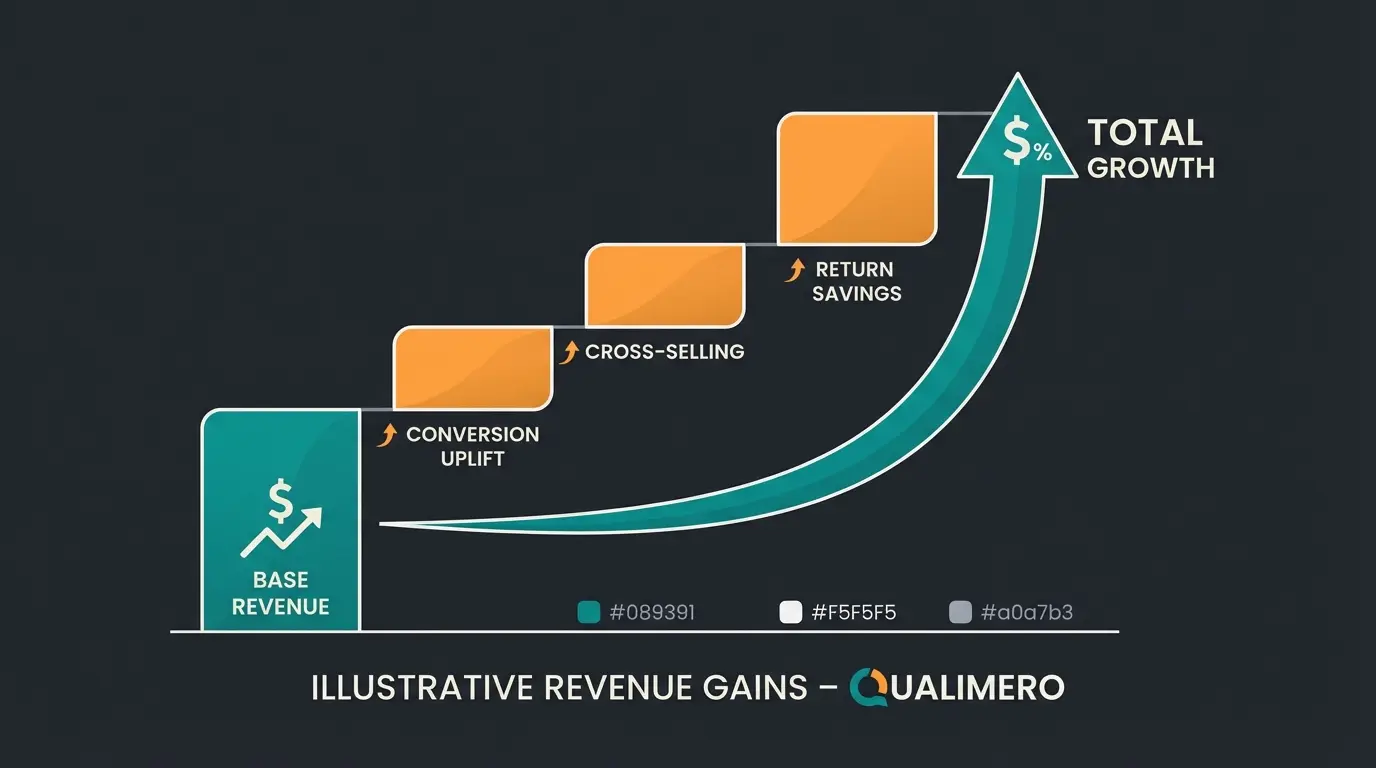
Let's get to the hard numbers. How do you calculate Shopware ROI when implementing guided selling? We use three main levers: Conversion Rate Uplift, Average Order Value (AOV) Increase, and Return Rate Reduction.
Lever 1: Conversion Rate (CR) Uplift
Data shows that customers who use a product finder or guided selling convert significantly better. While the average sits around 2%, users of guided selling tools often achieve conversion rates that are 40% to over 100% higher, according to Aiden.cx research.
The Logic: Uncertainty ("Will this part fit?") is eliminated.
The Calculation:
- Traffic: 50,000 visitors/month
- CR without AI: 2.0% = 1,000 orders
- CR with AI (conservative +25% uplift): 2.5% = 1,250 orders
- Result: 250 additional orders per month without additional marketing budget
Lever 2: Average Order Value (AOV) Increase
An intelligent AI consultant doesn't just sell the main product—exactly like a good human salesperson—it sells the necessary accessories as well. When AI transforms static rules into dynamic recommendations, cross-selling becomes natural.
- Human: "If you're buying this cylinder, you'll also need the seal kit, otherwise it'll leak in 3 months."
- Shopware AI: Can replicate exactly this logic through cross-selling rules or AI recommendations, as detailed by FireBearStudio.
The Calculation:
- AOV without AI: €200
- AOV with AI (+10% through cross-sell): €220
Lever 3: Return Rate Reduction
Germany is the "returns world champion." In 2024/2025, approximately 550 million return packages are expected, according to Retourenforschung.de. In B2B, returns are particularly expensive, with process costs (inspection, restocking, depreciation) often ranging between €10 and €50 per return, as noted by EHI.org.
The Logic: Those who buy the right product through guided selling don't return it.
The Calculation:
- Return rate without AI: 15%
- Return rate with AI: 10% (reduction by 1/3 through accuracy)
The ROI Scenario: Hidden Champion GmbH Case Study
Let's calculate these levers in a concrete scenario for a fictional B2B company, "Hidden Champion GmbH." This model demonstrates how Shopware B2B pricing investments translate into revenue growth.
Starting Point (Status Quo with Standard Shop)
- Annual Online Revenue: €5,000,000
- Number of Orders: 25,000 (at €200 AOV)
- Conversion Rate: 2.0%
- Return Rate: 15% (3,750 returns)
- Cost per Return: €20
Investment in Shopware Evolve + AI Guided Selling
- Additional license costs (upgrade to Evolve + AI tools): ~€30,000/year
- One-time implementation (agency): €50,000
The ROI Model After 12 Months
| Metric | Status Quo (Without AI) | With Shopware AI Guided Selling | Financial Effect |
|---|---|---|---|
| Conversion Rate | 2.0% | 2.4% (+20% uplift) | +5,000 orders |
| Orders | 25,000 | 30,000 | |
| AOV (Cart Value) | €200 | €210 (+5% uplift) | |
| Gross Revenue | €5,000,000 | €6,300,000 | +€1,300,000 |
| Return Rate | 15% | 12% (-20% reduction) | |
| Number of Returns | 3,750 | 3,600 (despite more sales!) | |
| Return Costs | €75,000 | €72,000 | +€3,000 (savings) |
| Total Earnings | €4,925,000 | €6,228,000 | +€1,303,000 |
The ROI Calculation
- Profit Uplift: €1,303,000
- Investment (Year 1): €80,000 (License + Setup)
- ROI: `(1,303,000 - 80,000) / 80,000` = 1,528%
Deploy guided selling on complex product categories
20-50% improvement through reduced purchase uncertainty
5-15% lift via intelligent cross-selling recommendations
20-30% reduction as customers buy correct products
Combined effect delivers 25%+ revenue growth
Stop debating license costs. Discover how much revenue you're leaving on the table without AI-powered product consultation.
Get Your Free ROI AnalysisPractical Implementation: Leveraging Shopware AI Features
Shopware already offers native features that support this ROI, particularly in commercial plans (Rise, Evolve, Beyond). Understanding these options helps you maximize your investment through AI-powered consultation.
1. Shopware AI Copilot
The AI Copilot, as detailed by Atwix and Shopware documentation, offers features that primarily boost efficiency but also influence revenue:
- Search by Context / Image: Customers can search for products via image or natural language. This lowers the barrier for customers who don't know the exact item number.
- AI-Generated Product Properties: Helps you enrich product data faster so filters work better.
- Custom Checkout Message: Increases customer loyalty through personalized post-purchase messages, as noted by BrainStream Technolabs.
2. Digital Sales Rooms (The B2B Game Changer)
For complex products, the Digital Sales Rooms feature (available from Shopware Beyond or as add-on) is the most powerful lever for guided selling, according to Shopware's product page, feature documentation, and implementation guides.
- Function: A sales representative can guide a customer live through the shop (co-browsing), add products to cart, and answer questions via video chat.
- ROI Effect: This combines e-commerce scalability with the closing power of personal sales. Conversion rates in such guided sessions often approach 20-30%, far above standard e-commerce levels.
This capability for Shopware support automation and guided selling represents a significant competitive advantage for B2B sellers.
3. Integration of External Guided Selling Tools
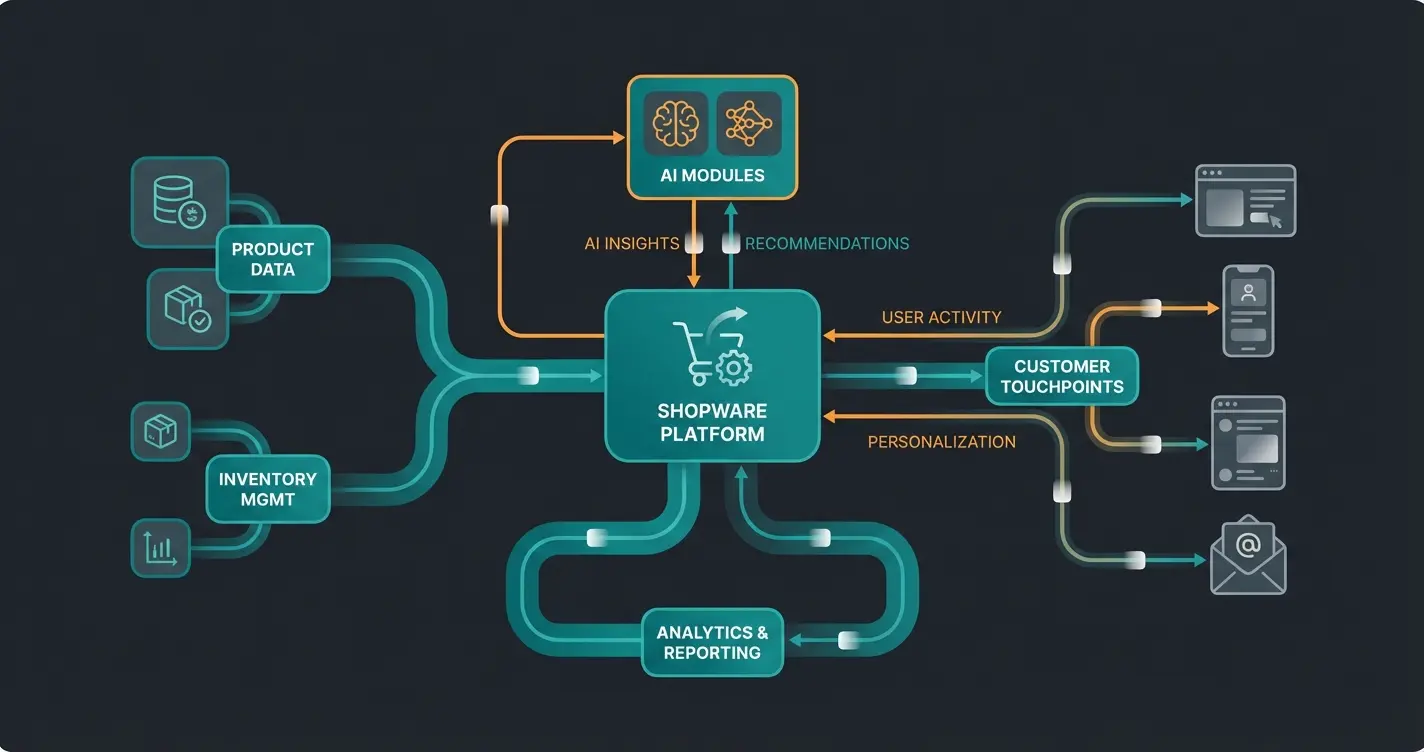
Thanks to Shopware 6's API-first architecture, specialized guided selling solutions (such as product configurators or AI chatbots from third-party providers) can be seamlessly integrated. These tools access Shopware product data and play results directly back into the cart. Using Shopware quick order functionality alongside AI consultation creates a powerful B2B experience.
Strategic Recommendations for the German Market
The German market operates differently. Data protection (GDPR) and technical accuracy matter more here than flashy marketing. When considering Shopware vs Shopify, these factors become crucial differentiators.
- Start with Data: Before introducing AI, your product data (PIM) must be clean. Shopware AI can only sell what it "understands."
- Focus on "Product Discovery AI": Invest budget not in support bots, but in search and finder technologies. Help customers find the product, not just complain about it.
- Use the "Fair Usage Policy" as an Opportunity: If you must switch from Community Edition to a paid plan (Rise/Evolve) due to new Shopware regulations in 2025, use this moment. Don't sell the upgrade internally as "forced compliance" but as the starting gun for your guided selling offensive.
Understanding EU AI Act requirements is also essential when implementing AI-powered consultation tools in the European market.
Conclusion: From Cost Optimizer to Revenue Architect
The question "What does Shopware cost?" is legitimate, but it's the wrong question for strategic growth. The right question for 2025 is: "How much revenue are we leaving on the table because our shop doesn't consult?"
A Shopware ROI calculator that only considers license costs and hosting ignores the potential of Experience Architecture (ROXA). By deploying AI Guided Selling and features like Digital Sales Rooms, you transform your shop from a passive cost center into an active revenue generator.
Action Recommendation
Stop polishing TCO spreadsheets. Start a pilot project for guided selling in your most complex product category. Measure the conversion uplift after 3 months. The results will dictate your budget for next year—and they'll be pointing upward.
The transformation from order-taking catalog to AI product consultation sales partner isn't just possible—it's essential for competitive survival in 2025's B2B landscape.
Frequently Asked Questions About Shopware ROI
Based on our calculations, B2B shops implementing AI guided selling typically see 20-50% conversion rate increases, 5-15% AOV growth, and 20-30% return rate reductions. For a €5M annual revenue shop, this can translate to €1M+ in additional yearly revenue, representing an ROI of 1,000-1,500% on the implementation investment.
Traditional TCO analysis focuses solely on costs (licenses, hosting, maintenance). True Shopware ROI uses ROXA (Return on Experience Architecture), measuring how customer experience investments impact conversion rates, average order values, and customer lifetime value. This shifts focus from cost-cutting to revenue generation.
Shopware Evolve typically offers the best ROI for ambitious B2B mid-market companies due to its B2B Suite and Advanced Search features. While Rise works for smaller B2B operations, Evolve's guided selling capabilities and shorter support response times justify the higher investment for complex product catalogs.
Most implementations achieve positive ROI within 60-90 days. With conservative estimates of 20% conversion uplift on existing traffic, the additional revenue typically covers both implementation costs and annual license fees within the first quarter of operation.
While basic guided selling is possible with Community Edition and third-party plugins, the full ROI potential requires commercial features like AI Copilot, Advanced Search, and Digital Sales Rooms. The 2025 Fair Usage Policy changes also make commercial editions necessary for shops exceeding €1M GMV.
Join B2B leaders who've moved beyond TCO debates. Implement AI-powered guided selling and unlock the revenue potential hiding in your product catalog.
Start Your AI Consultation Journey