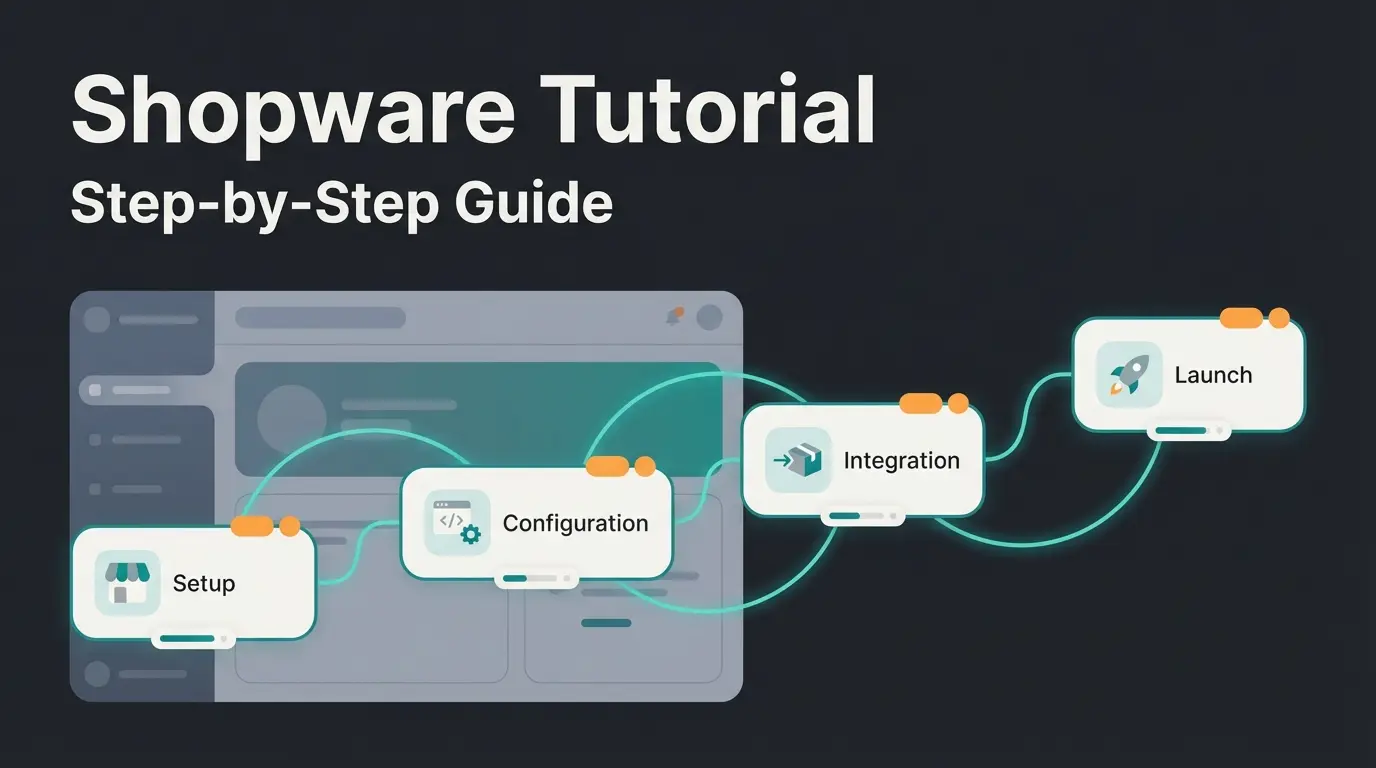
Why Shopware training must look different today
Shopware 6 introduced a completely new tech stack (Symfony, Vue.js, API-first architecture) that makes Shopware 5 knowledge largely obsolete. Teams need structured training specifically for the new platform to avoid costly implementation mistakes.
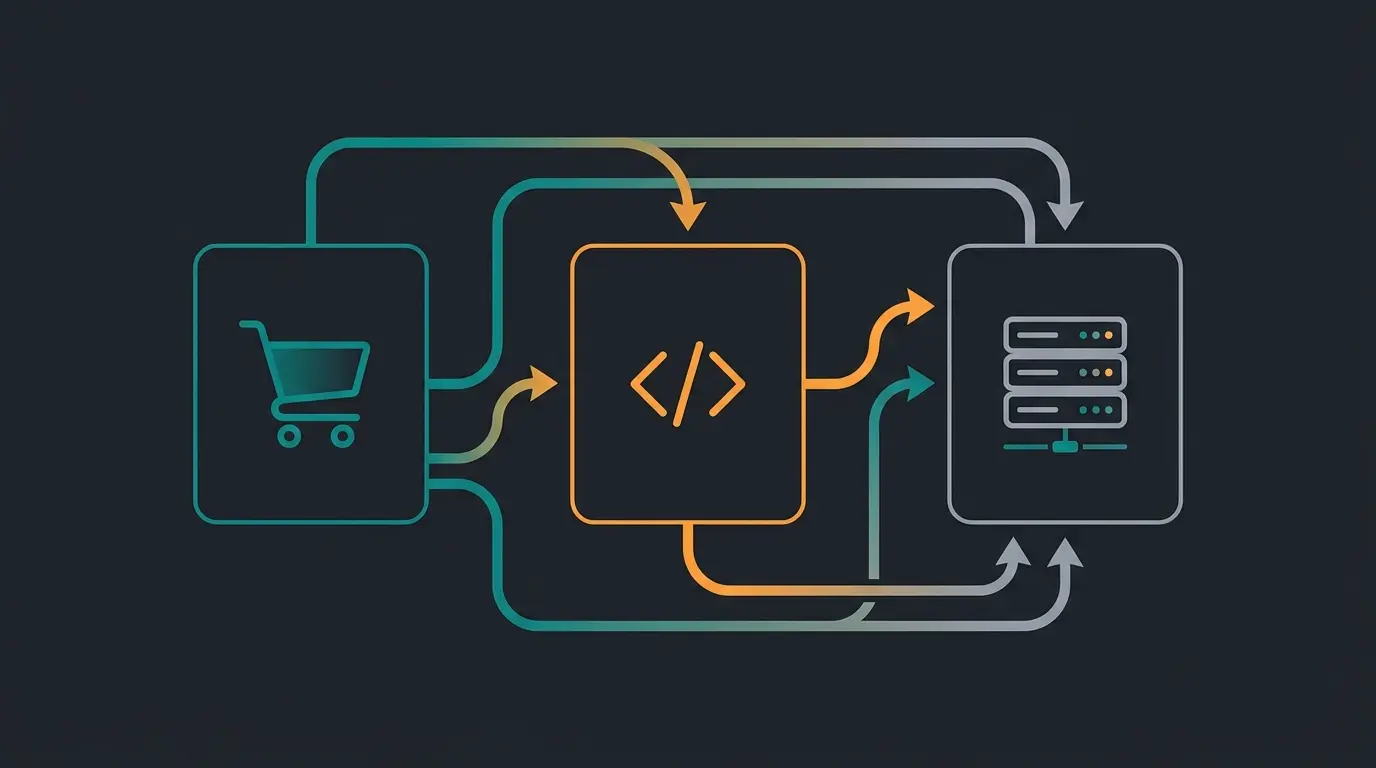
The gap is bigger than most merchants expect. Shopware 5 ran on a proprietary PHP framework with Smarty templates and jQuery. Shopware 6 replaced everything: Symfony 7 handles the backend, Vue.js 3 powers the administration panel, Twig templates drive the storefront, and an API-first architecture enables headless commerce. Knowing one does not prepare you for the other.
Shopware 5 reached end-of-life in July 2024, with no further security patches. Yet thousands of DACH merchants still run unmigrated shops as of Q2 2026. The training pressure is real: teams that skipped structured SW6 education report significantly longer development cycles and more costly integration errors.
And the platform keeps evolving. Shopware 6.6 upgraded to PHP 8.2 and migrated the administration to Vue 3. Version 6.7 removed the Vue 2 compatibility layer entirely, switched the build system from Webpack to Vite, and replaced Vuex with Pinia for state management. Any training material older than 12 months is already partially outdated. That matters when choosing a provider. For the broader training landscape, see our Shopware Training Guide.
The three pillars of modern Shopware training
Modern Shopware 6 training splits into three tracks: user training for daily store operations, developer training for plugin and theme development, and admin training for server setup and configuration.
The tracks serve different roles with different time commitments and prerequisites. Mixing them wastes budget. A content manager does not need Symfony knowledge, and a backend developer does not need order processing workflows.
| Track | Who needs it | Core topics | Typical duration | Prerequisites |
|---|---|---|---|---|
| User Training | Store managers, content editors, customer service | Product management, order processing, content pages, promotions, Flow Builder basics | 2-4 days | None |
| Developer Training | Plugin developers, theme developers, integration engineers | Symfony architecture, plugin system, App system, Twig templating, Vue.js 3 admin, REST/Store API | 4-6 days | PHP 8.x, basic Symfony, JavaScript |
| Admin Training | DevOps, system administrators, hosting teams | Server setup, deployment pipelines, performance tuning, caching (Varnish/Redis), monitoring, security patches | 2-3 days | Linux CLI, basic Docker |
The Shopware documentation covers all three tracks at a reference level. But documentation is not training. It tells you what exists, not how to work with it in practice. The difference matters most for the developer track, where the Symfony underpinnings require architectural understanding that pure docs cannot teach efficiently.
Learning formats compared: finding your best path
Shopware 6 training is available in four formats: official Shopware Academy courses, third-party provider workshops, self-paced online courses, and free community resources. Each comes with distinct trade-offs in cost, depth, and certification options.
| Provider | Format | Duration | Cost | Certification | Best for |
|---|---|---|---|---|---|
| Shopware Academy | Online, self-paced | Ongoing (annual pass) | EUR 999/year | Yes (all certs included) | Teams seeking official certification |
| Shopware Online Academy | Online courses | 4-8 hours per course | Included in Academy Pass | Via Academy Pass | Individual developers, self-learners |
| Yireo | Live workshops (online/in-person) | 1 day per topic | From EUR 489/day | No official cert | Developers wanting hands-on instruction |
| YouTube (Shopware Knowledge) | Video tutorials | Self-paced | Free | No | Beginners exploring the platform |
| Community (dev.to, GitHub, forums) | Articles, code samples | Self-paced | Free | No | Developers with existing Symfony/Vue knowledge |
I tested the Shopware Online Academy developer course and Yireo's backend workshops. The Academy content is structured and thorough but moves slowly for anyone with existing Symfony experience. Yireo's workshops, taught by Jisse Reitsma, are faster-paced and more practical. They assume PHP competence and jump straight into Shopware-specific patterns.
As Jisse Reitsma, founder of Yireo, puts it: "Shopware 6 is based on Symfony and Vue, two technologies that are proving to be a wise choice. Shops can only become competitive if they innovate. And innovation requires customizations by developers." That framing captures why generic PHP training is not enough. The Shopware-specific patterns on top of Symfony are what separate a working plugin from production-ready code.
One data point worth noting: Shopware's own YouTube channel (Shopware Knowledge DE) has published a structured 10-part tutorial series covering storefront and administration basics. It is free and current as of late 2024. For teams evaluating whether they need paid training at all, this series is the best free test. If your developers finish it and still have questions about plugin architecture or API integration, paid training will be worth the investment.
Costs and certification: what is actually worth it?
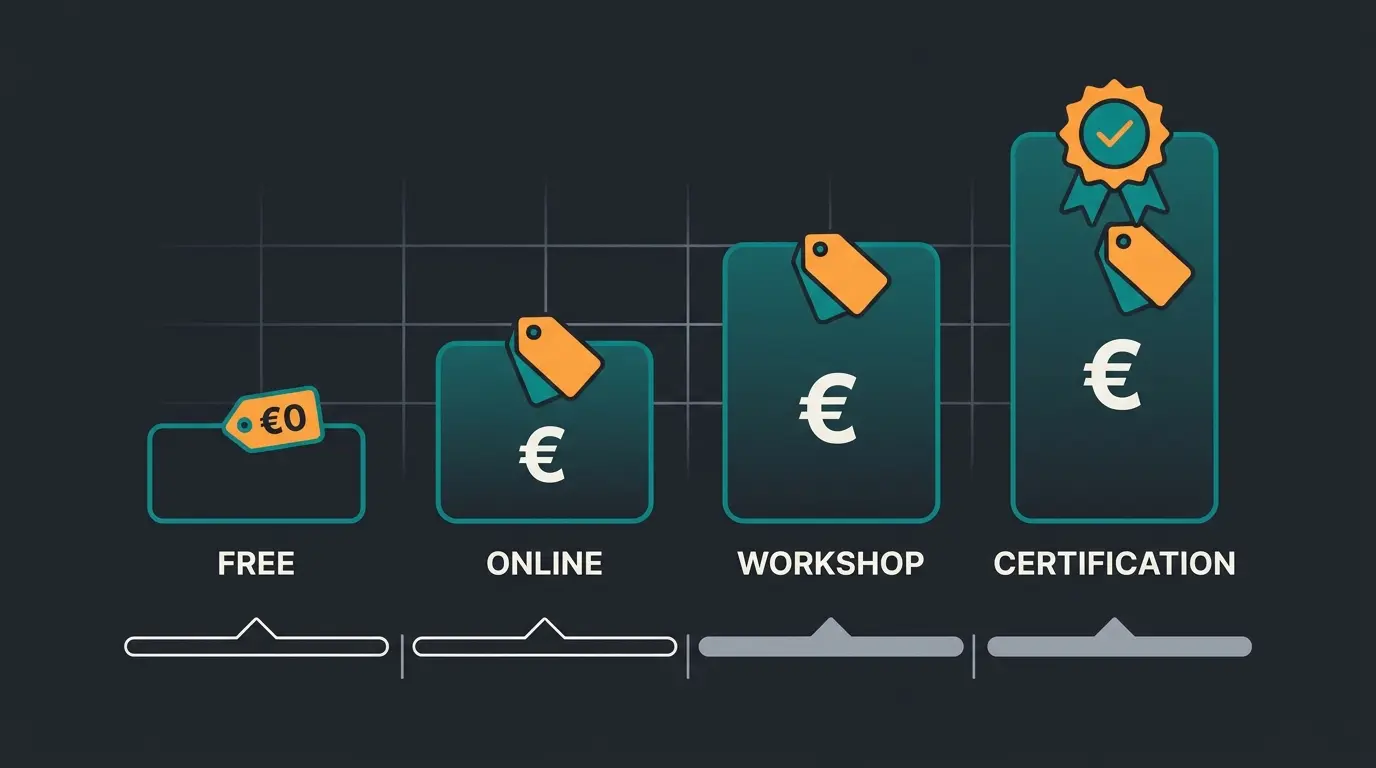
Shopware 6 training costs range from free (community resources and YouTube) to EUR 2,000+ for multi-day in-person workshops, with official Shopware certifications available through the Academy Pass at EUR 999 per year.
| Training type | Cost range | What you get | ROI signal |
|---|---|---|---|
| Free resources (YouTube, docs, dev.to) | EUR 0 | Basics, self-guided, no support | Low (no proof of competence) |
| Online courses (Academy Pass) | EUR 999/year | All courses, all certs, one exam attempt per cert | High (official certification) |
| Third-party workshops (Yireo) | EUR 489-990/day | Hands-on training, live instructor, code review | Medium (no official cert, strong skills) |
| Agency bootcamps | EUR 1,500-2,500 | Multi-day intensive, project-based | Medium-high (depends on agency) |
| Certification exam only | Part of Academy Pass | One attempt per certification per year | High (verifiable credential) |
The Shopware Academy offers three certification tracks: Certified Developer, Certified App Developer, and Certified Solutions Architect. Each certification is valid for two years, after which re-certification is required. According to Robert Half, certified e-commerce developers command a 15-22% salary premium over non-certified peers in comparable roles.
When does certification pay off? Two scenarios. First, agencies that need the badge for Shopware Academy partner status. Second, freelance developers competing for projects where clients filter by credentials. For in-house teams at SMEs, the training itself matters more than the certificate. Invest in the learning, not the paper.
A debatable opinion: I think the certification itself is overvalued for in-house teams. We have worked with Shopware shops where the certified developer produced worse code than the uncertified one who had built three production plugins. The exam tests knowledge of Shopware's architecture and APIs. It does not test whether you can ship reliable, maintainable code under real project constraints. For hiring, look at GitHub repositories and references before certificates.
The missing module: AI and automation training
No current Shopware training program covers AI-powered automation. Yet Flow Builder automation, AI product recommendations, and intelligent customer service are now essential skills for competitive e-commerce operations.
The gap is significant. Shopware 6 introduced Flow Builder for no-code workflow automation and Rule Builder for dynamic pricing and conditional logic. These are business-critical modules, but the Academy covers them only at a surface level. Third-party providers skip them entirely. AI-assisted product consultation, which Qualimero clients use to achieve +35% higher cart values and +60% checkout rates, is not part of any curriculum.
The reality: training teaches you how the platform works. Automation determines whether you use it profitably. A team that masters Shopware 6 admin but ignores Flow Builder automation and AI-driven selling is building a shop that runs on manual effort.
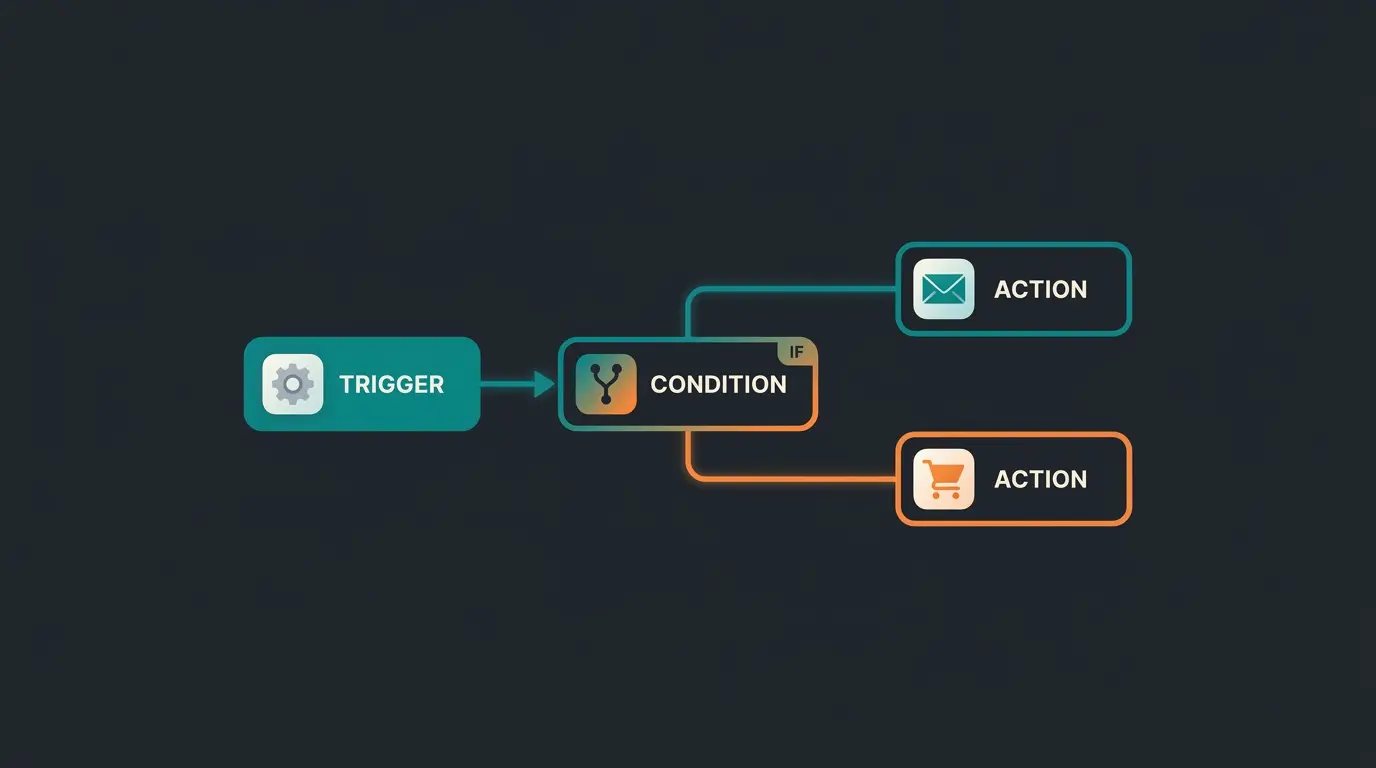
- Flow Builder: automate order status updates, email triggers, tag assignments, and stock management without writing code
- Rule Builder: set dynamic pricing rules, customer group conditions, shipping logic, and promotion triggers
- AI product consultation: guide customers through complex product decisions with an AI sales agent that understands your catalog
- Cross-channel automation: connect WhatsApp, live chat, and email into a single workflow with consistent product knowledge
A modern Shopware 6 training curriculum should include all four. Currently, none does. That is eben a gap the market has not caught up with.
According to Shopware, the platform introduced AI Copilot features in 2024, covering automated product descriptions, image generation, and customer segmentation suggestions. The Academy added AI Copilot curriculum modules in 2025. But these are platform-native features. What is still missing from every training program is how to integrate external AI systems, build custom AI-powered product consultation, or deploy AI employees that actually replace manual customer interactions at scale.
Checklist: how to find the right provider
Choose a Shopware 6 training provider based on five criteria: curriculum recency (must cover SW6.5+), hands-on exercises with real shop environments, instructor credentials, post-training support, and whether they cover automation and AI tools.
- Curriculum covers Shopware 6.6+ (Symfony 7, Vue 3, Vite build system). Anything teaching SW6.4 patterns is outdated.
- Hands-on exercises use a real Shopware installation, not slides or screenshots. Ask whether participants build a working plugin during the course.
- Instructor has verifiable Shopware credentials. Check their Shopware partner status, GitHub contributions, or conference talks. Jisse Reitsma (Yireo) is a known name. Unknown instructors need more vetting.
- Post-training support exists. Can you ask questions after the course? Does the provider offer a Slack channel, forum access, or follow-up sessions?
- Automation and AI modules are included or available as add-on. If the provider only teaches core admin and development, you will need a separate solution for the automation layer.
- Pricing is transparent. Hidden costs for exam retakes, courseware licenses, or environment setup are red flags. The Shopware Community Edition is free to install for practice.
Deep dive: essential modules explained
The Flow Builder and Rule Builder are the two most business-critical Shopware 6 modules that every training should cover. They enable no-code automation of order processing, marketing triggers, and dynamic pricing rules.
Flow Builder
Flow Builder is Shopware 6's visual automation engine. You define triggers (order placed, customer registered, stock below threshold), conditions (customer group, order value, product category), and actions (send email, assign tag, update custom field, create task). No PHP required.
In practice, most shops use Flow Builder for three things: automated order confirmation sequences, internal notification routing, and customer segmentation based on purchase behavior. We see teams that learned Flow Builder properly reduce their manual order handling by 60-70% within the first month. Those who skip it keep doing the same tasks by hand.
Compared to Shopify's Flow (their equivalent automation tool), Shopware's Flow Builder offers more granular conditions and supports custom triggers via the App system. WooCommerce has no native equivalent, relying entirely on third-party plugins like AutomateWoo. For teams evaluating platforms, this is a genuine differentiator, but only if you actually learn to use it.
Rule Builder
Rule Builder defines the conditional logic behind pricing, shipping, and promotions. A rule like 'If cart value > EUR 150 AND customer is in group Premium AND shipping country is DE, then apply free shipping and 5% discount' runs automatically on every checkout. For getting started with Shopware, understanding Rule Builder is one of the first things that separates a configured shop from an out-of-the-box installation.
{
  "name": "Premium Customer Free Shipping DE",
  "conditions": [
    {"type": "cartLineItemTotalPrice", "value": 150, "operator": ">="},
    {"type": "customerGroup", "value": ["premium"]},
    {"type": "shippingCountry", "value": ["DE"]}
  ],
  "actions": ["free-shipping", "percentage-discount-5"]
}
The Rule Builder is where training investment pays off fastest. A well-configured rule set can increase average order value by 10-15% through smart free shipping thresholds and customer group-specific discounts, without any code changes. But misconfigured rules create silent revenue leaks. We have seen shops where conflicting discount rules stacked unintentionally, giving 25% discounts instead of the intended 10%.
Beyond training: scaling with AI sales agents
Once your team masters Shopware 6 basics, the biggest performance leap comes from deploying AI sales agents that handle product consultation, customer service, and cross-selling automatically, delivering measurable ROI from day one.
Training builds competence. But competence alone does not scale. A trained team of three can handle 50 customer inquiries per day. An AI sales agent handles 500 without breaking a sweat, with consistent product knowledge and 24/7 availability.
Rasendoktor, an online specialist for lawn care products, faced exactly this challenge: 2,000-3,000 consultation-intensive inquiries per season, a small team, and products that require technical expertise. After deploying a Qualimero AI employee, they achieved 16x ROI, 100% automation of product consultation, and 40% support cost reduction. See how Rasendoktor automated product consultation for the full case.
The pattern is consistent across Qualimero clients: +35% higher cart values and +60% improved checkout rates through AI product consultation. Training teaches your team the platform. An AI employee multiplies what your team can do on it.
A Qualimero AI employee advises your customers in real time, recommends products from your catalog, and works 24/7. See it in action with a free demo.
Book a demoFrequently asked questions
Partially. Shopware offers free YouTube tutorials and community documentation. Structured training with certification requires the Academy Pass at EUR 999/year. Third-party workshops like Yireo start at EUR 489/day.
The Academy Pass gives you access to self-paced learning materials and one exam attempt per certification per year. Most developers complete the Certified Developer track in 4-8 weeks of part-time study, depending on existing Symfony and Vue.js knowledge.
Shopware 6 is built on PHP 8.2+ with the Symfony 7 framework for the backend, Vue.js 3 for the administration panel, and Twig for storefront templates. Developer training should cover all three.
Yes. The Shopware Online Academy offers courses in English, including the developer training. Yireo's workshops are conducted in English by default. YouTube tutorials from Shopware Knowledge are available in both German and English.
The Shopware Academy is the official training platform with certification authority. Third-party providers like Yireo offer instructor-led workshops with more hands-on practice but cannot issue official Shopware certifications. For agencies seeking partner status, official certification is required.

Kevin is CTO and co-founder of Qualimero. As an AI architect with over 15 years of experience as CTO and CPO in the tech industry, he designs the AI systems that automate tens of thousands of customer interactions daily for Qualimero's clients — reliably, securely, and at scale.