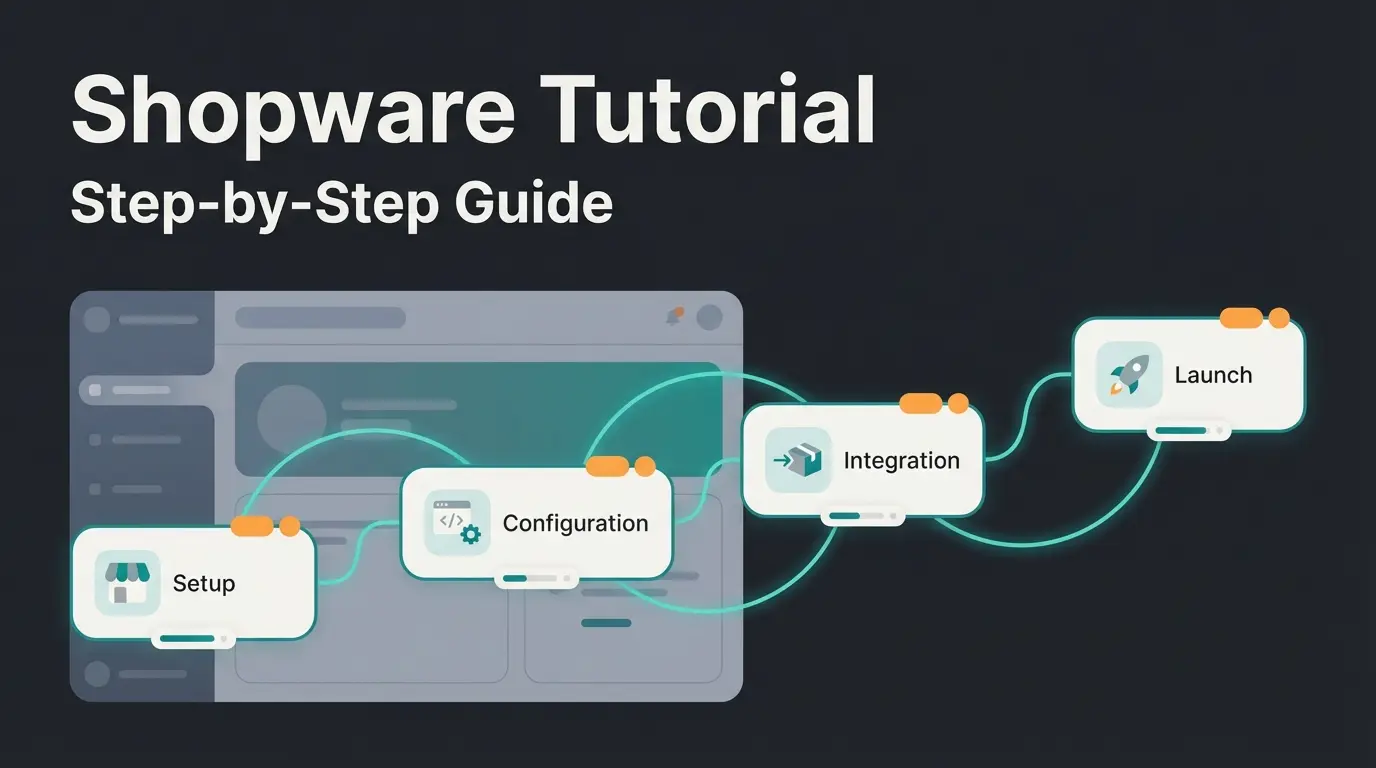
What is Shopware multichannel selling?
Shopware multichannel selling means managing products across your own online store, marketplaces like Amazon and eBay, social commerce channels like Instagram Shopping, and physical POS systems, all controlled centrally from a single Shopware 6 installation. Each channel operates as a separate Sales Channel in the Shopware admin, with its own pricing, currency, and product selection.
The distinction matters. Multichannel runs channels in parallel but independently. A customer on Amazon completes their purchase on Amazon. A customer in your Shopware store stays in your store. Omnichannel, by contrast, connects those channels: buy online, pick up in-store, or start a chat on Instagram and finish the purchase on the website. Shopware 6 supports both models, but most SMEs start with multichannel because it requires less integration depth.
Why bother? Because dependence on a single channel is a business risk. According to Mirakl's 2026 Multichannel Report, multichannel sellers generate up to 17.5 times more gross merchandise value than single-channel merchants. Businesses selling on three or more channels see a 250% higher purchase rate than those on a single channel. If Google changes its algorithm or Amazon suspends your listing, the other channels absorb the impact.
Shopware's API-first architecture is the technical foundation that makes multichannel work. Every function, from product data to inventory levels, is accessible via REST API. Connector tools pull data from this API and push it to marketplaces. Orders flow back through the same interface. No manual CSV exports, no copy-paste product descriptions.
Multichannel e-commerce sales are projected to total $892.4 billion in 2026, up 15.0% year over year. That growth is not evenly distributed. Merchants who sell on three or more channels capture a disproportionate share, while single-channel stores face increasing customer acquisition costs. Shopware's Sales Channel model is built for this reality: you maintain one product catalog, one inventory count, one order pipeline, and Shopware distributes data to each channel through its API.
Key sales channels for Shopware merchants
For Shopware merchants, Amazon, eBay, and Google Shopping are the highest-revenue marketplaces, complemented by social commerce channels like Instagram Shopping and TikTok Shop for reaching younger audiences. The right channel mix depends on your product type, margin structure, and target geography.
Amazon dominates. In 2026, Amazon captures 37.8% of total U.S. online sales. For European sellers, Amazon.de, Amazon.co.uk, and Amazon.fr add significant reach. The trade-off: referral fees of 8-15% depending on category, plus FBA costs if you use Fulfillment by Amazon. For a deeper dive into connecting Shopware to Amazon, including product syncing and repricing, see the Shopware Amazon Integration guide.
eBay remains relevant for used goods, collectibles, and price-sensitive categories. Final value fees range from 6.35% to 15.3%, with most categories at 13.6%. The Shopware eBay Integration explains setup and order synchronization.
| Channel | Monthly reach | Typical commission | Best for |
|---|---|---|---|
| Amazon | 310M+ monthly visitors (global) | 8-15% referral fee | Volume, brand visibility, FBA logistics |
| eBay | 130M+ active buyers | 6.35-15.3% final value fee | Used goods, auctions, price-sensitive buyers |
| Google Shopping | Varies by keyword volume | Free listings + CPC for ads | Comparison traffic, feed-based reach |
| Instagram Shopping | 2B+ monthly active users | No commission (own checkout) | Visual products, younger demographics |
| TikTok Shop | 1.5B+ monthly active users | 5-8% commission | Impulse purchases, viral products |
| Otto (DACH) | 12M+ monthly visitors | 15-20% commission | German market, home and garden |
| Kaufland (DACH) | 32M+ monthly visitors | 6.5-12.95% | DACH price-conscious shoppers |
Google Shopping works differently from a marketplace. You submit a product feed, Google displays your products in search results and the Shopping tab, and customers click through to your Shopware store to purchase. No commission on organic listings since 2020. Paid Shopping Ads use a cost-per-click model. For Shopware merchants with strong product data, Google Shopping is one of the highest-ROI channels because you keep the customer relationship.
Social commerce is growing fast. Global social commerce sales are projected to reach $2.6 trillion in 2026, with TikTok Shop leading at 4.7% conversion rate and 87.3% year-over-year revenue growth. Instagram Shopping converts at 2.1%, lower than TikTok but with a larger established user base. Both channels connect to Shopware via feed management tools.
Companies offering livestream shopping experiences report conversion rates between 9% and 30%, compared to 2-3% for standard e-commerce. TikTok Shop generated roughly $500 million in U.S. sales during Black Friday to Cyber Monday 2025 alone. For Shopware merchants, the question is not whether social commerce matters, but which platform fits your product category and audience demographics.
For physical retail, Shopware POS synchronizes inventory between your online store and in-store terminals. Real-time stock updates prevent overselling across channels. This is where multichannel becomes omnichannel: a customer can check availability online and pick up in-store.
Connector tools compared: Magnalister, Channable, and ChannelEngine
Magnalister connects Shopware directly to Amazon, eBay, and other marketplaces starting at EUR 49/month, while Channable manages 2,500+ feed channels and Shopware Multichannel Connect (powered by ChannelEngine) provides access to 1,300+ global marketplaces as the official Shopware integration.
We tested all three with a Shopware 6 installation running 600+ SKUs in a consultation-intensive product catalog. The differences are significant.
Magnalister is the direct connector approach. Install the Shopware plugin, configure your marketplace credentials, map your product attributes, and start listing. Setup took roughly 3 hours for Amazon and eBay combined in our test. Pricing runs from EUR 49/month (Basic, 48h support) to EUR 399/month (Enterprise, 2-4h priority support). Magnalister supports European marketplaces that other tools miss: Otto, Kaufland, Hood. The limitation: feed management is basic. If you need rule-based product data optimization or PPC automation, Magnalister does not cover that.
Channable takes a different approach. It is a feed management platform first, marketplace connector second. You import your Shopware product feed, then use IF/THEN rules to transform, enrich, and optimize product data for each channel individually. Over 12,000 brands and 1,300 agencies use Channable, including IKEA and MediaMarkt. The pricing model is usage-based: package + Core plan + module plans, starting around EUR 39/month for small catalogs. Channable covers 2,500+ export channels, including Google Shopping, Facebook Ads, comparison sites, and marketplaces. The strength: rule-based automation and PPC optimization. The trade-off: steeper learning curve than Magnalister, and marketplace order management is a separate module.
ChannelEngine (Shopware Multichannel Connect) is the official Shopware integration, built by ChannelEngine. Access to 1,300+ global marketplaces including Amazon, Zalando, Walmart, and Lazada. Jorrit Steinz, CEO of ChannelEngine, describes it as enabling merchants to "seamlessly activate new sales channels" from within Shopware. The 2026 Spring Release adds AI-powered product data generation and connections to agentic commerce platforms like Google AI Mode. Pricing is custom, based on SKU volume and number of channels. For merchants with large catalogs and international ambitions, this is the enterprise-grade option.
| Feature | Magnalister | Channable | ChannelEngine |
|---|---|---|---|
| Starting price | EUR 49/mo | ~EUR 39/mo | Custom (contact sales) |
| Marketplace count | 10+ (EU focus) | 2,500+ channels | 1,300+ marketplaces |
| Shopware plugin | Yes (native) | Yes (via feed) | Yes (official integration) |
| Feed optimization | Basic | Advanced rule-based | AI-powered (2026) |
| PPC automation | No | Yes | No |
| Order sync | Yes | Separate module | Yes |
| Setup time (tested) | ~3 hours | ~6 hours | ~4 hours + onboarding |
| Best for | SMEs, EU marketplaces | Feed-heavy, PPC-driven | Enterprise, global scale |
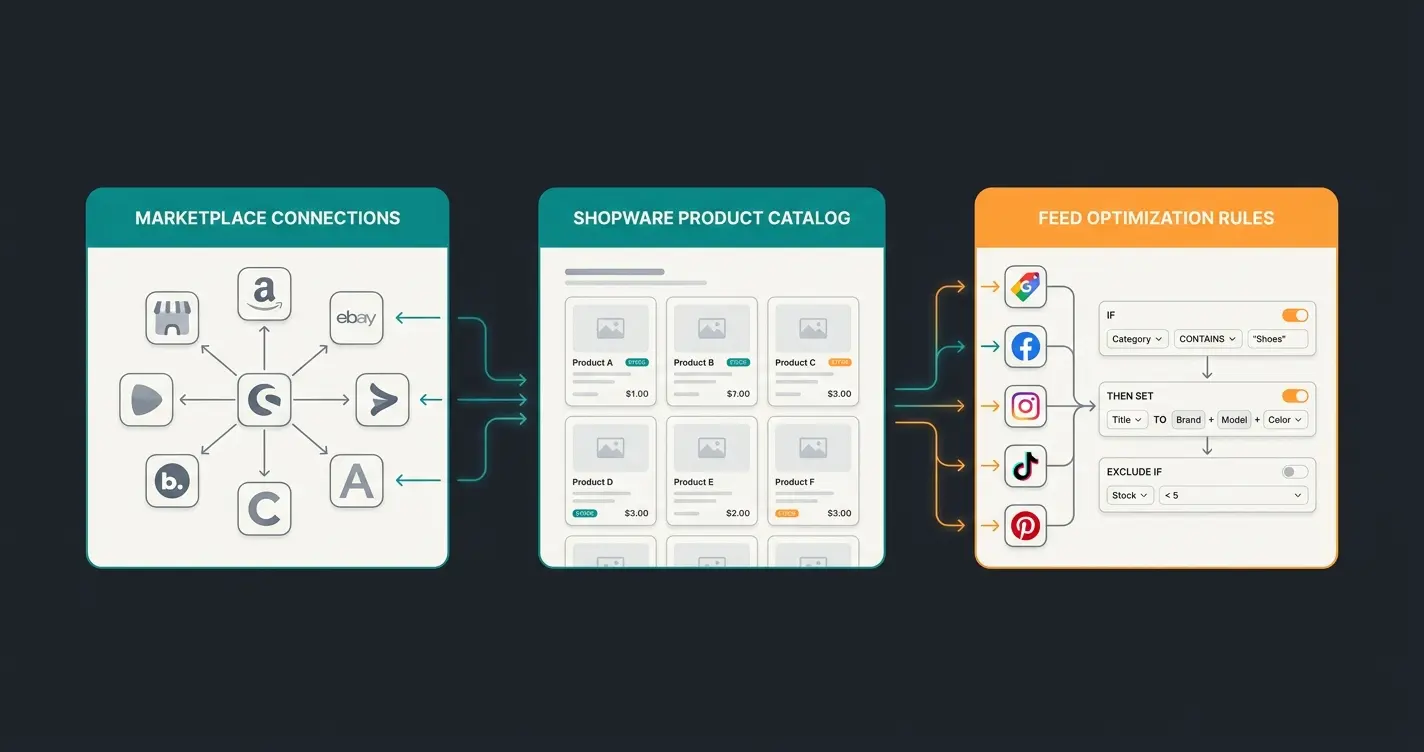
Setting up Instagram Shopping with Shopware
Instagram Shopping integrates with Shopware through the Facebook Commerce Manager and product feed plugins. Requirements: an Instagram Business account, an approved Facebook product catalog, and a Shopware plugin like Channable or a dedicated Social Commerce Connector for feed synchronization.
The setup has four steps. First, connect your Instagram Business account to a Facebook Business Page. Second, create a product catalog in Facebook Commerce Manager, either manually or by importing your Shopware product feed. Third, submit the catalog for Instagram Shopping review (approval typically takes 1-5 business days). Fourth, once approved, tag products in your Instagram posts, Stories, and Reels.
Product feed synchronization is where the technical work lives. Channable automates this: connect your Shopware store as a data source, create a Facebook/Instagram export channel, apply formatting rules (Instagram requires square images, specific title lengths, GTIN or MPN identifiers), and schedule automatic feed updates. Without automation, you are maintaining product data in two places. That breaks at scale.
- Connect Instagram Business account to Facebook Business Page
- Create product catalog in Facebook Commerce Manager (import Shopware feed via Channable or manual CSV)
- Submit catalog for Instagram Shopping review (1-5 business days)
- Start tagging products in posts, Stories, and Reels
Instagram Shopping converts at 2.1%, roughly half of TikTok Shop's 4.7% rate. But the value is not just direct sales. Instagram drives product discovery and brand awareness. Products tagged in posts appear in the Instagram Shop tab, in search results, and in the Explore feed. For visually driven products like home decor, fashion, or garden accessories, Instagram Shopping captures intent at the moment of inspiration.
One aspect that many guides overlook: Instagram Shopping performance depends heavily on your content strategy beyond product tags. Products tagged in Reels get 2-3x the reach of tagged static posts, because Instagram's algorithm prioritizes video content. If you are investing in Instagram Shopping, plan for short product demonstration videos, not just tagged photos. A 15-second Reel showing a garden tool in action drives more discovery than a product photo with a tag.
For Shopware merchants selling consultation-intensive products, Instagram Shopping has an additional angle. Customers discover your product through a tagged post, tap to view it, and then have questions. Without AI consultation, that question goes unanswered, and the customer moves on. With an AI employee integrated into Instagram DMs, the customer gets instant, personalized advice. The path from discovery to purchase shortens from days to minutes.
Marketplace strategy: choosing the right channels
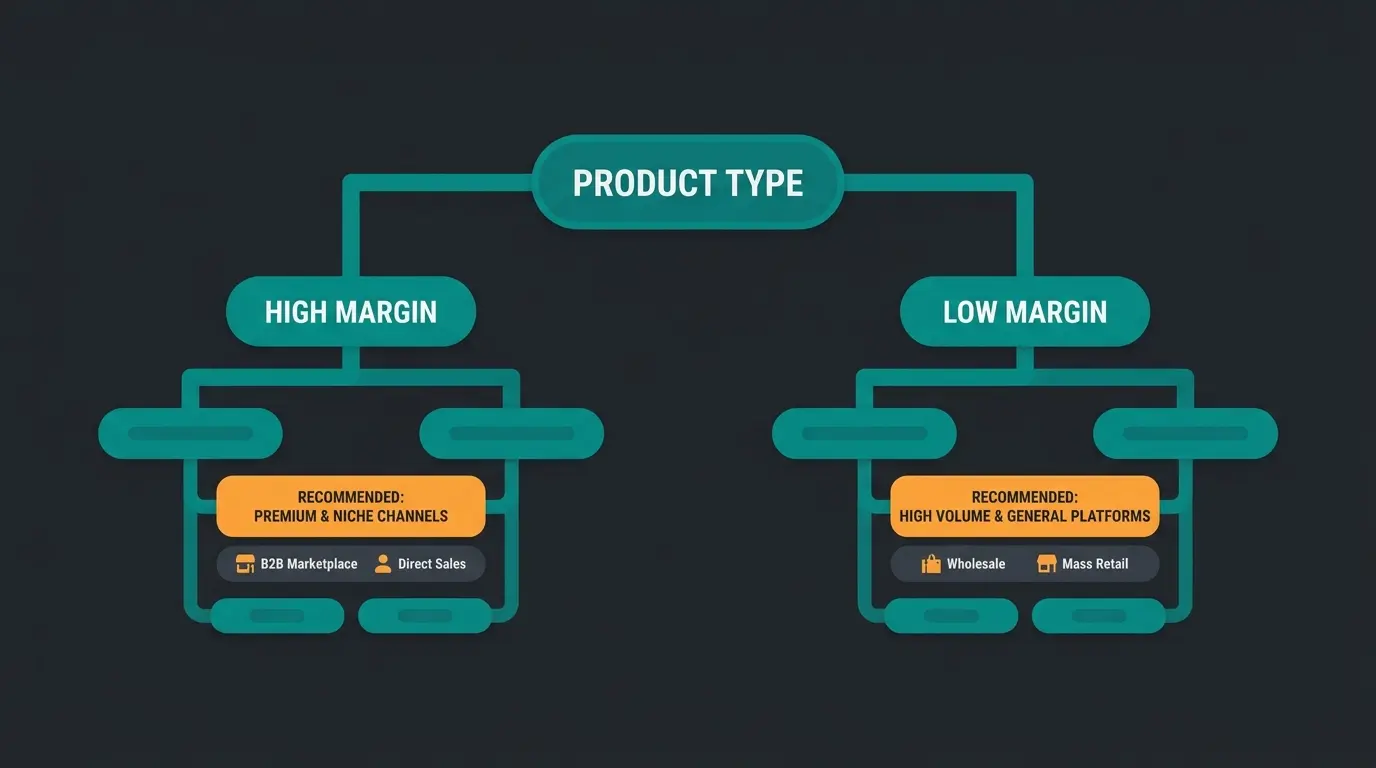
A successful marketplace strategy combines Amazon as a reach channel with lower-fee alternatives like eBay and regional marketplaces. The right mix depends on your product type, margin structure, and target audience. There is no one-size-fits-all answer, but there is a framework.
Start with margin analysis. Amazon's 8-15% referral fee plus FBA costs can eat 20-30% of your revenue per unit. If your product margins are below 40%, Amazon becomes a volume play with thin profits. eBay's 13.6% average final value fee is comparable, but without the FBA logistics cost if you handle shipping yourself. Regional marketplaces like Kaufland (6.5-12.95% commission) often offer better economics for DACH-focused merchants.
Then consider the customer journey. In our experience, the strongest multichannel setups use Amazon for discovery and your own Shopware store for repeat purchases. A customer finds your product on Amazon, buys once, and if the product quality and packaging are strong, they search for your brand directly next time. Your Shopware store captures that second purchase at zero commission.
According to Capital One Shopping research, 73% of consumers use multiple channels during their purchase journey. Omnichannel customers spend 16% more per order than single-channel shoppers. The data is clear: more channels mean more revenue. But each channel adds operational complexity. The question is not whether to sell on multiple channels, but how many you can manage well.
I would argue that two to three channels is the sweet spot for most SMEs with fewer than 50 employees. Your own Shopware store plus Amazon covers the highest-traffic segment. Add one regional or social commerce channel based on where your audience spends time. Going beyond four channels without dedicated marketplace management staff is where quality starts slipping: outdated listings, stock mismatches, slow response times.
Consider a practical example. A home and garden retailer with 800 SKUs on Shopware starts with Amazon.de for volume. After six months, they add their own storefront for branded search traffic and repeat customers. In month nine, they test Google Shopping for comparison shoppers who search by product name. Three channels, each serving a different stage of the customer journey. Amazon captures the "I need garden shears" search. Google Shopping captures the "Fiskars vs Gardena pruning shears" comparison. The Shopware store captures the "buy directly from brand" return visit.
The Marketplace Seller Trends Report 2026, based on surveys of 470 e-commerce decision-makers across Europe and the U.S., confirms this pattern. Top sellers focus on marketplace profitability over channel quantity. They invest in listing optimization and inventory management before adding new channels. The report highlights that sellers managing multiple marketplaces increasingly automate operations, with AI-driven tools reducing manual work by up to 40%.
AI-powered product consultation across channels
AI employees like those from Qualimero provide product consultation across all channels, whether in the Shopware store, on WhatsApp, or through Instagram DMs. The core problem with multichannel selling is that product listings on marketplaces are static. They describe features but do not advise. A customer comparing three lawn fertilizers on your Shopware store gets no guidance on which one suits their specific soil type and garden size.
That is where an AI employee changes the equation. Rasendoktor, an online specialist for professional lawn care, deployed Qualimero's AI employee Hektor to handle 2,000-3,000 consultation-intensive inquiries per season. The result: 16x return on investment, 100% automation rate, and 40% support cost savings. Not a simplistic FAQ responder. Hektor accesses the full product catalog, understands seasonal conditions, and recommends specific products based on the customer's garden situation. Read the full Rasendoktor Case Study.
Signed, a retailer for custom and decorative signs, saw similar results with their AI employee Alex across social media channels. The outcome: 18x ROI, 70% customer support automation, and 30% increase in up- and cross-selling. Alex handles inquiries on Instagram and WhatsApp, provides personalized product recommendations, and hands complex cases to the human team. The Signed Case Study details the full implementation.
Return on investment with AI employee Hektor
Return on investment with AI employee Alex
Rasendoktor product consultation automation
Average across Qualimero clients
The technical integration works like this: the AI employee connects to your Shopware product data via API. It reads product attributes, categories, inventory levels, and customer context. When a customer asks a question on any connected channel, the AI employee pulls relevant product data in real-time and delivers a personalized recommendation. Cross-channel consistency is built in: the same product knowledge powers the response whether it comes via your webshop chat, WhatsApp, or Instagram DM.
For merchants running multichannel, this solves a real operational problem. You cannot staff a consultation team for every channel separately. An AI employee scales to all channels from a single integration point. More traffic does not mean more support tickets. That is the difference between listing products across channels and actually selling them. Learn more about AI Product Consultation.
Technical implementation: step by step
Multichannel implementation in Shopware follows four phases: configure Sales Channels, install a connector tool, optimize your product data for each channel, and set up automated inventory and order synchronization. The entire process takes one to two weeks for a standard setup with two to three marketplaces.
Phase 1: Sales Channel configuration. In Shopware Administration, create a Sales Channel for each target marketplace or storefront. Assign the correct domain, language, currency, payment methods, and shipping methods. Define which products are visible in each channel. This takes 30-60 minutes per channel.
Phase 2: Connector tool installation. Choose your connector tool (Magnalister, Channable, or ChannelEngine) based on the comparison in the previous section. Install the Shopware plugin, enter your marketplace API credentials, and configure the data mapping. Product attributes in Shopware need to match marketplace category requirements. For Amazon, this means EAN/GTIN codes, bullet points, and category-specific attributes. Time: 2-6 hours depending on the tool and number of marketplaces.
Phase 3: Product data optimization. This is where most merchants underinvest. Each marketplace has different requirements for titles, descriptions, images, and attributes. Amazon titles follow a specific formula (Brand + Model + Key Feature + Size/Color). eBay rewards detailed item specifics. Google Shopping requires structured data with GTINs. Use your connector tool's rule engine to transform product data per channel. Do not use identical titles across all platforms.
Phase 4: Inventory and order synchronization. Enable real-time inventory sync through your connector tool. When a product sells on Amazon, the stock count in Shopware decreases within minutes, and the updated inventory is pushed to all other channels. This prevents overselling, which is the number one cause of marketplace account suspensions. Configure order import so that marketplace orders appear in your Shopware order management, with the correct shipping method and payment status.
Phase 5: Monitoring and optimization. Multichannel is not a set-and-forget operation. Track key metrics per channel: conversion rate, return rate, average order value, and listing quality score. Amazon's Account Health dashboard, eBay's Seller Hub, and your connector tool's analytics all provide channel-specific data. Review monthly. If one channel consistently underperforms after three months of optimization, consider dropping it and reallocating resources to channels that deliver.
The most common technical issue we see in multichannel implementations is data quality degradation over time. A new product gets added to Shopware but without the marketplace-specific attributes. The connector tool syncs it to Amazon with missing bullet points and wrong categorization. Amazon suppresses the listing. Nobody notices for two weeks. Build a monthly data quality audit into your workflow: check that all active marketplace listings have complete attributes, valid images, and correct pricing.
A final technical note: test your order flow end-to-end before going live on any new marketplace. Place a test order, verify it appears in Shopware with the correct shipping method and payment status, confirm the inventory decreases across all channels, and check that the order confirmation email sends correctly. We have seen merchants launch on a new marketplace only to discover that orders import with the wrong currency or missing customer addresses. A single test order prevents days of manual cleanup.
Classic vs. AI-enhanced multichannel: a comparison
Classic multichannel is limited to data synchronization and feed management, while AI-enhanced multichannel adds cross-channel product consultation, automated customer interactions, and personalized recommendations that convert browsers into buyers.
| Capability | Classic multichannel | AI-enhanced multichannel |
|---|---|---|
| Product listing | Automated via feed tools | Automated + AI-optimized descriptions |
| Customer consultation | None (static listings) | AI employee on all channels |
| Cross-selling | Manual product bundles | Personalized AI recommendations |
| Customer support | Per-channel support team | AI handles 70-100% of inquiries |
| Inventory management | Real-time sync | Real-time sync + demand prediction |
| Conversion optimization | A/B testing | AI-guided product consultation (+35% cart value) |
| Scalability | Scales with headcount | Scales with AI, not headcount |
The gap shows in the numbers. Classic multichannel adds channels but does not change conversion rates within those channels. You list products on Amazon, and your Amazon conversion rate is whatever Amazon's algorithm delivers. AI-enhanced multichannel actively improves conversion on every channel by providing the consultation that static listings cannot.
There is a honest limitation to acknowledge. AI consultation works best for products that require advice: technical products, products with many variants, or products where the wrong choice leads to returns. For commodities like phone chargers or basic office supplies, the consultation layer adds less value. Know your product catalog before investing.
From a technical standpoint, the integration depth determines the value. An AI employee that only reads product titles provides generic responses. One that accesses full product attributes, compatibility data, customer reviews, and seasonal patterns can deliver consultation that rivals a trained specialist. Qualimero's AI employees operate at this deeper level, pulling data from the Shopware product catalog in real-time rather than working from a static knowledge base.
The 2026 ChannelEngine Spring Release adds AI-powered product data generation, which helps with listing quality but does not solve the consultation gap. Generating better product descriptions and optimizing for marketplace algorithms is one problem. Actually advising customers on which product to buy is a different problem entirely. Both matter, but they solve different stages of the funnel.
FAQ
There is no hard limit. Shopware 6 allows unlimited Sales Channels in the administration. Each channel gets its own domain, language, pricing, and product assignments. In practice, most SMEs operate 3-5 channels without performance issues.
Shopware Multichannel Connect (powered by ChannelEngine) uses custom pricing based on SKU volume and the number of connected marketplaces. Contact Shopware sales for a quote. Magnalister starts at EUR 49/month, Channable at approximately EUR 39/month.
Yes. Shopware 6 supports channel-specific pricing through its Rule Builder. You can factor in marketplace commissions directly, offering lower prices in your own store and adjusted prices on Amazon or eBay. All three connector tools support per-channel pricing rules.
Enable real-time inventory synchronization through your connector tool. Set a safety stock buffer of 2-5 units. According to Shopware's multichannel guide, automated inventory reconciliation is the single most important technical requirement for multichannel operations.
Without automation, yes. Each channel generates its own customer inquiries. An AI employee like those from Qualimero handles 70-100% of product consultation inquiries across all connected channels from a single integration, keeping support costs flat even as channel count grows.
It depends on your scale. Magnalister for 2-3 EU marketplaces with under 1,000 SKUs. Channable for feed-heavy operations across Google Shopping, Facebook, and comparison sites. ChannelEngine for enterprise merchants scaling to 1,300+ global marketplaces.
Multichannel selling brings visitors from Amazon, eBay, Instagram, and Google Shopping to your products. An AI employee from Qualimero turns those visitors into buyers with personalized product consultation across every channel. Our clients see up to 35% higher cart values and 16x ROI.
Book a demo
Kevin is CTO and co-founder of Qualimero. As an AI architect with over 15 years of experience as CTO and CPO in the tech industry, he designs the AI systems that automate tens of thousands of customer interactions daily for Qualimero's clients — reliably, securely, and at scale.