What is a Shopware partner?
A Shopware partner is a certified company, either an agency, technology provider, or hosting specialist, vetted by Shopware AG to implement, extend, or support Shopware-based online shops. Partners are tiered into Bronze, Silver, Gold, and Platinum levels based on certifications, project volume, and platform expertise.
The ecosystem is larger than most merchants realize. According to StorLeads, over 30,000 active stores run on Shopware as of Q1 2026. Shopware itself reports EUR 25 billion in platform GMV for 2025, and a network of 1,600+ partners across agencies, technology vendors, and hosting providers.
That scale creates a real problem: how do you find the right partner when 1,600 options compete for your attention? The official Shopware partner directory lists agencies by region and tier, but it does not help you evaluate them. That is what this guide is for.
The three partner types serve distinct functions. Agency partners (also called solution partners) handle the build: shop design, custom development, migration from other platforms. Technology partners provide software that plugs into Shopware via API, adding capabilities the core platform does not cover natively. Hosting partners run the infrastructure. For most merchants, the critical decision is between the first two.
Partner levels explained: Bronze, Silver, Gold & Platinum
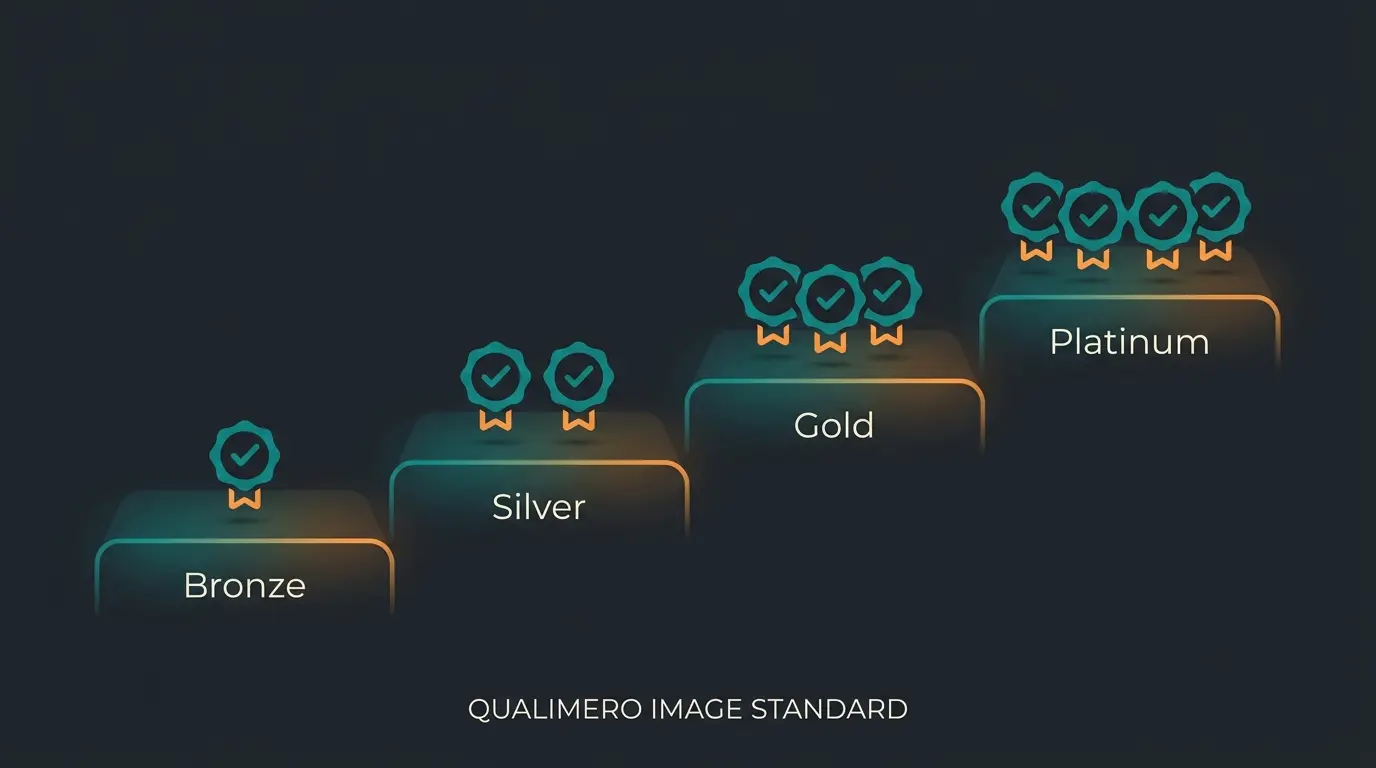
Shopware certifies partners into four tiers: Bronze (entry-level, basic onboarding), Silver (4+ certifications, dedicated partner manager), Gold (10+ certifications, proven project track record), and Platinum (elite agencies with the highest Shopware trust level and direct AG collaboration). Higher tiers correlate with deeper platform expertise, but also higher hourly rates.
| Tier | Min. certifications | Typical hourly rate | Best for | Shopware support level |
|---|---|---|---|---|
| Bronze | 0 (self-service portal) | EUR 80-100 | Simple setups, small shops | Self-service |
| Silver | 4+ | EUR 100-130 | Growing SMEs, standard migrations | Dedicated partner manager |
| Gold | 10+ | EUR 130-160 | Mid-market, complex integrations | Priority support + marketing fund |
| Platinum | Highest requirements | EUR 150-180+ | Enterprise, B2B, multi-channel | Direct Shopware AG collaboration |
These rates are market estimates based on Western European agencies. Actual pricing varies by region, project complexity, and whether you work with a pure Shopware specialist or a full-service digital agency. Central and Eastern European partners typically charge 30-50% less, though timezone and communication overhead can offset that advantage.
One thing I consistently see in partner evaluations: tier level alone does not predict project success. A Gold partner with 15 relevant industry references will outperform a Platinum partner that has never touched your vertical.
For Shopware solution partners specifically, the certification validates both technical skills and business process knowledge. A certified partner has demonstrated they can scope, plan, and deliver Shopware projects according to Shopware AG's quality standards. For enterprise needs, look beyond the tier badge. Shopware enterprise partners often have separate teams dedicated to B2B commerce, headless implementations, and multi-market rollouts, capabilities that are not reflected in the tier system alone.
Agency vs technology partner: which do you really need?
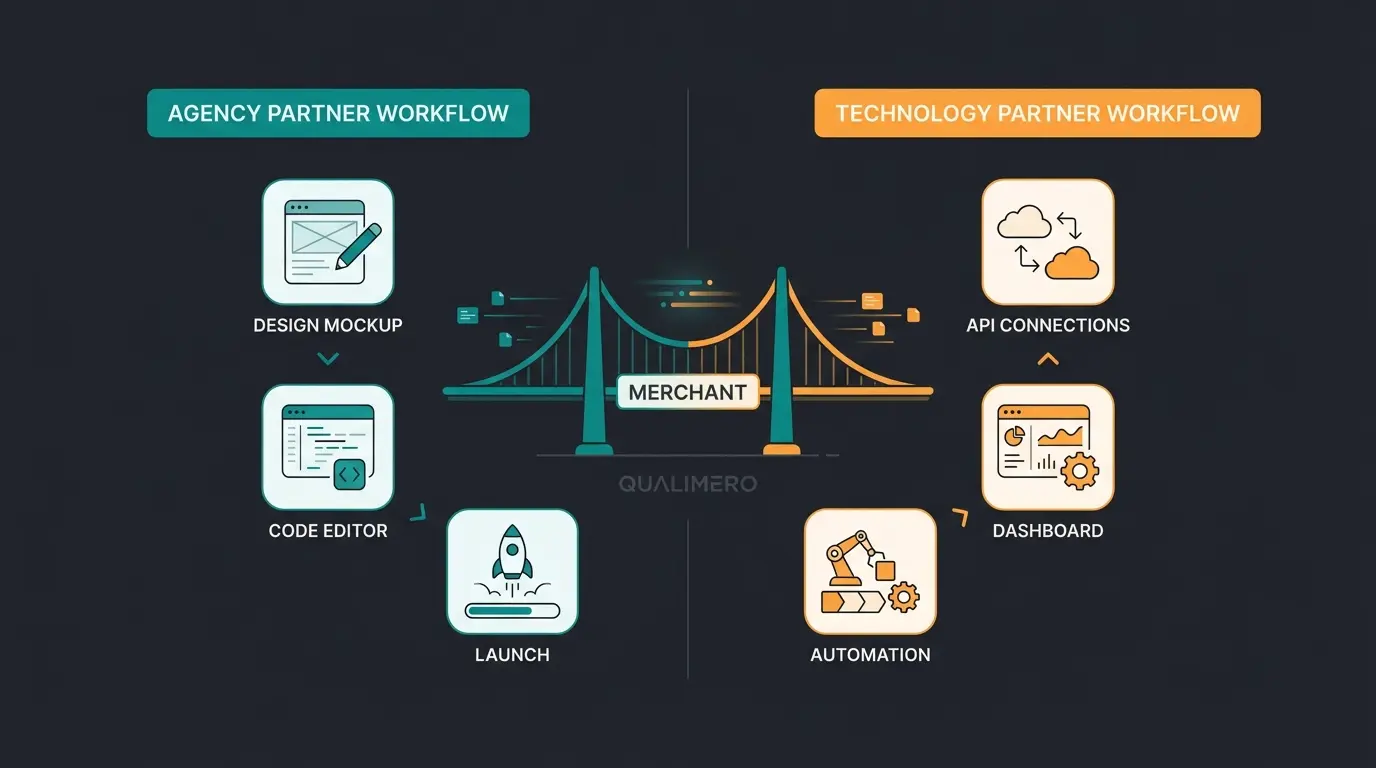
Choose an agency partner when you need custom design, shop setup, or migration. Choose a technology partner when you need ongoing automation, AI integration, or a specific platform capability like product advisory or customer service. Most growing merchants need both: an agency for the initial build and a technology partner for scalable operations.
| Dimension | Agency partner | Technology partner |
|---|---|---|
| Scope | Shop design, development, migration | SaaS tools: AI, ERP, analytics, search |
| Cost model | Project-based or hourly (EUR 80-180/hr) | SaaS subscription (monthly recurring) |
| Engagement length | Project-bound (3-12 months typical) | Ongoing, scales with your shop |
| When to choose | New shop build, redesign, platform migration | Post-launch optimization, automation, AI integration |
| Integration depth | Custom code, theme development | API-native, pre-built connectors |
| Typical ROI timeline | 6-12 months post-launch | Weeks to first measurable results |
The hybrid approach works well in practice. An agency builds and launches your shop. A technology partner handles the ongoing optimization, things like AI-powered product consultation, automated customer service, or ERP synchronization. The agency hands off a clean codebase; the technology partner takes it from there.
Where it gets tricky: some agencies position themselves as full-service partners covering both development and SaaS integration. In our experience, agencies that try to build their own AI or automation tools rarely match the depth of dedicated technology partners. Check whether the agency's "AI solution" is a white-labeled third-party tool or genuine in-house capability. For more on working with agencies specifically, see the Shopware agency guide. If you are considering independent developers, our Shopware freelancer overview covers that option.
Technology partners: the new force in e-commerce
Technology partners provide specialized software that extends Shopware's core capabilities, from AI customer service and product consultation to ERP integration and analytics. Unlike agencies who build your shop, technology partners provide ongoing SaaS tools that scale with your business without additional development hours.
The category has grown rapidly since Shopware 6 opened its API architecture. Three types dominate: payment and checkout optimization (Stripe, Mollie, Adyen), ERP and data connectors (WeClapp, Xentral, Microsoft Dynamics), and the newest segment, AI-powered customer interaction.
Qualimero operates in that third segment: AI product consultation that replaces static FAQ pages with a digital team member capable of advising customers in real time, recommending products based on context, and processing orders directly in conversation. The results are measurable. Rasendoktor, an online lawn care retailer running on Shopware, deployed a Qualimero AI employee and achieved a 16x return on investment with full automation of their 3,000 seasonal inquiries.
Signed, an e-commerce retailer for custom signs, automated 70% of customer inquiries on Instagram through a Qualimero digital employee and saw an 18x ROI with a 30% increase in cross-selling. Those are not hypothetical numbers. They are client-reported metrics from live deployments.
As Shopware CEO Sebastian Hamann noted in the 2025 Gartner recognition announcement: "Our open, API-first architecture enables technology partners to build deeply integrated solutions that create real value for merchants." That openness is exactly what makes the Shopware partner ecosystem different from closed platforms where third-party integrations are limited to surface-level plugins.
5 criteria for choosing the right Shopware partner
Evaluate every Shopware partner candidate on five dimensions: certification level and Shopware version expertise, relevant industry references, transparent pricing and project scoping, post-launch support model, and technology stack compatibility. This checklist works for agencies and technology partners alike.
- Certification and version expertise. Verify the partner's Shopware certification tier directly in the Shopware partner directory. Ask specifically about Shopware 6 experience, not just legacy Shopware 5. A Shopware certified partner with Gold status and current certifications signals ongoing investment in the platform.
- Industry references. Request case studies from your vertical. A partner who has built 50 shops but none in your industry is a risk. Ask for live shop URLs, not just logo walls. Check OMR Reviews, Google Reviews, and Gartner Peer Insights for unfiltered feedback.
- Pricing transparency. Demand a written scope document before signing anything. Fixed-price or time-and-materials? What is included in the post-launch phase? Hidden costs, scope creep without change orders, unspecified maintenance fees, are the leading cause of failed agency relationships.
- Post-launch support model. What happens after go-live? Is there an SLA? What is the response time for critical bugs? Budget 15-20% of your initial project cost annually for agency maintenance. For technology partners, the SaaS subscription should cover updates, support, and feature iterations without additional fees.
- Technology stack compatibility. Does the partner's approach integrate with your existing ERP, PIM, CRM, and payment systems? Ask for specific integration documentation, not vague promises. For Shopware consulting on complex architecture decisions, specialized advisors can map dependencies before you commit.
One pattern I keep seeing in failed evaluations: merchants pick the cheapest option or the one with the most impressive website, instead of testing actual project fit. The best filter is a paid discovery workshop (2-4 days, typically EUR 3,000-8,000) where the partner audits your current setup and proposes a concrete implementation plan. If they refuse to do paid discovery, that tells you something.
Here is the checklist in condensed form. Print it, bring it to your next partner meeting, and score each candidate on a 1-5 scale per criterion. A total score below 15 out of 25 means the partner is not ready for your project.
- Partner holds current Shopware certification (Silver or above)
- At least 2 live references in your industry or vertical
- Written scope document with transparent pricing provided
- Post-launch SLA defined with response time guarantees
- Integration compatibility confirmed with your ERP/PIM/CRM
- Paid discovery workshop offered as evaluation step
How to evaluate a technology partner
A strong technology partner demonstrates measurable ROI from existing clients, offers a free trial or proof-of-concept, integrates natively with Shopware 6 APIs, and provides transparent SaaS pricing without hidden implementation fees. Agency evaluation focuses on portfolios; technology partner evaluation focuses on data.
- Documented client results. Not testimonials, actual metrics. Qualimero publishes full case studies with verified KPIs: Rasendoktor (16x ROI, 100% automation), Signed (18x ROI, 70% support automation). Ask any technology partner for the same level of transparency.
- Free trial or POC. A technology partner confident in their product offers you a way to test it. If the only option is a 12-month contract, question why.
- Native Shopware 6 integration. Check whether the solution uses Shopware's REST API directly or routes data through a middleware layer. Direct API integration means faster response times and fewer failure points. Shopware 6 specialists can verify integration depth during the evaluation.
- Transparent pricing. SaaS pricing should be published or available on request. Watch for setup fees, mandatory onboarding packages, or per-transaction charges that scale unpredictably.
According to OMR Reviews, Qualimero holds a 4.9/5.0 rating across active enterprise clients. That is the kind of third-party validation worth checking before committing to any technology partner, including us.
Beyond individual evaluation, the broader market context matters. The DACH region accounts for over 80% of all Shopware installations globally, according to 6sense market data. Germany alone hosts roughly 24,000 of the platform's 30,000 active stores. That concentration means the deepest partner expertise sits in the German-speaking market, even for English-language shops.
Top agency partners by region
Germany's strongest Shopware agency clusters are in Berlin, Munich, Cologne, Hamburg, and Düsseldorf. Each region has certified agencies ranging from boutique specialists to full-service digital commerce firms. Rather than listing individual agencies here (which would be outdated within months), we maintain dedicated regional guides.
- Shopware agencies in Berlin: strongest cluster for enterprise and B2B projects
- Shopware agencies in Munich: heavy mid-market presence, strong design focus
- Shopware agencies in Cologne: traditional e-commerce hub with deep Shopware roots
- Shopware agencies in Hamburg: international-facing, strong in D2C brands
- Agencies in Düsseldorf: growing scene, competitive pricing
If your project requires physical meetings and on-site workshops, regional proximity matters. For pure technology partners, geography is irrelevant, the integration runs via API regardless of where the provider sits. Beyond regional selection, consider specialization: if organic visibility is a priority, a dedicated Shopware Seo Agency combines platform expertise with search optimization skills that generalist agencies often lack.
Cost structure and budgeting
Agency partners typically charge EUR 80-180 per hour depending on tier and region, with initial shop builds ranging from EUR 15,000 for a Silver agency doing a basic setup to EUR 150,000+ for a Platinum agency running an enterprise migration. Technology partners like Qualimero use SaaS pricing starting from a few hundred euros per month, with no per-transaction fees.
| Cost factor | Agency partner | Technology partner (SaaS) |
|---|---|---|
| Initial investment | EUR 15,000-150,000+ | EUR 0-2,000 (setup/onboarding) |
| Ongoing monthly cost | EUR 1,500-5,000 (retainer/maintenance) | EUR 200-1,500 (subscription) |
| Annual total (year 1) | EUR 30,000-200,000+ | EUR 2,400-20,000 |
| Scaling cost | Linear (more hours = more cost) | Flat or tiered (SaaS model) |
| Hidden cost risks | Scope creep, change orders, maintenance surprises | Low, pricing is typically fixed |
The real cost question is not agency vs technology partner. It is build vs buy. Custom development through an agency gives you exactly what you need, but at 10-50x the cost of a SaaS solution that covers 90% of the same functionality. We see this pattern repeatedly: a merchant pays EUR 40,000 for a custom recommendation engine that underperforms a EUR 500/month AI product advisor.
According to a 2024 Forrester report on digital commerce platforms, the average total cost of ownership for a mid-market e-commerce project over three years is EUR 250,000-500,000 when including agency fees, hosting, and technology subscriptions. The allocation is shifting: technology partner spend grew 28% year-over-year while agency project budgets remained flat. Merchants are investing more in SaaS tools and less in custom development.
What to expect after launch
Post-launch support includes bug fixes, security updates, performance monitoring, and feature iterations. Budget 15-20% of the initial project cost annually for agency maintenance, or rely on your technology partner's SaaS subscription that includes updates automatically.
The first 90 days after launch are critical. Expect three to four hotfix cycles, at least one integration issue you did not anticipate, and a round of UX adjustments based on real user behavior. A good agency partner includes this stabilization phase in the project scope. A good technology partner monitors performance dashboards and flags anomalies proactively.
Long-term, the split evolves. Agency involvement typically drops to monthly retainer hours for incremental changes. Technology partners become more embedded: as your product catalog grows and customer interactions increase, the AI and automation layer handles more of the workload. For a detailed breakdown of ongoing responsibilities, see our Shopware maintenance guide.
One question that rarely comes up during partner selection but matters enormously: data ownership. With agency partners, you own the code they build for you. With technology partners, clarify what happens to your data if you cancel. Can you export customer interaction logs? Is there a data portability clause? At Qualimero, all client data remains client property with full export capability at any time. Not every technology partner offers the same guarantee.
Frequently asked questions about Shopware partners
Start with the official Shopware partner directory and filter by region, tier, and specialization. Cross-reference with OMR Reviews and Google Reviews for unfiltered client feedback. As of Q2 2026, Shopware lists over 1,600 certified partners globally.
Silver partners hold a minimum of 4 Shopware certifications and receive a dedicated partner manager. Gold partners require 10+ certifications, demonstrate a proven track record of successful projects, and receive priority support plus access to Shopware's marketing fund. Gold typically signals mid-market capability.
Hourly rates range from EUR 80 (Bronze agencies, basic setups) to EUR 180+ (Platinum agencies, enterprise projects) in Western Europe. A standard Shopware 6 shop build costs EUR 15,000-50,000. Enterprise migrations with custom integrations can exceed EUR 150,000.
Yes, and many merchants do. The most effective setup combines an agency partner for development and design with a technology partner for ongoing SaaS capabilities like AI product consultation or ERP integration. Define clear responsibility boundaries in writing before the project starts.
A technology partner provides SaaS-based extensions for Shopware, such as AI customer service, payment processing, search optimization, or ERP connectors. Unlike agencies, technology partners do not build your shop. They provide software that integrates with it via Shopware's API and scales through a subscription model.
Shopware enterprise partners are typically Gold or Platinum agencies with demonstrated capability in handling large-scale B2B and B2C deployments. They have direct collaboration channels with Shopware AG, access to pre-release features, and dedicated technical account managers. Enterprise projects usually start at EUR 100,000+.
A Shopware partner builds your shop. A Qualimero AI employee turns visitors into buyers, with +35% higher cart values and 7x conversion rates across 25 active e-commerce clients.
Book a free demo
Kevin is CTO and co-founder of Qualimero. As an AI architect with over 15 years of experience as CTO and CPO in the tech industry, he designs the AI systems that automate tens of thousands of customer interactions daily for Qualimero's clients — reliably, securely, and at scale.