Introduction: The Silence of Online Stores
Imagine walking into a specialty running shoe store. The shop is immaculately clean, the shelves are perfectly lit, and inspiring posters of marathon runners adorn the walls. But there's one problem: not a single salesperson is in sight. No one asks about your running style, your goals, or previous injuries. Instead, you find a 2,000-word manual attached to every shelf. Would you buy? Probably not. You'd leave and go somewhere you'd actually receive advice.
This exact scenario plays out daily in thousands of Shopware online stores. We leverage the powerful Shopware Shopping Experiences (Erlebniswelten) to build visually stunning digital storefronts. We optimize SEO copy until our keywords practically glow. But we often forget the most important thing: the dialogue with the customer.
In today's e-commerce landscape, it's no longer enough to simply manage content (Content Management). We must use content to consult (Consultative Selling). This fundamental shift represents the difference between stores that struggle and stores that thrive. According to Qualimero, the future of e-commerce lies in bridging the gap between static information and personalized guidance.
This article shows you how to revolutionize your Shopware content marketing strategy for 2025. We're moving away from static layouts toward interactive, AI-powered consultation experiences that don't just generate traffic, but transform visitors into loyal customers. Whether you're managing a B2B enterprise or a D2C brand, the principles outlined here will help you leverage AI-powered product consultation to create meaningful customer connections.
The Status Quo: Shopware Content Marketing Today
Before we illuminate the future of content marketing in Shopware, we need to understand which tools the platform offers out-of-the-box and where their limitations lie. The current landscape is dominated by technical documentation and feature lists, but for a true strategy, we must look deeper. Understanding these foundations is essential before implementing advanced Shopware AI features.
The Foundation: Shopware Shopping Experiences
The heart of content marketing in Shopware 6 is the Shopping Experiences (Erlebniswelten). These have replaced the old 'Shopping Worlds' from Shopware 5 and offer an intuitive drag-and-drop editor to design landing pages, category pages, and shop pages. According to Kennersoft, this represents a significant upgrade in content flexibility for merchants.
- Functionality: The system is based on sections, blocks, and elements. You can combine text blocks, images, sliders, or product streams to create visual storytelling experiences
- Data Mapping: A powerful feature is Data Mapping, which allows you to create a layout once and dynamically populate it with content from various categories or products
- The Problem: As beautiful as these pages are – they're mostly static. They're digital window displays. The customer views them, but hardly interacts with them, unless they click on a product
The documentation from Atloss and Splendid Internet confirms that while Shopping Experiences excel at presentation, they weren't designed for consultation. They rely on customers reading lengthy texts to find their own answers – a passive approach that increasingly fails in today's attention-scarce environment.
Blogging in Shopware
Shopware 6 doesn't include a full-featured blogging functionality in its core, as you might know from WordPress. Many marketing teams therefore rely on plugins to fill this gap.
- Magefan Blog Extension: One of the most popular solutions. It enables SEO-friendly URLs, categories, tags, and navigation integration. According to Magefan and their GitHub repository, this plugin provides comprehensive blogging capabilities
- Shopware Blog Module: These extensions bridge the gap by creating content areas that go beyond pure product descriptions, as detailed on Shopware.com
But even here, the same limitation applies: A blog post titled 'The 10 Best Hiking Boots' is a monologue. The customer must read, filter, and decide for themselves which information is relevant to their needs. This approach fails to leverage the potential of conversational commerce.
SEO Foundation in Shopware
No content strategy works without visibility. Shopware provides solid technical prerequisites for SEO that every content marketer should understand and utilize:
- SEO URL Templates: Under Settings > SEO you can define how URLs for products and categories should be structured (e.g., `{{ product.translated.name }}/{{ product.productNumber }}`). Both Rhiem Intermedia and official Shopware documentation provide detailed guidance
- Meta Data: Titles and descriptions can be maintained at a granular level for maximum search optimization
- Technical Performance: With the update to Shopware 6.7 and the switch from Webpack to Vite, plus the introduction of Vue 3, the frontend becomes more performant – a critical ranking factor according to Shopware's release notes and Memo ICT
The Content Gap: Why Static Content Falls Short
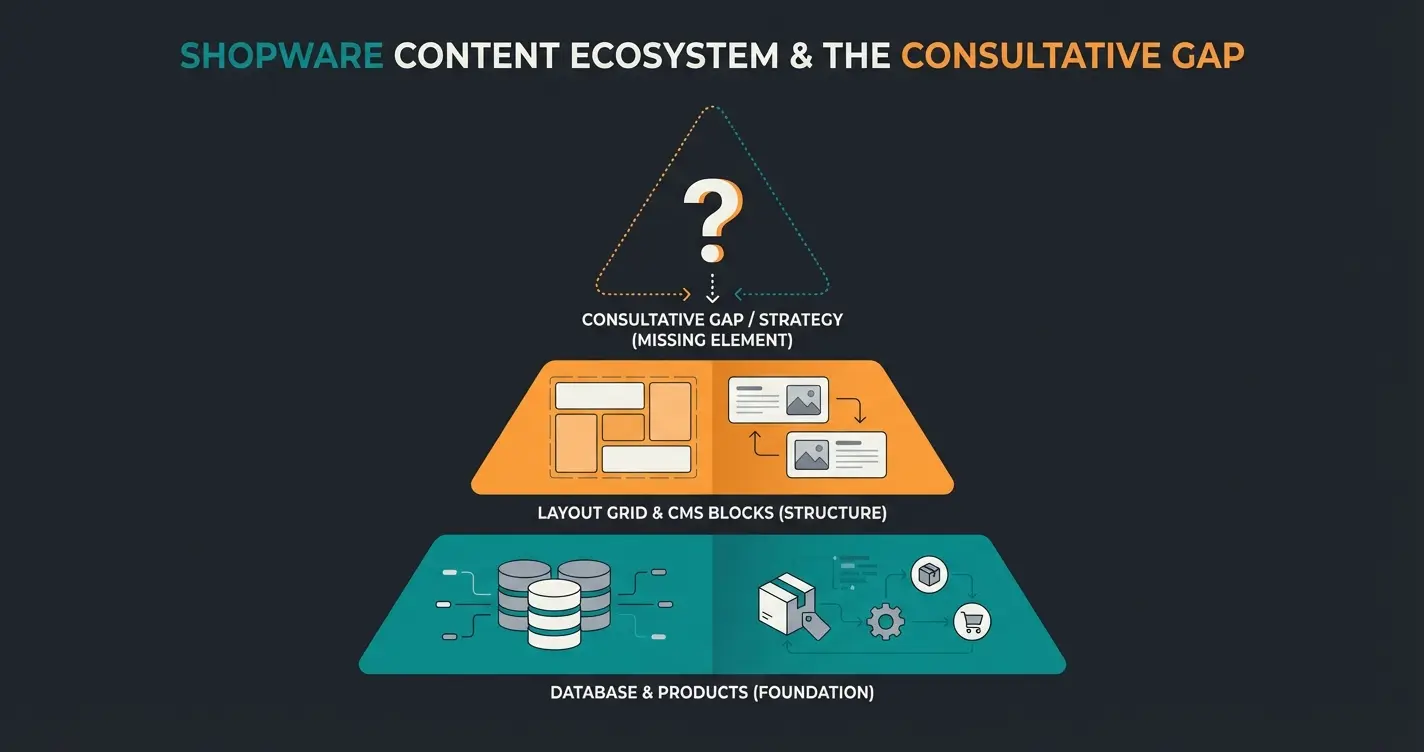
Analysis of the top search results for 'Shopware Content Marketing' reveals a clear gap: there are countless guides on configuring the CMS, but hardly any strategies for conversion through content. The current results are obsessed with the 'container' (CMS, Plugins, Layouts) but ignore the 'contents' (Strategy, Engagement, Conversion). This represents a massive opportunity for forward-thinking merchants.
The Problem of Filter Fatigue
In a typical Shopware shop, the customer lands on a category page. They see 50 products and a sidebar with filters (size, color, price, material). This experience, while functional, creates significant friction in the buying journey.
- The Reality: Customers often don't know which technical specifications they need. What does 'water column 10,000mm' mean? Do I need 'Gore-Tex' or is 'Softshell' sufficient? These questions remain unanswered by static filters
- The Consequence: The customer becomes overwhelmed. Bounce rates climb. Cart abandonment increases. Revenue disappears. Traditional Shopware 6 chatbots that only answer 'Where is my order?' do nothing to solve this fundamental problem
The Data Doesn't Lie: The Power of Interactive Content
Statistics for 2024/2025 dramatically demonstrate that static content is losing effectiveness. The evidence is overwhelming and points clearly toward interactive, consultative approaches:
Interactive content generates significantly more engagement than static content according to research from Fliki.ai and Insivia
Users spend 13 minutes with interactive content vs. only 8.5 minutes with static content per Donorocean research
Of marketers say interactive content is more effective at educating buyers according to Go-Globe and Linearity.io studies
These statistics from Fliki.ai, Insivia, Donorocean, Go-Globe, and Linearity.io paint a clear picture: the future belongs to interactive, consultative content. Understanding KI E-Commerce principles is essential for capitalizing on these trends.
The Consultative Gap: Your Competitive Advantage
Most Shopware shops ignore these data points. They optimize the 'container' (the layout) but neglect content as a consultation instrument. No one in the current search landscape is discussing how to replicate the in-store sales assistant experience online. They talk about 'Shopping Experiences' as static layouts (images + text), not interactive dialogues.
There's also a missing strategic content framework. There's no guide on how to plan a content strategy for Shopware that actually sells complex products. Users find buttons to click, but not advice on what to write to convert hesitant browsers into confident buyers. This gap represents your opportunity to differentiate and dominate.
The Solution: Interactive Content Strategy
To succeed in 2025, we must redefine content marketing entirely. It's no longer about sending information – it's about asking questions. We call this approach Consultative Content, and it represents the future of AI powered consultation in e-commerce.
What Is Consultative Content?
Consultative Content simulates the conversation with an experienced salesperson. Instead of giving the customer a list of all options, the content guides the customer through a decision-making process. This approach acknowledges that customers don't want more choices – they want confidence in their decision.
Example of the transformation:
- Old (Static): A blog article titled 'The Differences Between Road Running Shoes and Trail Shoes' – 2,000 words the customer must read and interpret
- New (Interactive): A tool that asks: 'Where do you prefer to run?' and based on the answer, displays the relevant paragraph or matching product – instant, personalized guidance
This shift from passive information delivery to active consultation is what separates average stores from exceptional ones. When guided selling outperforms traditional methods, the path forward becomes clear.
Why Shopware Is Perfect for This Approach
Shopware 6 is ideally suited for consultative approaches thanks to its API-First architecture. Unlike monolithic systems, Shopware allows you to seamlessly integrate external logic (like an AI or quiz tool) into your Shopping Experiences without bending the core code. This architectural advantage makes Shopware the ideal platform for implementing AI-powered Guided Selling.
The platform's flexibility means you can overlay conversational interfaces on top of your existing product data, creating intelligent consultation experiences that feel native to your brand while leveraging cutting-edge AI capabilities.
AI as Product Consultant: The Game Changer for Shopware
Here we arrive at the core of your new strategy. Artificial Intelligence in e-commerce is often misunderstood. Most discussions focus on AI for content generation, but the real transformation lies in AI for customer guidance. This is where digital sales consultants create genuine competitive advantages.
Shopware AI Copilot vs. Consultative AI
Shopware has done fantastic work with the AI Copilot. Features like AI-generated product descriptions, image keyword assistants, or review summaries are enormous time-savers for merchants, as documented on Shopware.com and analyzed by Atwix.
- Shopware AI Copilot: Focus on backend efficiency (merchant productivity) – helping store owners create content faster
- Consultative AI (Your Opportunity): Focus on frontend consultation (customer experience) – helping shoppers make confident decisions
The gap in the market is using AI not for creating text, but for guiding the customer. While competitors invest in generating more content, you should invest in making existing content actionable and personalized through AI for pre-sales engagement.
More Than Just a Chatbot
When we talk about AI consultation, we don't mean the classic support chatbot ('Where is my package?'). We're talking about Guided Selling – a fundamentally different approach to customer interaction that AI eliminates waiting times while simultaneously increasing conversion rates.
A Consultative AI accesses your Shopware product data (attributes, descriptions, prices) and uses this to make real-time recommendations. It understands context, remembers preferences within a session, and guides customers through complex decisions just like a knowledgeable human salesperson would – but at scale, 24/7, without breaks or bad days.
The German Market Angle: Trust and GDPR
Especially in the DACH region, skepticism toward 'black box' AI runs deep. German merchants and consumers are wary of opaque systems that can't explain their reasoning. A successful strategy must therefore address two critical concerns:
- Data Sovereignty: The AI must not hallucinate. It must be based on the actual product data in your Shopware system, not generic training data that might produce incorrect recommendations
- Transparency: The customer must know they're being advised by an AI functioning as an 'assistant.' This transparency builds trust rather than diminishing it, especially when the AI consistently delivers accurate, helpful guidance
Position your AI solution as a transparent, controllable layer on top of Shopware data – unlike generic ChatGPT wrappers that can't be held accountable for accuracy. This is precisely where AI consultation closes the trust gap that plagues many AI implementations.
Stop losing customers to decision paralysis. Our AI-powered product consultation integrates seamlessly with your Shopware data to guide visitors to confident purchases.
Start Your Free TrialStep-by-Step: Building a Content Strategy That Sells
How do you now implement this theory in your Shopware shop? Here's a concrete roadmap that takes you from concept to conversion-driving reality. This framework applies whether you're running a small specialty store or a large enterprise operation.
Identify products with high return rates and cart abandonment – these are your consultation candidates
Build contextual landing pages using the Layout Editor to create emotional storytelling foundations
Integrate an AI advisor prominently in your Shopping Experiences with full access to product attributes
Track conversions from AI interactions vs. static pages to prove ROI and optimize continuously
Step 1: Audit Products Requiring Explanation
Analyze your sales data thoroughly. Where are return rates high? Where do customers abandon on the product detail page? These patterns reveal where consultation is most needed and where AI can have the greatest impact.
Pro Tip: Use Shopware Analytics (available in higher plans) or Google Analytics to identify products with high 'view-to-cart' discrepancy. Products that get many views but few add-to-cart actions are your prime candidates for Consultative Content. According to Envive.ai and Red Stag Fulfillment, these 'leaky bucket' products often represent the biggest revenue recovery opportunities.
Step 2: Optimize Shopping Experiences for Storytelling
Before deploying AI, the foundation must be solid. Use Shopping Experiences to create the context that makes consultation meaningful. The visual and emotional framework supports the conversational layer you'll add next.
- Create landing pages for specific use cases (e.g., 'Home Office Setup' instead of just category 'Office Furniture') – this frames the consultation around customer goals, not product specifications
- Use the Layout Editor to mix emotional images with hard facts, creating a foundation that the AI can reference and build upon
- Structure content around customer problems and outcomes, not product features – this primes visitors for consultative engagement
Step 3: Implement the Consultative AI Layer
Integrate a solution that functions as a 'Digital Sales Consultant' – not a support bot, but a genuine advisor that understands products and customer needs. This is where AI-powered product consultation transforms your conversion rates.
- Placement: Embed the consultant prominently in your Shopping Experiences (e.g., as a floating element or embedded block) – visibility drives engagement
- Data Flow: Ensure the AI has access to your Properties in Shopware. When a customer says 'red,' the AI must know which products have the attribute `color: red` and can speak intelligently about them
- Conversation Design: Script the opening questions to quickly identify customer needs, then let the AI's intelligence guide the conversation naturally toward relevant products
Step 4: Measure Consultation-to-Cart Rate
Forget pure pageviews – they're vanity metrics that don't pay the bills. The new currency is conversion after consultation. This metric directly ties your content investment to revenue outcomes, as emphasized by Digital Web Solutions.
- Measure how many users who interacted with the content add a product to the cart – this is your consultation-to-cart rate
- Compare this with users who only saw the static page – the delta reveals your AI's true value
- Studies show interactive elements can double conversion rates according to Embryo.com, giving you a clear benchmark for success
Visualization and Comparison: Proving the Value
To sell the value of this strategy internally or explain it to stakeholders, clear comparisons help tremendously. Visual evidence makes the abstract concrete and builds buy-in for implementation investment.
Comparison: Static CMS vs. AI Consultation
| Feature | Static Shopping Experiences / Blog | Consultative AI (AI Consultation) |
|---|---|---|
| User Effort | High: Must read texts, search filters | Low: Answers simple questions |
| Personalization | Low: 'One-to-Many' communication | High: 'One-to-One' dialogue in real-time |
| Time-to-Purchase | Slow: Research & comparison required | Fast: Immediate recommendation |
| Data Insight | Superficial: Clicks & dwell time | Deep: Preferences, needs, the 'Why' |
| Engagement | Average (Passive) | +52.6% higher (Active) |
| Scalability | Linear (More content = More work) | Exponential (Once trained, infinitely scalable) |
This comparison table illustrates why forward-thinking merchants are shifting investment from content volume to content intelligence. The scalability advantage alone justifies the transition – according to 6sense, AI-powered approaches deliver compounding returns that static content cannot match.
The Shopware Content Ecosystem Pyramid
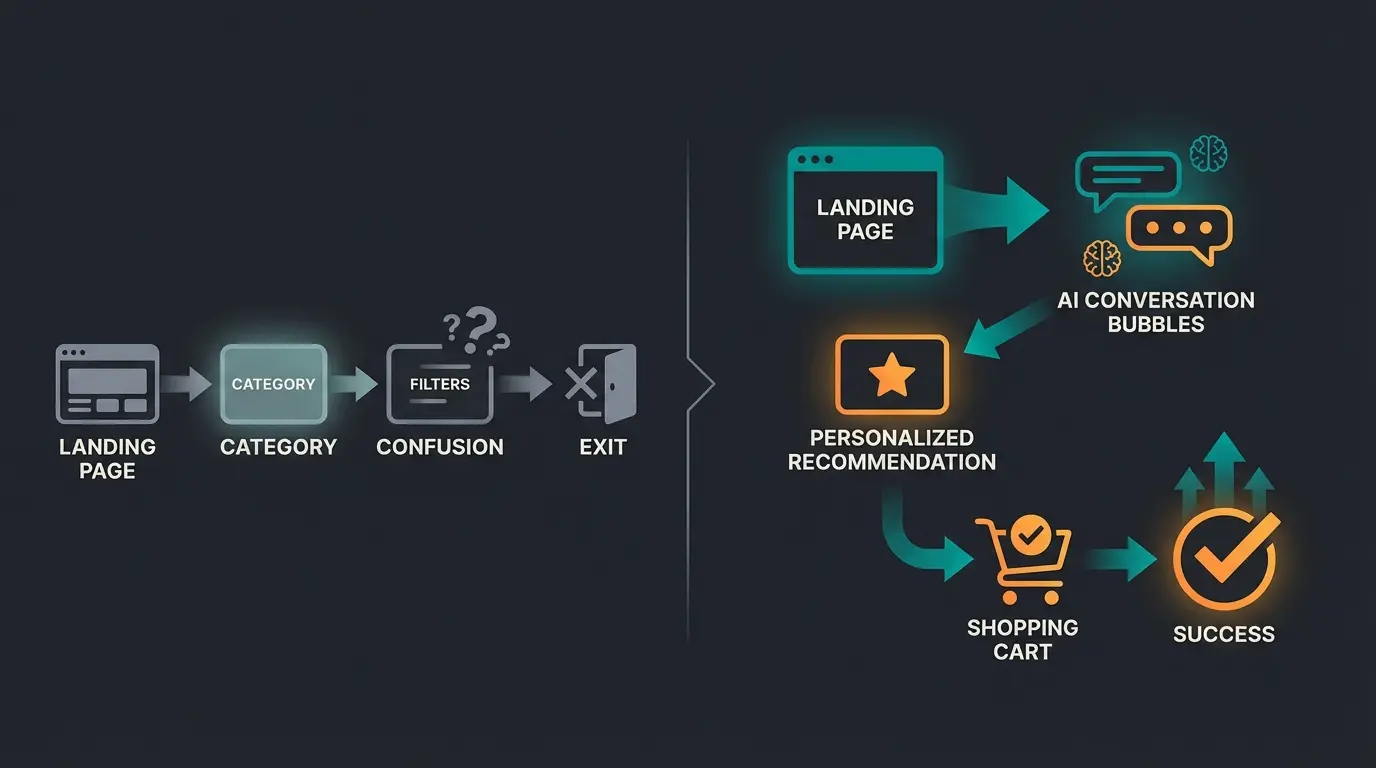
Visualize your content architecture as a three-tier pyramid that builds strategic advantage layer by layer:
- Base (The Foundation): Shopware Core Data. Products, prices, inventory, attributes. Without clean data, no strategy can succeed. This is your single source of truth
- Middle (The Presentation): Shopping Experiences & CMS. Here you create aesthetics, branding, and emotional resonance. This layer attracts and engages visitors
- Top (The USP): Consultative Layer. The AI that sits on top of data and design to actively guide users toward purchase decisions. This layer converts browsers into buyers
Customer Decision Journey Flowchart
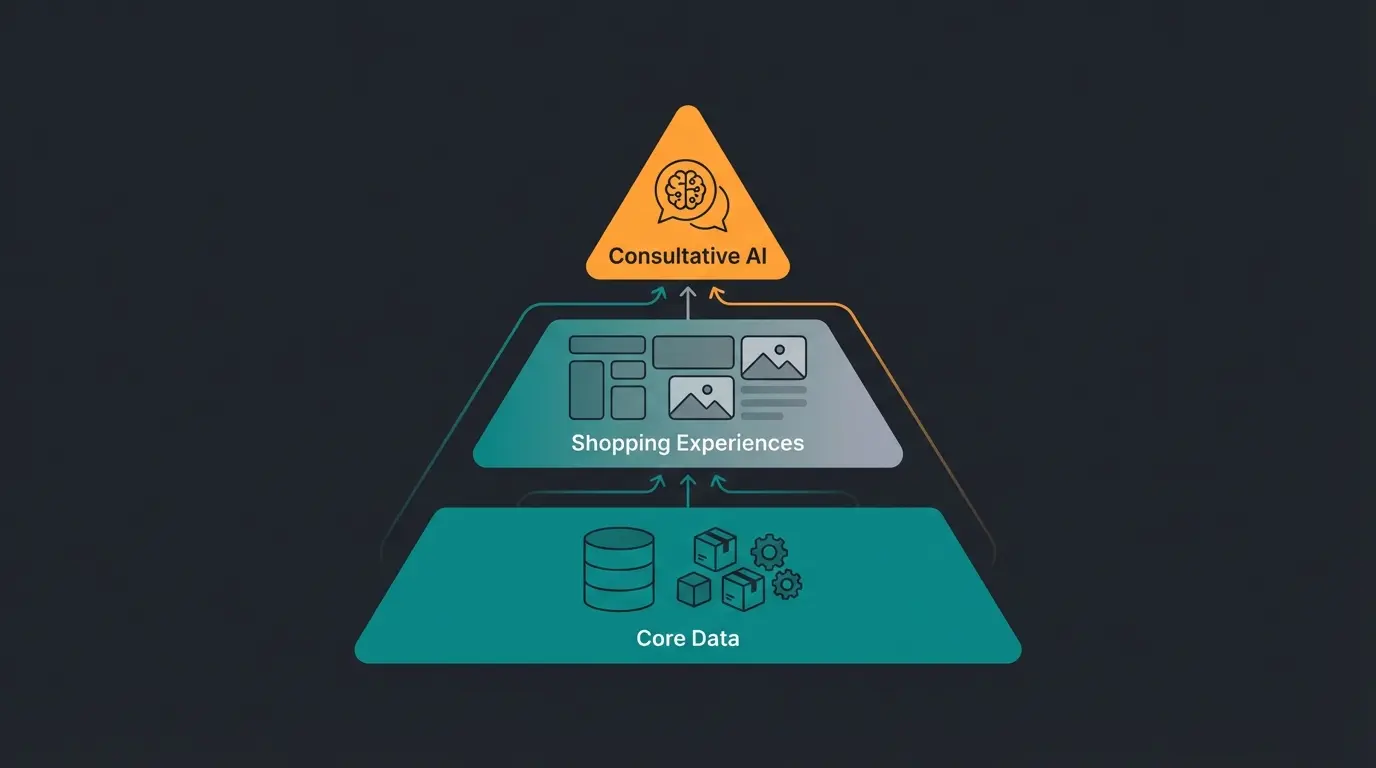
The transformation becomes clearest when mapped as customer journeys. Consider these two paths through your store:
- Path A (The Standard): Homepage → Category → Set filters (Frustration) → Read product page (Uncertainty) → Abandon cart → Leave site → Lost revenue
- Path B (With AI Strategy): Homepage → Interactive Consultant ('What are you looking for?') → AI analyzes needs → Precise product recommendation in the Shopping Experience → Confident purchase → Higher customer lifetime value
Path B doesn't just convert better – it creates happier customers who return and recommend. This is the power of consultative content marketing executed through AI-powered product consultation.
Quick Wins: Practical Tips for Shopware 6 Implementation
So you can start tomorrow, here are some technical and strategic quick wins that deliver immediate value while building toward your full consultative content strategy.
Leverage Custom Fields for Consultation Data
Shopware 6 offers extremely flexible Custom Fields. Use these not only for technical data, but for 'consultation data' that makes your AI smarter and your recommendations more relevant.
Example: Create a custom field 'Occasion' for clothing (Wedding, Casual, Business). Your AI or your filter can access this to give more human-like recommendations. Instead of asking about fabric weight, ask about where they'll wear the garment – then translate that to technical specifications behind the scenes.
Accessibility Compliance Is Coming
With the upcoming European Accessibility Act (EAA) and Shopware 6.7, accessibility becomes mandatory, as noted in official Shopware communications and industry analysis from Memo ICT.
- Ensure your interactive elements (quizzes, consultants) are keyboard-navigable and support screen readers
- Shopware 6.7 already delivers improved templates for accessibility compliance
- Build accessibility in from the start – retrofitting is always more expensive and less effective
Content Recycling with AI
Use the Shopware AI Copilot to transform your existing static texts into the foundation for your interactive consultation. Don't start from scratch – repurpose what you've already created.
Have the Copilot extract 'Key Benefits' from your long product descriptions, as described on Shopware.com. These short bullet points work perfectly as answers in a consultation chat. Your existing content investment becomes the knowledge base for intelligent conversations.
Case Study: Old Way vs. New Way
To crystallize the transformation, consider this concrete comparison of how customers experience the same product category under different content strategies:
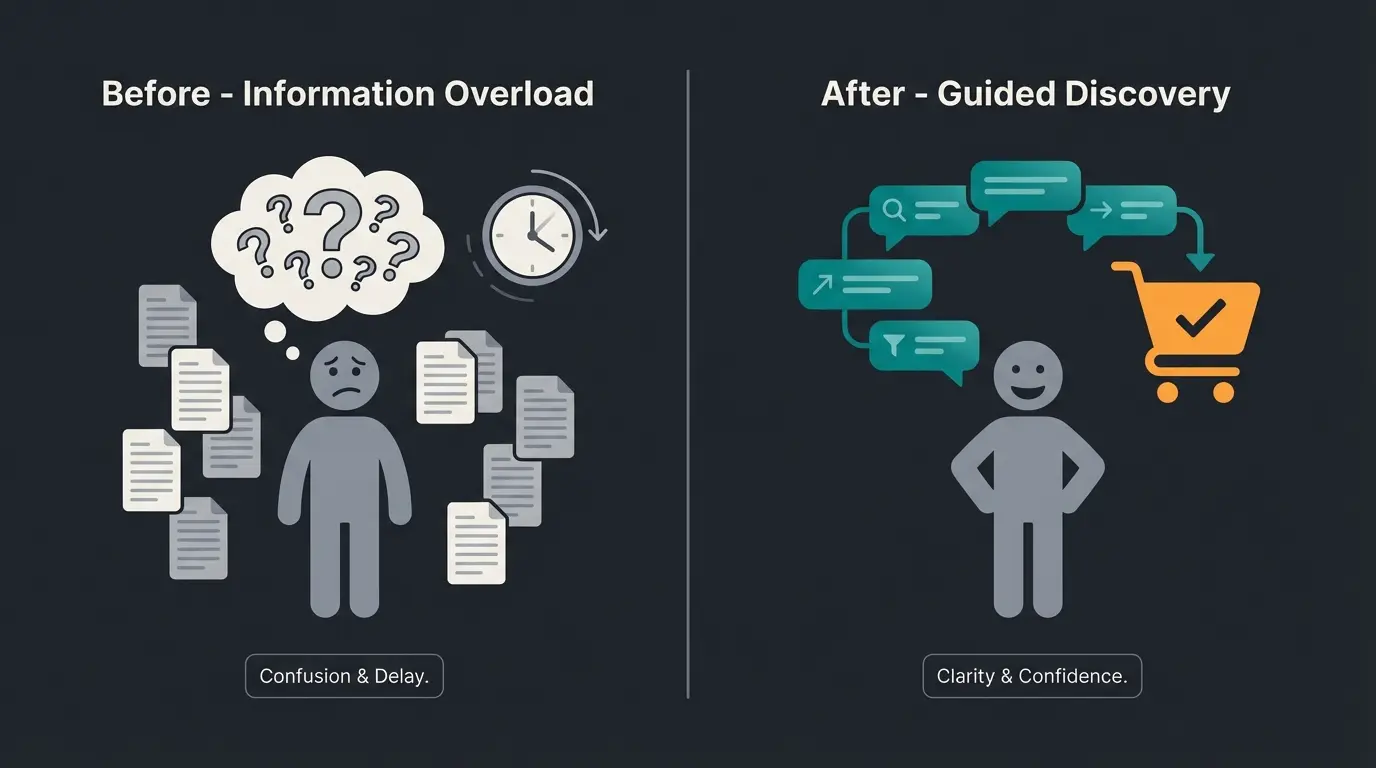
The Old Way: Information Overload
A customer searching for ski equipment lands on your category page. They see 47 skis. The blog post 'Which Ski Is Right for Me?' is 2,000 words long, covering ability levels, terrain types, ski lengths, construction materials, and binding compatibility. The customer reads for 8 minutes, becomes confused about which factors matter most for them, and leaves to 'think about it.' They never return.
The New Way: Guided Discovery
The same customer lands on the same category page. A conversational interface asks: 'Hey! Looking for the perfect ski? Mind if I ask a few quick questions?' Three questions later (ability level, preferred terrain, typical resort conditions), the AI presents two specific recommendations with clear reasoning: 'Based on your intermediate level and love for groomed runs, these two all-mountain skis will give you the control and confidence you're looking for.' Add to cart. Purchase complete. Customer delighted.
This is not theoretical – this is exactly how leading retailers using consultative AI are transforming their conversion rates. The technology exists today, and Shopware provides the perfect platform for implementation through solutions like AI-powered Guided Selling.
FAQ: Shopware Content Marketing Questions Answered
Shopware AI Copilot focuses on backend efficiency – helping merchants create product descriptions faster and manage content more efficiently. Consultative AI, on the other hand, focuses on the frontend customer experience – guiding shoppers through complex decisions in real-time. While Copilot helps you work faster, Consultative AI helps you sell better. Both are valuable, but they solve different problems.
Standard support chatbots answer transactional questions: 'Where is my order?' or 'What are your return policies?' Consultative AI engages in product discovery: 'What ski fits your riding style?' or 'Which laptop meets your needs?' It's the difference between customer service (reactive, post-purchase) and sales consultation (proactive, pre-purchase). Consultative AI drives revenue; support bots reduce support costs.
Yes, when implemented correctly. Key requirements include: data processing only for the stated purpose (product recommendation), transparency about AI usage, no storage of personal data without consent, and keeping all data within EU servers when possible. The best solutions use your Shopware product data as the knowledge base, not external training data, which simplifies compliance significantly.
Track 'consultation-to-cart' conversion rate: the percentage of users who interact with your AI consultant and then add products to cart. Compare this against users who only view static pages. Also measure: average order value after consultation (typically higher), return rates after consultation (typically lower), and customer satisfaction scores. Most merchants see 2x or higher conversion improvement within the first quarter.
Absolutely. The best implementations layer AI consultation on top of your existing Shopping Experiences rather than replacing them. Your beautiful layouts provide emotional context and brand expression; the AI adds interactive guidance. Think of it as adding a knowledgeable salesperson to your already-attractive store. The API-first architecture of Shopware 6 makes this integration straightforward.
Conclusion: The Future Is Conversational
The market for 'Shopware Content Marketing' is ripe for transformation. While your competitors still focus on how to pixel-perfectly position a text block in the CMS, you have the opportunity to fundamentally change the shopping experience and capture the market.
The technology is here. Shopware 6 offers the perfect foundation with its API structure and flexible Shopping Experiences. The customers are ready – they yearn for guidance in the flood of possibilities. According to India Times and 6sense, AI-driven consultation is rapidly becoming a customer expectation rather than a differentiator.
The step from 'We display products' to 'We consult customers' is the decisive lever for e-commerce growth in 2025. Use AI not just to work more efficiently, but to sell more effectively. The merchants who make this shift will dominate their categories; those who don't will wonder where their customers went.
The future of Shopware content marketing isn't about creating more content – it's about making every piece of content work harder through intelligent, personalized consultation. Start today, and you'll be leagues ahead of competitors who are still optimizing their Shopping Experiences for aesthetics rather than conversion.
Join forward-thinking merchants using AI consultation to double conversion rates. Our solution integrates seamlessly with Shopware 6 and respects German data privacy standards.
Get Started Free
Lasse is CEO and co-founder of Qualimero. After completing his MBA at WHU and scaling a company to seven-figure revenue, he founded Qualimero to build AI-powered digital employees for e-commerce. His focus: helping businesses measurably improve customer interaction through intelligent automation.