Why 2025 Is the Year of Compliance Transformation
Important Preliminary Note: This article does not constitute legal advice. It serves informational purposes only and is based on current research and best practices (as of 2025). For binding legal review of your store, please consult a specialized attorney or merchant association.
Legal warnings are the greatest fear of German online merchants. A wrong word in the imprint or a missing link to the OS platform could already become expensive in the past. But in 2025, the focus shifts dramatically. It's no longer enough to 'just' have an imprint.
Those who use automation, AI tools (like ChatGPT wrappers for customer support), or dynamic pricing need new safety nets. Technology evolves faster than many merchants can update their terms and conditions. At the same time, legislators are tightening the reins with the EU AI Act and the Accessibility Strengthening Act. Understanding the EU AI Act is now essential for every online merchant.
This article is your roadmap. We cover the basics so you're properly positioned for making Shopify legally compliant, then quickly pivot to topics your competition doesn't even have on their radar yet: How do I operate an AI chatbot without getting hit with legal warnings?
Executive Summary: The 2025 Compliance Landscape
The topic of making Shopify legally compliant is a perennial concern for merchants in the DACH region (Germany, Austria, Switzerland), but in 2025 the rules of the game are fundamentally changing. While most merchants are still busy optimizing their imprint and cookie banners, a new wave of regulations is rolling toward e-commerce.
Analysis of the current legal situation shows: It's no longer enough to just maintain static legal texts. Two massive changes are shaping 2025:
- The Accessibility Strengthening Act (BFSG): From June 2025, many online stores must be fully accessible for people with disabilities. This affects navigation, checkout processes, and content presentation according to eshop-guide.de.
- The EU AI Act: Anyone using chatbots, dynamic product consultation, or AI-generated content must fulfill new transparency obligations. According to haerting.de, merchants must clearly disclose when customers are interacting with AI systems.
This guide walks you through not only the classic obligations (imprint, terms and conditions, button solution) but also prepares your store for the era of 'Modern Commerce'—including AI compliance and accessibility. For those comparing platforms, our Shopware vs Shopify 2025 analysis provides valuable insights.
Accessibility requirements become mandatory for most B2C online stores
Full transparency obligations for AI-customer interactions take effect
Google's requirement became mandatory for EU advertisers
Strike-through prices must reflect lowest price of last 30 days
The Foundation: Mandatory Legal Texts & Settings
Before we dive into complex AI topics, we need to lay the foundation. Without this 'Holy Trinity' of legal texts, every German Shopify store is vulnerable to attacks.
The Four Essential Legal Pages
Every store in Germany absolutely requires dedicated pages for:
- Imprint (Impressum): Provider identification according to § 5 TMG. Your Shopify imprint must include complete company information, contact details, and registration numbers.
- Privacy Policy: According to GDPR requirements (including exact listing of all tracking tools). For comprehensive guidance, see our Shopify GDPR compliance guide.
- Terms and Conditions (AGB): The rulebook of your store. Your Shopify terms and conditions govern the customer relationship and purchase process.
- Cancellation Policy: Including a model withdrawal form for consumer protection.
Technical Implementation in Shopify
Shopify makes this relatively easy, but you need to know where to click:
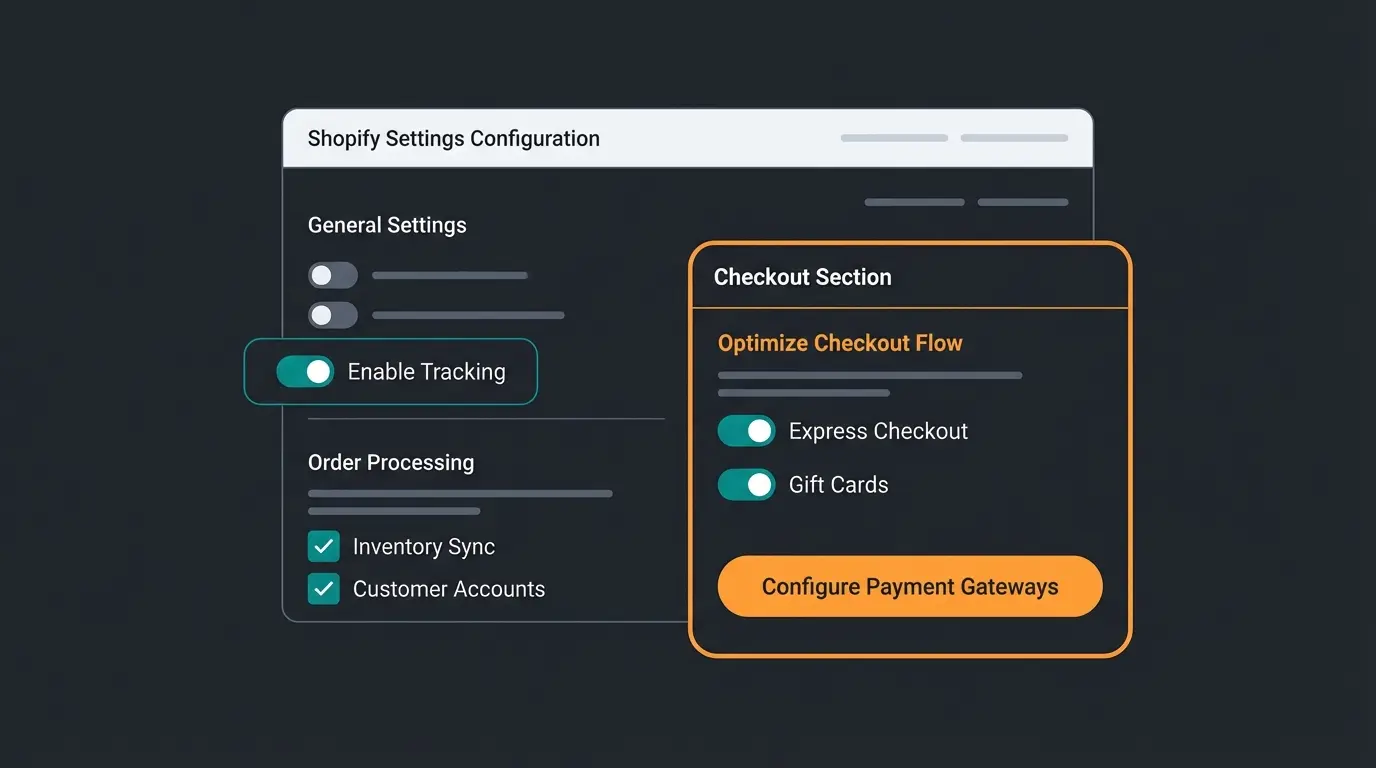
- Go to Settings > Policies in the admin area.
- Insert your texts into the corresponding fields there.
- Pro Tip: Don't use PDFs. The text must be directly readable and searchable on the HTML page.
- Link these pages prominently in the Footer and in the checkout process.
Checkout Checkboxes
In Germany, it's common and often necessary for customers to actively acknowledge the terms and conditions and cancellation policy before purchase. This requirement differs significantly from other markets, which is why understanding local requirements matters when evaluating consultative products platforms.
- Go to Settings > Checkout.
- Under 'Order processing,' activate the option: Confirmation step required.
The Button Solution: The Classic Legal Warning Trap
A topic that has been relevant for over a decade and is still done incorrectly in 2025 is the labeling of the purchase button. This remains one of the most common reasons for Shopify legal warnings.
The Problem: 'Buy' Is Not Enough
According to § 312j BGB (German Civil Code), the consumer must expressly confirm that they are committing to a payment. Labeling like 'Register,' 'Continue,' or just 'Order' is not permissible and results in no valid contract being concluded, as explained by it-recht-kanzlei.de.
Even the word 'Buy' is viewed critically by some courts or at least as risky because it doesn't clearly enough indicate the payment obligation, although it seems clear in common usage. According to cr-online.de, the explicit variant remains the safest choice.
The Solution: 'Order with Payment Obligation'
To make Shopify legally compliant, you must change the text of the final button in the checkout. The safest formulation in Germany is:
How to change the button text in Shopify:
- Go to Sales Channels > Online Store > Themes.
- Click the three dots `...` next to your current theme and select Edit default theme content.
- Search for 'Checkout & System' in the search bar.
- Filter or search directly for 'Pay now button label' or equivalent.
- Change the text to 'Order with payment obligation' (or your localized equivalent).
- Save your changes.
Prices, Taxes & the Omnibus Directive
Correct price labeling is a minefield. The Price Indication Ordinance (PAngV) applies here, and recently the Omnibus Directive, which regulates strike-through prices.
VAT and Shipping Costs
In Germany, the price must always state: 'incl. VAT, plus shipping costs'.
- Shopify Setting: Under Settings > Taxes and duties, activate the checkbox 'Show all prices including tax'.
- Ensure your theme displays the notice 'incl. VAT' and the link to shipping costs directly below or next to the product price. This often requires a small adjustment in the theme code or language settings.
Base Prices (Unit Pricing)
Do you sell coffee, shampoo, or fabrics? Then you must indicate the base price (price per 1kg, 100g, 1 liter, etc.).
- Since May 2022 (Omnibus), base prices must generally be based on 1 kilogram or 1 liter, unless the nominal filling quantity is less than 250g/ml, according to hochhardt.de and etailer.de.
- Shopify: Use the native 'Unit price' function in the product backend. Fill in the fields for 'Unit' and 'Reference unit' correctly.
Strike-Through Prices and the 30-Day Rule
If you advertise with discounts (e.g., 'Was €50, now only €30'), you need to be careful. The Omnibus Directive requires that the struck-through price be the lowest price of the last 30 days before the price reduction. This regulation is detailed by sysgrade.de and haendlerbund.de.
- The Risk: You may not artificially raise the price shortly before Black Friday to then suggest a huge discount.
- The Practice: Document your price changes. Apps that display automatic discounts must be configured to account for this 30-day rule. A violation is easy prey for competition associations.
GDPR & Cookies: Consent Mode v2 Is Mandatory
The topic of Shopify GDPR goes far beyond merely having a privacy policy. In 2024/2025, everything revolves around Google Consent Mode v2. For a deeper dive into data protection requirements, check our comprehensive Shopware GDPR guide.
Why the Old Cookie Banner Is No Longer Enough
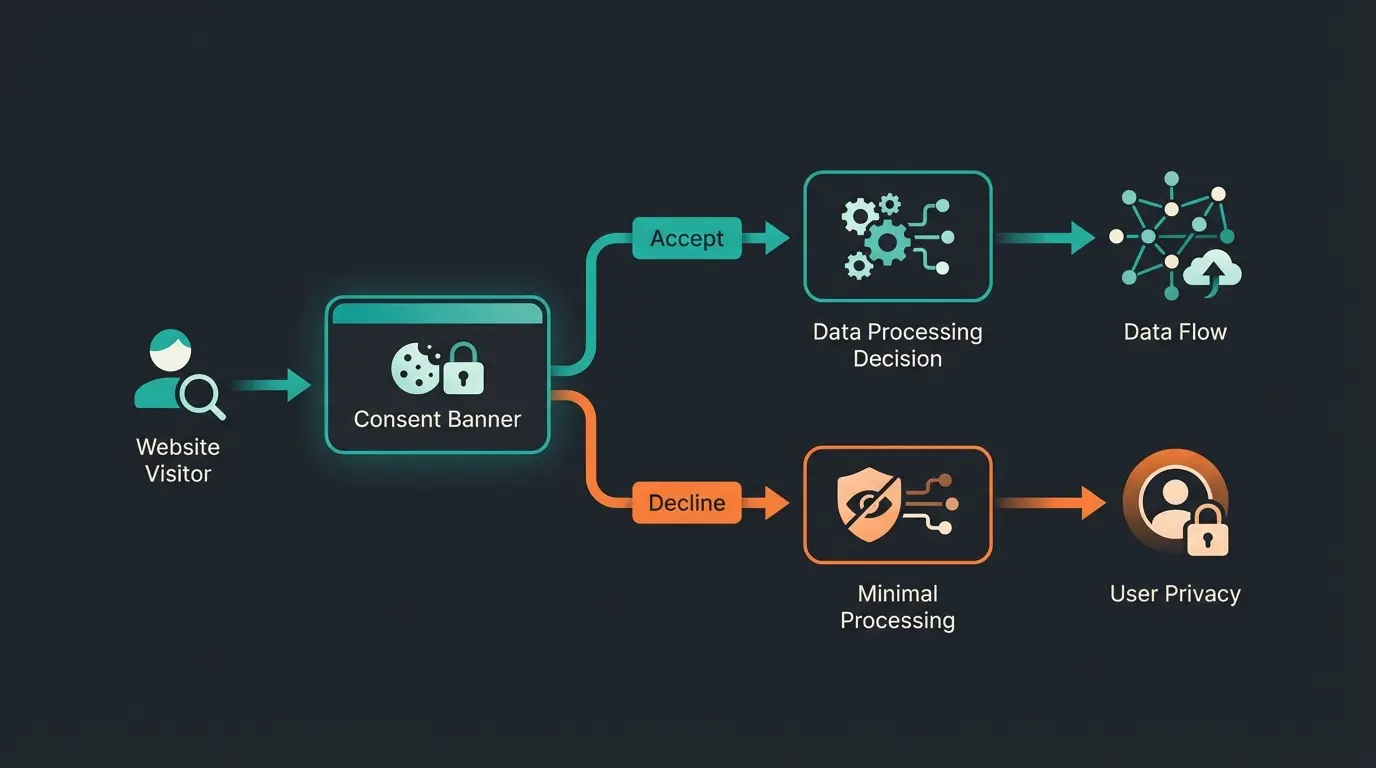
Previously, it was enough to block cookies until the user clicked 'OK.' Today, major advertising platforms like Google require that the 'consent status' be transmitted in a technically clean manner.
Since March 2024, Google Consent Mode v2 has been mandatory for all merchants who run Google Ads in the EEA (European Economic Area) and want to use audiences (remarketing), as confirmed by customerlabs.com and cookieinformation.com.
- Without Consent Mode v2: Google Ads can no longer cleanly measure conversions, remarketing lists no longer fill up. You lose massively in advertising efficiency.
- With Consent Mode v2: Your cookie banner sends signals to Google ('User has consented' or 'User has declined'). In case of refusal, Google uses AI modeling to close lost data gaps without violating privacy, according to secureprivacy.ai and vaimo.com.
Implementation in Shopify
Use a certified Consent Management Platform (CMP) that supports Consent Mode v2. Popular apps include:
- Consentmo (formerly GDPR/CCPA Compliance Manager) as detailed by consentmo.com.
- Pandectes as described on pandectes.io.
- Usercentrics (often integrated through agencies).
Understanding these requirements is crucial for Shopware GDPR compliance as well, especially if you're considering platform alternatives.
The Accessibility Act (BFSG): June 2025 Deadline
Here comes the 'elephant in the room' that many merchants are still ignoring. From June 28, 2025, the Accessibility Strengthening Act (BFSG) takes effect, as detailed by bfsg-gesetz.de.
Who Does It Affect?
The law applies to services in electronic commerce that are aimed at consumers (B2C). This explicitly includes online stores, according to ihk.de and ihk-muenchen.de.
The Exception (Micro-enterprises): You are temporarily exempt if you are a micro-enterprise. That means:
- Fewer than 10 employees AND
- Annual turnover of maximum 2 million euros (or balance sheet total max. 2 million €), as noted by onwalt.de.
But caution: As soon as you grow and exceed these limits, you must be compliant. Additionally, Google and customers prefer accessible stores. This consideration also applies to Shopware B2C features when evaluating platform capabilities.
What Do You Need to Do?
Your store must be accessible according to WCAG 2.1 Level AA standards. Specifically, this means:
- Keyboard Navigation: The entire checkout must be operable without a mouse, as emphasized by pictibe.de.
- Contrasts: Text colors must clearly stand out from the background.
- Alt Texts: All product images need descriptive alternative texts for screen readers.
- Understandability: Error messages in forms (e.g., 'Email missing') must be clear and distinct.
Our AI-powered consultation solution is built with privacy by design, helping you serve customers while staying legally compliant. Get audit logs, transparency features, and EU-hosted data processing.
Start Your Free TrialNew in 2025: Legal Compliance for AI & Product Consulting
This is the section that sets your store apart from the crowd. While others are still sorting cookies, you're integrating AI—but legally compliant. The EU AI Act (AI Regulation) brings new obligations for merchants starting in 2025, as detailed by casoon.de.
The EU AI Act for Store Operators: Transparency Requirements
From August 2026 (earlier for some systems), transparency obligations for AI systems that interact with humans take effect (Art. 50 AI Act).
The Scenario: You use a chatbot (e.g., Shopify Inbox with AI features or a GPT wrapper) that answers customer questions.
The Obligation: The user must know that they are speaking with an AI. The impression that there's a human on the other end must not arise, as clarified by veribot.de. This is particularly important when implementing AI product consultation features.
Implementation:
- Don't name your bot 'Employee Michael,' but rather 'Support Bot' or 'AI Assistant.'
- Add a disclaimer at the beginning of the chat: 'I am an automated AI assistant. Errors are possible.'
Consultation Liability: When AI 'Hallucinates'
What happens if your AI bot promises a customer: 'Yes, this phone is 100% waterproof up to 50 meters,' although it's not? The customer buys, the phone breaks. You as the merchant are liable.
AI hallucinations (false facts) are a real risk, as documented by technology-academy.group and sbs-legal.de. You cannot claim that 'the AI said that.' Under German civil law (BGB), you must attribute the behavior of your 'helpers' (including digital ones) to yourself, as explained by haerting.de.
Solution & Protective Measures:
- Audit Logs: Use AI tools that save and make searchable every chat history. This way, you can trace what was promised in case of dispute. Learn more about AI prevention strategies for managing these risks.
- Human-in-the-Loop: Don't let critical decisions (e.g., goodwill gestures, expensive product recommendations) run fully automatically, but hand them over to a human.
- Disclaimer in Terms: Include clauses (after legal review) that indicate automated product consultations are non-binding and the product description on the detail page is authoritative.
Map all customer interactions involving AI: chatbots, product recommendations, automated responses
Add clear disclosures at every AI interaction point: 'You are chatting with an AI assistant'
Configure your AI systems to record all conversations for liability protection
Establish escalation procedures for complex queries and high-value decisions
Update legal texts to include AI consultation disclaimers after attorney review
Data Processing in Chat (Conversational Consent)
Many merchants make the mistake of simply copying customer data from the chat into ChatGPT (OpenAI USA). This is a massive GDPR violation if no consent exists and no data processing agreement (DPA) is in place.
Best Practice 'Conversational Consent': Obtain consent for data processing in the chat before the AI processes personal data. This approach is also essential when implementing WhatsApp Business GDPR compliant communication.
- Bot: 'To give you my best recommendation, I need to analyze your skin type data. Is that okay with you?'
- Customer: 'Yes.'
This creates trust and legal security beyond the mere cookie banner. Understanding AI consulting in e-commerce helps merchants navigate these requirements effectively.
| Feature | Standard Chatbot | Compliant AI Consultant |
|---|---|---|
| Data Hosting | US servers (risky) | EU-hosted (GDPR-safe) |
| Hallucination Risk | High, uncontrolled | Controlled with guardrails |
| Audit Trail | None or minimal | Full conversation logs |
| AI Disclosure | Often unclear | Compliant transparency |
| Consent Handling | Cookie banner only | Conversational consent |
| Liability Protection | None | Documented interactions |
Common Legal Warning Traps (And How to Avoid Them)
Besides the major topics, there are 'evergreens' that still cost money in 2025:
Google Fonts
Never load Google Fonts directly from Google servers. This transmits the visitor's IP address to the USA without consent.
- Solution: Download the fonts and embed them locally in your Shopify theme (Assets folder) or use apps that do this automatically.
Newsletter Double Opt-In (DOI)
In Germany, you may not send newsletters without the recipient confirming their email address (click on confirmation link).
- Shopify: Under Settings > Notifications, activate the option 'Customers must confirm their subscription'.
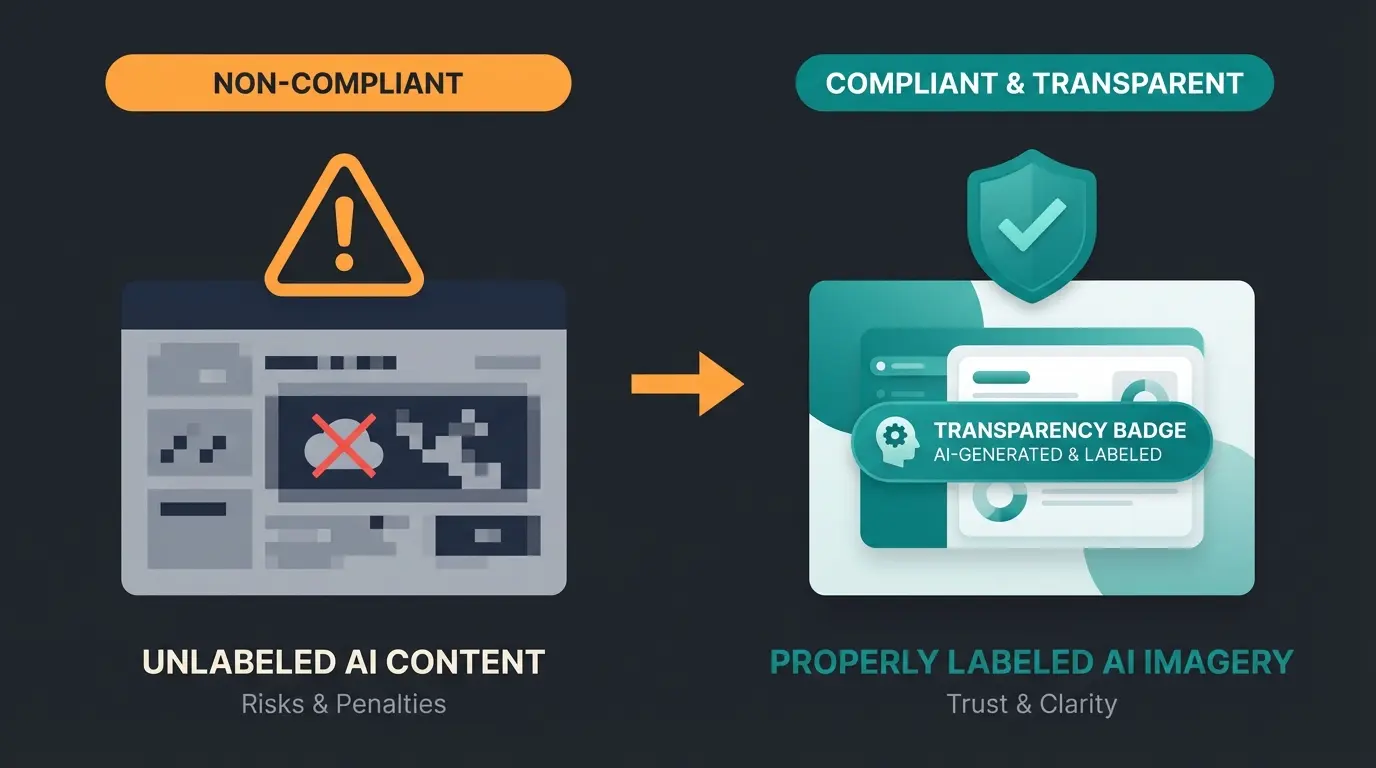
Missing AI Image Labeling
If you generate product images entirely through AI (e.g., Midjourney), you should make this transparent to avoid accusations of misleading (UWG), especially if the product looks different in reality.
Compliance Hierarchy: From Basics to AI Safety
Understanding the layers of compliance helps prioritize your efforts. This hierarchy shows how requirements build upon each other, with each layer requiring the previous one to be in place. The same principles apply whether you're using Shopify or comparing Shopware B2B approaches.
Imprint, Terms & Conditions, Privacy Policy, Cancellation Policy - the non-negotiable basics every store needs
Double opt-in, tax display, button labeling, Consent Mode v2, local font hosting
Transparency disclosures, audit logs, conversational consent, human oversight protocols
Is My Store Ready for the Future?
Use this checklist to assess your current status. This comprehensive review covers both traditional compliance requirements and the new AI-focused regulations coming into effect.
| Area | Check Item | Status |
|---|---|---|
| Basics | Imprint, Terms, Privacy Policy, Cancellation Policy are current & legally reviewed? | ☐ |
| Checkout | Button says 'Order with payment obligation'? | ☐ |
| Prices | Base prices (1kg/1l) correct? Strike-through prices follow 30-day rule? | ☐ |
| Tracking | Consent Mode v2 is active? Cookie banner blocks everything beforehand? | ☐ |
| Accessibility | Keyboard navigation possible? Alt texts maintained? (Deadline: June 2025) | ☐ |
| AI & Chat | Is the chatbot labeled as AI? (Transparency requirement) | ☐ |
| AI & Data | Is chat data processed GDPR-compliant (server location/DPA)? | ☐ |
| AI Liability | Audit logs enabled? Disclaimers in terms updated? | ☐ |
Shopify provides GDPR-compliant infrastructure, but compliance ultimately depends on how you configure your store. You need to implement proper consent management (Consent Mode v2), ensure cookie banners block tracking until consent, use a current Data Processing Agreement with Shopify, and avoid loading resources (like Google Fonts) directly from US servers without consent. The platform provides the tools, but correct setup is your responsibility.
Yes, under the EU AI Act (taking effect from August 2026), you must clearly disclose when customers are interacting with an AI system. Users must know they are speaking with a bot, not a human. Best practice is to name your bot clearly (e.g., 'AI Assistant' rather than 'Support Team') and include a disclosure message at the start of conversations.
German law requires four essential legal pages: an Imprint (Impressum) with provider identification per § 5 TMG, a GDPR-compliant Privacy Policy listing all tracking tools, Terms and Conditions (AGB) governing your customer relationships, and a Cancellation Policy (Widerrufsbelehrung) including a model withdrawal form. Use professional legal text providers rather than copying from other stores.
The BFSG applies to B2C e-commerce services from June 28, 2025. Micro-enterprises (fewer than 10 employees AND less than €2 million annual turnover) are temporarily exempt. If you exceed these thresholds, your store must meet WCAG 2.1 Level AA accessibility standards, including keyboard navigation, proper color contrasts, and alt texts for all images.
You as the merchant are liable for incorrect advice given by your AI systems. Under German civil law, you must attribute the behavior of digital helpers to yourself. To protect yourself: implement audit logs to document all conversations, use human-in-the-loop processes for critical decisions, and include disclaimers in your terms stating that automated consultations are non-binding and product descriptions are authoritative.
Conclusion: Compliance as Competitive Advantage
Making Shopify legally compliant in 2025 is no longer a one-time task but an ongoing process. The days when you could copy texts from a lawyer once and then have peace for five years are over.
The EU AI Act and the Accessibility Strengthening Act force merchants to keep their store not only legally but also technically clean. Those who act now—especially with AI bot labeling and accessibility—protect themselves not only from legal warnings but also build trust with an increasingly critical customer base.
Our Tip: Don't see compliance as a brake, but as a quality feature. A store that communicates transparently ('I am an AI bot'), is accessibly designed, and respects data converts better in the long run than the 'Wild West' competition.
Further Resources
- Händlerbund & IT-Recht Kanzlei for current legal texts
- Google Support for details on Consent Mode v2
- Federal Accessibility Agency (Bundesfachstelle Barrierefreiheit) for BFSG details
(Note: This article was created considering the legal situation as of 2025. Laws may change.)
Our AI consultation solution comes with privacy by design, full audit logging, EU data hosting, and built-in transparency features. Don't risk legal warnings—start with a compliant foundation.
Get Started Free
Lasse is CEO and co-founder of Qualimero. After completing his MBA at WHU and scaling a company to seven-figure revenue, he founded Qualimero to build AI-powered digital employees for e-commerce. His focus: helping businesses measurably improve customer interaction through intelligent automation.