Shopify WhatsApp Integration 2026: From Support Bot to AI Sales
Transform your Shopify WhatsApp integration from basic support to AI-powered sales consultation. Complete guide with GDPR compliance & app comparison.

Why Email Marketing No Longer Cuts It
Imagine walking into a boutique in downtown Manhattan. No one greets you. When you have a question about a shirt, you need to fill out a form and wait 24 hours for a response. Would you buy there? Probably not.
Yet that's exactly how the majority of e-commerce operates today. We rely on static product pages and email forms while our customers' communication habits have radically transformed. The era of the "email newsletter" as the primary revenue driver is coming to an end.
The statistics are clear: While email open rates in e-commerce often languish at a meager 20% according to hellomateo.de and Flowium research, messages via Shopify WhatsApp integrations achieve open rates of up to 98% as documented by Trengo.
But the problem runs deeper. Most Shopify merchants are using WhatsApp completely wrong: either as a pure support channel ("Where's my order?") or as a spam cannon for crude discount codes. As AI chatbots are transforming customer interactions, there's a massive opportunity being missed.
The thesis of this article: The real revenue lever in 2026 isn't in support and isn't in pure marketing blasts. It lies in automated product consultation (pre-sales consultation) powered by artificial intelligence.
In this comprehensive guide, you'll learn how to transform your Shopify store from a silent catalog into an interactive sales floor—using WhatsApp for Shopify and the next generation of AI consultants. Whether you're exploring AI chatbot integration for the first time or looking to upgrade your existing setup, this guide covers everything you need to know.
The Current State: WhatsApp Market Data & Statistics
Before we dive into technical integration, we need to understand why certain markets represent special cases in global e-commerce and why WhatsApp Business is the decisive factor for customer engagement.
The Trust-Based Consumer Culture
Markets like Germany exemplify trust-based consumer behavior. Unlike the USA where SMS marketing dominates, SMS in many European countries is considered outdated or invasive. WhatsApp, on the other hand, is the "living room" of digital communication for millions of consumers.
In Germany alone, over 60 million people use WhatsApp daily according to Superchat research
Approximately 80% of the population aged 14+ uses WhatsApp regularly as noted by Lime Technologies
Users open WhatsApp an average of 23-25 times per day according to Trengo data
Over 50% of the 60+ generation uses WhatsApp regularly per Chatarmin statistics
Understanding these statistics is crucial when implementing WhatsApp AI chatbots for your e-commerce operation. The engagement levels simply cannot be matched by any other channel.
Email vs. WhatsApp: The Performance Showdown
For Shopify merchants, the numbers speak a clear language. The comparison of WhatsApp Shopify integrations versus traditional email marketing reveals massive differences in efficiency that directly impact your bottom line.
| Metric | Email Marketing (Average) | WhatsApp Business (Average) |
|---|---|---|
| Open Rate | ~20-22% | ~98% |
| Click-Through Rate (CTR) | ~2-5% | 45-60% |
| Response Time | 90+ minutes | < 5 minutes |
| Spam Probability | High (Promotions Tab) | Near Zero (with API usage) |
The bottom line: Those who ignore Shopify WhatsApp Business solutions are ignoring the channel where their customers live. However, caution is warranted: the high attention level also means higher stakes. Anyone who annoys customers on WhatsApp gets blocked. That's why the shift from "advertising" to "consultation" is so essential—a core principle of how Conversational AI evolves customer relationships.
The 3 Levels of Shopify WhatsApp Integration
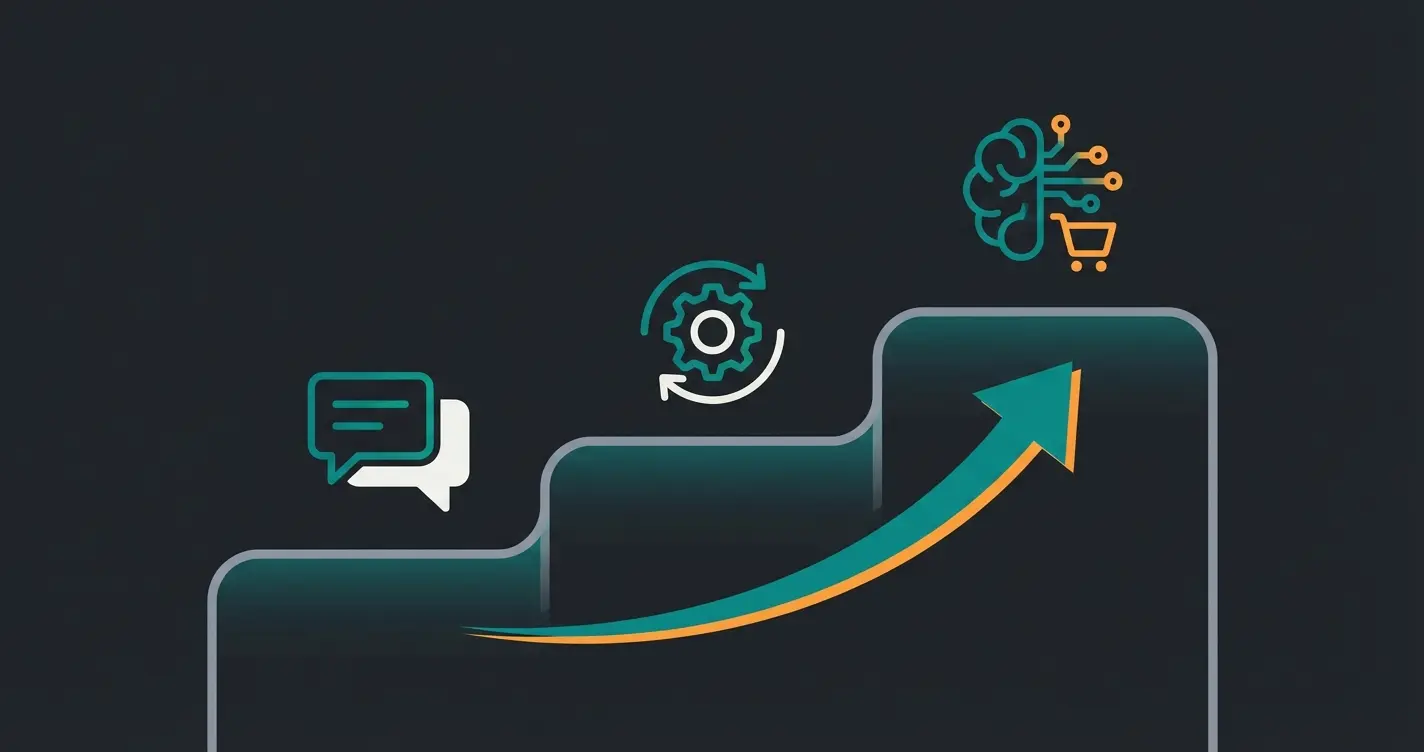
Not every integration is created equal. Based on our analysis of the market, three evolutionary stages can be identified. Where does your shop currently stand?
Level 1: The Button (Static)
This is the entry point for 90% of small shops. It's simple but severely limited in what it can achieve for your business.
- Function: A floating WhatsApp icon in the bottom right corner of the shop
- Technology: A simple link (wa.me/number) that opens the app on the customer's phone
- Problem: It's not scalable. When the customer writes at night, no one responds. There's no connection to Shopify customer data
- Suitable for: Hobby shops with fewer than 5 orders per day
Level 2: The Automator (Legacy Tools)
This is where most current app providers like SuperLemon or Zoko position themselves. They offer automation but with significant limitations.
- Function: Automated messages based on triggers like abandoned cart recovery ("You left something in your cart") and order updates ("Your package has shipped")
- Technology: Uses the WhatsApp Business API for basic automation
- Problem: It's a one-way street or rigid decision tree ("Press 1 for shipping status"). When the customer asks: "Does this shirt fit well with broad shoulders?" the bot fails completely
- Suitable for: Shops wanting to reduce support tickets and recover abandoned carts
Level 3: The AI Sales Consultant (Next-Gen)
This is the future—and the present of 2025/2026. This approach represents a fundamental shift in how AI customer service operates, building on what modern Shopify Live Chat solutions have pioneered.
- Function: An AI that knows the entire product catalog, understands brand values, and sells through consultation
- Technology: LLM (Large Language Models) + RAG (Retrieval Augmented Generation) connected to Shopify real-time data
- Suitable for: Brands wanting to increase conversion rate and average order value, not just reduce support costs
Real-world scenario: A customer asks: "I'm looking for skincare for dry skin, but without perfume." The AI responds: "I recommend our 'Sensitive Hydro Cream.' It's completely fragrance-free and contains hyaluronic acid. Should I add it to your cart?" This level of AI product consultation was previously impossible without human intervention.
Content Gap Analysis: Why Consultation Beats Support
Most articles about WhatsApp for Shopify focus on two things: Support (cutting costs) and marketing newsletters (increasing annoyance factor). The most lucrative area is being overlooked: Pre-Sales Consultation. This gap represents a massive opportunity for forward-thinking merchants.
The Problem with Support Bots
Traditional chatbots are "preventers." They're designed to prevent a human from having to spend time on basic queries. They answer questions like: "How long does shipping take?" or "How can I return this item?"
These questions are important, but they are a cost center. They arise after the purchase or when something goes wrong. They don't generate revenue—they consume it. This is the fundamental limitation that most Shopware 6 chatbots and similar solutions fail to address. For a detailed breakdown of this category, see our Shopify Chatbot guide.
The Opportunity of the Sales Consultant
An AI sales consultant acts like an experienced store employee. It intervenes before the purchase happens, precisely at the moment when the customer is uncertain and most likely to abandon their shopping journey. The same product knowledge that powers this conversation also drives AI product recommendations on your storefront, so the advice a customer gets in chat matches what they see on the product page.
Why is this so important?
- Product Complexity: The more explanation your product requires (supplements, tech, fashion sizing), the higher the abandonment rate. An AI consultant closes this gap instantly.
- Instant Gratification: According to Trengo research, 75% of customers expect a response within 5 minutes. Delayed answers mean lost sales.
- Conversion Rate from Conversation: Instead of just measuring "open rates," you should measure how many conversations lead to a purchase. AI-powered conversations can increase conversion rates by 10x compared to static websites, as documented by Firework research.
Rule-Based Bots vs. AI Consultants: A Comparison
Understanding the fundamental differences between legacy automation and true AI consultation is crucial for making the right investment decision for your store.
| Feature | Rule-Based Bot (Level 2) | AI Sales Consultant (Level 3) |
|---|---|---|
| Understanding | Only keywords ("shipping", "price") | Context & nuances ("gift for grandma") |
| Product Knowledge | Static / Manually maintained | Knows the entire Shopify catalog in real-time |
| Tone of Voice | Robotic ("Please select an option") | Human, empathetic, brand-consistent |
| Primary Goal | Avoid tickets (Support) | Close sales (Revenue) |
| Setup Effort | High (building flows) | Low (catalog sync & prompting) |
Step-by-Step: Setting Up WhatsApp for Sales
Setting up a Shopify WhatsApp solution that actually sells requires more than just installing an app. Here's the strategic approach that separates successful implementations from failures.
Step 1: The Technical Foundation (API & Meta)
Forget the private WhatsApp app on a company phone. That's not GDPR-compliant and not scalable. Proper AI integration for business requires the right foundation.
- Meta Business Manager: You need a verified business account with Meta (Facebook). This is the foundation for all official WhatsApp Business API access.
- WhatsApp Business API: This is the interface that third-party software uses. It enables automation, multiple users, and GDPR-compliant hosting through certified providers.
- Dedicated Phone Number: Use a dedicated number (landline or mobile) that is not linked to a private WhatsApp account. This separation is crucial for compliance.
Step 2: The Catalog Sync (The Heart of the System)
For your AI to sell effectively, it must know what you sell—in real-time, with all product details, variants, and availability information.
Most modern apps (e.g., Zoko, Chatarmin, Manifest AI) automatically synchronize your Shopify product catalog with the Meta Commerce Manager as documented by Zoko and ShopLinx.
Step 3: Training the Brand Voice
An AI consultant must not sound like a computer. Personality and brand consistency are essential for building trust and driving conversions.
- Define the persona in your app settings: "You are Lisa, a helpful fashion expert. You address customers informally, use emojis sparingly, and keep responses concise."
- Upload FAQs and knowledge bases (e.g., PDF guides you already have) so the AI also knows company values, policies, and unique selling points
- Test extensively with real customer scenarios before going live
Customer scans QR code or clicks 'Chat' button on product page
Customer asks complex question → AI analyzes query against full product catalog
AI sends product card directly in chat with image, price, and personalized reasoning
Customer clicks 'Add to Cart' → Checkout link generated or in-app purchase completed
30 days later: Automated follow-up asking about product satisfaction and suggesting complementary items
See how AI-powered product consultation can increase your Shopify conversion rates by up to 10x. Our team will show you exactly how it works for your product catalog.
Book Your Free DemoTop WhatsApp Apps for Shopify: 2025/2026 Comparison
The market is flooded with options. We've categorized the providers by use case to help you make the right decision for your specific needs.
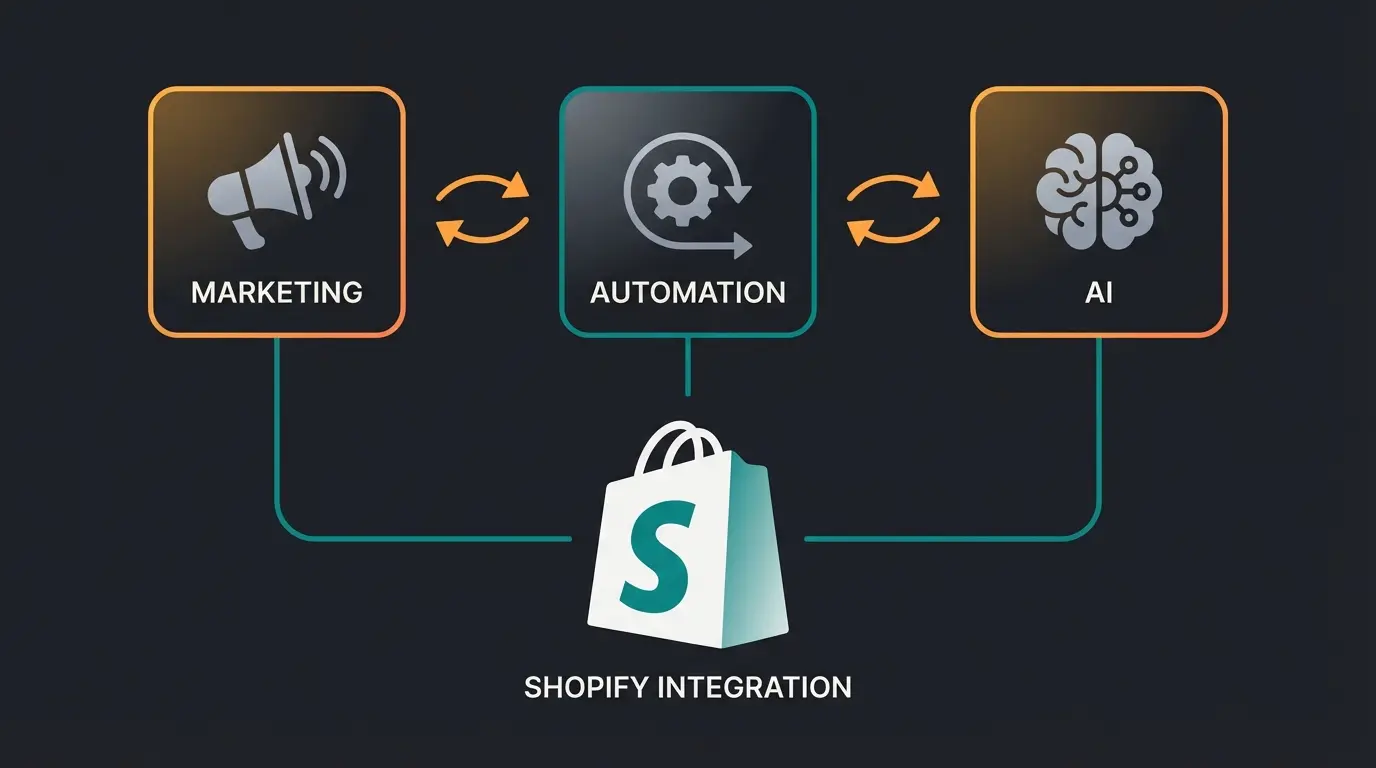
Category A: Marketing Specialists (GDPR-Focused)
If your focus is on privacy-compliant newsletters and integrations with tools like Klaviyo, these providers lead the pack.
Chatarmin: An Austrian company with an extremely strong focus on GDPR and integrations (Klaviyo, Shopify). Offers a flow builder for marketing campaigns as detailed in their Chatarmin documentation. Ideal for brands wanting to transfer email marketing logic to WhatsApp while maintaining strict WhatsApp Business GDPR compliant operations.
Charles: A pioneer in the German market with a strong focus on "Conversational Commerce" for enterprise customers. Ideal for large brands with substantial budgets and complex requirements.
Category B: The All-Rounders (International)
Zoko / SuperLemon: Cost-effective options with many features for support and simple automation as noted by Retenzy and QuickReply.ai.
Weakness: Often servers located in the USA (check data privacy carefully!), support frequently only available in English. Ideal for: Dropshippers or international shops with less stringent privacy requirements.
Category C: The AI Sales Consultants (Next-Gen)
Manifest AI / ShopLinx / Wizybot: These providers use GPT-4 or similar models to actively recommend products and understand the catalog at a deep level, as highlighted by Kaily.ai.
- Key Features: Intelligent "back-in-stock" alerts and context-based upsells that feel natural, not pushy
- Technology: LLM-powered understanding of customer intent and product matching
- Ideal for: Brands with complex products and high consultation needs where AI consultation boosts the entire customer journey
The Elephant in the Room: GDPR & Data Privacy
For shop operators in the EU, the question "Is WhatsApp for Shopify legal?" is essential and cannot be ignored. The answer is: Yes, but only with the API.
Why the Free Business App Is Problematic
The free WhatsApp Business App on your phone accesses your entire contact list and sends metadata to the USA. This violates GDPR because you're sharing data from contacts who don't even use WhatsApp, as explained by Superchat and Memacon.
The Secure Path: WhatsApp Business API
To use Shopify WhatsApp Business legally, you must fulfill the following checklist. This isn't optional—it's a legal requirement.
- No Contact Book Access: The API does not read contacts from your phone, eliminating the primary GDPR concern
- Server Location: Use a Business Solution Provider (BSP) like Chatarmin or Superchat that operates servers in the EU (ideally Germany/Frankfurt) as documented in Chatarmin's compliance documentation
- Data Processing Agreement: Conclude a data processing agreement (DPA) with the provider
- Explicit Opt-In: You cannot simply message customers. The customer must actively consent (e.g., checkbox at checkout or clicking a 'wa.me' link). This is called "User Initiated Conversation" or explicit opt-in for newsletters as explained by Heydata and Spurnow
Practical Tips for More Revenue: Conversion Hacks
How do you get the maximum out of your WhatsApp Shopify integration? These battle-tested strategies separate top performers from average implementations.
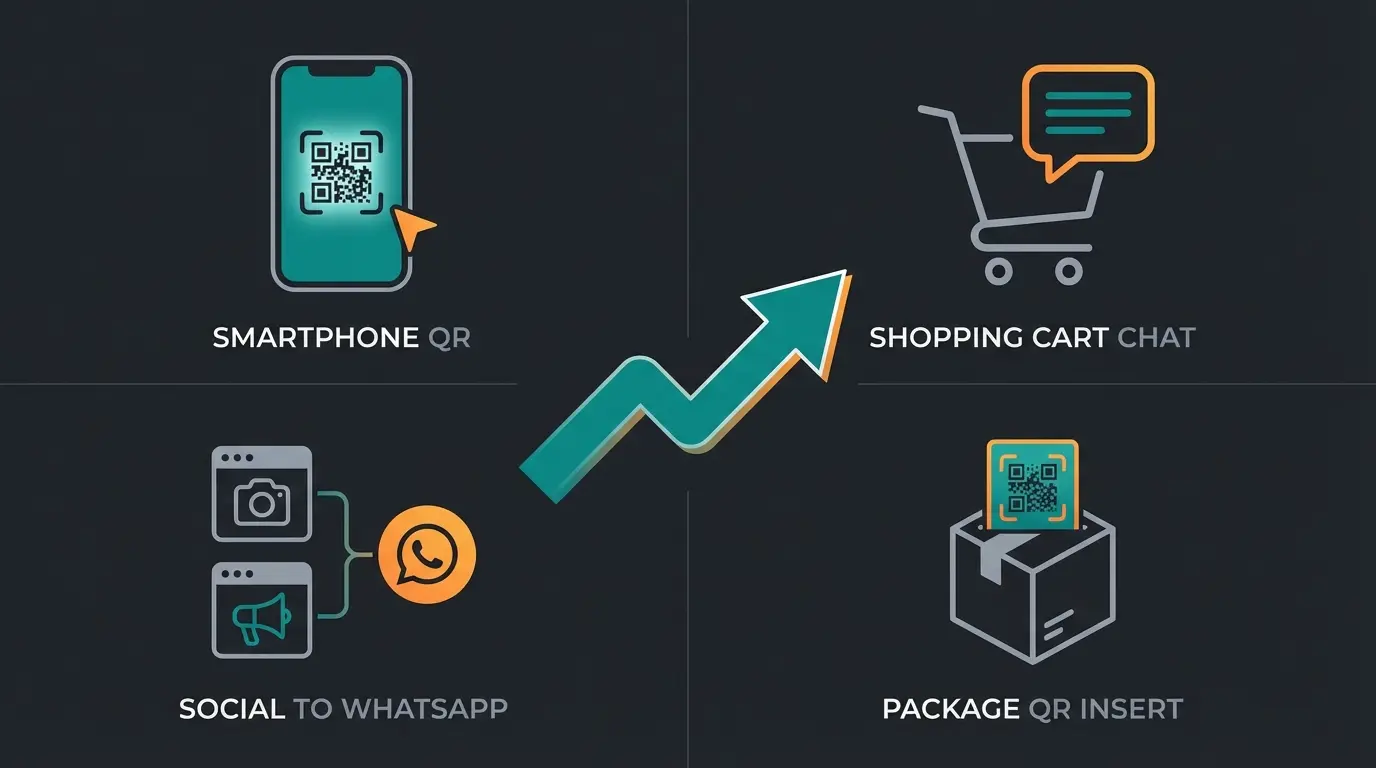
1. The Pre-Checkout Button Strategy
Don't just place the WhatsApp button on the homepage. Position it prominently on the product page next to "Add to Cart." Label it "Question about this product?" or "Need help deciding?" This captures customers at their highest purchase intent moment.
2. QR Codes on Package Inserts
Print a QR code on the "Thank You" card in the package: "Scan here for VIP support & 10% off your next order." This brings offline customers into your WhatsApp channel and creates a retention loop that email simply cannot match.
3. Abandoned Cart Recovery 2.0
Instead of an annoying reminder ("Buy now!"), have the AI ask: "Was there a technical problem, or do you still have a question about the product?" This comes across as helpful, not greedy—and often recovers sales that aggressive messaging would lose.
4. Click-to-WhatsApp Advertising
Run Facebook/Instagram ads that lead not to the website, but directly into the WhatsApp chat. There, the AI takes over qualification and guides the customer to purchase. This often drastically reduces CPA (Cost per Acquisition) while increasing conversion quality.
Conclusion & Future Outlook: Conversation Is the Future
E-commerce is on the verge of transformation. Customers are tired of impersonal online shops and overflowing email inboxes. They long for the simplicity and intimacy of chat—just like with friends and family.
Integrating WhatsApp into Shopify in 2026 is no longer optional but mandatory for every merchant who wants to remain competitive. But technology alone isn't enough. The strategic approach matters enormously.
- Past: Processing support tickets reactively
- Present: Sending newsletters via WhatsApp (marginally better)
- Future: An AI assistant that personally knows, advises, and accompanies every customer through their entire journey
Don't start today with the goal of saving support costs. Start with the goal of offering the best shopping experience on the web. Your new best salesperson isn't waiting behind the counter—they're in the chat, available 24/7, infinitely scalable, and constantly improving.
FAQ: Common Questions About Shopify & WhatsApp
It depends on your goal. For pure marketing and GDPR security in the DACH region, Chatarmin is leading. For AI-powered sales consultation, tools like Manifest AI or ShopLinx are strong contenders. For simple buttons without automation needs, SuperLemon often suffices. Evaluate based on your specific use case: marketing automation, customer support, or sales consultation.
Yes, if you use the WhatsApp Business API and have explicit opt-in (consent) from the customer. Cold outreach is prohibited. The key distinction is between 'user-initiated conversations' (customer writes first) and 'business-initiated conversations' (you write first)—the latter requires explicit prior consent.
Yes, through integration with the Meta Commerce Manager (Facebook Catalog), you can synchronize your products directly to WhatsApp and send them as 'Collections' or individual product cards with images, prices, and direct purchase links.
The model is based on conversations. There are costs for the software (the provider) and costs per conversation (paid directly to Meta). 'Service conversations' (customer writes first) are often cheaper or partially free. 'Marketing conversations' (you write first) cost money—approximately €0.11 in Germany, though prices vary by region and volume.
Traditional chatbots use rigid decision trees and keyword matching—they can only respond to pre-programmed scenarios. AI-powered consultants use Large Language Models (LLMs) to understand context, nuance, and complex product queries. They can recommend products based on vague customer descriptions and adapt their responses to individual needs, functioning like a knowledgeable human sales associate.
Transform your WhatsApp from a support burden into your highest-converting sales channel. Join leading Shopify merchants who've already made the switch to AI-powered consultation.
Start Your Free Trial
Lasse is CEO and co-founder of Qualimero. After completing his MBA at WHU and scaling a company to seven-figure revenue, he founded Qualimero to build AI-powered digital employees for e-commerce. His focus: helping businesses measurably improve customer interaction through intelligent automation.