Introduction: The New Era of Enterprise E-Commerce
For a long time, the world of Shopware was simply divided: There was the free Community Edition for beginners, the Professional Edition for mid-sized businesses, and the powerful "Enterprise Edition" for the major players. But in 2025, the landscape looks entirely different. With the introduction of the new plans Shopware Evolve Beyond and the drastic changes to the Fair Usage Policy (revenue limit for the Community Edition starting at €1 million GMV), many CTOs and e-commerce managers are facing a complete reevaluation of their platform strategy.
According to Shopware's official announcements, the new pricing structure reflects a fundamental shift from one-time licenses to ongoing service relationships. This change affects businesses of all sizes, as detailed in analysis by Splendid Internet.
If you search for "Shopware Enterprise" today, you'll mostly find technical data sheets or generic price lists. What's often missing is the answer to the crucial question: Does upgrading to Enterprise actually solve my sales problem, or does it just scale my costs?
In this comprehensive guide, we illuminate not only the hard facts—costs, hosting options, and B2B features—but also address the "elephant in the room": The gap between technical scalability and genuine digital customer consultation. We'll show why classic "Enterprise Search" is no longer sufficient in a world of AI-powered consultation (Conversational Commerce) and how you can transform your Shopware store from a digital catalog into an intelligent sales advisor using AI-powered consultation.
What Is Shopware Enterprise Today? (The New Definitions)
The term "Shopware Enterprise" is still commonly used in everyday language, but officially Shopware has radically restructured its licensing model to a subscription model. When we speak of Enterprise solutions today, we primarily mean the plans Shopware Evolve and Shopware Beyond.
The Shift from License Purchase to Service Model
Previously, companies purchased a one-time license (on-premise). Today, you rent a service package. This transformation brings both advantages and disadvantages but above all offers one thing: planning security and continuous updates. As Shopware explains in their official documentation, this shift aligns with modern SaaS expectations.
- Shopware Evolve: The direct successor to the classic Enterprise base. It targets ambitious B2B and B2C retailers who need extended features like the B2B Suite and Flow Builder but don't yet require the full infrastructure of a corporation. According to Scope01's analysis, this tier represents the sweet spot for growing enterprises.
- Shopware Beyond: The "all-inclusive package" for market leaders. This is about maximum performance, 24/7 support, and features for complex business models like Multi-Inventory or subscription models.
One-time license purchase, on-premise hosting, perpetual ownership model
Migration support, feature mapping, gradual subscription adoption
Monthly subscription, cloud-ready, continuous updates and premium support
Who Is Shopware Enterprise Suitable For?
The decision for Evolve or Beyond is rarely a gut feeling. It's usually data-driven and depends on several key factors that determine whether the investment makes business sense:
- GMV (Gross Merchandise Volume): Starting from annual revenue of approximately €5-10 million, the switch often becomes economically sensible, even if the Community Edition could technically still keep up.
- Complexity: As soon as you need to manage individual price lists for 5,000 B2B customers, approval processes (budgets), or multiple warehouse locations, standard editions reach their limits.
- Internationalization: Anyone operating simultaneously in multiple currencies, languages, and tax zones benefits massively from Enterprise features.
Understanding these thresholds is essential for making the right platform decision. The AI capabilities you need should also factor into your evaluation, as enterprise-level businesses increasingly require intelligent automation beyond basic platform features.
Key Features: Why Upgrade from Professional (Rise)?
Many retailers start with Shopware Rise (the successor to the Professional Edition). But from a certain point, the upgrade becomes unavoidable. Here are the three main drivers for switching to Evolve or Beyond, each representing significant business value that justifies the investment.
The B2B Suite – The Heart of Enterprise Wholesale
Perhaps the strongest USP of Shopware in the Enterprise segment is the deeply integrated B2B Suite (included in Evolve and Beyond). While other systems often only map B2B through shaky third-party plugins, this is "Native Core" here. As Atwix's detailed breakdown explains, this native integration provides significant advantages over plugin-based solutions.
The most important B2B functions in detail:
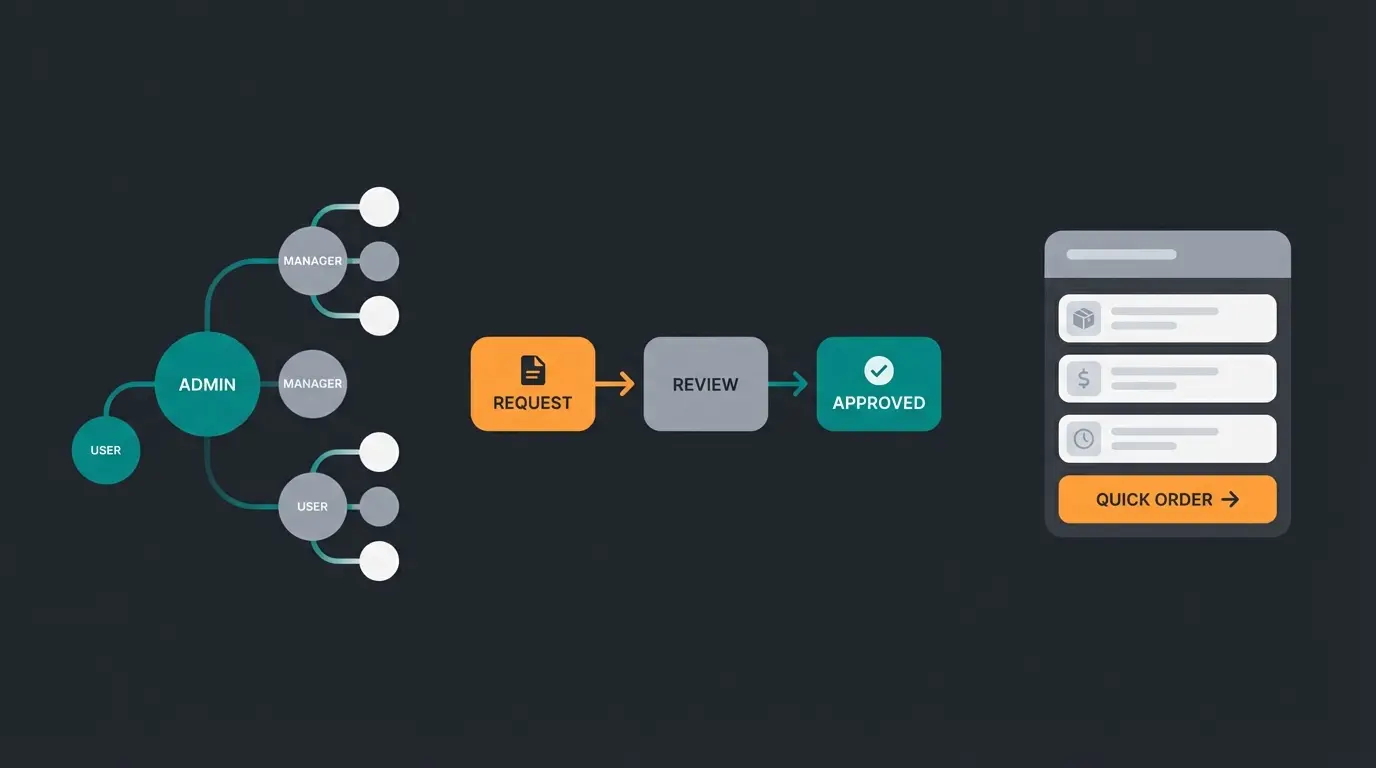
- Rights & Roles (Budgeting): You can map your customers' organizational structure in the shop. A purchaser may order up to €500; above that, the department head must approve. The system digitally maps this approval workflow.
- Quick Orders: Upload of CSV files or entry of SKUs for bulk orders – essential for professional buyers who have no time for "Shopping Experiences." According to Shopware's B2B documentation, this feature alone saves hours of ordering time.
- Individual Price Lists: Every customer sees their negotiated price, not the RRP. This is possible in real-time, even with millions of price combinations.
- Quote Management (Quotes): A customer can fill a shopping cart and instead of "Buy," click the "Request Quote" button. Your sales team can then grant discounts in the backend and play the quote back.
Enterprise Search vs. Intelligent Consultation
Here lies an often misunderstood point. Shopware Enterprise advertises heavily with Advanced Search (based on Elasticsearch). Understanding the distinction between search and consultation is crucial for businesses with complex product catalogs.
- What it does: It's extremely fast and fault-tolerant. If a customer searches for "M10 bolt galvanized," they'll find it – even among 100,000 items.
- What it DOESN'T do: It doesn't consult. If the customer doesn't know they need an "M10 bolt" but only knows they want to "connect two steel beams outdoors," the search delivers 0 results or 5,000 irrelevant ones.
Performance & Scalability for High-Traffic Scenarios
For shops with high traffic (e.g., TV advertising or Black Friday), Evolve and Beyond offer technical infrastructures that prevent crashes. According to Datrycs' technical analysis, these infrastructure improvements can handle significant traffic spikes:
- High-Performance Clustering: The load is distributed across multiple servers to ensure consistent performance.
- Database Replication: Read and write accesses are separated to keep checkout speed high during peak times.
- Multi-Inventory (Beyond Only): Managing different inventory levels (e.g., Berlin warehouse vs. Munich warehouse) is natively integrated, enabling complex logistics scenarios.
Shopware Enterprise Pricing & Plans 2025 Overview
Transparency is rare in the Enterprise segment, but based on current market information and partner data, the following price structure for 2025 can be outlined. Note that Shopware often creates individual offers based on GMV, so these figures represent starting points rather than fixed prices.
| Feature / Plan | Shopware Rise | Shopware Evolve | Shopware Beyond |
|---|---|---|---|
| Target Group | Ambitious B2C / D2C | B2B & Scaling Shops | Market Leaders & Corporations |
| Price (approx.) | from €600/month | from €2,400/month | from €6,500/month |
| B2B Suite | ❌ (Basic features only) | ✅ Included | ✅ Included |
| Support SLA | 8 hrs response time | 4 hrs response time | 1 hr response (24/7) |
| Search | Standard Search | Advanced Search (Elastic) | Advanced Search (Elastic) |
| Multi-Inventory | ❌ | ❌ | ✅ Included |
| Flow Builder | Standard | Advanced (Webhooks) | Advanced (Webhooks) |
| Consultation Level | Static Filters | Technical Search | Technical Search |
Important to understand: These monthly costs only cover the license and support. Hosting (for Self-Hosted), agency services for setup, and ongoing optimizations come "on top" and can significantly increase total cost of ownership.
The Hidden Column: The Consultation Level
Pay attention to the last row in the table. Whether you pay €600 or €6,500 – Shopware delivers no "out of the box" solution that replaces a human salesperson. You receive excellent tools to manage and search products, but no tools to advise customers. This is where AI-powered product consultation becomes essential for closing the conversion gap.
Starting price for B2B-ready enterprise features
Premium tier for market leaders with 24/7 support
No AI-powered customer advice included in any tier
Shopware Enterprise provides the infrastructure. Our AI consultation solution provides the sales expertise your customers expect. See how the combination drives conversions.
Explore AI ConsultationThe Missing Puzzle Piece: Why Enterprise Search Falls Short
We live in a time when customers are spoiled by ChatGPT and similar technologies. Expectations have shifted: Customers no longer want to search—they want to find. This fundamental change in consumer behavior has profound implications for how enterprise e-commerce platforms must evolve.
The Problem of the "Expertise Gap"
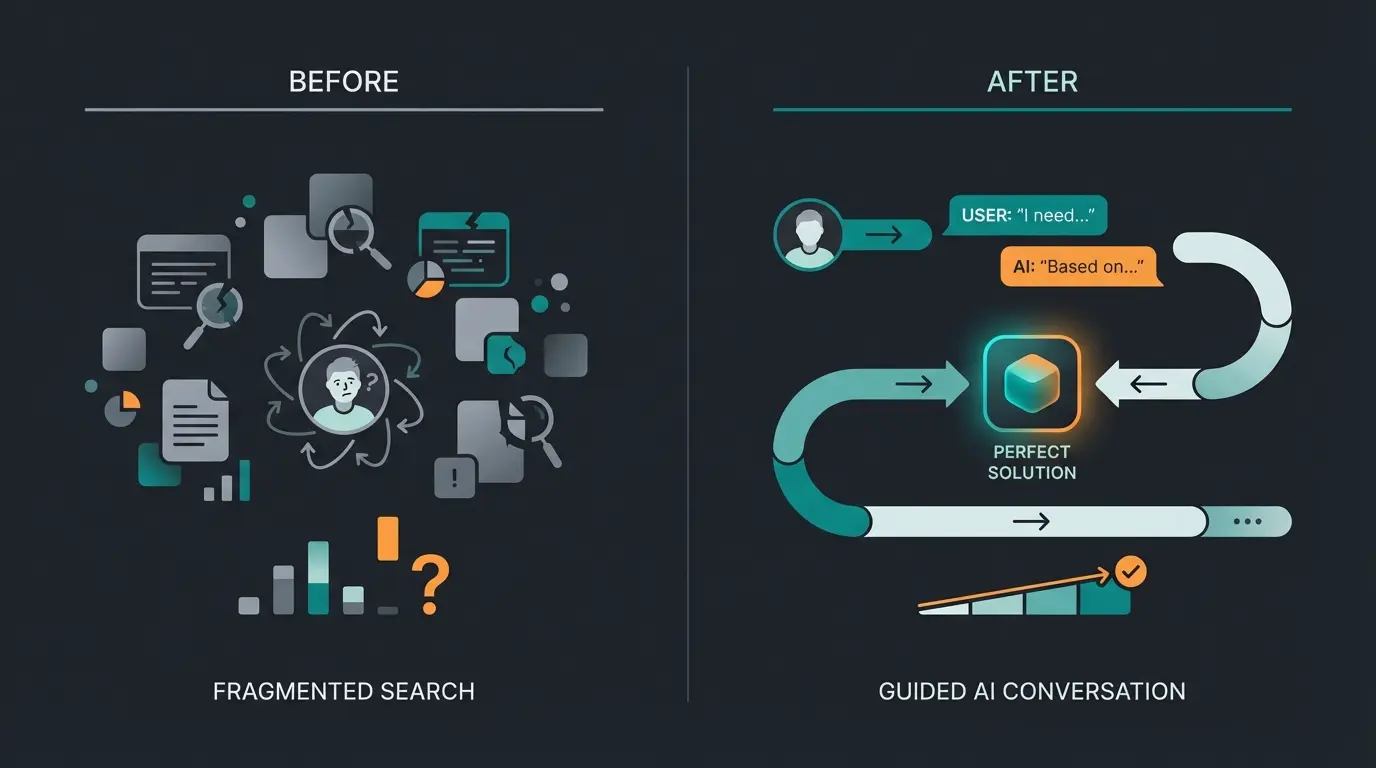
In a physical specialty store, a customer approaches the salesperson and says: "I need a pump for my garden pond, about 10,000 liters, lots of algae." The salesperson asks 2-3 follow-up questions and places the perfect product on the counter. This personal consultation experience is what customers still crave, even in digital environments.
In an online shop (even in the Shopware Enterprise Edition), the process looks like this:
- Customer types "pond pump" into the search.
- They receive 450 results spread across multiple pages.
- They must use filters: "Flow rate," "Wattage," "Particle size."
- The Problem: The customer often doesn't know these technical values. They're overwhelmed and frustrated.
- The Result: Cart abandonment or call to support (high costs, typically €15-25 per call).
This expertise gap represents a massive conversion opportunity. Customers who can't find what they need don't convert—they leave. And expensive enterprise licenses don't solve this fundamental problem.
The Limitations of Elasticsearch Technology
The "Advanced Search" included in Shopware Evolve/Beyond is powerful, but it's "dumb" in the human sense. It matches keywords. It doesn't understand context or intent. It cannot ask: "What do you want to use the product for?" This limitation becomes critical when dealing with complex or technical products.
Here opens the content gap that most agencies and competitors overlook: They optimize search until it's millisecond-fast—but they don't optimize the path to the decision. This is where AI product consultation becomes the differentiator between good and exceptional e-commerce experiences.
Comparing Shopware AI Copilot vs. AI Consultation
Shopware has introduced a strong feature set with the AI Copilot. But if you look closely, almost all these functions target merchant efficiency, not customer consultation. Understanding this distinction is crucial before you allocate your budget.
Shopware AI Copilot: The Backend Helper
The native AI features in Shopware Evolve/Beyond focus on process optimization as documented by Shopware's AI feature documentation and Atwix's AI analysis:
- Content Generation: Creates product descriptions at the push of a button, saving hours of copywriting time.
- Image Recognition: Automatically sets alt tags and keywords for images to improve SEO.
- Export Assistant: Helps with exporting CSV data using natural language queries.
- Review Summarization: Summarizes customer reviews for quick insights.
Conclusion: These tools save your time as a merchant. They don't actively help customers find the right product. The AI Copilot is merchant-facing, not customer-facing.
The New Generation: AI Product Consultation
Here's where specialized AI Product Consultation solutions come into play (the "Blue Ocean" strategy). Instead of just automating backend processes, we deploy AI where the money is made: in the dialogue with the customer. This represents a fundamental shift from operational efficiency to revenue generation.
- Intent Recognition: The AI understands "I want to jog but have knee pain" and translates it into technical filters (e.g., "Cushioning: High," "Drop: 8mm").
- Guided Selling: Like a real salesperson, the AI asks follow-up questions ("What surface do you usually run on?") to narrow down the selection.
- Explanation Instead of Listing: Instead of just displaying products, the AI explains why this product fits ("This shoe is ideal for you because the gel cushioning relieves your knees on asphalt").
This is where AI sales assistants become invaluable—they bridge the gap between having products available and actually selling them to the right customers.
| Capability | Enterprise Search | AI Consultation |
|---|---|---|
| User Input | 'Red Sneaker' (exact match) | 'I need shoes for a marathon, easy on my knees' |
| Result Type | 500 product links to browse | 3 top recommendations with personalized explanations |
| Follow-up Ability | None - static results | Asks clarifying questions like a sales expert |
| Technical Knowledge Required | User must know specifications | AI translates needs to specifications |
| Conversion Impact | Standard browsing behavior | Guided path to purchase decision |
Case Study: The Difference Between Searching and Consulting
Let's walk through this with a concrete B2B example: A retailer for industrial supplies (hydraulic components). This scenario illustrates how the same customer need leads to dramatically different outcomes depending on the approach.
Scenario A: Shopware Enterprise Standard (Without AI Consultation)
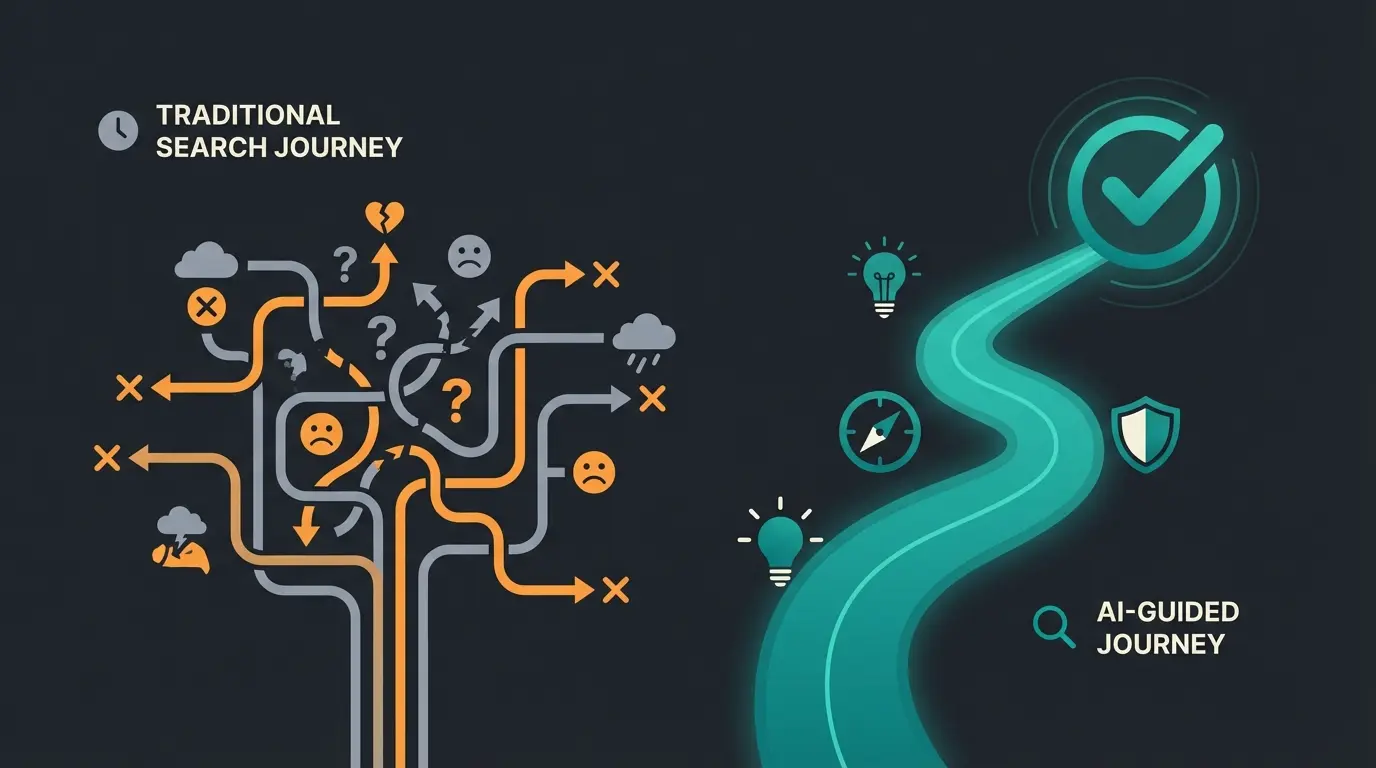
- User: A maintenance technician is looking for a replacement seal. He doesn't know exactly what it's called but has the measurements written down.
- Interaction: He uses the faceted filters. He clicks through "Material," "Inner diameter," "Outer diameter." He's unsure whether "NBR" or "FKM" is the right material for oil applications.
- Result: To be safe, he orders both (return pre-programmed) or calls the hotline (cost factor: approx. €15-25 per call, plus the technician's wasted time).
Scenario B: Shopware Enterprise + AI Sales Agent
- User: The technician opens the chat assistant or uses the guided search interface.
- Input: "I need a seal for an oil line, 50mm, gets up to 120 degrees hot."
- AI Reaction: The AI analyzes the input. It knows: Oil + 120 degrees requires material "FKM" (Viton) because NBR would fail at these temperatures.
- Result: The AI suggests exactly the one correct product and explains: "Based on your temperature specification of 120°C, we recommend FKM because NBR is only stable up to 100°C."
- Business Impact: No return, no support call, immediate completion. The technician is back to productive work in minutes instead of hours.
This scenario demonstrates why combining enterprise infrastructure with AI-powered product consultation creates exponential value. The platform handles the complexity while AI handles the customer relationship.
B2B vs B2C: Enterprise Considerations for Each Model
The choice between Shopware Enterprise tiers isn't just about company size—it's about business model complexity. Understanding the specific needs of AI consultation for B2B versus B2C contexts helps clarify the right investment strategy.
B2B Enterprise Requirements
B2B commerce introduces layers of complexity that B2C rarely encounters. Multiple decision-makers, approval workflows, custom pricing, and technical product specifications all demand robust enterprise features. The B2B Suite in Evolve and Beyond addresses these operational needs, but the consultation gap remains equally critical—perhaps more so given the technical nature of most B2B products.
B2C Enterprise Requirements
B2C at enterprise scale focuses on traffic handling, personalization, and conversion optimization. While the technical infrastructure needs differ from B2B, the fundamental consultation problem remains identical: customers need guidance to find products that match their needs, not just fast search results.
Implementing AI product consultants addresses both scenarios by providing the human-like guidance that neither B2B nor B2C customers receive from standard search functionality.
Implementation Strategy: Building the Future Stack
Success with Shopware Enterprise in 2025 requires thinking beyond the license itself. The most successful implementations combine robust platform infrastructure with intelligent customer-facing technology. Here's the strategic framework for maximizing your enterprise investment.
Evolve or Beyond tier providing B2B Suite, performance clustering, and advanced workflows
Customer-facing AI that understands intent, asks questions, and recommends products
Native integration ensuring AI has access to inventory, pricing, and customer data
AI improves recommendations based on conversion data and customer feedback
This layered approach ensures you're not just paying for infrastructure—you're investing in a complete solution that drives revenue. The combination of enterprise features with KI E-Commerce capabilities creates a competitive moat that's difficult for competitors to replicate.
Conclusion & Checklist: Is Shopware Enterprise Right for You?
The switch to Shopware Evolve or Beyond is a significant step. It's necessary when you need to scale technically. But don't be deceived by the illusion that a more expensive license automatically improves your conversion rate. The license is just the beginning of your enterprise journey.
The Enterprise Checklist for 2025:
- Revenue Check: Is your GMV over €1 million? (If yes, the new Fair Usage Policy forces you to act anyway).
- B2B Check: Do you need individual prices, budgets, and approval workflows? -> Shopware Evolve is mandatory.
- Logistics Check: Do you have multiple warehouse locations? -> Shopware Beyond is mandatory.
- Consultation Check: Are your products explanation-intensive? Do customers leave the shop because they're overwhelmed?
If you answered yes to the consultation check: Then the license upgrade alone isn't enough. You additionally need an AI Consultation Strategy to capture the revenue you're currently losing.
Our Recommendation
Invest in Shopware Enterprise for the foundation (performance, B2B features, security). But invest in AI Consultation for growth. A high-performance warehouse is useless if no one at the front of the store is serving customers. The platforms that win in 2025 will be those that combine operational excellence with intelligent customer engagement.
Would you like to learn how to equip your Shopware shop with real sales intelligence? Let's talk. We'll show you how to close the gap between "searching" and "finding."
Frequently Asked Questions About Shopware Enterprise
Shopware Professional (now Rise) offers basic e-commerce features suitable for growing B2C stores. Shopware Enterprise (now Evolve and Beyond) includes advanced B2B Suite features like budgets, roles, quick orders, individual pricing, plus superior support SLAs, Enterprise Search, and high-performance infrastructure. The main difference is depth of B2B functionality and support response times.
Shopware Evolve starts at approximately €2,400/month while Shopware Beyond starts at approximately €6,500/month. These are base prices—Shopware often creates custom offers based on your GMV (Gross Merchandise Volume). Additional costs for hosting, agency services, and integrations come on top of the license fees.
Shopware has transitioned from one-time license purchases to a subscription model. Existing Enterprise Edition licenses typically map to the Evolve or Beyond tiers depending on your feature set. Shopware provides migration paths and support for transitioning to the new model while maintaining your existing capabilities.
Yes, Shopware Enterprise (Evolve and Beyond tiers) is specifically designed for B2B commerce. The native B2B Suite includes rights and roles management, budget controls, approval workflows, quick orders via CSV, individual customer pricing, and quote management—all essential features for wholesale and B2B operations.
Enterprise Search (Elasticsearch) excels at finding products when customers know exactly what they're looking for. However, it cannot consult customers who don't know technical specifications. AI-powered product consultation fills this gap by understanding customer intent, asking clarifying questions, and recommending products based on needs rather than keyword matches.
Don't just upgrade your license—upgrade your customer experience. See how AI consultation turns your Shopware Enterprise investment into measurable conversion growth.
Start Your AI Journey
Lasse is CEO and co-founder of Qualimero. After completing his MBA at WHU and scaling a company to seven-figure revenue, he founded Qualimero to build AI-powered digital employees for e-commerce. His focus: helping businesses measurably improve customer interaction through intelligent automation.