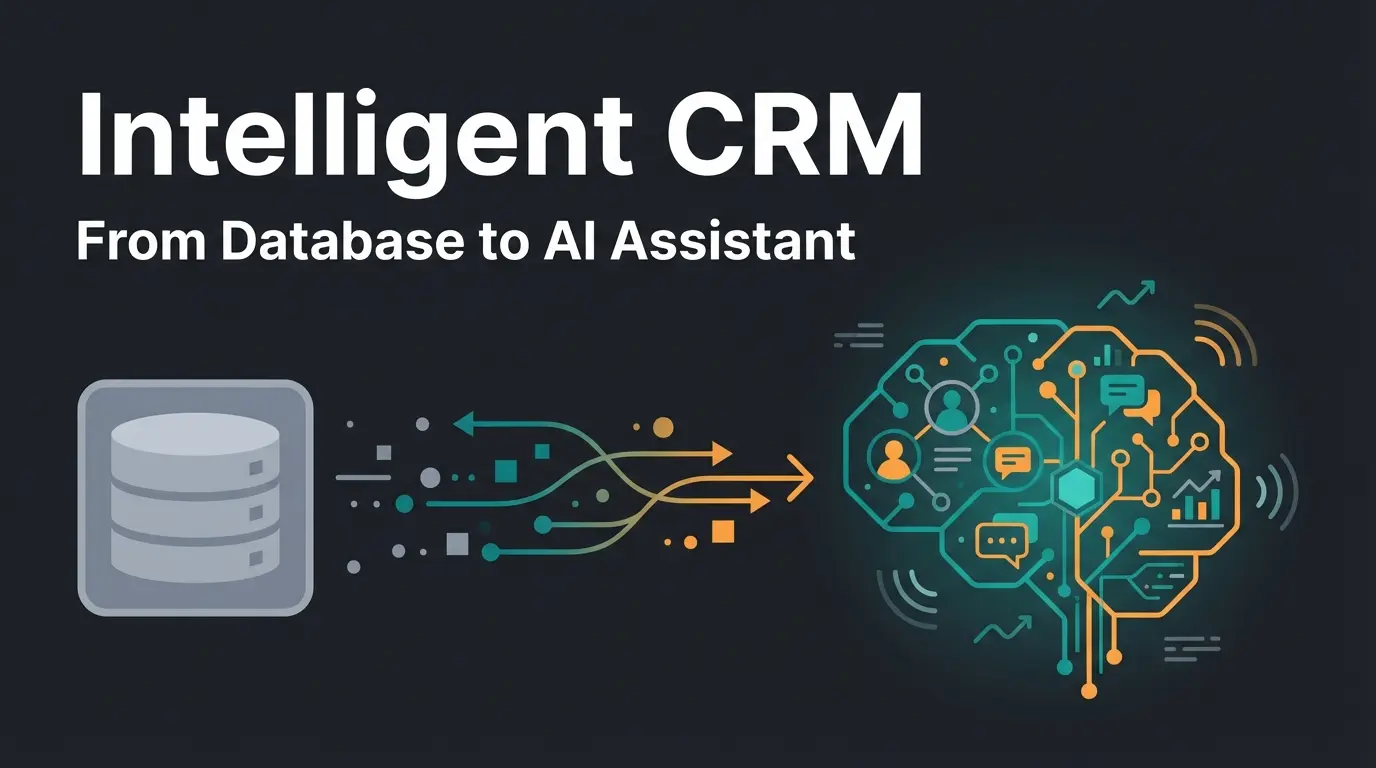
Why Traditional Integration Falls Short in 2025
In the world of e-commerce, the connection between ERP systems (Enterprise Resource Planning) and web shops has long been purely a logistical exercise. It was about pushing orders from A to B and synchronizing inventory levels. But in 2025, the playing field has changed dramatically. A Magento SAP integration is now far more than just a data channel—it's the nervous system of your digital commerce.
Companies using Adobe Commerce (Magento) and SAP (whether S/4HANA, ECC, or Business One) face a dual challenge: They must not only ensure operational excellence but also meet the expectations of an AI-driven customer journey. If your web shop doesn't know in real-time what your SAP system knows about complex product configurations or individual B2B pricing, you're not just losing time—you're losing revenue.
This article guides you through the complex landscape of the SAP Magento connector ecosystem. We're leaving behind the marketing buzzwords of agencies and diving deep into architecture, costs, and most importantly, the untapped potential of your data for AI applications. As explored in our guide on Shopware SAP integration, the principles of intelligent ERP connectivity apply across platforms.
Why Connect SAP & Magento? Beyond Just Saving Time
The obvious benefits of integration—reducing manual errors, accelerating order processing, and automating accounting—are well-documented by sources like MGT Commerce and MageStore. However, for decision-makers in 2025, there are more strategic reasons to prioritize the Magento SAP interface.
The Sword of Damocles: SAP ECC End of Maintenance 2027
An often-overlooked driver for current integration projects is the forced modernization of SAP landscapes. Mainstream maintenance for SAP ECC 6.0 ends in 2027 (with optional, paid extension until 2030), according to IgniteSAP, The First Call Consulting, and Rimini Street. Many companies are currently migrating to SAP S/4HANA.
- The Risk: If you build an outdated point-to-point connection now, you'll have to completely redevelop it during S/4HANA migration.
- The Opportunity: A modern integration architecture (e.g., via middleware) decouples the shop from the ERP. Replace the backend (ECC to S/4HANA), and the frontend (Magento) remains stable.
Data as Fuel for AI Sales Agents
Here lies your greatest differentiation opportunity. Traditional shops offer a search bar. Modern shops offer consultation. For an AI agent on the frontend (based on LLMs) to explain to a customer why component A is better than component B, it needs access to the deep, structured data that often only exists in SAP (e.g., in classification or variant configurator), as highlighted by CX Today and SAP Cloud.
A Magento SAP integration today must transmit not just "Stock: 5 pieces" but also "Attribute: Heat-resistant up to 500°C" so that AI can use this information to drive sales. This approach to AI product consultation represents the next evolution of e-commerce.
Hyper-Personalization in B2B
B2B customers now expect B2C convenience. This means real-time individual pricing (tiered prices, framework agreements), insight into open items and credit limits directly in the Magento customer account, and availability checks (ATP – Available to Promise) considering production plans from SAP. Companies excelling in Shopware B2B demonstrate how ERP integration enables these capabilities.
Mainstream maintenance ends, forcing migration decisions
Expect B2C-like personalized experiences in business purchases
Without real-time pricing and inventory synchronization
The 3 Core Strategies for Magento SAP Connection
There is no one-size-fits-all approach. The choice of architecture determines stability, costs, and scalability. Understanding these options is crucial for implementing effective Shopware ERP integration or Magento SAP connectivity.
Option 1: Point-to-Point Connectors (Extensions)
These are ready-made Magento extensions that communicate directly with SAP. Examples include solutions from providers like Webkul, Amasty, and MageStore.
- Advantages: Low entry costs, quick installation ("Plug & Play" promise).
- Disadvantages: Scales poorly. When you update SAP, the connector often breaks. There's no central monitoring instance when data gets stuck.
- Suitable for: Small shops with SAP Business One and low customization requirements.
Option 2: Middleware / iPaaS (Integration Platform as a Service)
Here, a software layer is placed between Magento and SAP. The middleware "translates" the data. Examples include Alumio, Lobster_data (as referenced by MCB and Lobster World), MuleSoft, and Talend, according to Ask Daman.
- Decoupling: Changes to SAP don't paralyze Magento.
- Monitoring: You see exactly where an order is stuck.
- Flexibility: Data can be transformed and enriched before handoff (important for AI!).
- Disadvantage: Higher license costs (monthly).
- Suitable for: Mid-market and Enterprise (S/4HANA, ECC), complex B2B scenarios. This is the recommended strategy for 2025.
Option 3: Custom Interface Development
A tailor-made interface, often based on microservices. This offers 100% coverage of specific business processes (e.g., custom manufacturing) but comes with extremely high development costs, dependency on individual developers, and high maintenance effort ("Technical Debt"). This approach is comparable to building custom AI sales agents from scratch.
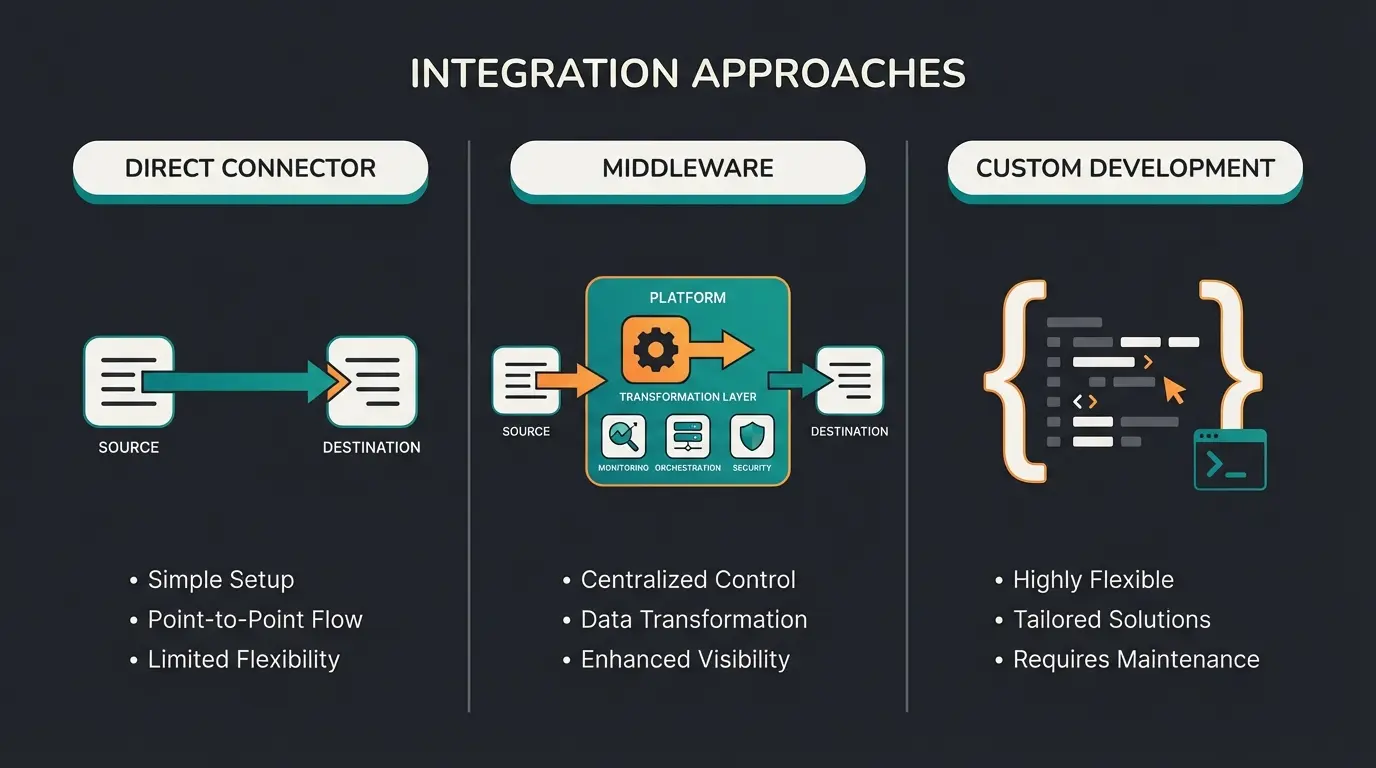
Integration Methods Comparison Table
| Feature | Connector/Extension | Middleware (iPaaS) | Custom Development |
|---|---|---|---|
| Initial Costs | Low (€) | Medium (€€) | High (€€€) |
| Ongoing Costs | Low | Medium (License) | High (Maintenance) |
| Scalability | Low | Very High | Medium |
| AI-Readiness | Low | High (Data Transformation) | High |
| Maintenance Effort | Medium (during updates) | Low (Vendor-managed) | Very High |
Technical Deep Dive: REST API vs. OData
When technically implementing the SAP Magento connection, teams often face the question: Which protocol should we use? The answer is crucial for performance, as detailed by Iteanz, SAP, and DreamFactory.
REST API (Representational State Transfer)
- Standard: Magento 2 natively uses a strong REST API.
- Use Case: Ideal for simple CRUD operations (Create, Read, Update, Delete).
- Limitation: For complex queries (e.g., "Give me all red products that cost more than $50 and are in stock"), often more data load must be transferred than necessary, which impacts performance.
OData (Open Data Protocol)
- SAP's Favorite: OData builds on REST but is more powerful. It's the standard for SAP S/4HANA and SAP Fiori applications.
- Advantage: It allows complex filter and sorting logic directly in the query URL.
- Why It Matters: For Magento SAP integration, OData means Magento (or the middleware) can request very precisely only the exact data needed from SAP. This massively reduces server load and speeds up the shop.
- Recommendation: For S/4HANA integrations, preferably use OData services for complex data queries (prices, inventory) and REST for simple transactions (order submission).
The Critical Question: Which is the Leading System?
A common point of contention in projects: Who has data sovereignty? The answer determines data quality. Understanding this is essential whether you're implementing AI E-Commerce solutions or basic data synchronization.
SAP Leads for:
- Prices & Taxes: SAP is the financial system. Magento should never calculate prices itself but retrieve (or synchronize) them from SAP to avoid discrepancies in invoices.
- Inventory: Only SAP knows the true stock (including reservations from other channels).
- Order Status: The status "Shipped" or "Partially Delivered" originates in logistics (SAP).
Magento Leads for:
- Shopping Cart & Checkout Logic: The user experience lives in the shop.
- Unstructured Product Data: Images, marketing texts, and SEO data are often maintained in Magento (or a PIM), as SAP is too rigid for this.
- Customer Registration (Initial): First contact often happens on the web.
The New Approach: AI as the Intermediary
In a modern architecture (see "Future-Proofing" below), SAP data (technical attributes) and Magento data (user behavior) are fed into a "Data Lake" or vector database. The leading system for sales consultation is then neither SAP nor Magento, but the AI agent that accesses both sources. This represents the evolution described in Conversational AI implementations.
Technical specs, pricing rules, inventory, and Bill of Materials flow from ERP
Data is normalized, enriched, and prepared for multiple consumers
Product knowledge is vectorized for semantic AI retrieval
Customer queries trigger intelligent responses using combined data sources
Critical Data Points: What Really Needs Synchronization?
Not all data needs to flow in real-time. An intelligent Magento SAP connector strategy differentiates by urgency.
Inventory (Lagerbestand)
- Requirement: Near real-time.
- Solution: A full sync often runs overnight. During the day, only delta updates (changes) are pushed.
- Pro Tip: Use "Thresholds." If stock > 100, show "Available." If stock < 10, start real-time SAP query (ATP check) in cart to prevent overselling.
B2B Pricing (Advanced Pricing)
SAP often has extremely complex pricing rules (Customer Group A gets 5% on Product Group B, but only during Period X). Magento can barely replicate this natively.
- Synchronization: Prices are replicated in Magento price tables (fast but complex to maintain).
- Live Call: Price is queried live from SAP in the cart (always correct, but performance risk).
- Hybrid: Standard prices in cache, customer-specific prices via live call.
Product Attributes (The AI Key)
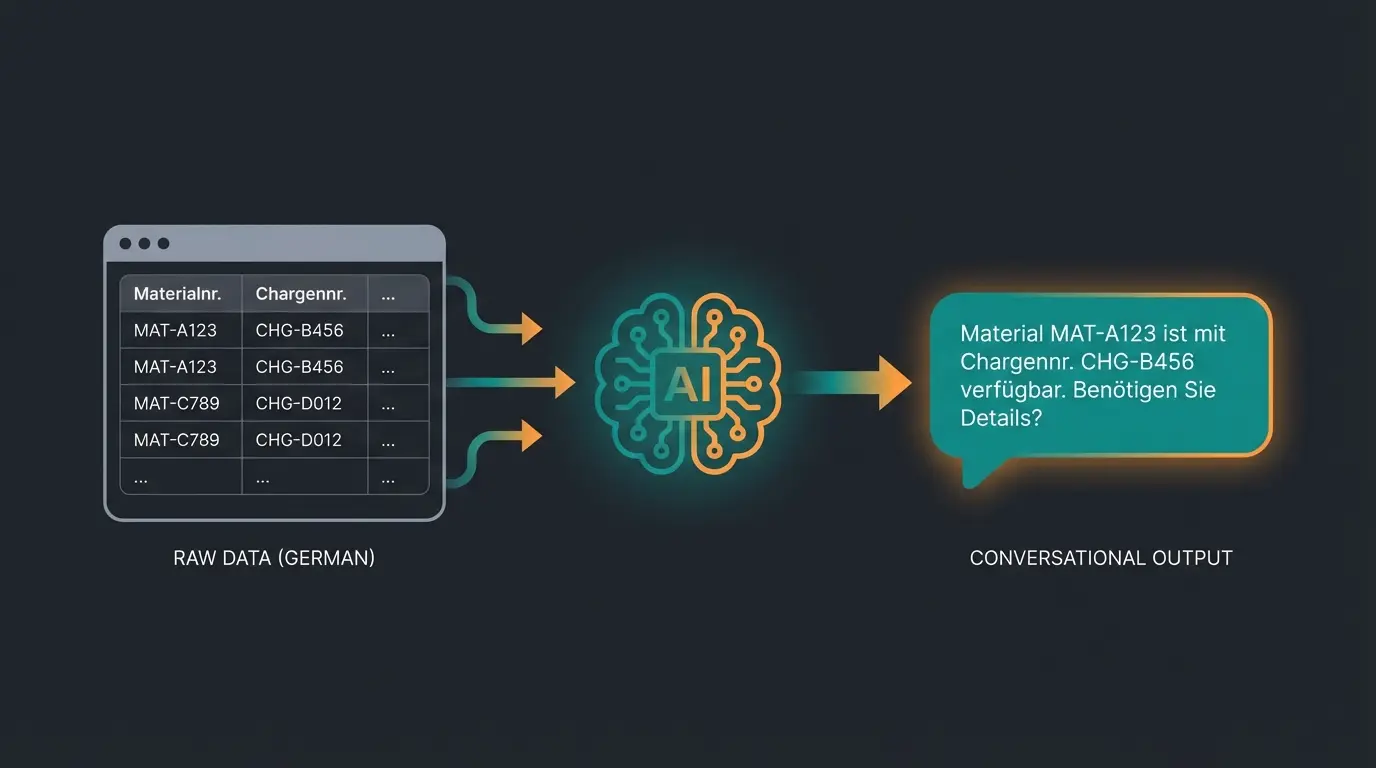
Here lies buried gold. SAP often contains technical characteristics (customs numbers, material composition, compatibilities). The strategy should synchronize these "boring" data not just for display in a table. Use middleware to translate this data into understandable language ("Feature Engineering") so AI can use it.
Stop treating integration as a backend task. Our AI-powered product consultation turns your SAP data into a competitive advantage that actively drives conversions.
Start Your AI IntegrationChallenges in the German Market: GDPR & Compliance
German companies must apply stricter standards to Magento SAP integration than US competitors. Understanding the history of chatbots and their data handling evolution helps contextualize these compliance requirements.
Data Sovereignty and Cloud Hosting
Many iPaaS solutions (middleware) are US-based. Since the fall of "Privacy Shield" and the uncertainty around the "EU-US Data Privacy Framework," as noted by Heuking and Nextcloud, caution is warranted.
- Solution: Choose middleware providers that guarantee hosting in the EU (e.g., Lobster_data or Alumio).
- Contract: Pay attention to Standard Contractual Clauses (SCCs) when data leaves the EEA.
The Infamous "Z-Tables"
German SAP systems are often heavily customized ("Z-tables" are user-defined tables in SAP). Standard connectors often fail here because they only read standard SAP fields.
Costs and ROI: A Realistic Look
What does a professional Magento SAP integration cost? The range is huge, but transparency is important according to SAP Cloud One, Advox Studio, and DCKAP.
Cost Factors
- License Costs (Middleware): Expect €150 to €1,000+ per month for professional iPaaS solutions (e.g., Alumio, Lobster). Cheap connectors start at around €500 one-time but have high follow-up costs when problems arise.
- Implementation (Services): Simple Integration (Business One): €5,000 - €15,000. Complex Integration (S/4HANA, B2B): €20,000 - €100,000+.
- Maintenance: Plan for approximately 15-20% of initial costs per year for updates and adjustments.
Total Cost of Ownership (TCO) Consideration
A cheap P2P connector seems attractive. But if it causes 3 days of downtime and developer hours with every SAP update (or Magento upgrade), the TCO after 2 years is higher than with robust middleware.
- ROI Calculation: Don't just calculate saved data entry time. Calculate the value of prevented errors (wrong prices, returns due to incorrect stock) and additional revenue through better availability.
- Consider the enablement of AI in sales capabilities as a revenue multiplier.
| Integration Type | Year 1 Cost | Year 3 TCO | AI Capability | Risk Level |
|---|---|---|---|---|
| Basic Connector | €5,000-15,000 | €25,000-40,000 | None | High |
| Middleware (iPaaS) | €25,000-50,000 | €60,000-90,000 | High | Low |
| Custom Development | €50,000-100,000+ | €100,000-200,000+ | High | Medium |
Future-Proofing: Preparing for AI Product Consultation
This is the decisive step to set yourself apart from the competition. Integration today is Knowledge Activation. This concept aligns with the broader transformation seen in Consultative AI implementations across industries.
The Problem: The "Silent" Catalog
A normally integrated shop displays products. When a customer asks: "Does this spare part fit my 10-year-old machine?" the standard search doesn't help them, even though the answer is buried deep in SAP's Bill of Materials.
The Solution: The AI Layer
Instead of just copying data from SAP to Magento, we use the integration pipeline to train an AI agent. This approach transforms static product data into dynamic AI selling capabilities.
Middleware pulls not just titles and prices, but technical datasheets, maintenance histories, and compatibility lists from SAP
Data is loaded into a vector database (Knowledge Base) optimized for semantic search
An AI chatbot in the Magento frontend accesses this knowledge to provide intelligent responses
Customer interactions feed back to improve AI accuracy and coverage
Example Scenario in Action
Consider this customer interaction comparison:
- Customer: "I need a gasket for Pump X, but it's not available."
- Standard Shop: "Out of stock." (Customer goes to competitor).
- AI-Integrated Shop: The AI checks inventory via SAP integration, sees "0", but also checks technical attributes in SAP and finds a compatible successor model.
- Response: "The original is sold out, but according to SAP specifications, Model Y also fits and is immediately available. Should I add it to your cart?"
This is how the Magento SAP integration transforms from a pure data cable into a revenue driver. The implementation of AI Chatbots capable of such interactions requires this deep integration foundation.
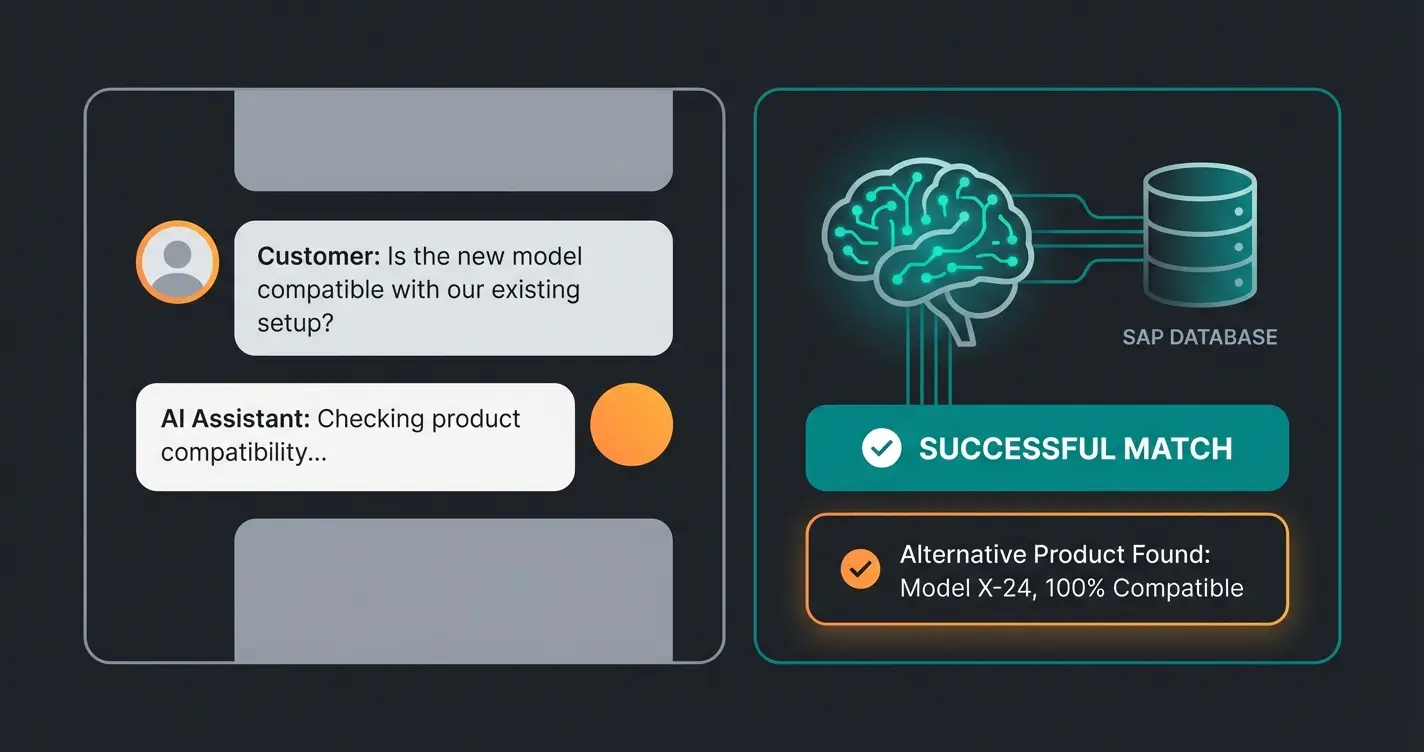
Architecture Diagram: The AI-Ready Integration
A modern integration architecture positions the AI layer as a critical component rather than an afterthought. As demonstrated in AI product consultation deployments, this architecture enables capabilities impossible with traditional approaches.
| Component | Standard Integration | AI-Ready Integration |
|---|---|---|
| Data Flow | SAP → Magento | SAP → Middleware → Vector DB + Magento |
| Data Types | SKU, Price, Stock | + Technical specs, compatibility, service history |
| Frontend Capability | Search & Filter | Conversational consultation |
| Customer Experience | Self-service catalog | Guided selling with intelligent recommendations |
| Revenue Impact | Baseline | 20-40% conversion improvement |
Conclusion & Project Checklist
The connection between Magento and SAP is the backbone of your e-commerce. Given SAP ECC's end of maintenance in 2027 and the rise of AI in sales, now is the right time to rethink your integration strategy. Opt for middleware instead of makeshift solutions and prepare your data for the AI era.
Your Checklist for Getting Started
- Check Current Status: Are we still using SAP ECC? When is migration to S/4HANA planned?
- Choose Architecture: Is middleware (iPaaS) more cost-effective long-term than constant adjustments to direct interfaces?
- Data Audit: What data in SAP is "dead capital" that an AI agent could use (e.g., service histories)?
- Compliance Check: Where is data processed? (EU vs. US servers).
- Partner Selection: Does the agency have experience with both worlds (Magento & SAP) and understand modern AI requirements?
Invest in intelligent integration—your customers (and your sales team) will thank you. The transformation from basic data synchronization to AI-powered commerce represents the next frontier in competitive differentiation.
Frequently Asked Questions
A connector is a direct extension that links Magento and SAP through point-to-point communication. Middleware (iPaaS) is a separate software layer that sits between both systems, translating and transforming data. Middleware offers better scalability, monitoring capabilities, and the ability to enrich data for AI applications, making it the recommended approach for complex B2B scenarios.
Timeline varies significantly based on complexity. A basic Business One integration with standard connector might take 4-8 weeks. A comprehensive S/4HANA integration with middleware, custom mappings, and AI preparation typically requires 3-6 months. Factor in additional time for testing, especially for complex B2B pricing scenarios.
Yes, and this represents the greatest untapped opportunity in most SAP environments. Technical specifications, compatibility matrices, service histories, and Bill of Materials data can all be vectorized and loaded into a knowledge base. This enables AI chatbots to provide intelligent product recommendations and answer complex technical questions that standard search cannot address.
German companies must ensure data processing occurs within the EU or under valid Standard Contractual Clauses (SCCs). Choose middleware providers guaranteeing EU hosting. Pay special attention to customer data transfer protocols between US-centric Magento cloud instances and on-premise SAP systems. Document all data flows for compliance audits.
Calculate three factors: (1) Cost of downtime and developer hours during SAP/Magento updates with current connector, (2) Value of prevented errors (pricing discrepancies, overselling) that middleware monitoring catches, (3) Additional revenue from AI-enabled capabilities like intelligent product recommendations. Most enterprises see positive ROI within 18-24 months of middleware implementation.
Don't just sync data—activate knowledge. Our AI-powered approach turns your SAP investment into a competitive weapon that drives conversions and customer satisfaction.
Get Your AI Assessment
Kevin is CTO and co-founder of Qualimero. As an AI architect with over 15 years of experience as CTO and CPO in the tech industry, he designs the AI systems that automate tens of thousands of customer interactions daily for Qualimero's clients — reliably, securely, and at scale.