Why Standard Magento SEO No Longer Cuts It
If you're running a Magento store, you know the challenge: The platform is an e-commerce powerhouse, but "out of the box" it's often an SEO headache. For years, Magento search engine optimization primarily consisted of maintaining meta tags, configuring `robots.txt` files, and hoping for backlinks.
But in 2025, the rules of the game have changed. Google no longer just evaluates what's on your page (keywords), but how users interact with your page (User Experience & Dwell Time). While competitors are still exclusively turning technical screws, the real opportunity lies in combining technical excellence with modern, AI-powered user guidance. This is where a Magento SEO agency can provide significant value.
This guide isn't your ordinary SEO article. We'll cover the essential technical basics you need for Magento SEO, dive deep into the specifics of the German-speaking market, and finally show you how to close a content gap with AI technology that your competitors haven't even noticed yet.
The Foundation: Technical Magento SEO Must-Haves
Before we talk about AI and user interaction, the house must stand on a solid foundation. Magento 2 (especially from version 2.4.7 onwards) offers many levers, but also many pitfalls. Here are the mandatory technical tasks for proper Magento SEO settings.
URL Structure and Rewrites
A clean URL structure is the backbone of your SEO for Magento. By default, Magento often appends cryptic parameters or `.html` extensions that can contradict modern SEO best practices.
- Server URL Rewrites: Make sure that under Stores > Configuration > General > Web > Search Engine Optimization, the "Use Web Server Rewrites" option is set to Yes. This removes `index.php` from your URLs.
- Remove extensions: Whether you want to keep `.html` at the end is a matter of preference, but consistency is mandatory. Many SEOs today recommend keeping URLs as short as possible (e.g., `/mens/running-shoes` instead of `/mens/running-shoes.html`). You can adjust this under Catalog > Search Engine Optimization.
Solving the Duplicate Content Problem (Canonical Tags)
Magento is notorious for duplicate content. A product is often accessible via multiple paths:
- `domain.com/product-a`
- `domain.com/category-1/product-a`
- `domain.com/category-1/subcategory/product-a`
For Google, this looks like three different pages with identical content—poison for your ranking.
Path to the setting: `Stores > Configuration > Catalog > Catalog > Search Engine Optimization`
- Use Canonical Link Meta Tag for Categories: Set this to Yes as recommended by Plumrocket and Mageplaza.
- Use Canonical Link Meta Tag for Products: Set this to Yes.
Pro Tip: Make sure you don't accidentally let filter URLs (e.g., `?color=red&size=L`) get indexed. These should be set to `noindex` via `robots.txt` or meta robots tag to avoid wasting crawl budget. For more comprehensive strategies on optimizing your online presence, check out our AI e-commerce guide.
Sitemap and Robots.txt Configuration
An XML sitemap helps Google understand your structure. In Magento 2, you can automate this process.
- Sitemap: Under Stores > Configuration > Catalog > XML Sitemap, you can set the generation frequency. Make sure the sitemap is in the root directory and linked in the `robots.txt`.
- Robots.txt: This file controls what Google should not see. Block internal search results (`/catalogsearch/`), checkout pages, and customer logins.
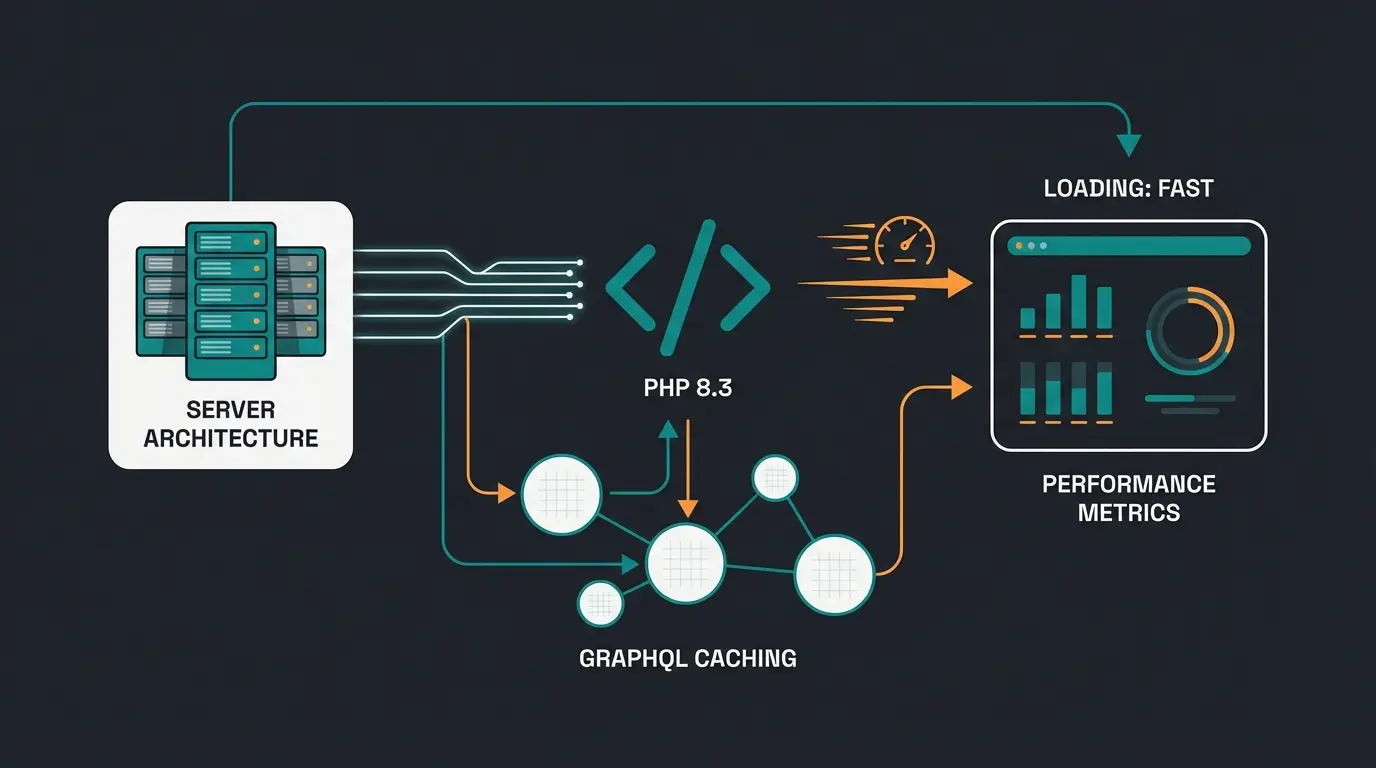
Magento 2.4.7 and Technical Updates
With the release of Magento 2.4.7 in April 2024, there were important updates to the technical foundation, according to MagentoBrain and MageComp.
- PHP 8.3 Support: This provides faster execution times in the backend, which indirectly improves TTFB (Time to First Byte).
- GraphQL Caching: For headless stores or PWA frontends, caching of GraphQL queries was massively improved, noticeably shortening load times for end users as detailed by ioVista and Adobe.
Performance and Core Web Vitals: Speed as Ranking Factor
Google has made user experience measurable with Core Web Vitals (CWV). Since March 2024, a crucial change has occurred: INP (Interaction to Next Paint) has replaced FID (First Input Delay) as confirmed by Google and web.dev.
INP: Why Response Time Is Everything
INP measures not just how fast a page loads, but how quickly it responds to an input (e.g., clicking "Add to Cart" or opening a menu). Magento stores overloaded with heavy JavaScript (e.g., from too many tracking pixels or poorly optimized themes) often fail here.
Optimization for INP in Magento:
- Reduce JavaScript: Remove unused JS files and scripts.
- Unload the Main Thread: Outsource heavy computing processes or use Web Workers.
- Varnish Cache: A correctly configured Varnish Cache (Version 7.4 is supported by Magento 2.4.7 according to web-vision.de) is mandatory to keep server response times low.
Hyvä Theme vs. Luma: The Game Changer
The standard Magento theme ("Luma") is technologically outdated and extremely sluggish (keyword: RequireJS). It's almost impossible to achieve perfect Core Web Vitals scores with Luma.
This is where Hyvä comes in. Hyvä is a modern frontend for Magento that throws out all the old baggage and relies on Alpine.js and Tailwind CSS.
- SEO Advantage: Hyvä stores often achieve Google PageSpeed Scores of 90+ "out of the box" according to RaveDigital Agency.
- Less Code: Instead of hundreds of JS files, Hyvä loads only a fraction, which directly impacts the INP value as noted by Viha Digital Commerce and HumCommerce.
For businesses exploring platform options with AI capabilities, our guide on AI commerce solutions provides valuable comparisons.
Image SEO: WebP and Lazy Loading
Images are often the biggest bottleneck. Magento doesn't natively support WebP fully automatically everywhere without configuration.
- Use WebP: Use extensions (e.g., from Magefan or Amasty) or Hyvä's capabilities to automatically convert images to WebP format. WebP images are often 30% smaller than JPEGs at the same quality according to FME Extensions and Plumrocket.
- Lazy Loading: Images should only load when they come into the visible area (viewport). This improves LCP (Largest Contentful Paint).
Typical score for Hyvä-powered Magento stores
WebP image compression vs. traditional JPEG
INP improvement with optimized JavaScript
The German Factor: SEO for the DACH Region
Many English-language guides ignore the specifics of the German-speaking market. But for Magento search engine optimization in Germany, Austria, and Switzerland, special rules apply. Understanding regional requirements is essential, similar to how our Shopware SEO guide addresses platform-specific optimization.
Server Location and Load Time
The physical location of your server affects latency. A server in Frankfurt responds to a user in Berlin faster than a server in the USA.
- Ranking Influence: Google uses load time as a ranking factor. Hosting in Germany is therefore a direct SEO advantage for German shops, as explained by webhosting.de.
- GDPR: A server location in the EU (ideally Germany) massively simplifies GDPR compliance, which brings us to the next point.
Trust Signals: GDPR and Legal Notice (Impressum)
Google evaluates E-E-A-T (Experience, Expertise, Authoritativeness, Trustworthiness). In Germany, missing or hidden legal information (Impressum, privacy policy) is a massive negative trust signal.
- User Signals: If users first have to click away a cookie banner that blocks the page or loads slowly (CLS - Cumulative Layout Shift), they bounce. Bounce rate rises, ranking falls.
- Solution: Use performant, GDPR-compliant cookie solutions that don't shift the layout (CLS optimization).
Hreflang: The Master Class for DACH
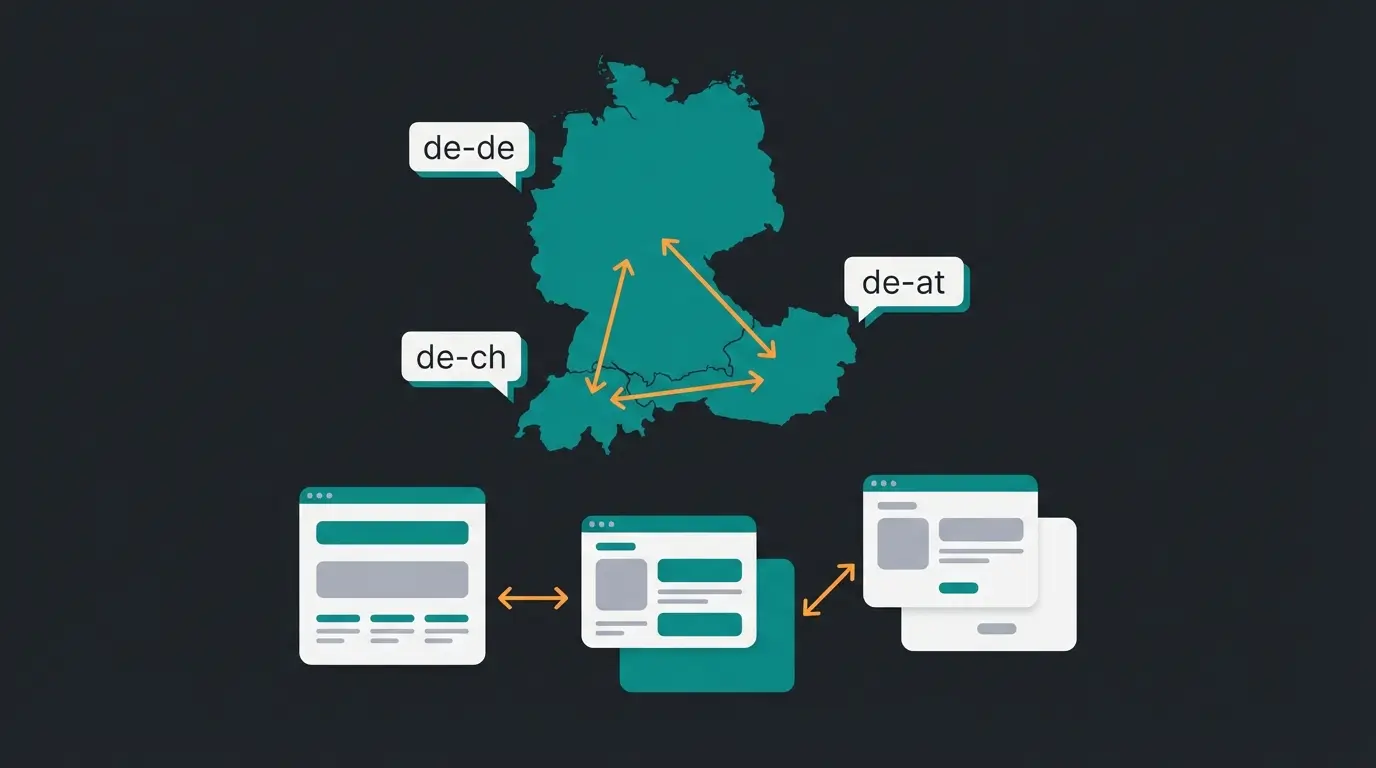
If you sell to Germany (de-de), Austria (de-at), and Switzerland (de-ch), you have almost identical content. Without `hreflang` tags, Google interprets this as duplicate content.
Challenge in Magento: Magento doesn't natively offer simple hreflang configuration for store views at the CMS page or product level that run across different domains.
- Solution: You usually need an extension (e.g., from Magefan or BSSCommerce) or clean XML sitemap integration to tell Google: "This is the page for Austria, this for Germany."
- Important: Hreflang must be bidirectional. Page A must point to Page B and Page B back to Page A.
The Missing Link: Optimizing for Search Intent and Dwell Time
Here's where the wheat separates from the chaff. Most stores optimize for keywords ("buy running shoes"). But users search differently today. They search for solutions ("Which running shoe for wide feet in rainy weather?").
The Problem with Static Magento Pages
A classic Magento category page is a list of products with filters.
- Scenario: A user searches for "Best laptop for video editing under €1000."
- Result: They land on your "Laptops" category. They now have to painstakingly set filters (price, RAM, graphics card).
- Consequence: Often it's too complicated for them. They leave the page (bounce). The dwell time is short. Google learns: "This page is not a good result."
The Solution: AI as Product Consultant
Instead of just using AI for writing product texts (which everyone does), you should use AI for live consultation. This approach is central to AI product consultation strategies.
The Concept: Integrate an AI agent on your category pages that doesn't act like a dumb support bot, but like a salesperson.
- User: "I'm looking for a laptop for video editing, max €1000."
- AI: "For video editing, you need a lot of RAM. In this price range, I recommend Model X or Model Y, as they have 16GB RAM and a dedicated graphics card. Should I compare them for you?"
The SEO Lever: Dwell Time and User Signals
Why is this SEO for Magento?
- Increased Dwell Time: The user interacts with the AI, reads the responses, clicks on the suggested products. They stay 3-4 minutes instead of 30 seconds as research from AdsSpiders confirms.
- Lower Bounce Rate: The user immediately finds a solution instead of frustratedly returning to Google ("pogo-sticking" is avoided).
- Semantic Coverage: The chat history covers long-tail keywords that you could never include in static texts.
This is precisely why KI-Produktberatung outperforms support in driving both customer satisfaction and search rankings. The combination of AI consultation guide principles with SEO creates a powerful competitive advantage.
| Feature | Standard Magento Filter | AI Product Consultant |
|---|---|---|
| User Interaction | Passive clicking & scrolling | Active dialogue & consultation |
| Search Intent | Must be translated by the user (e.g., "video editing" → "16GB RAM") | Understood and translated by AI |
| Dwell Time | Low (often seconds when overwhelmed) | High (minutes through dialogue) |
| Bounce Rate | High for complex products | Low through immediate relevance |
| Long-Tail SEO | Only covers defined attributes | Covers natural language & questions |
See how AI-powered product consultation can dramatically increase dwell time, reduce bounce rates, and boost your search rankings while converting more visitors into customers.
Start Your Free TrialAdvanced: Semantic SEO and Long-Tail Keywords
With the rise of voice search and AI-powered search engines (like Google's AI Overviews), exact keyword matching is becoming less important. Semantics is king.
Question-Based Content Strategy
Users ask questions. Your Magento page must deliver answers.
- Strategy: Don't just use the "FAQ" feature on product pages for shipping info. Answer specific questions about product benefits.
- Schema.org: Mark these FAQs with `FAQPage` schema markup. Magento usually needs an extension for this since the standard schema is very limited according to FastWhiteCat and MGT Commerce. This enables rich snippets in search results that can massively increase your click-through rate (CTR).
Topic Clusters Instead of Keyword Stuffing
Instead of optimizing one page for "running shoes," build clusters. This is an essential strategy that an AI-powered sales consultant approach can enhance.
- Pillar Page: The main category "Running Shoes."
- Cluster Content: Blog articles (integrated into Magento, e.g., via Magefan Blog Extension according to Amasty) that link to the category: "Running Shoes for Beginners," "Cushioning vs. Stability Differences."
- Internal Linking: Use automated cross-linking tools in Magento to automatically link relevant terms in blog posts with matching category pages.
Complex query like 'Best X for Y'
Arrives at your Magento category
Interactive consultation begins
Stays 3+ minutes exploring options
Google recognizes quality signals
Checklist: Your Magento SEO Routine
SEO isn't a one-time project but an ongoing process. Here's your checklist for success, which ties into understanding AI-powered cost savings when planning your optimization investment.
One-Time Setup Tasks
- Upgrade: Check for update to Magento 2.4.7+ (PHP 8.3 support)
- Theme: Evaluate switching to Hyvä Theme for Core Web Vitals
- URLs: Activate server rewrites, remove `.html` extensions
- Canonical: Set canonical tags for categories and products to "Yes"
- Sitemap: Generate XML sitemap and submit to Google Search Console
- Hreflang: Configure correctly for DACH stores (use extension)
- Tracking: Link Google Analytics 4 and Search Console
Weekly Routine
- Crawl Errors: Check Search Console for 404 errors and set up redirects
- Content: Publish a new blog post or guide text (topic clusters)
- Performance: Check Core Web Vitals (especially INP and LCP)
Monthly Routine
- Backlink Audit: Who's linking to me? (Disavow harmful links)
- AI Analysis: Evaluate AI consultation chat logs—what are customers really asking? Incorporate these terms into product texts
- Speed Test: After plugin updates, check whether the site has become slower
Understanding AI consulting in e-commerce helps you maximize the value from these regular optimization efforts.
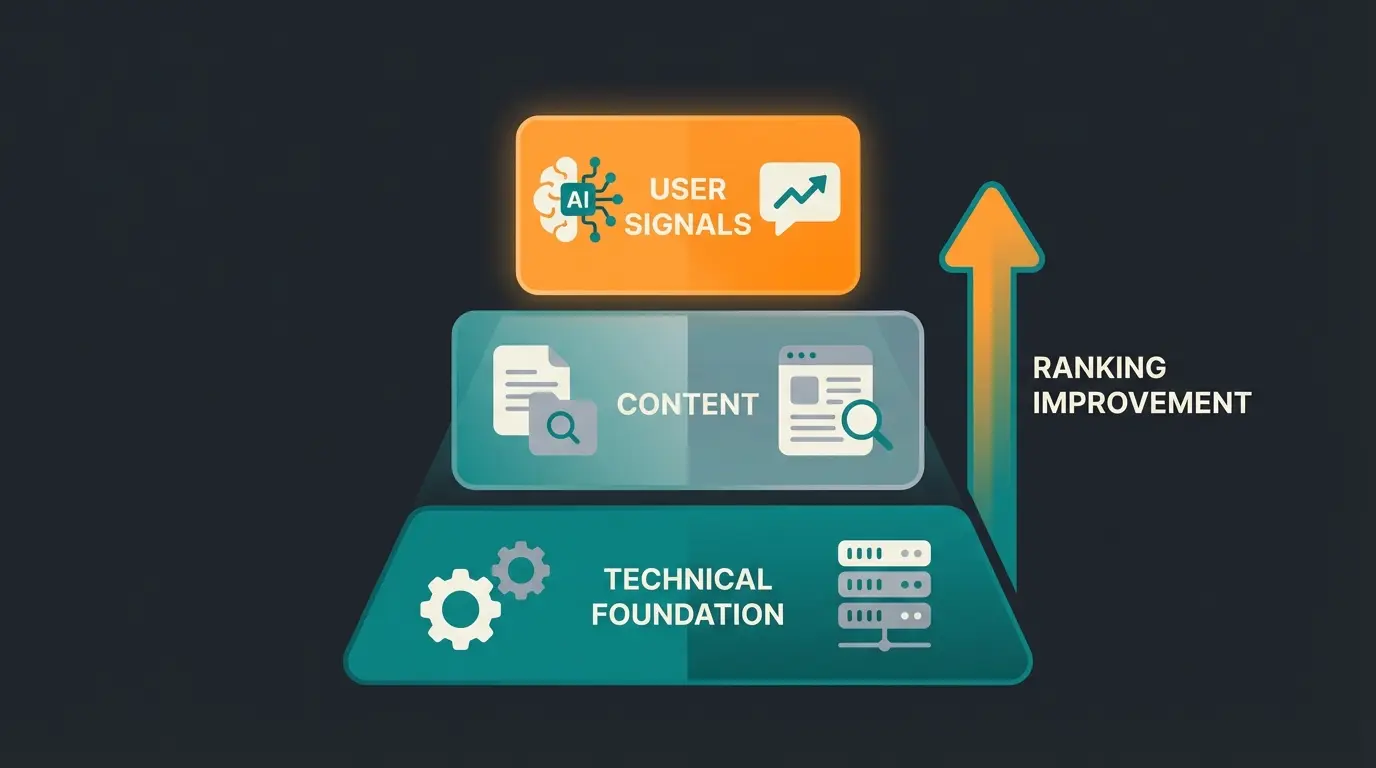
The Magento SEO Pyramid: A Visual Framework
To understand how all these elements work together, visualize the Magento SEO Pyramid. This framework, which can be enhanced with AI-enhanced design principles, shows the hierarchy of optimization priorities:
- Peak (The Winning Factor): User Signals & AI Consultation (Dwell Time, Interaction, Semantic Match)
- Middle (Content & Structure): High-quality descriptions, topic clusters, internal linking, Schema.org markup
- Base (Technical Foundation): Magento 2.4.7, Hyvä Theme, Canonical Tags, Hreflang, Server Speed (INP/LCP)
B2B Considerations for Magento SEO
For B2B Magento stores, the SEO considerations extend beyond traditional consumer-focused optimization. Complex product catalogs, custom pricing, and longer sales cycles require specialized approaches. Our AI-powered sales consultant guide covers these B2B-specific strategies in detail.
When considering platform migrations or upgrades, AI product consultation plays a crucial role in maintaining SEO equity while improving user experience.
Frequently Asked Questions About Magento SEO
The most critical Magento SEO settings are canonical tags (set to Yes for both categories and products), URL rewrites (enable server rewrites and consider removing .html extensions), and XML sitemap configuration. These foundational settings prevent duplicate content issues and ensure Google can properly crawl and index your store.
Hyvä replaces Magento's outdated Luma theme with a modern frontend built on Alpine.js and Tailwind CSS. This dramatically reduces JavaScript overhead, enabling stores to achieve PageSpeed scores of 90+ out of the box. The improved Core Web Vitals, especially INP (Interaction to Next Paint), directly impacts search rankings.
AI product consultation improves critical user signals that Google uses for rankings. When visitors engage with an AI consultant, dwell time increases from seconds to minutes, bounce rates drop significantly, and semantic coverage expands to include natural language queries. These positive signals tell Google your page provides valuable, relevant content.
Magento doesn't natively support easy hreflang configuration across store views. You'll need an extension (such as from Magefan or BSSCommerce) to properly configure de-de (Germany), de-at (Austria), and de-ch (Switzerland) tags. Remember that hreflang must be bidirectional—each page must reference all language variants, including itself.
INP (Interaction to Next Paint) replaced FID (First Input Delay) in March 2024 as a Core Web Vital. While FID only measured the delay before the browser started processing an interaction, INP measures the entire response time including visual feedback. This makes INP more comprehensive and harder to optimize for JavaScript-heavy Magento stores.
Conclusion: Technology Is the Entry Ticket, UX Wins the Race
Magento SEO in 2025 is far more than filling out meta tags in the backend. The technical foundation (Magento 2.4.7, Hyvä, Canonical Tags, Hreflang) is the entry ticket to even participate in the game. Without these homework assignments, Google will ignore your site.
But victory in rankings is no longer decided by technology alone. It's won through user satisfaction.
- When your page loads in milliseconds (Hyvä/Varnish)...
- When the user immediately gains trust (German server location/legal compliance)...
- And when they immediately find the solution to their complex problem through AI-powered consultation and stay on the page for extended periods...
...then you've created the perfect symbiosis of technology and user experience. That's the key to top rankings in 2025.
Are you ready to transform your Magento store from a static catalog into an intelligent advisor? Start today with an audit of your Core Web Vitals and consider how AI can revolutionize your customer guidance.
Combine technical excellence with AI-powered product consultation to create the ultimate user experience that Google rewards with top rankings and visitors reward with conversions.
Get Started Now
Lasse is CEO and co-founder of Qualimero. After completing his MBA at WHU and scaling a company to seven-figure revenue, he founded Qualimero to build AI-powered digital employees for e-commerce. His focus: helping businesses measurably improve customer interaction through intelligent automation.