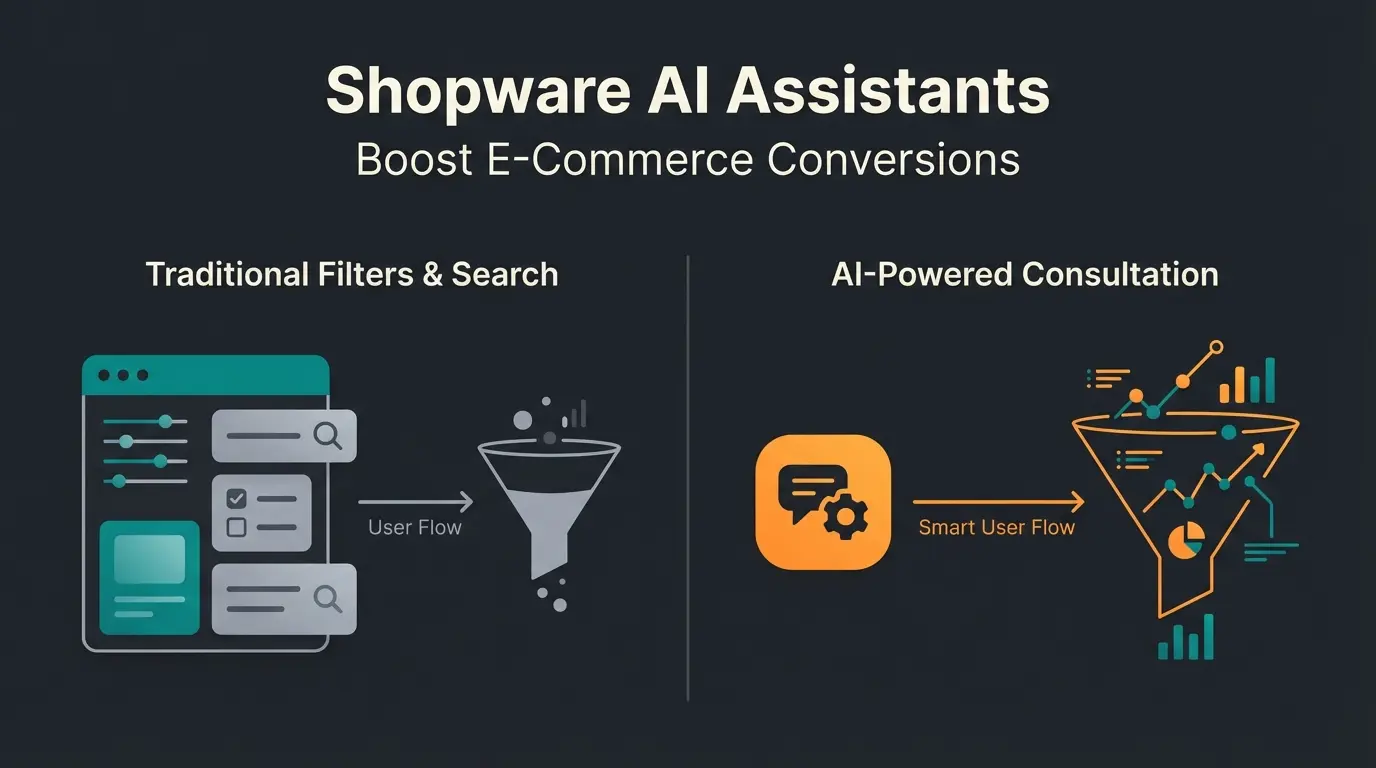
Introduction: Why Speed Alone Is No Longer Enough
The German e-commerce landscape is experiencing both excitement and confusion. For years, the classic Shopware theme (based on Twig and PHP) was the gold standard for online shops. However, requirements have changed dramatically. Customers no longer expect static product catalogs – they demand interactive experiences that feel as fluid as a smartphone app.
This is where Shopware Frontends enters the picture. Often, this technology is reduced to performance alone – "it's faster" or "it's better for Google Core Web Vitals." While accurate, this perspective falls short. For merchants, especially those in complex B2B environments or selling consultation-heavy products, Shopware Frontends is the key to an entirely new way of selling: AI-powered guided selling.
This article isn't a pure technical manual. It's a strategic guide for e-commerce managers, CTOs, and agency owners who want to understand why Shopware Frontends is the essential foundation for their shop's future – and how to bridge the gap between technical innovation and genuine business value. According to Shopware, the composable frontend approach represents the future of flexible e-commerce development.
What Is Shopware Frontends? (And What It Isn't)
To make strategic decisions, we first need to clarify terminology. The term "headless" is often used as a buzzword without illuminating the concrete technology behind it.
Definition and Technology Stack
Shopware Composable Frontends (Shopware Frontends for short) is a toolkit for creating custom storefronts for Shopware 6. Unlike the classic "monolith" where frontend and backend are tightly coupled, Shopware Frontends completely decouples the user interface from the shop core.
The technology stack is modern and future-proof. Vue.js 3 and Nuxt 3 form the heart of the system – a JavaScript framework used for building user interfaces and Single-Page Applications (SPAs). Tailwind CSS or UnoCSS provides utility-first CSS for rapid styling, while the Shopware Store API serves as the interface through which the frontend communicates with the Shopware backend.
As documented on GitHub, the official repository provides extensive resources for developers looking to implement custom storefronts. The framework offers pre-built composables and helpers that significantly accelerate development time.
The Difference from Classic Themes
Imagine your shop like a house. With a Classic Shopware Theme, you're buying a furnished house. You can move furniture around and paint walls, but if you want to knock down a wall or change the foundation, it becomes complicated and expensive.
With Shopware Frontends, you're commissioning an architect. You get exactly the rooms you need. If you want a living room that transforms into a cinema at the push of a button (interactivity), that's planned from the start. This flexibility is why AI-powered consultation solutions work seamlessly with headless architectures.

The Elephant in the Room: Shopware PWA vs. Frontends
Anyone searching for headless solutions for Shopware inevitably encounters the term Shopware PWA. This often creates confusion: Is it the same thing? Should I use PWA?
The clear answer is: No, choose Shopware Frontends.
The Evolution
The Past (Shopware PWA): This was the first attempt at a headless solution, developed in cooperation with Vue Storefront. It was a "reference implementation" that often proved difficult to customize and suffered from update problems.
The Future (Shopware Frontends): Shopware has restructured the project. Frontends isn't a ready-made "theme" but a framework (a building kit). It offers developers much more freedom and is less susceptible to "breaking changes" during updates because it doesn't rely on volatile internal APIs but on the stable Store API.
For merchants comparing platform options, understanding how Shopware vs Shopify handle complex product requirements is equally important. The headless approach gives Shopware a significant advantage for sophisticated use cases.
The Business Case: Why German Merchants Are Switching
Why should you go through the effort of changing your architecture? A headless project is often initially more expensive than a standard theme. The Return on Investment (ROI) comes from three areas:
A. Performance and Core Web Vitals
Google loves speed. Shopware Frontends uses techniques like Server-Side Rendering (SSR) and Static Site Generation (SSG). This means content is pre-rendered on the server and delivered lightning-fast to the browser.
Result: Better rankings, lower bounce rates, and higher conversion rates, especially on mobile devices. According to industry benchmarks, headless storefronts can achieve up to 50% faster load times compared to traditional monolithic architectures.
B. Independence and Scalability
In a monolithic system, a backend update (e.g., Shopware 6.6 to 6.7) can cause your frontend to "break." With Shopware Frontends, both systems are decoupled.
Advantage: Your marketing team can launch campaign landing pages or change the design without involving the backend team. You can host the frontend on high-performance servers (like Vercel) while the backend remains secure on German servers.
C. Closing the "Consultation Gap"
This is the most important point for merchants with complex products. A standard shop is good at displaying products. It's bad at explaining products.
If you sell bicycles, industrial machinery, or configurable furniture, standard filters often fail. The customer stands alone facing 500 items. Shopware Frontends enables app-like consultation features to be integrated directly into the shop without the page reloading with every click. This is where AI sales assistants truly shine.
Average improvement with SSR/SSG compared to traditional themes
Increase from improved Core Web Vitals and user experience
On mobile devices with app-like interactivity
Faster feature deployment with decoupled architecture
The Hidden Superpower: AI and Guided Selling
Here lies your real competitive advantage. Most agencies talk about technology. We're talking about sales psychology through technology.
The Problem with Static Themes
In a classic Twig template, every interaction is a "request" to the server. Customer clicks filter → page reloads. Customer changes variant → page reloads. Customer asks chatbot → chatbot is often just an overlay with no access to the shopping cart.
The Solution: Native AI Integration
Because Shopware Frontends is based on Vue.js, the shop runs in the customer's browser like an application. This enables real-time interactivity.
Scenario: The AI Sales Consultant
Imagine integrating an AI solution that doesn't just output text but controls the shop.
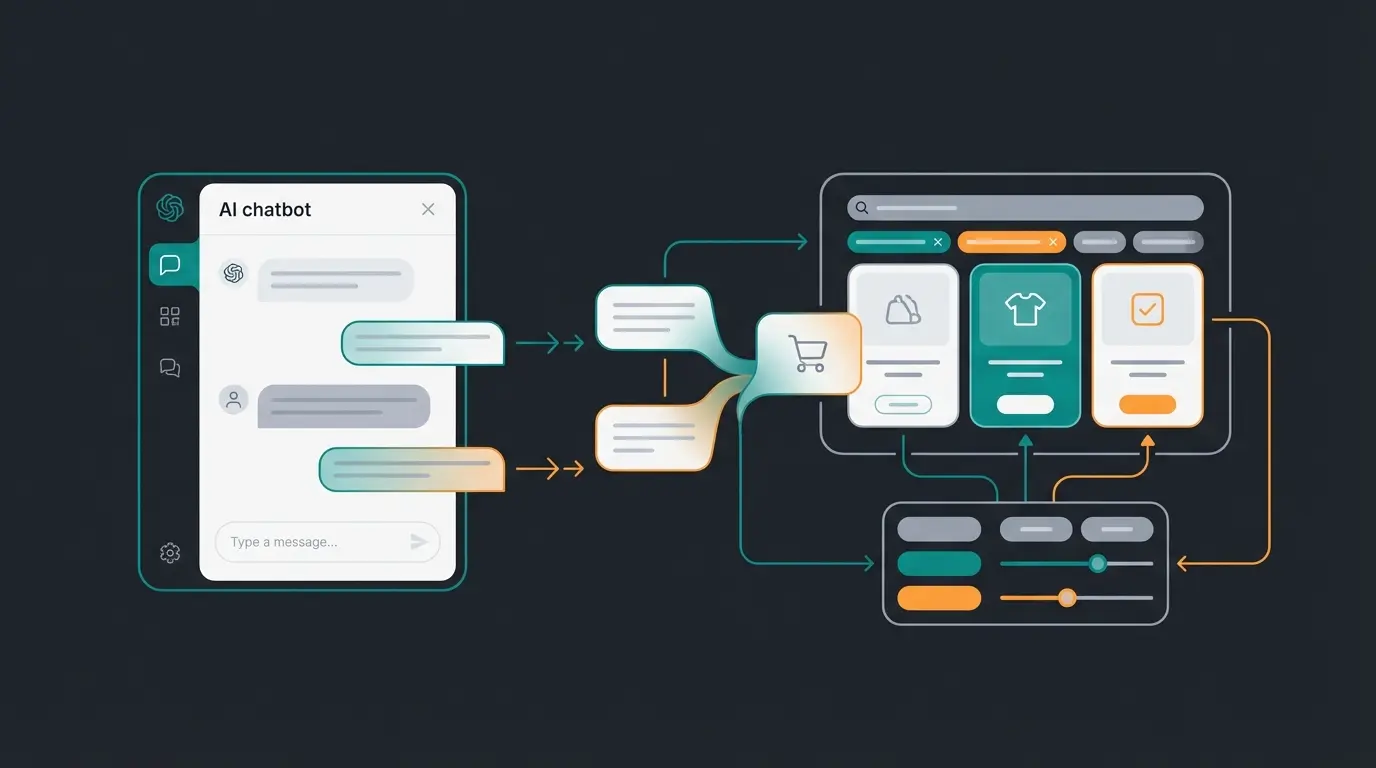
- The Dialog: The customer asks: "I'm looking for a beginner mountain bike, budget €2000, I'm 180cm tall."
- The Reaction: The AI understands the parameters.
- The Magic (Headless): Instead of just writing a response, the AI filters the product list in real-time in the background. The customer immediately sees the 3 matching bikes without the page reloading.
- The Conversion: The AI says: "Based on your height, I've selected frame size L. Here are the top 3 models."
This is natively possible with Shopware Frontends because frontend (display) and logic (AI) can communicate in a decoupled manner. The frontend reacts immediately to the AI's data. In a classic theme, this would only be possible with massive, error-prone JavaScript hacks.
Conclusion: Shopware Frontends is the infrastructure that turns a "dumb" catalog into an intelligent sales floor. Learn how AI Product Consultation providers are leveraging this technology to transform online shopping experiences.
Discover how AI-powered consultation integrates seamlessly with Shopware Frontends to guide customers through complex product decisions.
Start Your Free TrialTechnical Reality Check: What Decision Makers Need to Know
Before you give the green light, you need to understand the technical implications. Headless isn't "plug-and-play" for everyone.
Hosting Requirements
A classic Shopware shop runs on a PHP server (e.g., Apache/Nginx). Shopware Frontends requires a Node.js Runtime.
Option A (Static): For small shops. The site is built once and delivered as static HTML files. Very fast but inflexible for price changes.
Option B (Dynamic/SSR): The standard for e-commerce. A Node.js server (e.g., via Vercel, Platform.sh, or specialized hosting providers like Shop Studio) generates pages dynamically. This is necessary for shopping carts, logins, and live prices.
Developer Skills
Your existing team or agency needs to rethink. PHP developers handle the backend (Shopware Core, database, API extensions). Frontend developers must be proficient in Vue.js, Nuxt 3, and TypeScript. Twig knowledge doesn't help here.
According to Kiwee.eu, finding developers with the right Nuxt.js expertise is one of the most critical factors for project success. The learning curve exists but pays dividends in flexibility.
Plugin Compatibility
This is the biggest pitfall. A plugin from the Shopware Store that promises "great banners in the frontend" typically doesn't work out-of-the-box with Shopware Frontends.
Why? The plugin delivers Twig templates and CSS that the headless frontend cannot read.
Solution: You need to check whether the plugin provides its data via the API. If so, your frontend team must build the visual component (the Vue component) themselves. This approach actually enables superior AI-driven consultation experiences that wouldn't be possible with standard plugins.
Comparison: Standard Theme vs. Shopware Frontends
To facilitate your decision, here's a direct comparison of both approaches:
| Feature | Standard Shopware Theme (Twig) | Shopware Frontends (Headless/Nuxt) |
|---|---|---|
| Technology | PHP, Twig, Bootstrap/SCSS | Vue.js, Nuxt 3, Tailwind CSS |
| Performance | Good (depends on caching) | Excellent (through SSR & Edge Caching) |
| Interactivity | Limited (page reloads often necessary) | High (app-like feel, no reloads) |
| AI Integration | Cumbersome (often only as overlay/iFrame) | Native & Deep Integration (UI control) |
| Development Effort | Lower (many ready-made plugins) | Higher (initial build, custom components) |
| Hosting | Standard web hosting | Requires Node.js / Vercel / Platform.sh |
| Time-to-Market | Fast (days/weeks) | Medium (weeks/months) |
| Ideal For | Standard shops, limited budget | Brands, complex products, B2B, innovation |
This comparison clearly shows why merchants focused on AI-powered product consultation increasingly choose the headless approach. The native integration capabilities simply cannot be matched by traditional architectures.
Implementation Roadmap
How do you approach such a project? Here's a proven roadmap for German mid-market companies.
Analyze where customers abandon carts or contact support before purchasing
Find agencies with Nuxt.js and headless commerce expertise, not just Shopware experience
Leverage Shopping Experiences for marketing autonomy or evaluate external CMS needs
Implement client-side cookie consent and consider server-side tagging for data sovereignty
Build AI consultation into core composables from day one, not as an afterthought
Step 1: Audit Your Consultation-Heavy Products
Analyze your product range. Where do customers abandon? Where do they call support?
Example: "Customers don't understand which spare part fits their machine." → This is the leverage point for Shopware Frontends + AI.
Step 2: The Right Partner Choice
Don't just look for a "Shopware agency." Look for expertise in Nuxt.js and Headless Commerce. Ask explicitly: "Do you have experience with the Shopware Store API and Node.js hosting?" This expertise is also crucial for implementing revenue-generating digital sales solutions.
Step 3: Define CMS Strategy
Shopware offers a powerful CMS with "Shopping Experiences." Shopware Frontends supports this CMS.
Advantage: Your marketing staff can continue building pages in the Shopware admin (drag & drop), and the frontend automatically renders these as Vue components. You don't need to introduce an external CMS like Storyblok unless you have very specific content requirements.
Step 4: Data Protection and Compliance (GDPR)
An important topic for German markets. Since the frontend is separated from the backend, cookie consent tools (like Usercentrics or Cookiebot) must be integrated client-side in the Nuxt project. There are ready-made Nuxt modules that ensure tracking scripts only load after consent.
Tip: Use server-side tagging to maintain data sovereignty and bypass ad blockers, which is easier to implement with Shopware Frontends' Node.js infrastructure. This consideration is especially relevant for AI consultation transforms in multi-channel environments.
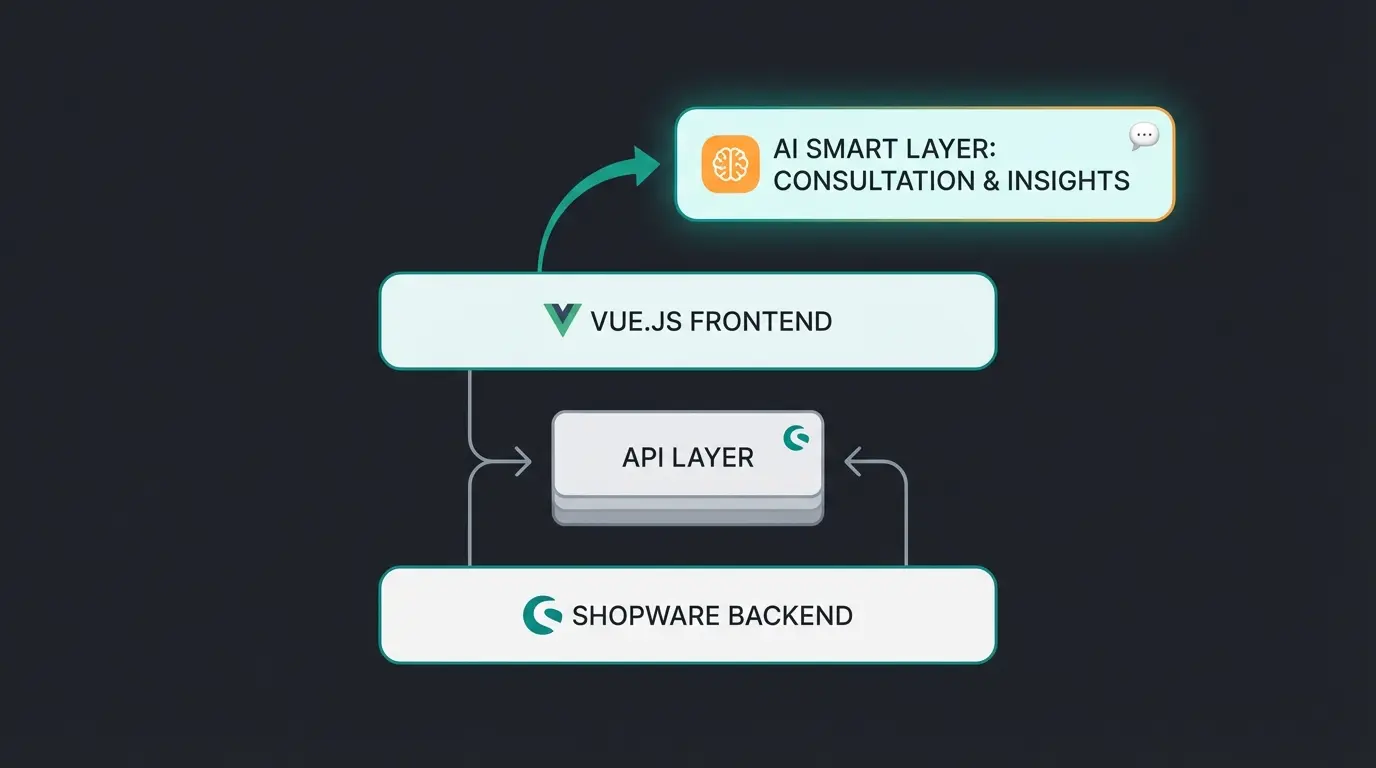
Step 5: The Smart Layer Integration
Don't plan AI integration as an afterthought. Build the API connection to your AI tool directly into the `useProduct` or `useCart` composables. This way, consultation becomes part of the core experience.
The Consultation Score: Is Headless Right for You?
Use this checklist to evaluate whether Shopware Frontends makes sense for your business:
- Do you sell complex or configurable products?
- Is your bounce rate on detail pages high because customers are "overwhelmed"?
- Do customers frequently email support before purchasing?
- Are you planning to use AI for active sales consultation?
- Do you have internal or external resources for Vue.js/Nuxt development?
- Do you want to perform frontend updates independently of Shopware core updates?
Glossary for Decision Makers
Understanding the terminology helps you communicate effectively with development teams:
- Composable Commerce: The approach of flexibly combining best-of-breed solutions (Shopware for checkout, Storyblok for content, AI for search)
- SSR (Server Side Rendering): The server builds the page completely before sending it to the customer. Important for SEO.
- Store API: The "language" the frontend uses to communicate with the Shopware backend
- Nuxt 3: The framework that provides structure and features for the frontend
- Composables: Reusable Vue.js functions that encapsulate business logic and state management
Frequently Asked Questions
Shopware PWA was the legacy headless solution developed with Vue Storefront, which had customization and update challenges. Shopware Frontends is the modern, actively developed toolkit based on Nuxt 3 that offers greater flexibility and relies on the stable Store API instead of volatile internal APIs. For new projects, always choose Shopware Frontends.
Yes, the skill requirements differ significantly. Traditional Shopware development requires PHP and Twig expertise, while Shopware Frontends requires Vue.js, Nuxt 3, and TypeScript knowledge. Your PHP developers continue handling backend work, but you'll need frontend specialists with JavaScript framework experience.
Not automatically. Plugins that render frontend elements using Twig templates won't work out-of-the-box. You need to verify if plugins expose their data through the Store API, then build custom Vue components to display that data. This is actually an advantage for AI integrations, as you gain complete control over the user experience.
Initially, yes. The development effort is higher due to custom component creation and specialized hosting requirements. However, the ROI comes from improved Core Web Vitals (better rankings), higher conversion rates through real-time interactivity, and the ability to implement sophisticated AI consultation that drives sales.
Cookie consent tools must be integrated client-side in your Nuxt project using dedicated modules. The decoupled architecture actually offers advantages: you can implement server-side tagging for better data sovereignty, and keeping the backend on German servers while using edge hosting for the frontend provides both compliance and performance benefits.
Conclusion: The Infrastructure for Tomorrow's Commerce
Shopware Frontends is more than just a technical update. It's the departure from rigid "online catalogs" toward flexible "Digital Experience Platforms."
For merchants selling simple products (t-shirts, coffee), the standard theme may continue to suffice. But for the German mid-market, which often offers complex, explanation-intensive products and B2B solutions, the headless approach is the breakthrough.
It enables you to transfer the consultation quality of an in-store salesperson into the digital world – scaled through AI, delivered in milliseconds through Shopware Frontends. This transformation is already helping businesses achieve AI-powered digital sales success across various B2B scenarios.
Is your shop ready for the next step?
The technology is mature. The question is no longer whether headless is the future, but how quickly you can leverage this architecture to outpace your competitors – not just through speed, but through intelligent consultation. The combination of Shopware Frontends with AI-powered sales consultants represents the gold standard for modern e-commerce experiences.
See how our AI consultation solution integrates perfectly into Shopware Frontends architecture to transform browsers into buyers.
Schedule a Demo
Kevin is CTO and co-founder of Qualimero. As an AI architect with over 15 years of experience as CTO and CPO in the tech industry, he designs the AI systems that automate tens of thousands of customer interactions daily for Qualimero's clients — reliably, securely, and at scale.