Why Shopware Training Must Look Different Today
Shopware 6 is more than just an update; it represents a technological paradigm shift. While Shopware 5 was still heavily monolithic in structure, Shopware 6 offers enormous flexibility with its API-first architecture and headless approach—but also comes with a steeper learning curve. Anyone searching for Shopware training today often faces a dilemma: Most offerings on the market are classic "click-through tutorials." They show you where to create a product or how to move a category.
But that's no longer enough in 2025.
The e-commerce market has radically transformed. It's no longer just about operating the shop technically, but about scaling it efficiently. If your employees know how to manually enter SEO texts but don't know how to use the Shopware AI Copilot to complete this work in a tenth of the time, you're burning resources. According to Shopware, the AI features introduced in version 6.5.1.0 fundamentally change how daily operations should be handled.
This guide is different. We don't just examine the classic content of a Shopware training (which of course remains important), but expand the perspective to what's often missing: the integration of automation, AI, and modern workflows. We analyze costs for you, compare providers, and show why the best training today combines technical know-how with strategic AI competence. Understanding how Shopware AI features work is now essential for any serious e-commerce operation.
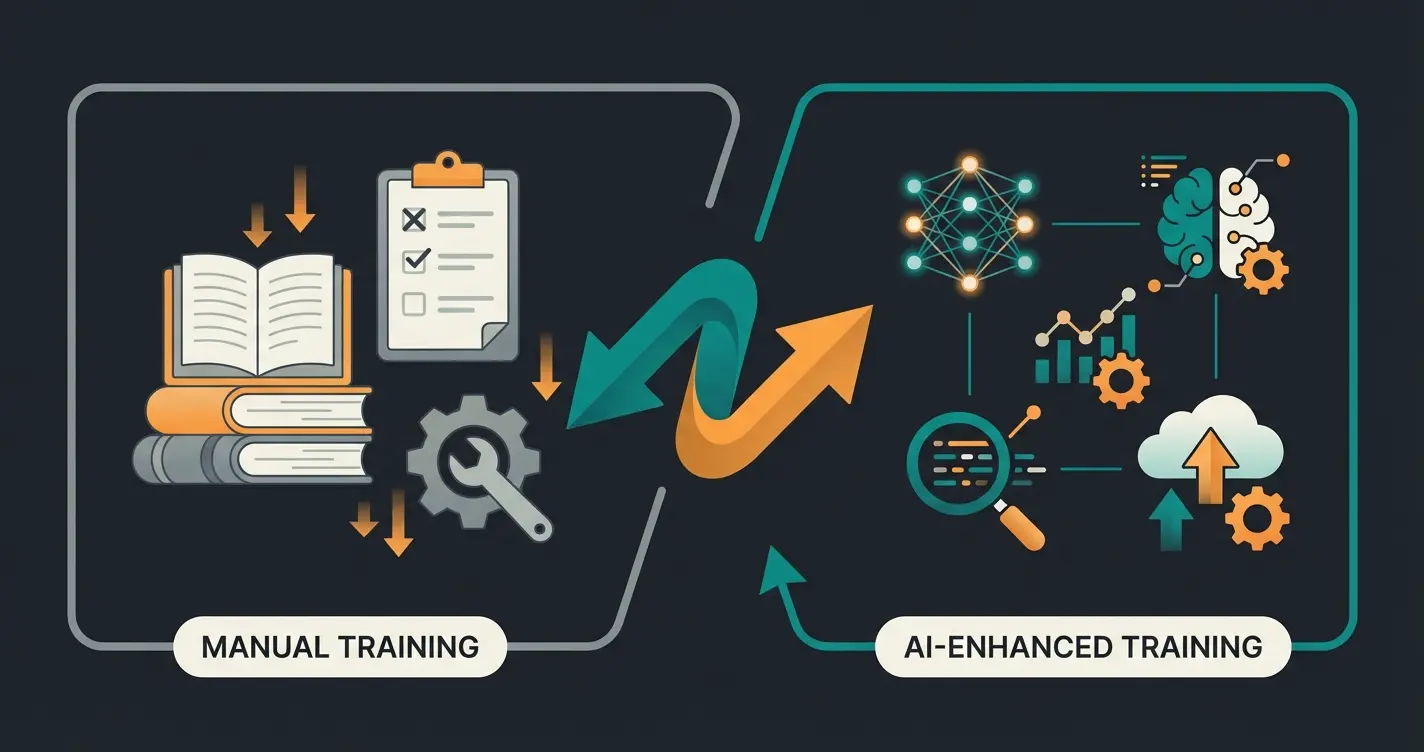
The Three Pillars of Modern Shopware Training
To understand what type of training you or your team needs, we must clearly separate the content. A developer requires completely different skills than a marketing manager. A professional Shopware training should strictly separate these target groups to avoid boredom or overwhelm.
User Training: Mastering Daily Operations
These training sessions target shop managers, content maintainers, and marketing teams. The focus here is on the backend (administration) and daily work.
- Product Management & Catalog Maintenance: Creating variants, properties, and dynamic product groups according to Shopware United. Managing inventory and prices (including advanced pricing rules).
- Shopping Experiences (Erlebniswelten): Shopware 6 relies heavily on content commerce. Users must learn how to build landing pages via drag-and-drop without writing a single line of code. Important: Understanding the assignment of layouts to categories.
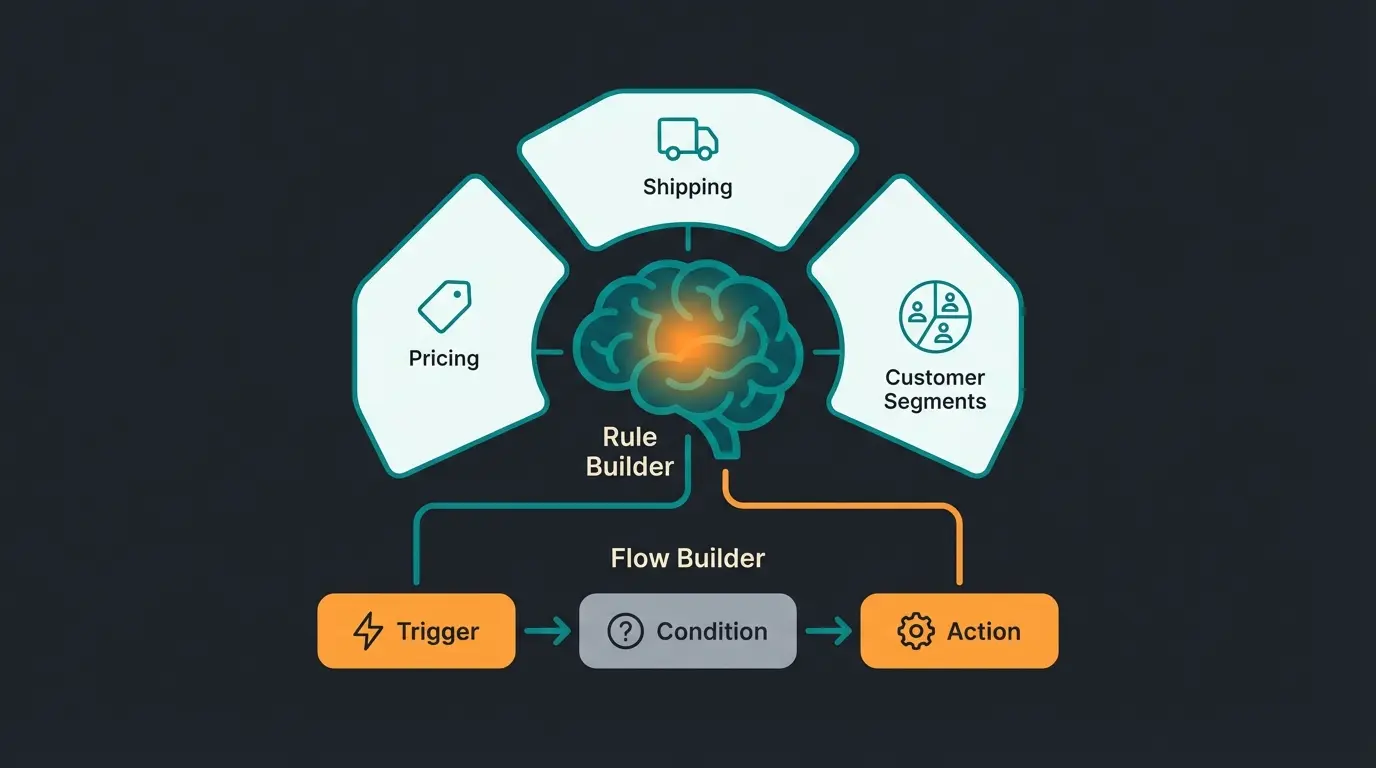
- Rule Builder & Flow Builder: This is the heart of Shopware 6. Users learn to create complex business rules (e.g., 'Customer from Switzerland + Cart > €100 = Free Shipping'). The Flow Builder automates processes without programming knowledge, as demonstrated in various YouTube tutorials.
- Order Processing & Customer Management: Status emails, returns management, and document creation.
The AI-powered product consultation capabilities now available in Shopware 6 mean that user training must extend beyond basic operations. Staff need to understand how AI eliminates waiting times and improves customer satisfaction.
Developer Training: Looking Under the Hood
This is about code. Shopware 6 is based on Symfony and Vue.js. Developers coming from Shopware 5 (Zend Framework/Smarty) often need to completely relearn everything, as noted by Storetown Media.
- Frontend & Themes: Working with Twig (template engine) and SCSS. Understanding the inheritance hierarchy for themes.
- Backend & Plugins: Plugin architecture and events/subscriber system. Working with the DAL (Data Abstraction Layer) instead of direct SQL queries. API usage for connecting third-party systems (ERP, PIM).
- App System: Developing apps that also work in the cloud version (as opposed to classic plugins).
Admin & Setup Training: Building the Foundation
Often underestimated, but critical for starting out. This training targets the "super-admin" or business owner.
- Basic Settings: Taxes, currencies, countries.
- Shipping & Payment Methods: Connection with the Rule Builder.
- Legal Compliance: Imprint, data protection, geoblocking.
- Migration: Strategies for transitioning from Shopware 5 to 6 (data migration, SEO redirects). According to Vierpunkt Commerce, migration planning requires careful consideration of data structures and URL management, as documented on Wikipedia.
Plugin development, API integration, theme customization using Symfony and Vue.js
Product management, order processing, Rule Builder, Shopping Experiences
AI Copilot usage, Flow Builder automation, AI-powered content creation—the new essential branch
Learning Formats Compared: Finding Your Best Path
Not every company has the budget for in-house training, and not every employee learns well through videos. Here's an objective comparison of common formats for a Shopware training.
| Criterion | Self-Study (Docs/YouTube) | Official Shopware Academy | Agency Workshop (In-Person/Remote) |
|---|---|---|---|
| Cost | Free (high time investment) | Medium (~€999/year for Pass) | High (€1,000 - €1,600/day) |
| Time Required | Very high (searching & filtering) | Structured, self-paced | Compressed (1-3 intensive days) |
| Customization | None | Low (standard courses) | Very high (your own data/problems) |
| Certification | None | Yes (officially recognized) | Usually only participation certificate |
| Currentness | Variable (often outdated tutorials) | High (directly from manufacturer) | High (agency's practical knowledge) |
| Interaction | None (only forums) | Limited (depending on course) | Direct Q&A with experts |
Our Recommendations by Audience
- For Solo Operators & Beginners: Start with free resources (Shopware Docs, YouTube) and book individual Academy courses as needed.
- For Agencies & Freelancers: The Shopware Academy Pass is mandatory to obtain certifications necessary for Partner level status, as outlined on GitHub and the official Shopware Academy.
- For Businesses (Merchants): An individual agency training is usually most economical. Why? Because you don't want to learn 'Shopware in general' but 'Shopware for YOUR business.' If you sell B2B machinery parts, you don't need training on B2C coupon codes.
The investment in proper training pays dividends when combined with modern tools. How AI Chatbots E-Commerce integrates with your trained staff creates a powerful combination that neither approach achieves alone.
The Missing Module: AI & Automation Training
Here lies the biggest gap in current training offerings. Most courses teach you how to operate Shopware. They don't teach you how to make Shopware work for you.
A modern Shopware training must necessarily include working with AI tools. Shopware has integrated powerful tools with the AI Copilot (since version 6.5.1.0) that revolutionize daily work, according to Rhiem Intermedia and official Shopware documentation.
Why 'Learning to Click' Is No Longer Enough
Imagine you have 500 new products to process.
- The Classic Way: An employee spends 3 days typing product descriptions, searching for SEO keywords, and manually translating texts.
- The Modern Way: The employee uses the AI Copilot. They enter bullet points, have the description generated, review it, and have it automatically translated. Duration: 4 hours.
This efficiency difference is why understanding AI-driven consultation has become essential for any competitive e-commerce operation. The AI training strategy you implement determines whether your team thrives or struggles.
What Modern Training Must Include: The AI Curriculum
1. AI Content Creation:
- Generating product descriptions based on properties, as explained by Agiqon Shopware and Scope01
- Creating texts for Shopping Experiences at the push of a button
- Using the 'Image Keyword Assistant' that analyzes images and automatically assigns Alt tags for SEO, according to Folio3
2. AI in Customer Contact:
- Summarizing complex product reviews through AI to identify trends faster
- Creating personalized checkout messages ('Thank you for purchasing the sneakers, here are care tips...') as described in Shopware's official features
3. Data Automation:
- Using the AI Export Assistant: Instead of building complex SQL queries or export profiles manually, tell the AI: 'Export all orders from yesterday in CSV format,' as demonstrated by IT Delight
Understanding how AI transforms rules within the Rule Builder context opens entirely new possibilities for automation that traditional training simply doesn't cover.
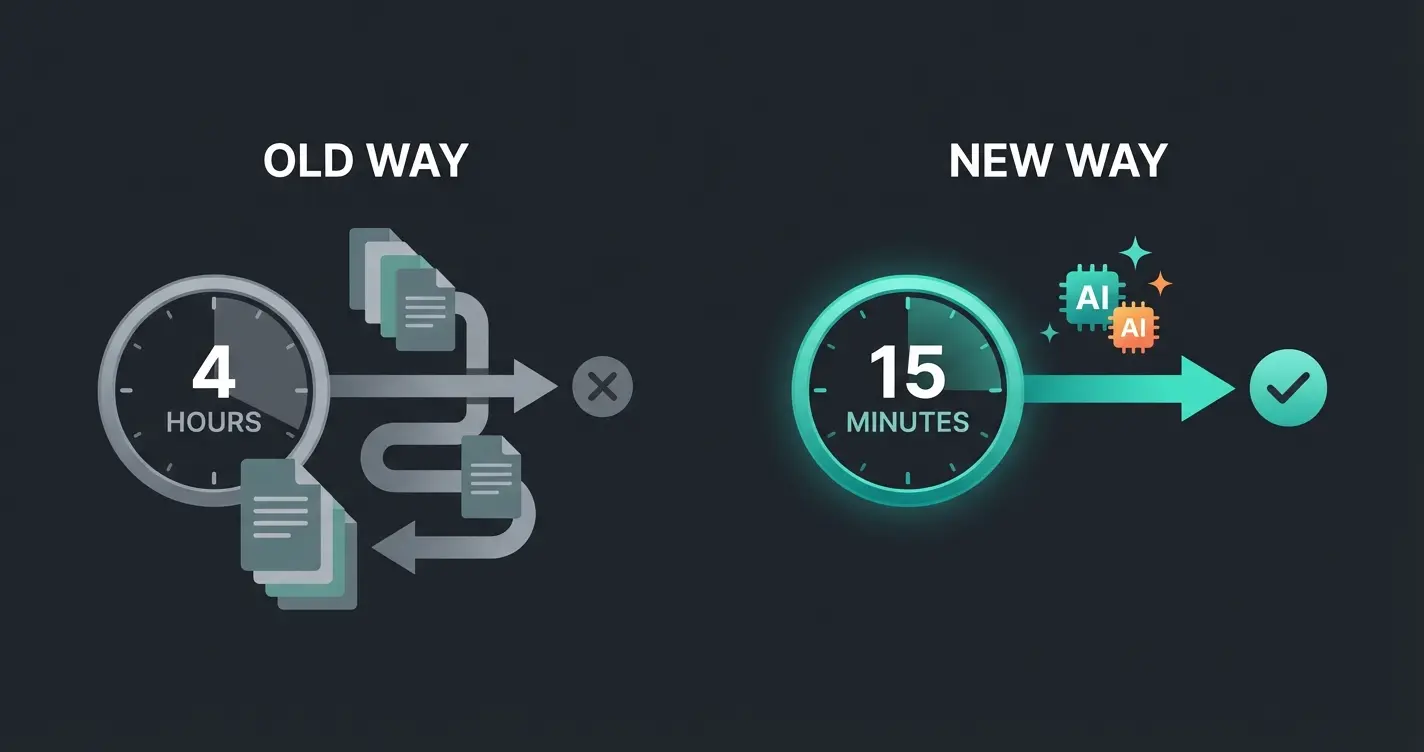
Discover how AI-powered product consultation can reduce your staff training time by 50% while improving customer satisfaction. Stop teaching memorization—start teaching strategy.
Explore AI SolutionsCosts & Certification: What's Actually Worth It?
Price transparency is rare in the industry. We've analyzed costs based on current market data (as of late 2024/2025).
What Does Shopware Training Cost?
Open Seminars (Remote/In-Person):
- Price: approximately €500 to €800 per participant/day
- Advantage: Affordable for individuals
- Disadvantage: Standard content, no confidentiality possible
In-House / Individual Agency Training:
- Price: approximately €1,200 to €1,800 daily rate (plus travel costs), according to Medienreich and Qualimero
- Advantage: Customized content, team can openly discuss internal problems, high ROI through direct problem solving
- Note: Many agencies offer package prices with project implementation
Shopware Academy:
- Individual certification exams often cost separately, but the Academy Pass for €999/year (net) provides access to all certifications and learning paths, as detailed on the Shopware Academy website
Per participant/day for standard group sessions
Daily rate for customized in-house training
Full access to all certifications and learning paths
Are Certifications Important?
For Agencies/Developers: YES, absolutely. Shopware partners must demonstrate a certain number of certified employees to maintain their partner status (Silver, Gold, Platinum). A 'Certified Developer' or 'Solutions Architect' is a quality mark in the market.
For Shop Operators (Merchants): Rather NO. It's more important that your team can operate the shop efficiently than having a certificate on the wall. Invest your budget in a practical workshop rather than in Academy exam fees.
The real competitive advantage comes from combining certified knowledge with AI Product Consultation capabilities that scale beyond what any individual team member can memorize.
Checklist: How to Find the Right Provider
Before booking a Shopware training, you should thoroughly vet the provider. Use this checklist:
- Certified Partner? Is the provider an official Shopware agency? Only then is it ensured that knowledge is current and best practices are taught.
- Shopware 6 Focus? Beware of providers still recycling a lot of Shopware 5 material. Shopware 5 reached its 'End of Life' in July 2024, as documented on End of Life Date. Training must be 100% focused on Shopware 6 (ideally version 6.6 or 6.7).
- Practice vs. Theory: Ask: 'Will we work in a demo shop or in our system?' Working in your own system (staging environment) is didactically more valuable.
- The 'AI Criterion': Ask explicitly: 'Will you also show us how to use the AI Copilot and Flow Builder to automate processes?' If the answer is 'No' or 'That's just gimmicky'—keep looking.
- Post-Training Support: Is there support after the training? Questions often arise 2 days later in everyday work.
Deep Dive: Essential Modules Explained
So you know what to expect, here's a deeper look at the two most powerful tools that must not be missing from any training.
The Flow Builder: Automation Without Code
Previously, developers had to write a plugin for every small automation. Today you use the Flow Builder, as shown in comprehensive YouTube tutorials.
- Trigger: E.g., 'Order received' or 'Customer has registered'
- Conditions: E.g., 'Is the customer from the USA?' or 'Is it a B2B customer?' (This is where the Rule Builder comes in)
- Action: E.g., 'Send email', 'Set tag VIP', 'Generate document' or 'Send data to Slack', as explained by Shop Studio
Training Goal: Your team should be able to independently create marketing campaigns (e.g., automated emails after 7 days) in the Flow Builder without calling the IT department. Understanding how AI consultation beats traditional manual approaches is crucial for maximizing this tool's potential.
The Rule Builder: Your Shop's Logic Center
The Rule Builder is your shop's brain. It defines when something happens, according to official Shopware documentation.
Examples:
- Shipping Costs: 'Free shipping when cart > €50 AND delivery country = Germany'
- Payment Methods: 'Allow invoice payment only for business customers'
- Prices: 'Show VIP customers 10% discount on everything except sale items'
Integration: Rules from the Rule Builder are used everywhere: in shipping methods, pricing, the Flow Builder, and Shopping Experiences.
Beyond Training: Scaling with AI Sales Agents
Traditional training teaches your team to handle customer inquiries manually. But as your business grows, this approach doesn't scale. This is where AI sales agents enter the picture.
Consider the reality: A well-trained employee can handle perhaps 20-30 customer consultations per day. An AI-powered product consultation system handles unlimited simultaneous conversations. The math is simple—but it requires a shift in how you think about training.
Modern training should include modules on:
- Managing AI assistants: How to oversee and optimize AI-powered customer interactions
- Training AI systems: Understanding AI Chatbot Training principles to ensure accurate responses
- Hybrid workflows: When to let AI handle inquiries versus human intervention
- Performance monitoring: Using analytics to continuously improve AI consultation quality
This represents the evolution from 'learning the software' to 'orchestrating intelligent systems.' How AI Chatbots transform customer service is no longer theoretical—it's the new baseline for competitive e-commerce.
Conclusion: Invest in Hybrid Knowledge
A Shopware training in 2025 is no longer a one-time event where you learn how software works. It's an ongoing process of process optimization.
The most successful e-commerce teams aren't those who can click through the backend fastest. They're the teams who understand how to use Shopware 6's architecture to delegate repetitive tasks to the Flow Builder and the AI Copilot. Features like 'Spatial Commerce' and new B2B components continue to evolve, as highlighted in Shopware's roadmap.
Our Strategic Recommendations:
- Secure the Basics: Book a solid user training for the operational team (products, orders). Resources from IT Schulungen and BOW Agentur can help identify appropriate programs.
- Master Automation: Schedule a workshop that focuses only on Rule Builder, Flow Builder, and AI features. This is where the leverage for your margin lies.
- Stay Current: Shopware develops quickly (monthly releases). Use the Academy Pass or regular update calls with your agency to stay on top of new features.
Are you ready to make your team future-proof?
Don't rely on standard courses. Look for partners who combine technology and strategy. Because ultimately, it's not the software that sells your products—it's a team that knows how to use it masterfully.
Frequently Asked Questions
For user training: No. Shopware 6 is optimized for 'no-code' in the admin area. For developer training: Yes, knowledge of PHP (Symfony) and JavaScript (Vue.js) is mandatory. The key distinction is whether you'll be managing content and orders (no coding required) or building custom functionality (coding essential).
Usually 1 to 2 days for users. Developer training is often more intensive and takes 3 to 4 days to thoroughly cover the complex architecture. Some providers offer extended programs spanning several weeks with weekly sessions for deeper retention.
No. Support for Shopware 5 ended in July 2024. Invest your budget in migration workshops and Shopware 6 training instead. Any provider still offering Shopware 5 content should be avoided—you'd be learning a deprecated system.
Yes, the Shopware documentation is excellent and there are many YouTube tutorials available. However, for professional requirements and certifications, there's no way around the Academy or agencies. Free resources work well for initial exploration, but structured training accelerates mastery significantly.
Absolutely. Training that ignores the AI Copilot and automation tools teaches outdated workflows. Modern e-commerce efficiency requires understanding how to leverage AI for content creation, customer communication, and data management. Ask any potential training provider explicitly about their AI curriculum.
Stop memorizing product catalogs—start orchestrating intelligent systems. Discover how AI-powered consultation reduces training time while boosting customer satisfaction and conversion rates.
Start Your AI Journey