Introduction: Why Traditional Newsletters Are Becoming Obsolete
Imagine standing in a crowded room, shouting as loud as you can: 'BUY OUR SHOES!' A few people might turn around, but most will either ignore you in annoyance or simply leave the room. This is exactly the principle behind the traditional newsletter—whether sent via email or (unfortunately, increasingly) via WhatsApp.
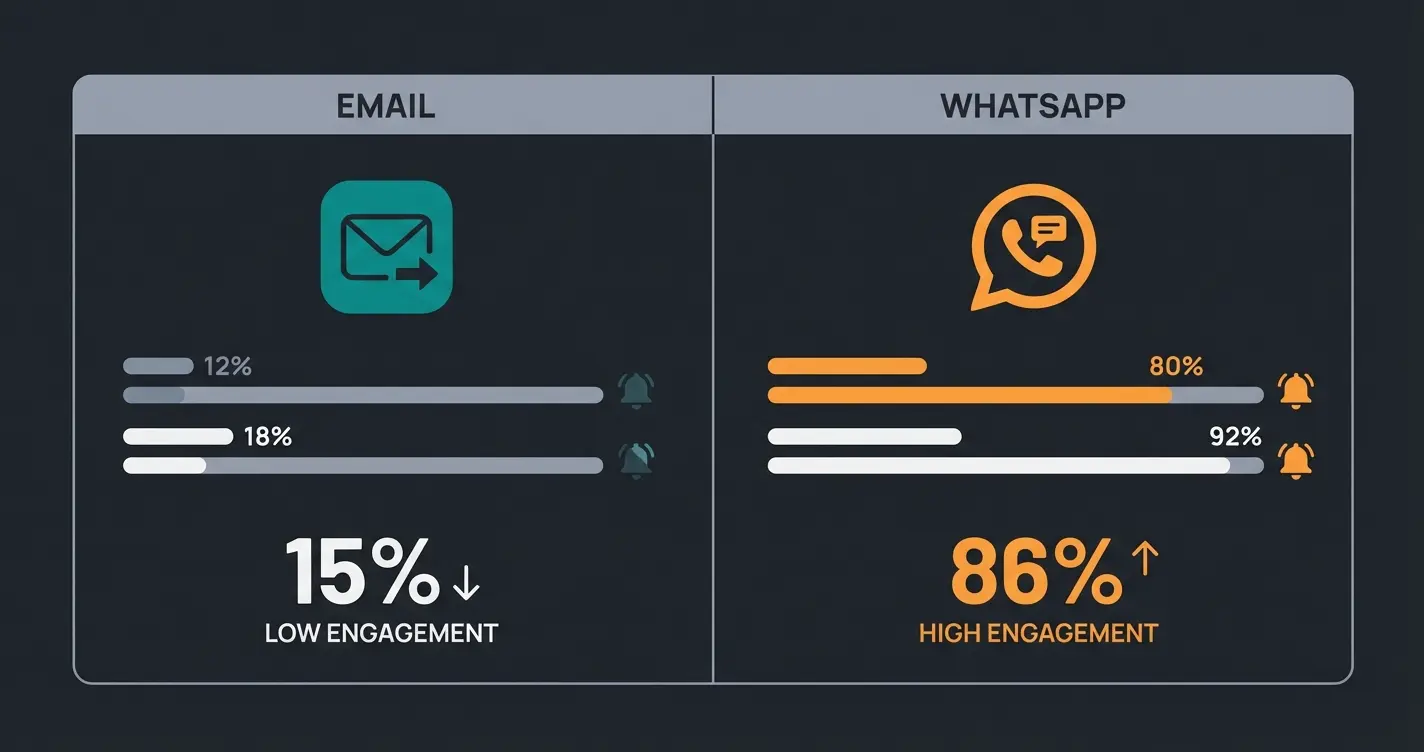
The email marketing statistics speak a clear language: open rates often hover around 20%, with click-through rates in the low single digits, according to BotPenguin and AiSensy. The channel is saturated. As a response, many businesses are fleeing to WhatsApp newsletters. The logic seems compelling: everyone uses WhatsApp, and open rates sit at a dreamy 98%, as reported by Bowaba and DoubleTick.
But here lies the problem: most businesses use WhatsApp exactly like email—as a one-way street for blunt advertising. They send discount codes to thousands of contacts and hope for clicks. The result? High block rates, annoyed customers, and burned budgets. Understanding WhatsApp Business features is essential, but execution strategy matters even more.
The future doesn't belong to broadcasting (sending), but to consultation (advising). In this article, we'll show you how to transform your WhatsApp newsletter from an annoying interruption into a helpful service. We'll explain how to use cutting-edge AI to turn a single message into a full-fledged product consultation that sells while you sleep.
What Is a WhatsApp Newsletter (And Is It Legal)?
Before we dive into AI strategy, we need to clarify the foundation. Many businesses still have the outdated 'broadcast lists' from the private WhatsApp app in mind. For professional business purposes, however, this approach is strictly off-limits.
Definition: WhatsApp Business API vs. App
A professional WhatsApp newsletter is technically not sent via a smartphone, but through the WhatsApp Business API (Application Programming Interface). This API is provided by software vendors (Business Solution Providers, BSPs) like Charles, Superchat, or Chatarmin, according to Chatarmin.
The critical difference lies in scale and compliance. The Private App / Business App is designed for small businesses like bakeries or hair salons. Mass messages here are limited and misuse quickly leads to account suspension. The WhatsApp Business API, on the other hand, is the only GDPR-compliant solution for mid-market companies and enterprises. It enables sending to unlimited contacts, automation capabilities, and AI integration. For businesses looking to implement a WhatsApp Business API chatbot, understanding this distinction is fundamental.
The Elephant in the Room: GDPR and Legality
In Germany and across the EU, there's often uncertainty: 'Can I simply contact customers via WhatsApp?' The short answer: No, not without consent. For your WhatsApp newsletter marketing to be legally compliant, you must strictly follow GDPR (called DSGVO in Germany), according to both Chatarmin's legal guide and IT-Recht-Kanzlei.
According to e-recht24, the double opt-in process isn't just a legal requirement—it's an opportunity. Don't use the DOI procedure merely as a legal hurdle, but as your first engagement opportunity. Instead of just 'Confirm your registration,' ask: 'Confirm with START and tell us whether you're Team Sneaker or Team Boots.'
WhatsApp vs. Email: The Hard Data Comparison
Why should you invest budget in a WhatsApp newsletter when email is practically free? The answer lies in attention. Here's a direct comparison of performance data for 2024/2025, compiled from Cooby and other industry sources:
| Metric | Email Marketing | WhatsApp Newsletter | Analysis |
|---|---|---|---|
| Open Rate | ~20% | ~98% | WhatsApp messages are almost always seen. The lock screen is the most valuable real estate in the world. |
| Click-Through Rate (CTR) | 2-5% | 15-60% | The barrier to interaction is much lower in chat than in an email. |
| Response Time | 90 minutes to days | < 5 minutes | WhatsApp is a 'now' medium. Perfect for time-sensitive offers. |
| Visibility | Often lands in 'Promotions' tab or spam | Push notification directly on lock screen | Maximum penetration, but also higher risk of being perceived as intrusive. |
| Cost | Low (flat rates) | Per message (see pricing section) | WhatsApp requires a budget but delivers higher ROI with proper usage. |
The bottom line: Email remains relevant for longer content like storytelling and weekly digests. But for actions requiring an immediate response, WhatsApp newsletter business strategies are unbeatable. This is where AI consulting in e-commerce becomes a game-changer.
Why Traditional WhatsApp Newsletters Fail (The Broadcast Trap)
Many businesses transfer their email strategy 1:1 to WhatsApp. They send colorful images with a link saying 'Buy now.' This approach fundamentally misunderstands the platform.
The Problem of the 'One-Way Street'
When you send a newsletter consisting only of an image plus link, you degrade WhatsApp to a pure advertising channel. This creates several critical problems:
- High Costs: You pay for every marketing template message (approximately 11-13 cents in Germany from 2025 onward, according to Heltar). If the customer doesn't click, that money is gone.
- High Block Rates: Users are extremely sensitive on WhatsApp. Irrelevant advertising immediately leads to blocking or spam reports. If your 'quality rating' drops with Meta, your account gets throttled or suspended, as outlined in Facebook's documentation.
- Wasted Potential: WhatsApp is a messenger. The word implies dialogue. Those who only send are using just 50% of the platform.
Content Gap: What Happens After the Click?
Most tools and guides focus on how to send the message. But what happens when the customer replies? Consider these scenarios:
- Scenario A (Standard): The customer replies to the newsletter with a question. No response comes, or an automatic message says 'Please send us an email.' → Frustration.
- Scenario B (Human): A support employee must respond. This is expensive and not scalable when you're sending 10,000 newsletters.
- Scenario C (AI Solution): This is where the magic begins—and where implementing an AI sales consultant transforms your results.
The New Strategy: The 'Consultative Newsletter' Approach
Here's where we differentiate from the competition. Instead of 'Interruption Marketing' (disturbance), we practice 'Invitation Marketing' (invitation). This represents a fundamental paradigm shift in how businesses approach WhatsApp newsletter marketing.
The Concept
Instead of directly selling the product, the newsletter sells a consultation. The goal of the first message isn't the click to the shop, but the reply in the chat. This approach aligns perfectly with AI chatbot guide principles that transform support interactions into sales opportunities.
Example comparison:
- Old (Push): 'Here's our new running shoe collection. 20% discount. Click here.'
- New (Consultative): 'Hey Thomas 👋, spring is coming! Are you planning short sprints this year or training for a marathon? Reply briefly, and I'll show you the perfect shoe for your goal.'
Why This Strategy Wins
The consultative approach delivers advantages across multiple dimensions:
- Algorithm Advantage: Meta loves interactions. When users reply, your Quality Score increases, improving your account standing and deliverability.
- Cost Advantage (Pricing Hack): Once the user replies, a 24-hour 'service window' opens. Within this window, further messages are often cheaper or free (depending on the exact model and reply type). You transform an expensive marketing conversation into an inexpensive service conversation.
- Psychology: People are more likely to buy when they feel understood. A consultation builds trust that pure advertising simply cannot create.
Craft a question-based newsletter that invites dialogue rather than just clicks
User response opens a free 24-hour service window and signals intent
Intelligent AI analyzes the reply and provides personalized product recommendations
Customer receives tailored advice and can purchase directly, increasing conversion rates
How AI Transforms the Subscriber Experience
Now we close the gap that most competitors leave open: scaling consultation through Artificial Intelligence. We're not talking about dumb chatbots that only react to keywords like 'shipping.' We're talking about LLM-based agents (like GPT-4 integrations) trained on your product data. For a deeper dive into implementation, check out this AI consultation guide.
1. Instant Product Matching (The 'Sommelier' Principle)
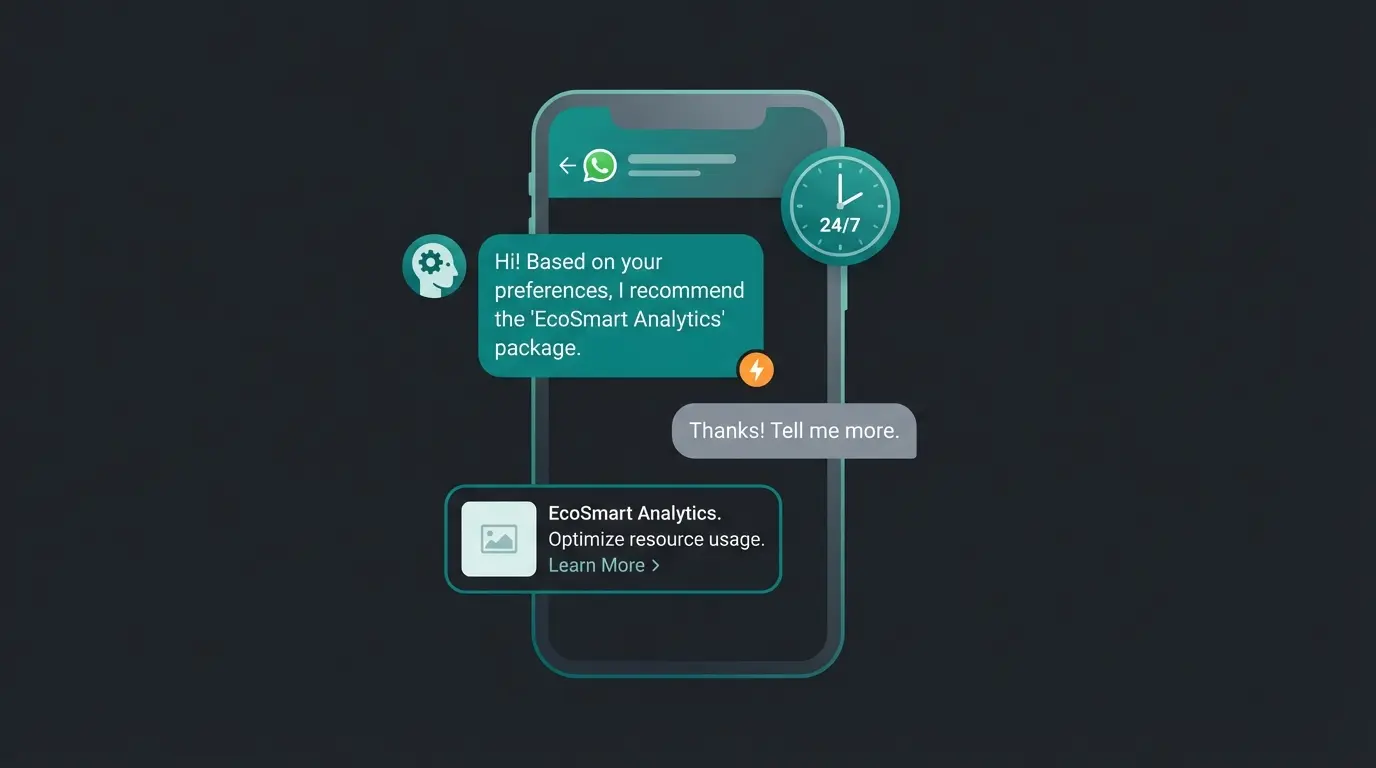
An AI can know your entire product catalog (feed). When a customer replies to the newsletter ('I run marathons but have wide feet'), the AI can within fractions of a second:
- Understand the intent (Marathon = cushioning needed)
- Extract the detail (Wide feet = Wide Fit needed)
- Filter the catalog accordingly
- Make a recommendation: 'For marathon running with wider feet, I recommend the UltraRun Pro Wide. It offers extra stability. Want me to send you the link?'
This is the power of AI product consultation—delivering personalized recommendations at scale that would be impossible with human agents alone.
2. Hallucination-Free Consultation in Context
A major obstacle for businesses is the fear that AI will 'talk nonsense' (hallucinate). Modern solutions use RAG (Retrieval-Augmented Generation). As Chatarmin's AI documentation explains, the AI only provides answers based on your uploaded PDFs, web pages, or product descriptions. It also masters the switch between informal and formal address perfectly, matching your brand voice.
3. 24/7 Availability as a Conversion Driver
Newsletters are often read in the evening on the couch (e.g., 8:00 PM). No human support is available then. The customer has purchase intent but a small question ('Does this shoe run small?'). Without AI, they write an email, wait, and lose interest. With AI, they immediately get the answer ('Yes, take one size larger!'), click, and buy. This is AI product consultation at its finest.
Static vs. Conversational Newsletters: Full Comparison
Here you can see the difference in the user journey between traditional and AI-powered approaches. This visualization demonstrates why implementing AI chatbots in marketing delivers superior results:
| Feature | Classic WhatsApp Newsletter | AI-Powered Consultative Newsletter |
|---|---|---|
| Engagement Type | Passive (Read & Click) | Active (Reply & Discuss) |
| Reply Handling | Manual (slow) or not at all | Instant via AI (scalable) |
| Personalization | Only the name ('Hello Max') | Context-based ('Hello Max, since you bought X last week...') |
| Goal | Funnel traffic to website | Consultation and conversion preparation directly in chat |
| Data Collection | Only click data | Valuable 'Zero-Party Data' (customer wishes, preferences) |
| Cost Efficiency | Pay per message sent | Trigger free service windows through interaction |
Costs & Pricing 2025: WhatsApp Newsletter Expenses
This is one of the most important sections, as Meta's pricing model changes in 2025. Outdated information can become expensive here. Starting April/July 2025, the model shifts from 'per conversation' more strongly toward 'per template message,' according to Heltar's pricing analysis and Omnichat. For a comprehensive breakdown, see our guide on WhatsApp Business costs.
The 4 Cost Categories
- Marketing Templates: (These are your newsletters) — Cost: Most expensive category. In Germany approximately 11-13 cents per message. Use: Offers, product launches, 'back in stock' alerts.
- Utility Templates: (Useful notifications) — Cost: Cheaper (approximately 5-6 cents). Use: Shipping confirmations, invoices. New in 2025: When sent within an open service window, they're often free.
- Authentication Templates: (Security) — Cost: Medium (approximately 6-7 cents). Use: OTPs, login codes.
- Service Conversations: (The AI area) — Cost: Free for the business when the user starts the conversation (within a 24h window), as detailed by Latenode.
The 'ROI Hack' with AI
When you send a pure advertising newsletter, you pay 11 cents per user. But when you send a newsletter that provokes a response ('Reply with START for your personal guide'), the user's reply opens a free service window. All further messages your AI sends within this window to advise the customer and lead them to purchase are free (since they're 'free-form' messages, not templates).
This means: Interaction lowers the effective cost per conversion. This is a massive advantage for interactive AI strategies that the AI consultation guide explores in detail.
WhatsApp messages are seen almost universally compared to email's 20%
Dramatically higher than email's 2-5% average
Users respond within minutes versus hours or days for email
User-initiated conversations trigger free messaging windows
Stop broadcasting. Start conversing. Our AI-powered solution turns every newsletter into a personalized consultation that converts.
Start Your Free TrialStep-by-Step: Setting Up Your First AI Newsletter
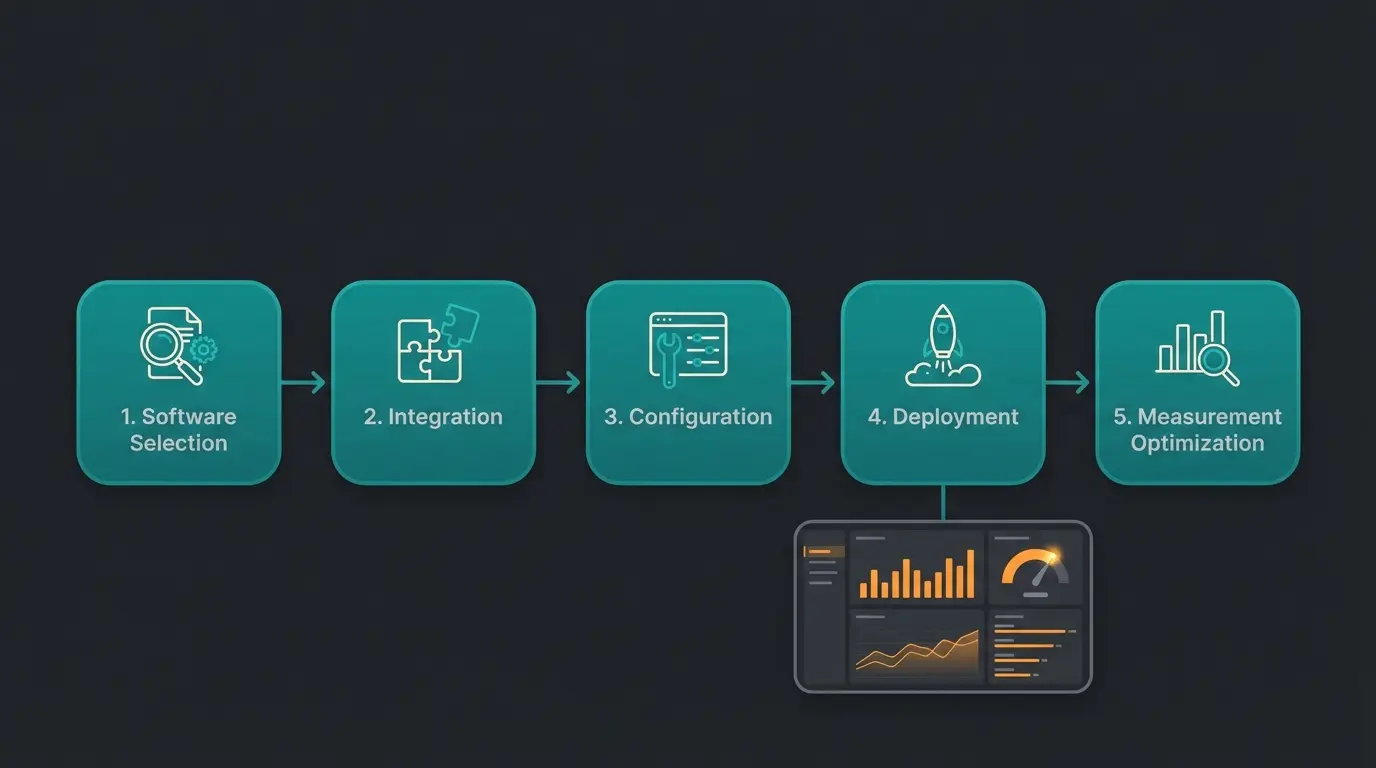
How do you implement this technically? Here's the roadmap for launching your WhatsApp newsletter business with AI capabilities.
Step 1: Choose the Right Software
You cannot do this with the normal WhatsApp App. You need a provider that: 1) Has access to the WhatsApp Business API, 2) Offers a 'Flow Builder' for newsletters, 3) Has deep AI integration (OpenAI/ChatGPT interface). Candidates include Chatarmin (strong focus on e-commerce & AI), Charles (Enterprise), and Superchat (all-rounder), according to Chatarmin's platform comparison.
Step 2: Build the List (The 'Entry Point')
Nobody has your number just like that. You need to direct traffic into the channel:
- Website: A 'chat bubble' widget in the bottom right corner
- QR Codes: On package inserts ('Scan for support & VIP offers')
- Checkout: Checkbox 'Receive updates via WhatsApp' (Note: Observe DOI requirements!)
Step 3: Craft the 'Hook' Message
Create your marketing template in the software. Here's the difference between approaches:
- Bad: 'Summer clearance sale! Click here.'
- Good (AI-Ready): 'Hey [Name], summer is here! ☀️ Are you looking more for an outfit for the beach 🏖️ or for the next garden party 🍹? Reply with 'Beach' or 'Party' and our AI stylist will find you the top 3 looks (including a secret discount).'
Step 4: Connect the AI
In tools like Chatarmin or Superchat, you can define: Trigger: When reply contains 'Beach' OR 'Party'. Action: Hand over chat to 'AI Agent'. Prompt: 'You are a fashion consultant. When the customer says Beach, suggest products from Category A. Be casual, use emojis.' This is where AI product consultation guide strategies come into play.
Step 5: Measure and Optimize
Don't rely only on the open rate (which is high anyway). Measure the Conversation Rate (How many reply?) and the Conversion Rate (How many buy after the consultation?). Following the AI consultation guide will help you refine these metrics over time.
Best Practices for European and German Markets
Germany and the broader European market operate differently than the USA or Brazil. Cultural nuances are decisive for the success of your WhatsApp newsletter marketing.
1. Data Protection as a Quality Feature
Don't hide the topic of data protection. Write proactively: 'Your data stays in Germany. No spam, promised. Unsubscribe anytime with STOP.' This builds trust that sets you apart from competitors who treat privacy as an afterthought.
2. The Formal vs. Informal Address Question
WhatsApp is a private space. A stiff 'Dear Sir or Madam' feels out of place here. Recommendation: Use a 'respectful informal' tone or a modern formal approach. Importantly, your AI must remain consistent. Nothing is worse than a bot that switches between formal and informal address mid-conversation.
3. Frequency: Less is More
In Brazil, companies send daily WhatsApps. In Germany, this leads to immediate blocking. Rule of thumb: Maximum 1-2 newsletters per month, unless there's an extremely relevant occasion (Black Friday, Advent calendar). Use segmentation with tags. Someone who bought baby shoes doesn't want advertising for high heels. Send only to relevant segments.
The Anatomy of a Perfect WhatsApp Newsletter
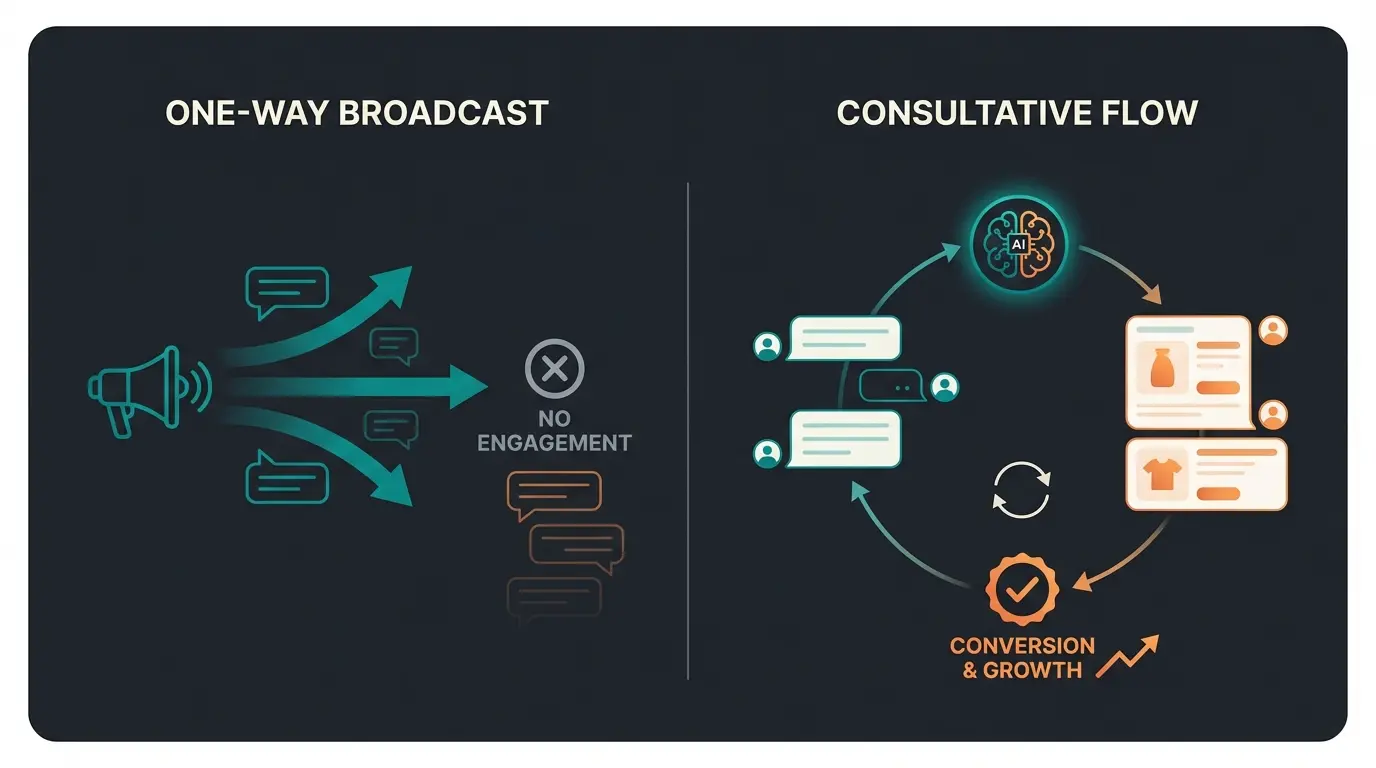
Understanding the difference between old-school broadcasting and modern conversational approaches is crucial for success. Here's a visual breakdown of how these two methods compare in practice:
The Old Way (Link Blaster): Generic image → Link → User clicks → User browses website alone → Often abandons without purchase. The New Way (AI Dialogue): Question → 'Reply to Consult' CTA → User replies → AI suggests perfect product → User buys in chat. This transformation represents the future of AI consultation guide implementation.
Conclusion: Stop Sending, Start Conversing
The WhatsApp newsletter stands at a turning point. The days when you could simply push blunt advertising into customers' pockets are ending—regulated by prices and user behavior alike.
The winners of tomorrow are brands that use WhatsApp for what it is: a channel for relationships. By combining the reach of the newsletter with the intelligence of modern AI, you can provide every single customer with a personal shopping advisor—scalable, immediately available, and highly profitable.
Through the strategic implementation of consultative newsletters powered by AI, businesses are seeing dramatic improvements in conversion rates while simultaneously reducing their cost per acquisition. The shift from broadcast to conversation isn't optional—it's the new standard for WhatsApp newsletter marketing success.
Frequently Asked Questions About WhatsApp Newsletters
Yes, but only with proper consent. You must implement GDPR-compliant double opt-in (DOI), where users first provide their number and then confirm via a reply message. Every newsletter must include an easy unsubscribe option (typically 'STOP'), and WhatsApp must be explicitly mentioned in your privacy policy.
Marketing templates cost approximately 11-13 cents per message in Germany. However, when users reply to your newsletter, it opens a free 24-hour service window where subsequent messages (including AI consultations) are free. This makes interactive, consultative newsletters significantly more cost-effective than one-way broadcasts.
The WhatsApp Business App is designed for small businesses with limited broadcast capabilities. The Business API is the professional solution for mid-market and enterprise companies, enabling unlimited contacts, automation, AI integration, and GDPR compliance. For newsletter marketing at scale, the API is required.
In Germany and Europe, users are privacy-sensitive. The recommended frequency is maximum 1-2 newsletters per month, unless there's a highly relevant occasion like Black Friday. Over-sending leads to blocks and damages your Meta quality rating. Focus on relevance over frequency.
Modern LLM-based AI (like GPT-4 integrations) trained on your product data can handle the vast majority of consultation queries instantly and accurately. Using RAG (Retrieval-Augmented Generation), these AIs only provide answers based on your actual product information, eliminating hallucination risks while delivering 24/7 availability that human teams cannot match.
Join leading brands using AI-powered consultative newsletters to achieve 5x higher conversion rates. Start your journey from broadcasting to meaningful customer conversations today.
Get Started Free
Lasse is CEO and co-founder of Qualimero. After completing his MBA at WHU and scaling a company to seven-figure revenue, he founded Qualimero to build AI-powered digital employees for e-commerce. His focus: helping businesses measurably improve customer interaction through intelligent automation.